
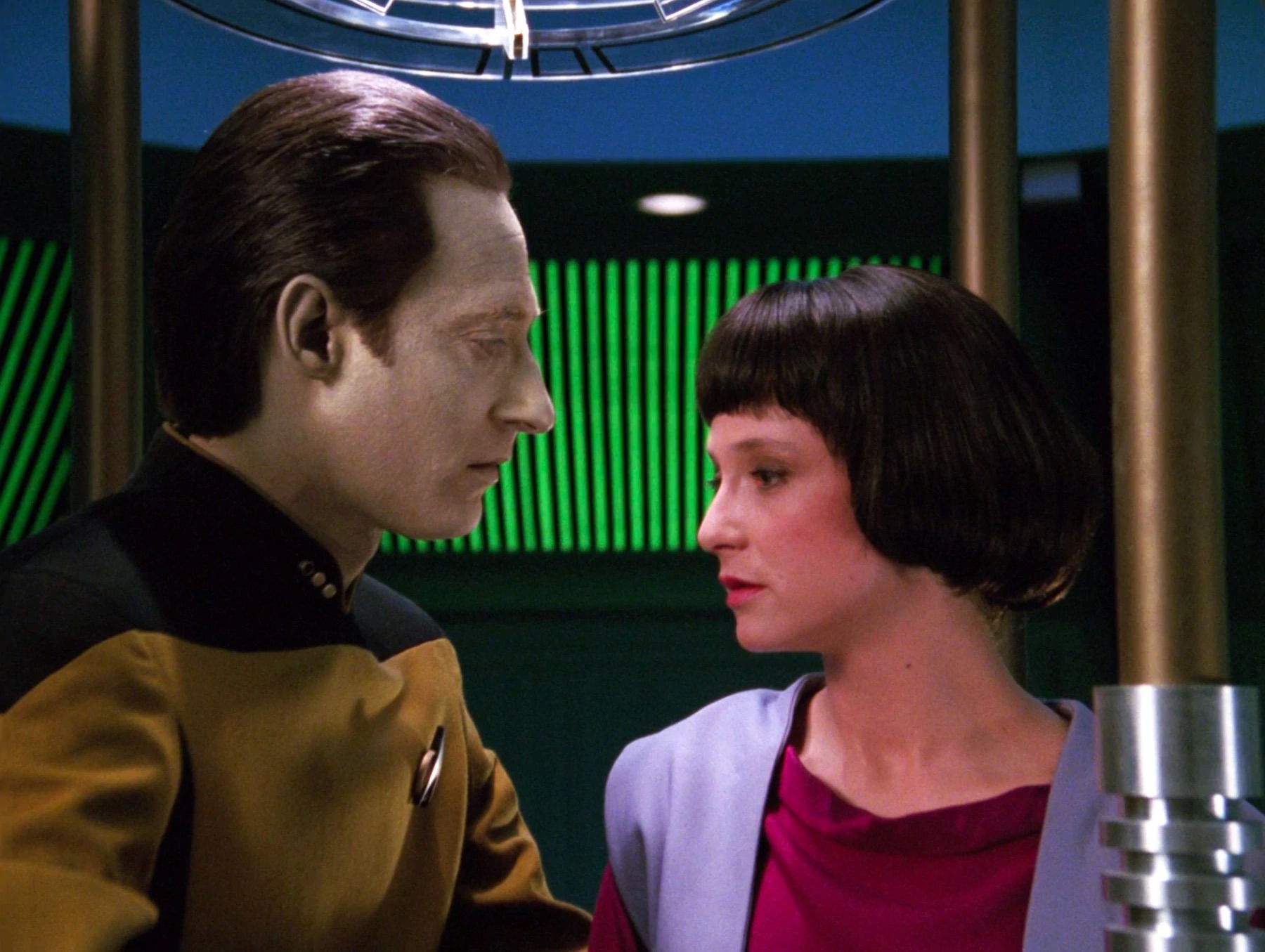
Argh. How does one rate an episode that entangles a delightful and moving story with an ill-conceived and irritating one? I so very, very much want to like this one. I’m immensely fond of Data as a character, and episodes that focus on him striving to understand aspects of the human condition and “become more human” reliably prove insightful and deeply affecting. Why, though, does this one feel the need first to initially mis-characterize Picard, and second, to rehash (in a far less satisfactory way) issues that were already addressed in “The Measure of a Man”? (In the TNG Companion, author Larry Nemecek attempts to soft-pedal the latter criticism, essaying the view that this episode “made viewers forget that android rights had been addressed only a year earlier in “The Measure of a Man.” Yeah…no. Not so much.)
The idea of Data seeking to replicate his creator’s achievement and create another android like himself—and the conceit that he would view the said android as his “child”—is the stuff of which great Trek is made. What’s more, Lal is wonderfully realized. Her mannerisms and demeanor are just enough like Data’s, yet also just different enough, to sell the idea of a quasi-Data who is only just crossing the threshold into sapience (Trek continues to use the word “sentience” when it means “sapience”—an error that led me to confuse the terms myself for much of my life). Between the writing and the acting, the episode manages to make me feel Lal’s sense of wonder as she sponges up knowledge from the world around her in moments like the flower-smelling scene, the moment when she relays to Data that she has learned about hand-holding, or the slew of philosophical questions with which she bombards him after one of the transfers of neural pathways. And in the end, when she unexpectedly develops genuine, human-like emotions, but it unfortunately destabilizes her positronic brain and leads to her death? That scene where Troi realizes that Lal is actually scared, and Lal starts slapping her chest and repeating “this is what it means to feel”? I can’t watch either that scene, or her death scene, without tearing up. That’s compelling Trek at it’s best.
Sigh. However. A substantial amount of the episode’s running time, alas, is taken up by the other side of its plot, which is about Starfleet wanting to appropriate Lal, and also about Picard resisting seeing her the way Data sees her but then slowly coming around. That this is a retread of ground that was already covered—and covered much, much more skillfully—in “The Measure of a Man” is the kindest thing that I have to say about these aspects of the episode. Having Starfleet behave this way when the issue of android rights was already decided in a previous episode not only represents a slap in the face to a classic from the second season, but also portrays Starfleet as not at all the enlightened organization that it’s supposed to be. Likewise, Picard’s resistance to the idea that Lal is “a child,” and his general freak-out about Data’s having created her, are not at all becoming or in character; other characters are compelled, here, to make the same kinds of arguments to him that he is usually the one to make in other episodes (going all the way back to “Datalore”!). Plus, on top of the legal and ethical issues, Starfleet’s insistence that Lal be separated from Data is just flat-out irrational; surely Data is more qualified than anyone else in existence, hands down, to help a new sapient android learn and develop! In “The Measure of a Man,” Dr. Maddox had both a good reason for wanting to get his hands on Data and a point of view that justified, to him, his disregard for Data’s rights. Here, for all his bluster, Admiral Halftel never manages to offer a single compelling argument for relocating Lal to his research institute—nor, for that matter, is it even particularly clear what his/Starfleet’s motives are supposed to be. I mean, if there were a clear interest that could be identified as lurking behind and motivating the admiral’s bullshit, that would at least be something; instead, though, the conflict mostly just feels manufactured to me. It doesn’t even play out to any “natural conclusion” (to borrow a phrase from Lal’s own exchange with the admiral, in which she was great), either. Picard makes a big impassioned stand, theoretically risking his career…only for the issue to immediately become moot when Lal experiences system failure (and the admiral even softens in the end, after working directly with her and Data and being emotionally affected by the experience, to boot).
If I’m being honest, there are also a couple of other things in “The Offspring” that don’t really work for me. The main one is that the episode makes several attempts to mine the Data-and-Lal situation for some fairly corny parenting humor. I’ll put my cards on the table and acknowledge that I’ve never been a parent, so maybe some of this lands for people who are (or have been) in ways that it doesn’t for me…but, I dunno. Troi’s “you’ve never been a parent” zinger to Picard, after his rant about Lal not being like a child, seems to me to fall flat for two reasons. One is that, even though I think Picard is out of character in this scene, it is fair to acknowledge both the ways in which Lal is and isn’t like a “child”—but the other is that, um, Troi? You’ve also never been a parent! Where do you come off being all ironic and long-suffering about the trials of parenthood, exactly? Then, too, I find Data’s slightly nonplussed reaction when Lal starts peppering him with rapid-fire philosophical questions wrongheaded. It’s, again, clearly meant to be mildly comical, but it’s just not how Data would react. (And the fact that he puts an end to it by deactivating Lal is especially off-putting!) Most un-funny of all, though, is the “What are your intentions toward my daughter” moment in Ten-Forward. Sorry…that just doesn’t work for me. Finally (but off the corny humor theme now), the scene in which Lal is choosing its (not yet “her”) sex and species leaves something to be desired. Really? The android narrows thousands of options down to just four, and two of them are human (one of each sex)? I could maybe roll with this if it were explained, say, by the fact that it’s surrounded by mostly humans and has little to base a choice on other than its meager experiences of the world to date…but then, the other two options that make the cut are an Andorian (and Troi makes a point of remarking that there are no Andorians on the ship) and a Klingon (of which we know there to be exactly one on board, and Lal never interacts with him).
So…does the emotional heft of this episode’s best scenes (which by themselves feel like they belong in a four-star episode) redeem the mess of its “Starfleet wants to whisk Lal away from Data” plot, and its other various failings, enough to warrant three stars? Or are they merely the good bits in what is almost a textbook example of “flawed/subpar, but with some merits”—i.e., my description of what a two-star rating signifies? I suppose if I wanted to make the latter case, I could point out that even the good parts of the episode are a bit…light. What if there had been a bit more story involved in Lal’s fate? What if it had happened for interesting narrative reasons, for instance, rather than inexplicable ones? Or if Data had actually had to struggle (even if only briefly) with the task of “raising” a “child” who had emotions, when he himself does not? However, having raised these points, I’m still ultimately going (obviously, for anyone reading this) with three stars for “The Offspring,” if only because the good bits make it a genuine pleasure to watch. (It’s certainly a much more rewarding watch than any episode to which I’ve given only two stars.)
A couple of final tidbits: “The Offspring” marked two significant behind-the-scenes debuts for Trek. It was written by René Echevarria, who eventually joined the writing staff and became one of the show’s better writers (continuing to DS9 in due course as well). Also, it was the debut directorial stint of Jonathan Frakes, who would go on to direct numerous future Trek offerings, including two movies. I’m not a person who often notices directing, but there are a couple of scenes in this episode in which unusual camera angles do grab my attention (in a positive way). So, kudos on that.
Quite so. Also, in addition to what you said, the idea that Lal has to choose a species is kind of ridiculous, and not only because of her limited experience (though her foolish choices illustrate that she does not have the experience to make this choice), but also because in no sense would she actually “be” a member of that species. She would just be choosing to look like one. This seems especially obvious when you consider that if she had chosen to be a Klingon, no Klingon we’ve ever met would have agreed that she was one. She wouldn’t have experienced any of the Klingon socialization, nor would she have any of the genetic inclinations. One assumes Data looks human because he was built and programmed by a human, and therefore human assumptions and socialization are built into his thinking and behavior. Lal could either continue that, I suppose, or just look like something not the same as an existing species. Guess what? You don’t need to present with a gender or a species, especially when both are contrived affectations when you’re a freaking robot. Also, what does it even mean for Lal to choose a gender? Does Data change her programming based on this in some way, or is it just how other people react to her? As soon as you start thinking about this, it becomes clear how thorny and complicated it is, and how the sane thing to do is not to make self-aware robots adopt them unless they for some reason come to that conclusion on their own.
That’s all true, and yet–obviously–there was never going to be a version of this episode in which Lal was non-gendered. For one thing, this was prime time television in 1990. (In a 4th season episode, Q implies that his male presentation is an arbitrary choice, and the line comes across like it’s meant to be eye-opening and risqué.) But also, given the premise of Data exploring the human condition and the goal of presenting Lal as relatable in spite of being an android, it probably made good sense dramatically to have her present a) as human, and b) with a gender in the conventional sense. I mean, yes, not all humans identify with a gender, but most do–and, again, this WAS 1990. The smart thing, I think, would have been to avoid opening this can of worms at all, by just presenting Lal as a human female from the beginning, implying that Data chose to make her that way for his own reasons.
As for what it “means” for Lal to be female? Well, I would assume that it basically comes down to her physical form, just like what it means for her to present as human. Like Data, she is presumably “fully functional.”