
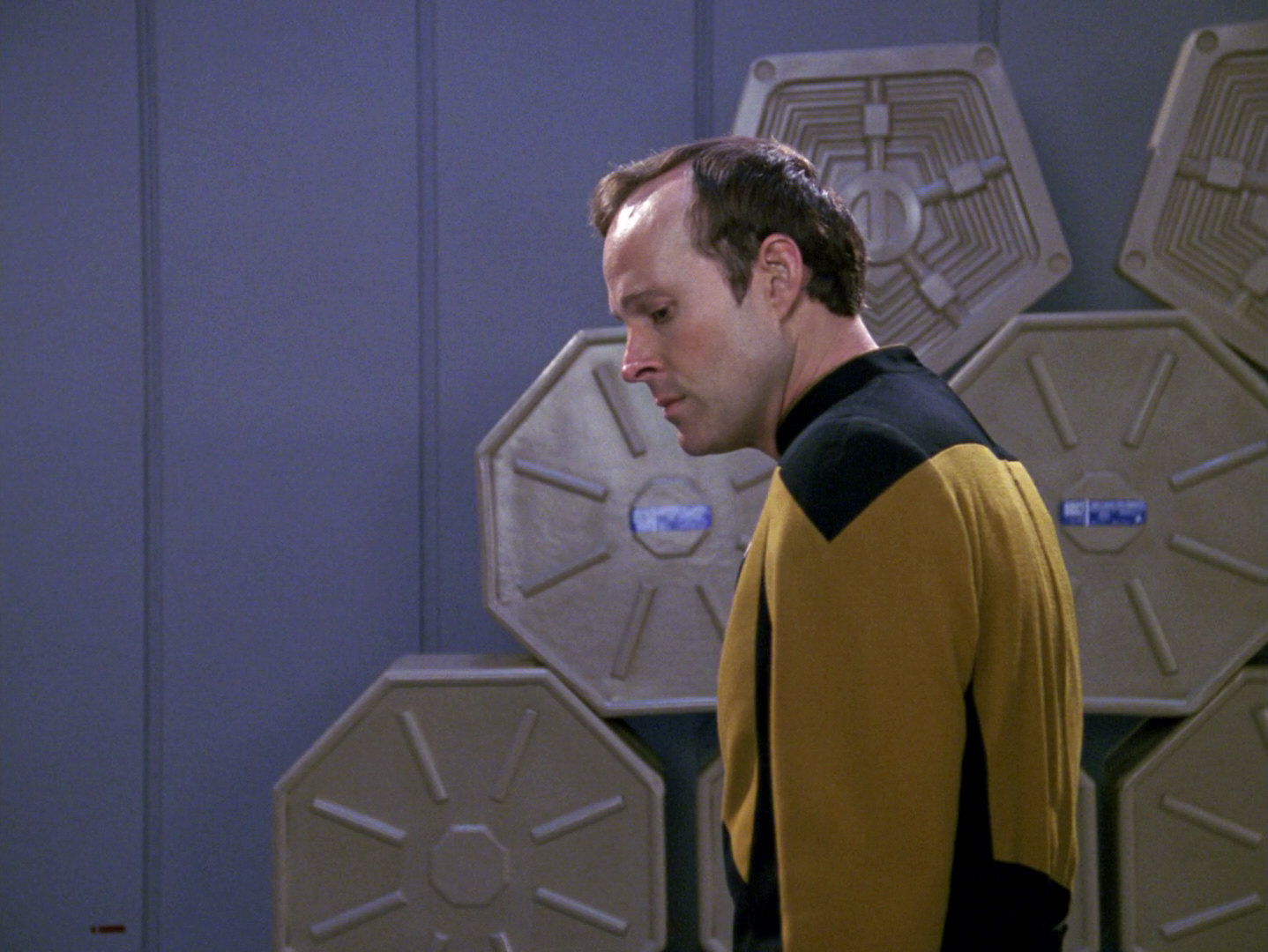
This is one of the delightful, relatively low-key sorts of episodes (I mean, okay, the ship almost flies itself apart at the climax, but still) that round out TNG as a show, and I’ve always really liked it. Reginald Barclay is a relatable and extremely appealing character, and the idea of there being a member of the crew who doesn’t quite “fit in,” and the regulars having to figure out how to deal with this, was an excellent one. The officers and crew of the Enterprise have always been presented as “the best and the brightest,” and there’s something inherently elitist in that concept—which is foregrounded here when Riker questions whether Barclay is “Enterprise material.” To any but the most confident and self-assured of people, this would actually be a very intimidating environment to work in! To its credit, too, the episode manages to make me empathize both with Riker’s impatience (surely we’ve all had the experience of that one frustrating coworker who can’t seem to hack it, and creates headaches for everyone else) and with Barclay’s self-doubt and shyness. And even if I might wish, at times, for Riker to show a little more empathy, watching the other regulars (mainly Picard and Geordi) compassionately step up to the challenge of integrating Barclay is gratifying.
Picard plays, here, the same role that he always plays, as the leader who expects the best from those serving under him but also shows compassion for their failings and seeks to create a collaborative environment in which they can all thrive. When he tells Geordi that Barclay is “part of your team” and that he needs to find a way to integrate him, I find myself reflecting that this, after all, is a captain whose own senior staff includes a Klingon warrior, a touchy-feely empath counselor, and a know-it-all teenager! Geordi, for his part, also acquits himself well. As Barclay’s immediate superior, he’s the one most directly impacted by the lieutenant’s chronic lateness and other failings, and the strain and frustration of dealing with him does show—but not, for the most part, to Barclay himself. Geordi, of course, is the character who normally functions as the resident “everyman,” as something of an audience stand-in, and even (in romantic situations) as the socially awkward guy, so it stands to reason that once he gets past his personal frustration, he would find it easy enough to relate to Barclay. In particular, I loved the continuity nod in which he confesses to having once fallen in love with a holodeck simulation (“Booby Trap”). (His scene discussing Barclay with Guinan, though, doesn’t quite work for me. For one thing, Guinan comes off a bit too smugly superior in her rejection of social expectations about fitting in; for another, the scene is sandwiched between others in which, difficult though it may be for him, Geordi seems to be doing just fine reaching out to and empathizing with Barclay, so Guinan’s intervention feels unnecessary—or at least, out of sequence.) Riker seems the least sympathetic to Barclay, and although he probably ought to lighten up a bit in the holodeck scene, his general attitude does seem to fit both with his position (being in the middle between the immediacy of Geordi’s interactions with Barclay and the buck-stops-here detachment of Picard’s) and his personality—and after all, someone had to play his role, or the episode wouldn’t quite work. Wesley behaves…well, like a teenager, initially indulging in juvenile name-calling, but also “getting it” when Geordi points out how his interaction with Barclay contributed to shutting him down. Troi is the hardest to evaluate. The episode mines her hypocritical outrage at Barclay’s holodeck simulation of her (after having made allowances for the insulting simulations of the others) for comedy, but it is a pretty understandable reaction (in the moment, at least) to coming across such a sexualized image of herself—and we never really get to see whether she manages to move past this response later and handle it like a mental health professional. (I’ll add here that despite both having just expressed more sympathy for Troi’s indignance at her holodeck simulation than Riker’s, and having said that I find Barclay very appealing and relatable, I do find the part of his coping mechanism that involves simulating wussy versions of his superior officers so that he can push them around and beat them up…rather childish. But on the other hand, creating versions of the attractive women in his life that want to get it on with him? Yeah…that, I can relate to.)
This episode is also enjoyable for the way that it shows us a slice of the everyday life of the Enterprise‘s engineering staff, complete with morning briefings around the central island console and a nicely collaborative atmosphere under Geordi’s leadership that mirrors the functioning of the senior staff under Picard’s. In contrast to, say, “Booby Trap,” where it rather seemed as though Geordi was the only engineer on board, here we see a smoothly functioning team of professionals! Also, the backdrop plot about the series of seemingly unrelated malfunctions that ramp up into a crisis near the end is effective. There are, for sure, far too many “rash of weird malfunctions” plots throughout TNG’s run, but this one has always stood out to me as the best instance. For most of the run time, it remains nicely in the background, merely providing something for Barclay to be working on so that we can see his difficulty functioning as part of the crew play out in action; then, when it escalates, we get a wonderful scene of the engineering team brainstorming together, and the logic by which they arrive at the answer (with the key insight, of course, provided by Barclay) is satisfying. That the cause of the problem proves to be something that logically follows from character actions throughout the episode (we actually saw the characters interacting with the various systems, so it makes sense when we realize that the problems stemmed from something that they were physically transmitting via their persons) is a huge plus as well. All very nicely done, to my mind.
It strikes me that this is arguably a rare case in which an episode that focuses on, essentially, a one-off guest character, manages to be compelling and effective. True, Barclay would be featured again in a handful of future episodes and thus is not actually a one-off, but there was no way for the audience to know this at the time when “Hollow Pursuits” initially aired. Besides the fact that he’s just an immediately appealing character, I suppose the episode works because even though we haven’t seen him before, he’s a part of our regulars’ everyday world, not just some random outsider—and a significant part of the appeal is in seeing how they deal with the challenge of working with someone like him. I suppose, too, that the final scene, which teases the notion that he is leaving the Enterprise but then reveals that he’s actually just leaving behind his holodeck escapism, might have been taken for an implicit promise that we would be seeing Barclay again at some point. I appreciate, too, the touch of realism that has him stop short of deleting all of his holodeck programs; he’s had a validating experience out in the real world and made some progress, but come on! Finally, I have to add here that perhaps the crowning irony relating to the surprising effectiveness of this episode (given that it focuses on a guest character, I mean) is that, alas, most future episodes featuring Barclay (as no longer just a one-off character) will prove disappointing compared to this one! Sigh. Still, that’s no mark against this very enjoyable outing.