
I think of this episode as sort of the focal point where all the threads that make up TNG’s Klingon saga meet and cross each other. It serves as a sequel to both “The Emissary” from season two and “Sins of the Father” from season three, and it sets up the Klingon civil war story that will give season four its cliffhanger finale and open season five. It introduces both the incomparable Gowron and Worf’s son, Alexander—two characters who will be important parts of Trek’s world for years to come. Not only that, but the bat’leth even makes its debut appearance here! And, of course, the ever-present tension between Worf’s “Klingon heart” and his Federation values and Starfleet training come to a head more fully than ever before in this episode, even though his personal agenda and the Federation’s interests end up very much in alignment.
In some respects, that last observation provides the key to what makes the episode work. The premise of a dying K’mpec showing up and dumping the responsibility of identifying his murderer—and thereby, in effect, choosing which of the two rival contenders should rightfully succeed him as leader of the Klingon High Council—on Picard, is a fantastic one, but the danger, it seems to me, was that the episode might well have ended up feeling sort of predictable and anticlimactic, especially given that the writers chose to go the “obvious” route of having Duras be the bad guy. If, after playing the mystery of which contender was behind the poisoning and the bomb through most of its run time, the episode had merely ended with Picard presenting the two contenders with evidence of Duras’s duplicity, that wouldn’t have been much of a story. On the other hand, the writers could have chosen to redeem Duras a bit by having him not turn out to be the one responsible for conspiring with Romulans and assassinating K’mpec—but of course, they didn’t (and to be fair, he was portrayed so negatively in “Sins of the Father” that this might simply not have felt believable). But for the Enterprise folks to come to the expected conclusion about Duras, but events to then take their own course before Picard has a chance to act on the information? For the matter to end up being settled by Worf killing Duras in revenge for the latter’s murdering of his “mate”? That’s a dramatic and impactful resolution!
What makes this possible, of course, is the episode’s weaving together of two parallel stories: the Klingon politics one that began in “Sins of the Father,” and the Worf and K’Ehleyr one that began in “The Emissary.” K’Ehleyr, it turns out, has come around to the view that she and Worf should get Klingon-married, as Worf wanted when last he saw her—but of course, Worf now holds back on account of his official dishonor. This makes total character sense, and it allows for K’Ehleyr’s determination to uncover the truth of what went down in “Sins of the Father” to become the force that ends up driving the plot of the episode, which is fun. That said, there is maybe an argument to be made that Duras behaves like rather an idiot here; what did he expect to happen, exactly, after he murdered a Federation ambassador in her quarters on the Enterprise? Okay, he probably didn’t anticipate Worf chasing him down, challenging him to a duel, and impaling him through the chest (nor, I suspect, did most first-time viewers!), but surely he could not have expected Picard to rule him a legitimate challenger for the succession, either? Or, for that matter, to not take him into custody for murder? On the other hand, he also couldn’t afford to let K’Ehleyr discover and publicize the truth about his father at Khitomer, so I guess it’s not clear that he had many good options—and, after all, he’s hot-blooded and not particularly bright, so… In any event, the end of the episode moves the pieces into place for the next phase of the Klingon politics story while also leaving Worf grieving and young Alexander motherless, which is all to the good dramatically speaking.
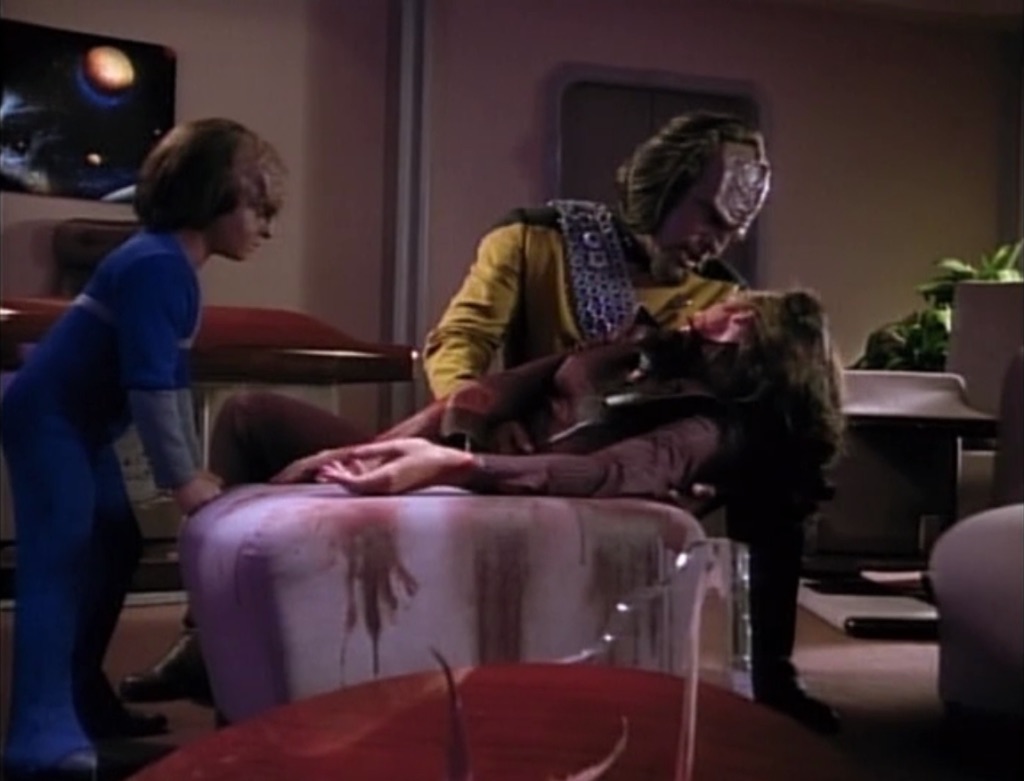
Having said all that… The material between Worf and K’Ehleyr, and the introduction of Alexander, serve their function in the episode, but aren’t as compelling as I might have liked for them to be. For my taste, the initial bickering and distance between Worf and K’Ehleyr before they manage to push past each other’s barriers feels a little…perfunctory. Really, guys? Just get over yourselves; you like each other, okay? I like K’Ehleyr as a character quite a bit, so I don’t want to stress this point too much; her presence is part of what makes “Reunion” enjoyable (thanks in large part to another great performance by Suzie Plakson), and I do think that she and Worf play off each other well. I just also feel like the initial friction between them here is kind of “more of the same” (we saw them butting heads like this back in “The Emissary,” but to better story effect) and doesn’t really add much. Also, the idea of Worf having a son to raise is one that the show will struggle to make compelling almost every time Alexander appears, and that includes this initial appearance. Not that there’s anything terribly bad about Alexander’s scenes here; there’s just nothing terribly good about them, either. Although, the scene in which Worf and Alexander discover the dying K’Ehleyr does succeed in making me feel the tragedy of their loss—and the bit of continuity with “Heart of Glory,” in which Worf lets out a roar to warn the dead of her imminent arrival, is nice. I’m not in love with the story putting Worf in the position of being reluctant to acknowledge the child that he fathered (even though his reasons do make sense for the character), but the moment at the end when he does finally tell Alexander that he is his father still works. And for him to send Alexander away to live with his adoptive parents at the end feels like a bit of a cop-out on the show’s part, but knowing that Alexander comes back to live with Worf on the Enterprise later makes me somewhat less critical of it. So, overall, these aspects of the episode are a somewhat mixed bag: not terrible, not great, but with nice bits.
But to get back to things that I do really like about “Reunion”: Did I mention that it includes the debut appearance of my favorite bug-eyed future leader of the Klingon High Council? Gowron will perhaps never be a particularly deep character, but he’s an extremely fun one, and I’ve always loved the unique, quirky, and—yes—bug-eyed intensity that Robert O’Reilly gives him. “You will die—slowly—Duras!” is a line whose delivery permanently imprinted itself in my brain years ago. It’s fun, too, to watch Gowron react after Worf and Picard inform him and Duras that the bomb from earlier in the episode used a Romulan detonator; the look that he shoots at Duras before heading off to corroborate the Enterprise‘s findings clearly says “I see who you are and what you’re about.” (Duras blusters too, but of course he’s acting, since he obviously already knew about the Romulan detonator; Gowron, for his part, is coming to know the truth about his enemy in this moment.) Anyway, besides just being fun and well-acted, Gowron is also a narratively useful character, since he perfectly embodies TNG’s concept of the modern Klingon: neither entirely trustworthy nor outright treacherous; genuinely caring about honor and all the traditional Klingon values, yet not above the occasional dubious, self-serving ploy; canny and clever, but not particularly self-aware; a potentially loyal friend and ally, with a good heart, but always on the lookout for what he has to gain by any act of overt friendship. In short, he’s just the kind of guy you want (narratively speaking) as the leader of the warlike empire with whom the Federation maintains a wary yet increasingly stable alliance, and a great foil to play against both Worf the outsider Klingon idealist and Picard the Federation exemplar.
Speaking of Picard, he’s a lot of fun to watch in this episode as he strings along two belligerent and impatient Klingon warriors who both want him to just rush through the legal formalities so that they can be done dealing with this interloper and get on with the important business of killing each other and seizing power. From asserting himself as to his chosen time for the initial ceremony (and then casually informing K’Ehleyr that he intends to start it late!), to insisting on making the contenders go through an obsolete recitation of their victories in battle, to taking perverse pleasure in the fact that Worf’s presence will be “disruptive,” he more than holds his own. Go Jean-Luc! Needless to say, too, his dressing-down of Worf at the end, followed by a softer personal moment (his signature move), makes for another great scene. Worf gets off easy, to be sure, for running off half-cocked and murdering a member of the Klingon High Council, but in the moment when Picard tells him that his service has been exemplary “until now,” it doesn’t feel like getting off easy. Captain Picard being disappointed in you hurts worse than most other people punching you in the gut.
It was a thrillingly gutsy story move to have Worf kill Duras. But, should there have been actual consequences for his behavior? Since the Klingons are fine with it, he doesn’t face criminal charges as a murderer, and of course, respect for different cultural ways provides some amount of cover. Still, as Picard points out, Worf is a Starfleet officer, and this is not a kind of behavior that Starfleet or the Federation condone! And “a reprimand will appear on your record” seems pretty weak as a response to a revenge killing. Realistically, of course, this comes down to TNG’s episodic structure, and its unwillingness, most of the time, to let the events of one episode disrupt the show’s overall status quo—but it’s fun to put that awareness aside and speculate about in-universe motivations. Is Picard letting his personal feelings influence his decision here, considering that (as he reminds us earlier in the episode) Duras once tried to have him killed? Or, does the fact that Worf’s act resolves the succession issue in a way that the High Council finds acceptable, thus both relieving the immediate pressure on Picard and serving Federation interests (by ensuring that the empire won’t be ruled by a Romulan collaborator), play in? Is there, in other words, an element of realpolitik letting some of the air out of loftier ideals at work not just for the Klingons, but on the Federation side of things as well? I don’t know whether anything like this was intended or not, but it’s interesting to ponder.
Anyway, this is a pretty great episode!
Final tidbit: There’s a scene in the observation lounge early on in which K’Ehleyr briefs the regular characters, and in the first shot of this scene, K’Ehleyr is seen via her reflection on the conference table before the camera pans up to focus directly on her. In this last rewatch, my immediate thought when seeing this was “Did Jonathan Frakes direct this episode?” And, sure enough, he did!
Not much to add except to emphasize just how unconvincing and dull Alexander ends up being as character. I’m not sure if there are many child actors who could have pulled that off–not many, if so–but nothing about that kid seems like what a Klingon child should be like, even one raised under the circumstances he was.