
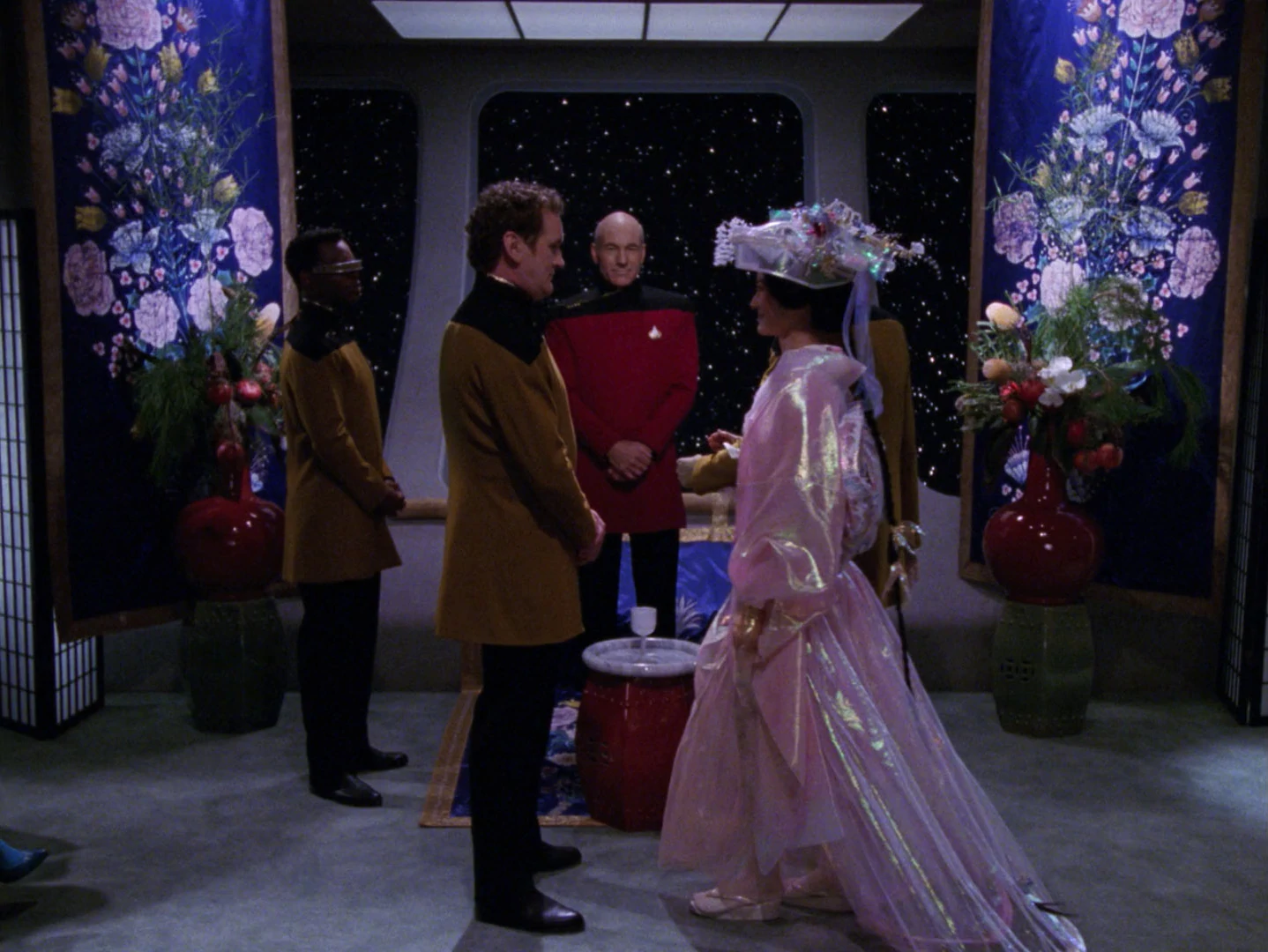
This has always been one of my personal all-time favorite TNG episodes, and I perhaps can’t really evaluate it “objectively” at this point (not that any such assessment is ever meaningfully “objective”—but this one even less so, if that makes sense). On one hand, giving it five stars admittedly feels sort of…self-indulgent. Does it really stack up alongside the likes of “Q Who” or “Yesterday’s Enterprise” or “The Best of Both Worlds”? Honestly, I don’t know. But I do know that I love it with all my heart and can’t bring myself to rate it any lower than five stars. It isn’t perfect, and I will have a few criticisms to register. But the episode’s “day in the life” format, its focus on Data, its many classic moments, the ways in which it feels wholly enmeshed in the show’s larger continuity, the confidence and deftness with which it foregrounds delightful character stuff while allowing its “bigger” plot to play out largely in the background, and the bit of philosophizing in Data’s final couple of voiceovers, all combine to make “Data’s Day,” in my opinion, a masterpiece and a classic.
Superficially, the episode contains two storylines: the Vulcan ambassador / Romulan spy plot and the O’Brien wedding thread. In almost any other episode, a premise like the former would be the ‘A’ story, while the wedding would serve as the focal point of the ‘B’ story. To observe that this episode reverses that—giving more prominence to the events leading up to the wedding than it does to the other story—would be accurate, but doesn’t go far enough. Because, of course, what the episode is really about is how these two separate sequences of events impact Data, who is involved in both of them without really being one of the central players in either. Each contains the beats of a genuine story; for instance, the wedding story puts characters in conflict, takes Keiko through a little arc, and has a resolution. And yet, this episode is in no sense a “Keiko story.” She’s in the background; her motivations and her thinking are sketched in, but not focused on. Instead, the focus is on Data’s internal monologue as he intersects with the Miles and Keiko story and tries to navigate the complexities of human emotions and relationships. And, sure, I absolutely recognize that TNG did not invent the concept of a “day in the life” episode, and that what I’m calling attention to here about this episode’s structure, while it was a departure for the show, was hardly revolutionary in a broader context. But I am, perhaps, a bit of a sucker for this type of episode, and here we have one of my most cherished shows ever, not only doing a “day in the life” episode but nailing it—and, of course, using Data as its focal character. Also, for a show that relied heavily, overall, on high-stakes sci-fi jeopardy plots, putting a plot like the Romulan spy storyline here so far in the background was a fairly bold move—and on top of that, the Romulans actually outmaneuver our heroes this time around, leaving Picard with no recourse but to resign himself to defeat and retreat back into Federation space!
I remarked, above, that “Data’s Day” feels (at least to me) like an episode that is “enmeshed in the show’s larger continuity” to an unusual degree. It’s not easy to articulate the fullness of what I mean by this. Part of it is the fact that the episode contains a delightful number of references and callbacks to prior episodes. The pretext for Data’s voiceover is that he is composing a letter to Bruce Maddox, for example. When given the assignment to investigate the apparent death of the “ambassador,” he references his fascination with Sherlock Holmes. During the climactic face-off between Picard and the Romulan commander, he reflects on the role of bluffing in poker (his voiceover, incidentally, elevating a good scene into a fantastic one). (Hell, going beyond TNG itself, Picard’s lines in the wedding scene are a deliberate callback to a similar scene in a classic episode from the original Trek!) But in addition to these backward-facing continuity touches, the episode also debuts a surprising number of things that will be recurring elements going forward from here, such as the character of Keiko, Data’s cat, the ship’s barbershop and its Bolian barber, and our first-ever glimpse of the arboretum. Just classic little pieces of the world of the show, and of what the show was, in season four and beyond. Also, I’m not 100% sure, but when Data says in this episode that he considers Geordi to be his best friend, I think it’s the first time that this has ever been verbalized. And then there’s Miles Edward O’Brien, whose evolution from unnamed background extra in TNG’s pilot to eventual full-fledged main character on Deep Space Nine takes a major leap forward during TNG’s fourth season as a whole. Getting married, in this episode, represents a big part of that larger process. Finally, thanks to the day-in-the-life structure, this episode just conveys more of the flavor of what daily life aboard the Enterprise is like than perhaps any other, before or since. We get to see changeovers between day and night shifts on the bridge. Data notes the various routine shipboard events taking place on this particular day. As a young Trek fan, I always yearned for more of this sort of thing; exciting plots and intriguing premises of the week were great, but part of me just wanted to geek out imagining the details of routine shipboard operations and day-to-day life as a Starfleet officer—things, naturally, that most episodes could afford to devote relatively little time to. But this one delivers on them! Put all of these things together—the continuity references, the introduction of classic recurring elements (Spot!), the spelling out of previously implicit things (like night watch, or the Data/Geordi friendship), the “slice of life” feel—and add in the fact that we’re only about four episodes off, here, from the literal midpoint of of the entire series—and it’s almost like “Data’s Day” functions as the linchpin episode of TNG as a whole. It’s a far cry from the most exciting, dramatic, or momentous episode, but it’s still a great episode—and in some ways, for me at least, the paradigmatic exemplar of the show that TNG, in its maturity, fundamentally was.
I’ll say this, even: Despite the inclusion of the Romulan story, this episode’s primary focus on low-key character exploration invites comparison, to some degree, with “Family.” And whereas the latter offers deeper new insights into its featured characters, “Data’s Day” tells a meatier, and more satisfying, story. In my review of “Family,” I expressed disappointment with its somewhat narratively empty nature, despite the richness with which it fleshed out both Picard and Worf by compellingly developing family backgrounds for them. But here, with the two backgrounded-yet-fully-realized storylines and the integrating thread of Data’s thoughts and observations in voiceover throughout the course of the day, I’m left fully satisfied.
I said near the start of this review that I do have criticisms of “Data’s Day,” though. Two things, in particular, stick out to me enough to warrant mention, although the second one is mostly just a nitpick. But the first one concerns Keiko Ishikawa-O’Brien. Keiko, of course, will hereafter be a recurring character both for the next couple seasons of TNG and then throughout the entire run of DS9, and I’ve already talked about how the fact that she appears here for the first time plays into how classic an episode “Data’s Day” is. But Keiko will always be, in my view, a somewhat problematic character…and that starts here as well. Married couples are not, on the whole, featured very prominently in Trek, and TNG had a real opportunity here to broaden its depiction of 24th-century society in potentially interesting ways via its portrayal of newlyweds Miles and Keiko. And the show will try do at least some of that. Alas, though, the O’Briens’ marriage will be depicted in all-too-gender-stereotypical a fashion, more often than not. Only rarely will Keiko feel like a fully realized character in her own right, and too much of the time, the writers will milk the O’Briens (as a couple) for irritatingly trite, quasi-sitcom-ish marital sniping stories and portray them as embodying gender stereotypes that felt outmoded to me even in the late twentieth century, much less the mid-to-late 24th. DS9 actually has much more to answer for in this regard than TNG. But already here in “Data’s Day,” Keiko is the overly emotional woman who freaks out and goes to pieces on the eve of her wedding, in contrast to Miles, who is more “rational” yet also storms off in anger (not hurt or confusion, notice, but anger) when he receives the news that Keiko has canceled the wedding. And Data’s classic lines to Troi (“Chief O’Brien talks to me. Keiko talks to you. Why do they not talk to each other?”) sum up so much about what will be wrong with their character dynamic in the years to come. (Also: Why is he “Chief O’Brien,” but she is “Keiko,” in the bit that I just quoted? Shouldn’t they be Keiko and Miles, or Chief O’Brien and Ms. Ishikawa?)
The second critique concerns one small moment in which I’m unsatisfied with the portrayal of Data. When the captain orders an unexplained course change toward the neutral zone, Data comments in voiceover: “It is fortunate that I am able to perform my duties without emotional distractions. If that were not the case, a sudden course correction toward the Neutral Zone would make me very…nervous.” Played straight, this line would have been perfect; however, Data’s body language as we hear this bit of his internal monologue very clearly does betray nervousness, in a way that is obviously deliberate on the part of the episode. What were they going for, here? I appreciate the occasional small touches that indicate that Data is not entirely devoid of any kind of feeling, even though he doesn’t have vivid or remotely human-like emotions—but this moment very much crosses the line for me, and is just flat-out inconsistent with his character premise (and with most of the rest of what he says and does in this episode, for that matter). It’s weird, and annoying.
But there are so many classic, entertaining moments in “Data’s Day”! “My hair does not require trimming you lunkhead” is one of my favorite lines, and “I may be pursuing an untamed ornithoid without cause” is also classic. Data’s reflections on several of the other regulars and his relationships with them (Geordi, Worf, Riker, Troi) are fun, and his “insightful” analysis of Riker’s sarcasm when the latter refers to the fake Vulcan ambassador as “charming” is good for a laugh. Small bits of humor such as Data’s too-persistent efforts to make O’Brian comfortable when the latter comes to talk to him in his quarters also entertain. The scene in which Dr. Crusher teaches Data to dance, of course, is legendary. And there are many more!
Finally, I cannot end this review without mentioning the impact that Data’s final voiceover lines—about the meaning of being human, and about “learning, changing, growing, and trying to become more than what I am”—had on me, as a teenager. Data’s quest to understand human emotion and to become “more human” was always a metaphor for all of our individual strivings toward self-actualization and self-improvement, and I suppose that’s fundamentally why I connect so strongly with the character. But this was never more explicit, or more eloquently expressed, than here. Shortly before this, in the wedding scene, Data says that for all that human emotion still baffles him at times, he does understand the need for friendship and the desire to be loved. This is the right way to push the limits of our favorite android’s non-emotionality, in contrast to that “nervous” moment earlier on, and it’s a scene that typically moves me to tears. But the final scene spoke even more powerfully to my teenage self, and continues to resonate strongly with me to this day. It’s not too much to say that Data’s thoughts here played a role in crystalizing some of my own core values, at the age of 17 and afterward. He helped inspire me to define the meaning of “being human” for myself—to understand what kind of “best self” I aspired to become.
I agree. The Ishikawa-O’Briens had some pretty annoying aspects. What in blazes did those two see in each other? Keiko is not well fleshed out as a person and never becomes so, so maybe there’s no way to answer that. I really enjoy O’Brien’s portrayal as an everyman (it makes it all the more fun to see how he reacts to all the abuse the writers put him through on DS9), but that also means that his character concept is rooted in being kind of ordinary and boring, so matching him with an even more boring person (who is all too easy to imagine being annoyed or grossed out by almost everything) isn’t going to lead to compelling arcs. It’s going to lead to a dynamic where anytime one character has a strong reaction to anything, the other one picks a fight. Admittedly, I think she got some passion from her DS9 teaching role. That’s about the only memory I can conjure of that character that feels positive.
As you say, though, the worst of it is the gratingly traditional gender stuff. It’s the old TV trope—I remember it particularly from the 90s, though I don’t know if it’s subsided at all since—that strives to depict marriage as a tedious slog of criticism and obligation that you almost immediately regret once you do it. These two were already at each other’s throats with ridiculous conflicts even *before* they were married; if they had a period of being deeply in love, we seemingly tuned in well after it was over. While I have my quibbles with the institution of marriage in general, or at least the fairy tale constructs heavily associated with it, I’m certainly willing to go along with the idea that an “ideal” culture has retained the tradition provided that people seem to be thinking seriously about what it means to them to be married and don’t just fall into the tradition because it’s expected. However, the idea that marriage wouldn’t be reimagined in a more empowering way than it was usually depicted in 90s TV is pretty damn discouraging, and yet another example of how the optimistic future is all about telling ourselves things are great in the 24th century without presenting even a fairly marginal amount of evidence for it. Trek doesn’t have a lot of marriages, and I’m not sure that there any that look like good ideas from what we see of them.