
I have generally remembered this episode as well-meaning but a bit too “easy,” and I expected (before re-watching it) that I would give it three stars. I imagined commenting that I appreciated what it had to say, but felt that it was a bit too smug and preachy in how it went about saying it. I was going to add, too, that making poor Worf into the stooge who needed to learn the lesson of the episode’s moral was (I felt) a bit unimaginative and disappointing. Well, I wasn’t wrong on either of these counts…but I now see them as merely the tip of the iceberg. “The Drumhead,” it turns out, is actually considerably worse than I had remembered it.
To say that this episode is heavy-handed and preachy is true, but fails to get to the heart of what’s most wrong with it. “The Drumhead” seeks to dramatize a Big Issue, but it dumbs that issue down and presents it in a starkly black and white way that robs it of the kind of meaty ambiguity that makes for compelling storytelling. To grapple honestly with the conflict between security and liberty, the episode would have needed to present a genuine dilemma involving actual uncertainty and hard choices, and a viewer should feel at least some sympathy for both sides of the argument. Also, in order to tell a meaningful story about our characters struggling to deal with this issue, we should have seen at least one of them torn between sides, and going through an arc in which he (“he,” because obviously the character in question should have been Worf) comes to define his position more clearly through taking some kind of actual stand. (There’s even a potential setup for such an arc, with Worf feeling a personal stake in rooting out treason and proving himself after the Klingon traitor tries to play on his public dishonor in order to pressure Worf into setting him free. We know Worf isn’t going to take that bait, but will he be able to draw a line between loyally doing his duty and rushing to judgement in a way that closely parallels what happened to him?) Instead, though, we just get Worf unquestioningly acting as Admiral Satie’s henchman, while Picard (whose views are never in any doubt) tries to act as a brake on the proceedings. The captain eventually wins, and Worf (after witnessing Satie go nuts and turn on his captain) finally sees the error of his ways, but this is profoundly dramatically unsatisfying. Worf has no agency in the story, and his views change only after events have run their course; Picard, meanwhile, is presented (albeit ineptly, which I’ll get to) as uncomplicatedly perfect. Even if everything else about the episode worked, this would be a pretty fatal flaw.
On top of that, “The Drumhead” is quite poorly constructed in almost every way. For one thing, let’s talk about Admiral Norah Satie, and about her interactions with Captain Picard throughout the episode. Satie clearly belongs to the dubious pantheon of TNG guest characters whom the show initially takes great pains to assure us are distinguished and impressive personages about whom we should definitely care, then actually portrays as off-putting, arrogant, and unhinged (think Ira Graves from “The Schizoid Man,” or Riva from “Loud as a Whisper,” or even Captain Benjamin Maxwell from “The Wounded”). Despite Picard’s expressed, and apparently sincere, confidence in her in an early scene, and the episode’s attempt to flesh her out with back story, there is never a moment when she comes across as the seasoned, authoritative Starfleet admiral we’re clearly meant to see. Her not being in uniform doesn’t help here, but worse are the weird manic energy that she tends to project, or the bit where she declares herself “out of her element” when trying to follow Geordi and Data’s moderately technical language (which our captain clearly finds perfectly comprehensible). Even before she eventually shows her colors, her demeanor seems to reflect either an intelligent but sheltered dilettante, or simply the fanatic that she ultimately proves to be. She exudes the brash overconfidence of an ideologue, not the understated self-assurance of someone who is accustomed to being in a position of authority. I’ve said it before: if the audience is to be convinced that a character is someone impressive, we have to be shown this—and if we’re to have any emotional investment, and actually care when a character makes disturbing choices, we have to like and trust her at least somewhat to begin with. Some episodes have actually accomplished these things with their guest characters, but this is not one of them.
The relationship between Satie and Picard also never gels. It was an odd enough choice to start by having her tell Picard “I came here resenting the idea of having to work with you, but now I’ve decided you’re all right,” before we’ve even seen any instances of the two of them either butting heads or working well together (?). Plus, even before they do start disagreeing, at no point does it seem remotely like she actually sees the captain as anything like a partner in her investigation. It’s not just that they soon find themselves at odds with each other; it’s also that, before long, she’s making decisions without even consulting him, and springing surprises on him in the hearing room. What we don’t ever get, though, is any revisiting of the ideas planted in that earlier scene; she never says “I guess my instinct to go it alone, unencumbered by the likes of you, was right after all,” for instance. So what was the point of the “we’re a team” scene? Are we to understand that she was being disingenuous from the outset? Later, when the captain asks to speak with her privately, she again pays lip service to them being partners; but then, during the ensuing conversation, she bluntly tells him that she’s in charge and doesn’t need his “permission or approval” for anything (even though earlier she said that command had ordered her to work with him on an equal footing). Again, there’s no clear arc here; the relationship between them just seems totally incoherent.
(By the way, has Admiral Satie been called out of retirement for this investigation, as Picard’s log entry claims…or has she been relentlessly traversing the Federation like a crusader on a mission to ensure its security for four years, as per her later monologue? Also, what is the meaning of the assertion that her “investigation exposed the alien conspiracy against Starfleet command” back in season one’s “Conspiracy”? Um…aren’t Picard and Riker actually the ones who did that?)
Next, let’s talk about the admiral’s Betazoid aide, Sabin. For one thing, do (full) Betazoids just really vary a lot in the extent of their telepathic abilities? We’re usually given to understand that they can actually read people’s thoughts, and that Counselor Troi is limited to sensing emotions on account of being only half-Betazoid. Putting aside (for a moment) the worldbuilding implications and the ethical issues that this raises, why doesn’t Sabin seem able to get anything more out of interrogation subjects than Troi normally does (e.g., “he’s hiding something”)—and why does Picard minimize his contributions by calling them “Betazoid intuition”? But that’s not even my biggest question concerning Sabin’s role in the investigation. After the Klingon confesses to being a spy yet denies being a saboteur, Sabin backs him up, saying that he doesn’t seem to be lying. Yet later, after crewman Tarses is exposed as having lied about his Romulan ancestry, this lie is treated as cause to disbelieve his denials of being a traitor. “How can we believe someone whom we know to be a liar?” Sabin demands of Tarses. Well, I’ll tell you how! Aren’t you supposed to be able to sense these things, Sabin? Can’t you tell that, just like with the Klingon, there’s no further deception going on after the initial lie has been exposed? Or, on the other hand: If Sabin does still sense deception from Tarses, why doesn’t this come up explicitly? The entire second half of the episode is presented as a witch hunt driven by distrust of (and probably prejudice against) Tarses for having lied about his heritage, but this doesn’t really work when it has already been established that one of the witch-hunters can actually tell when someone is, or is not, lying!
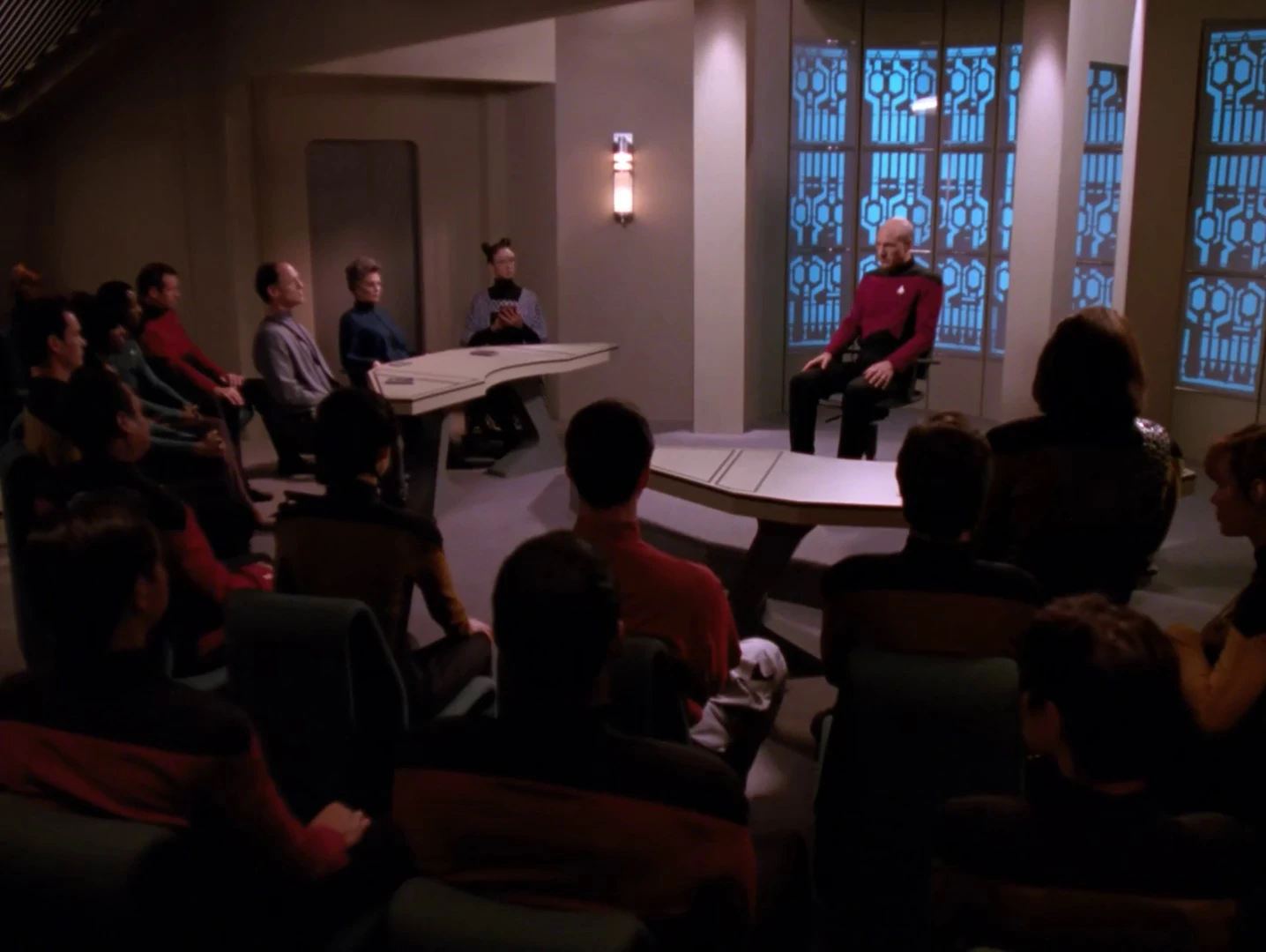
For that matter, very little about the way that the plot unfolds actually makes much sense. We are supposed to be witnessing an investigation that begins on firm ground (with crimes having been committed and evidence being examined), then slowly spirals out of control and turns into the aforementioned witch hunt—but at every step, the episode cheats. Rather than constructing a plausible sequence of events that would actually dramatize an investigation going off the rails, it has characters assume positions that make little sense, then relies on the audience’s understanding that Picard is the good guy and Satie the Mad Admiral to ensure that our sympathies fall where they are intended to fall. The writers first tip their hand in an amateurish way by having Picard immediately grow concerned the minute Tarses comes under suspicion (because Sabin senses that he is lying when he is first questioned). As yet, no one has done anything to prompt his concern, and his insistence that there be “clear evidence” against the suspect before he will take any action at all against him makes no sense. Satie is correct when she suggests that he would be listening if it were Troi telling him that Tarses was lying…and anyway, they aren’t talking about summary judgement here! It’s more like a provisional arrest based on probable cause (in 20th/21st-century terms, anyway)! Admittedly, things do become murkier when the next scene reveals that there was no actual sabotage; now it becomes a case of investigating someone, despite the absence of a clear crime, merely because there is reason to believe that he has lied about something, and because of paranoia about possible conspiracies in the wake of having arrested a confessed spy. And yet, whereas previously Picard had said “no, we’re not continuing this”…now he reluctantly allows the investigation to proceed! Whatever. Then the crewman’s big lie is outed, and there is a rush to judge him, and we have a scene of Picard being very smug and preachy with Worf. After that he goes and chats with Tarses one on one, which in itself I like, although it’s weird if we’re still buying into the fiction that Picard and Satie are partners in an ongoing investigation in which Tarses is the chief suspect. But while Picard is entirely right, in my view, to be concerned for Tarses, and to worry about people rushing to judgement…is he right to want to entirely shut down the investigation at this point? Tarses did commit a crime by falsifying his Starfleet application, and it’s one that could have been motivated either by fear of prejudice or by something more sinister, and it seems to me that determining which it was is probably a good idea, right? Picard will later characterize the entire investigation as being “based on insinuation and innuendo,” and say that Tarses is being persecuted because his grandfather was a Romulan. But actually, he’s under suspicion because he lied about his grandfather, and because he has a circumstantial link to a known spy who leaked information to the Romulans. And Satie is right to dismiss Picard’s personal chat with Tarses as a valid basis for the captain’s deciding unilaterally that the crewman is innocent. In short, if Satie and Sabin and Worf are leaping to unwarranted conclusions…so is Picard!
But the biggest cheat of all is saved for last. Satie responds to Picard’s opposition not with reasoned arguments or calm authority, but with impassioned zeal and veiled threats. Then she unveils those threats, swerves off course from the Tarses investigation, and starts slinging wild accusations at PIcard himself, with another admiral on hand to witness the proceedings. And then, just to really stick it to this extremely ill-treated character, the episode has Picard defend himself by quoting famous words penned by the father that Satie hero-worships, prompting the respected admiral to have a total meltdown befitting a whiny child. (One wonders: would the writers ever treat a male authority figure like this?) This cheap, melodramatic scene sidesteps the need for the episode to offer any real resolution to the question of Tarses’s innocence or guilt, and leaves space instead for one final smug speech from Picard to Worf to finish things off.
In short, and with apologies to the contingent of fandom that seems to regard “The Drumhead” highly, I can only call it a structurally incoherent and narratively unsatisfying mess. I’m also inclined to point out not only that this episode was written by Jeri Taylor, but that, in fact, she is said (in Nemecek’s TNG Companion) to be especially proud of it. I have already commented once in these reviews (see “Suddenly Human“) that it is my perception that Taylor’s writing tends toward cheap political grandstanding in the service of fairly unchallenging Big Messages in lieu of digging into the nuanced complexities of an issue in an honest way, and I’m afraid “The Drumhead” fits this description all too well.