
The second half of “Redemption” is a bit all over the place, and honestly, it both could and should have been better than it is. And yet, it’s also an episode that I’ve always very much enjoyed. Maybe this is an instance of me going easy on an iffy episode because of how much I like certain pieces of it, but I think my overall characterization of it would be that it’s a flawed classic.
There are definitely too many story threads being woven together here, with the result that none of them really has room to breathe. On one hand, the story of Worf trying out life among his “kind” and finding that he doesn’t really fit there deserved more attention that it gets; on the other hand, I frankly find the Romulan blockade and Data-in-command stories more interesting than the Worf story, so it’s hard for me to wish for the former to have been cut to make more time for the latter. Be that as it may, though, there are things that work for me in the Worf story and things that don’t. I’m not sure whether this was exactly the intent or not, but Worf definitely comes across as more rational than your average Klingon here. As obsessed with the warrior ethos as Klingons are, it’s kind of funny how un-serious they are, in a way, about war. The capital city is officially neutral ground, where members of each side (including the Duras sisters themselves!) can mingle safely in the same bar, drinking together? Really? That seems insane! Just how much does either side actually care about winning this war? I think what the episode is going for here is “Worf lacks the boisterous warrior spirit of other Klingons,” but what comes across to me is more along the lines of “Worf is more serious about actually winning the war than other Klingons are.” Mind you, I’m not sure that this is a criticism, exactly; it’s just interesting and kind of odd. (On the other hand, the Duras sisters do end up abducting Worf from that bar, so maybe it’s not quite so safe a haven for drinking with the enemy in devil-may-care fashion as Kurn would have us believe?) One small criticism that I do have, though, is that during the opening battle, Worf should not (to my mind) have been written as not following what Kurn is up to when the latter causes a solar flare to engulf their attackers’ ships. Worf is supposed to be a clever, Starfleet-trained tactical officer, right? Plus, he’s our protagonist here. The story is about him deciding that the Klingon way is not his way, sure, but clever tactical maneuvers in battle are his thing. Why start the episode by having him be shown up by his brother like this? And then, a much larger criticism: What is served by having Worf spend half the episode as a captive of the Duras sisters? This is supposed to be his story, right? His big chance to try out life among other Klingons? Yet the episode squanders part of even the limited time that it has for this storyline by sidelining him. (There’s also a totally bizarre thing where Gowron reports to the Enterprise that Worf has been taken captive and can be presumed dead, and the rest of the regulars seems unfazed; in the very next scene, Picard and Riker are gleefully planning their trap for the Romulan fleet, as though all is well! Somewhat similarly, when Worf sees Sela, he fails to react in any way to the weirdness that is her—the episode having already had its WTF moment springing her on the Enterprise.) Finally, I do like Worf being given Toral’s life by Gowron in the end and choosing to spare it (this effectively sells his realization that he must find his own way), but (as probably everyone who has ever commented on this episode has noted) his return to Starfleet seems far too easy. I’m not saying that I think Picard should arbitrarily deny his request to return to duty, exactly, but his resigning was the big cliffhanger moment at the end of part one, where it was treated as a consequential thing…and then, in the end, it actually has no consequences. It’s narratively unsatisfying.
(The way in which the Klingon civil war plays out is a bit head-scratching, too, in that the state of the war feels wildly inconsistent from scene to scene. First, the Duras are defeating Gowron’s forces at every turn, and things are looking grim. Then, prompted by Picard, Gowron launches one big all-out assault, and suddenly the Duras are “nearing defeat.” Really?)
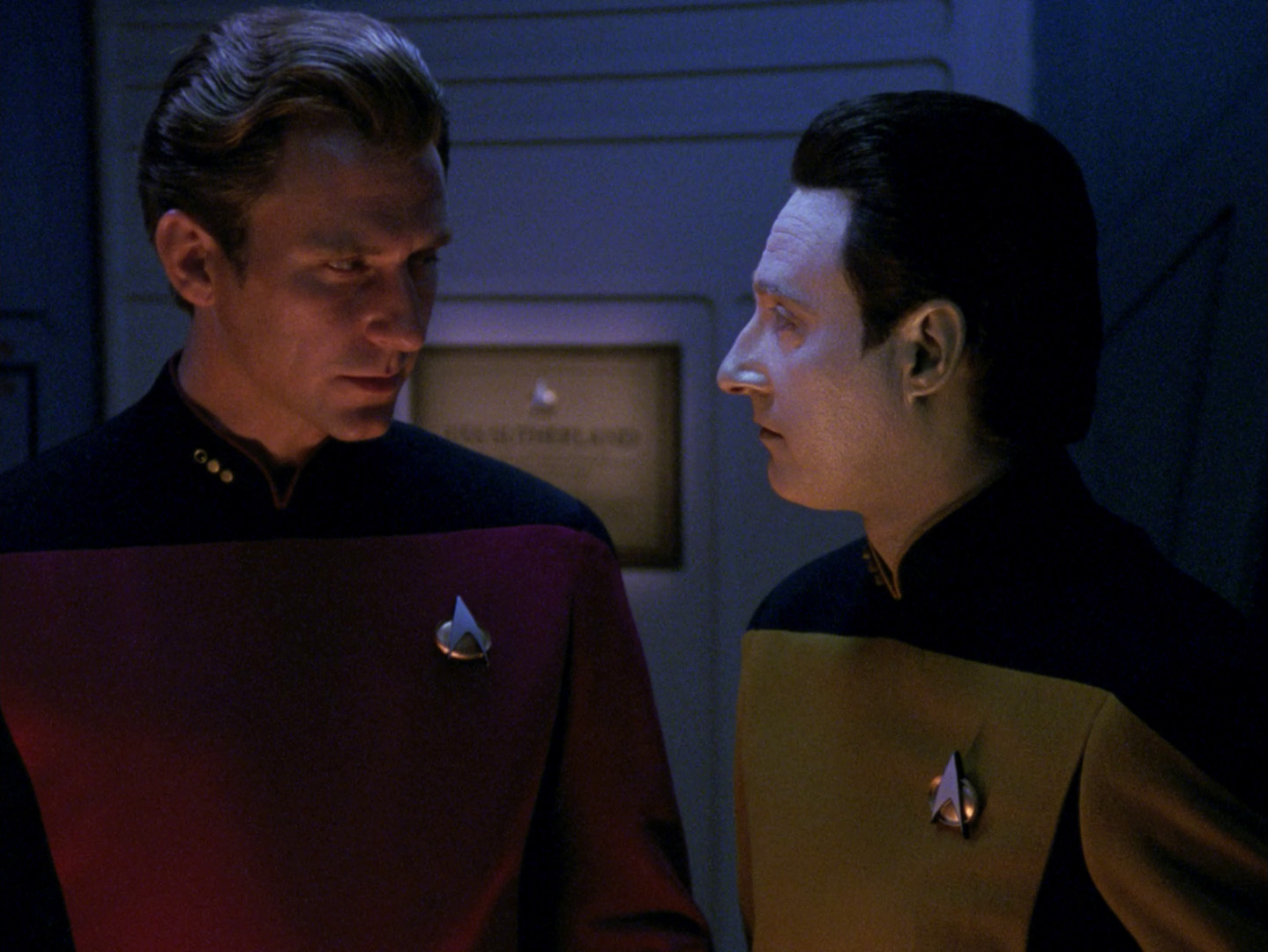
On the other hand, I really enjoy the entire blockade-the-Romulan-border storyline. Sure, it can be nitpicked. (Twenty ships can somehow effectively guard the entire Klingon-Romulan border? The Romulans can’t just go around the blockade? Etc.) But the ambition of it is just really fun—seeing our heroes in charge of an operation that is so much larger than just the Enterprise. Picard pitching the idea to the admiral at the start of the episode is a cool scene, and him and Riker admitting to each other afterwards that they both are less then entirely sure of their course is cool, too. They’re playing against type here, in a way; for once, it’s Picard who is pushing Starfleet to adopt a somewhat aggressive posture and take decisive action against a possible threat. Obviously, he both goes through channels and presents a plan characterized by prudence and restraint; he’s Jean-Luc Picard, not Ben Maxwell from “The Wounded,” or the captain who went charging into the neutral zone on his own authority in season two’s “Contagion”—or even James T. Kirk. But it’s just fun to see him playing this role. Also, I’ve always found this episode’s Data-as-captain thread extremely engaging, even if it is, admittedly, somewhat imperfectly realized. I enjoy Data pointedly questioning Picard as to why he has not been assigned to command a ship, and Picard (seemingly) immediately recognizing that, despite his respect for (and history of advocacy for) Data, he has succumbed to unconscious prejudice in this. And even though Lt. Commander Hobson, Data’s reluctant first officer, might honestly be too prejudiced to fit in Trek’s allegedly ideal future (not only with respect to Data, but also in his comments about how entire other races are unsuited to certain occupations), I even enjoy him as a character. I’m not unable to inhabit his perspective: there’s this anomalous android officer of whom Hobson has no firsthand knowledge, and said android has been assigned to command his ship, of which he feels protective, and he’s not convinced that the android can or will be invested in actually keeping the ship and crew safe…plus, he probably resents having to take orders from the android on a personal level. And of course, I totally love how Data handles him and eventually wins him over. I do, though, wish that the writing could have been a bit smoother during the climax, when Data is disobeying orders and implementing his idea for unveiling the cloaked Romulan ships. As presented, there seems to be no actual reason for him to ignore Picard’s communications. It wouldn’t even have been hard for the episode to establish a reason, either, so its failure to do so is rather vexing.
There’s something sort of off, too, with regard to the message being conveyed by this story thread. Data sets aside the chain of command and defies orders because he sees a way to resolve the tactical situation that his commanding officer doesn’t see, and in the end Picard lets him off the hook for this, delivering a spiel (which I’ve always loved) about how Starfleet doesn’t want officers who just blindly follow orders. And yet, Data’s clash with Hobson throughout the episode has been precisely about Hobson thinking he knows better than his commanding officer, and Data having to assert his authority and get Hobson to respect it! And, okay, it’s not as if these opposing ideas can’t be reconciled; the story could have been made to be about the balance between taking liberties versus following orders, and anyway there’s a difference between a captain strictly enforcing his authority in the face of resentful insubordination, on one hand, and an officer who has a good working relationship with his captain deviating from orders in a way that he knows will serve said captain’s overall objectives, on the other. But the episode doesn’t really handle these ideas very deftly, and that’s disappointing. It reads a little too much like Data gets away with what he does because he’s Data, while Hobson needs to learn to respect Data because he is a mere guest character. (On another note, I wonder if the writer (Ron Moore) deliberately intended to contrast Data’s “Starfleet” response to a challenge to his authority with Gowron’s Klingon response? Food for thought.)
I come, then, to the matter of Romulan Commander Sela, about whose existence (and role in this episode) I have always been at least somewhat ambivalent—and I must say that, on this rewatch, I find myself deciding more definitively that I really don’t care for it. For one thing: After Yesterday’s Enterprise redeemed Tasha Yar’s original meaningless death, did we really need to further retcon that after heroically joining the crew of the doomed Enterprise-C, she essentially submitted to concubinage, and then was ultimately executed after a failed escape attempt? Could the poor woman not have just died heroically in battle, for fuck’s sake? Then, in this episode, the scene with Sela coming aboard the Enterprise to chat with Picard just doesn’t really ring true to me. Why is she indulging him in this way? Why bare her soul and all that? Picard and company are naturally going to be baffled about her, but from her point of view, why not just let them wonder? Plus, what does this whole angle really add to the story? One just gets the sense that somebody had a “cool idea” (“what if Yar had a child with a Romulan, and that child is now a Romulan commander?”), and the said idea then got thrown into the episode despite its not really serving any narrative purpose. It’s not awful or anything, but just—why? (In the end, I’m left reflecting that it probably would have been more fun if the whole Romulan ploy had been under the direction of Commander Tomalak.)
I feel like this review has been mostly negative in a way that perhaps doesn’t really mesh with a four-star rating. Still, this episode is big and bold and does cool things, and there are many pieces of it that I really, really like. The overall story is really compelling, and I love that its telling exists as part of the fabric of TNG as a whole. It tries to do too much and squanders some of its potential, and there are some bits of it that could really have used polishing up, but it remains an episode that I very much enjoy watching and remember much more positively than negatively. Like I said: a flawed classic.