
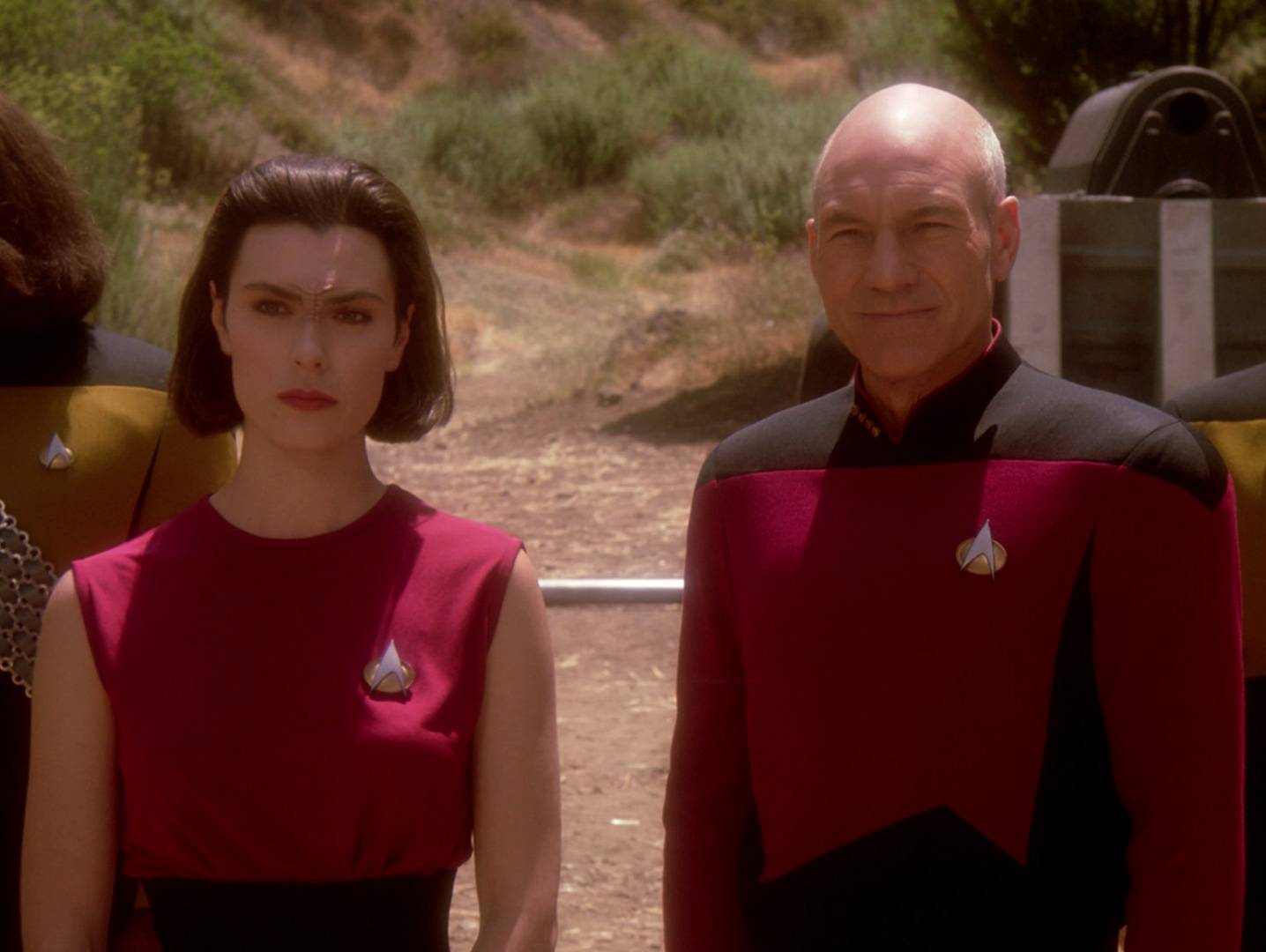
This is a complicated, tricky episode, and teasing out the intricacies of what works and what doesn’t is going to take some doing. There’s a fair amount, I feel, that doesn’t quite work, but there are also a lot of great ideas and a really solid character story at the heart of the episode.
As its title implies, this episode’s raison d’etre was to introduce Ro Laren as a new recurring character, so I’ll start by talking about the eponymous ensign. Basically, I like Ro, but I dislike some aspects of how the episode goes about introducing her to us—and in particular all the drama and hand-wringing and negative pre-judgement of her by the regular characters. I’m fine with her having a troubled past, both as a Bajoran from a refugee camp and as a disgraced and court-martialed Starfleet officer. But the facts about the incident behind the latter seem to suggest that she’s essentially just someone with a bit of an anti-authority streak (not unlike many celebrated Starfleet officers!) who made a well-intentioned but bad call, with disastrous results—not, for instance, that she’s some kind of dangerous fanatic or something! So, for Riker and Geordi and even Picard to be so hostile toward her comes across both as an irrational overreaction and as out of character to varying degrees. The scene in which Geordi spouts off to Guinan about Ro is especially dumb; does he not remember how Guinan responded when he vented to her about Barclay not fitting in, a couple seasons ago? Besides, he’s just not that judgemental a guy. As for the captain, he’s normally an exemplar of compassion and an advocate for giving people second chances…yet right off the bat, he declares Ro unfit to wear the uniform. I guess I do half-buy Riker adopting this kind of attitude, but even in his case, I would enjoy the episode more if it showed him taking a more self-aware and open-minded view of her, despite his concerns. That’s the thing: For the regulars to have concerns, and to be seen to doubt Ro’s judgement, would have been fine; I just wish this would have been depicted with more nuance, and in a way that I could believe of the characters.
Ro herself, though, is appealingly depicted. Because the episode is in many respects her story, and because its intent is to bring her into the family of the main cast/bridge officers, I kind of wish that it would have made her more fully the point-of-view character, letting us into her head and encouraging us to identify with her from the outset, rather than introducing her as an apparent loose cannon and unwanted element with whom the audience only gradually comes to empathize. However, the way she finds herself caught up in all the intrigue generated by powers and interests outside of her control, and has to struggle to navigate it and feel out whom to trust or not, ends up being very engaging. I have misgivings about the plot of this episode relying on yet another Mad Admiral (okay, granted it was a captain and not an admiral in “The Wounded,” but whatever; must all Cardassian plots involve a rogue Starfleet officer in some way?), and I particularly dislike the cliched, cheesy reveal scene in which we learn that Ro is secretly reporting to the admiral in furtherance of some covert agenda. But from the point at which she begins to realize that she, too, is in the dark about what’s really going on, and starts stewing and hesitating over what to do next, and Guinan sort of forcibly befriends her and convinces her to trust the captain (and also gets Picard to listen to her), things get more interesting. I guess you could say that I like the Ro character story aspect of all of this but dislike the plot stuff out of which it emerges. (The “Cardassian virus” bit strikes me as a bit silly, too: partly because TNG could never seem to make up its mind as to whether or not cold-like respiratory ailments are still a thing in the 24th century, but also because, as a “clue” pointing to the admiral’s underhanded dealings with the Cardassians, it doesn’t really work.)
The rest of what I have to say about “Ensign Ro” concerns its establishment of the Bajorans as a people and their oppression at the hands of the Cardassians, and the related larger issues with which the episode makes some attempt to grapple. In retrospect, of course, all of this reads as TNG laying groundwork for DS9, but apparently this was merely fortuitous, as the future series had not yet been conceived when this episode was written. Still, the Cardassian/Bajoran back story is inherently meaty and interesting, and was so even when I did not yet know that it would end up being central to the premise of an intriguing new incarnation of Trek. And yet, I feel that some missteps were made in rolling this back story out here. Mainly this: Bajoran settlement camp leader Keeve Falor faults the Federation for having stood by and done nothing for 40 years while the Cardassians brutally oppressed the Bajorans, and Picard offers the limp excuse that this took place “within the designated borders of the Cardassian Empire,” as though that somehow justifies anything. This makes the Federation look pretty bad (worse than I am comfortable with, in fact), and the bullshit notion that its hands were tied because of its non-interference principles doesn’t work for me at all. But this all seems to ignore the fact that “The Wounded’ established a back story wherein the Federation has been at war with the Cardassians until very recently. Given that, how could it have been in any position to intervene on behalf of Bajor? Could the Cardassians have been expected to be receptive to diplomatic pressure on behalf of Bajor from a rival power with whom they were actively at war!? (One wonders, too, what the Federation-Cardassian war was even about. Might it not have been, at least in part, precisely about Cardassia’s interstellar imperialism versus a Federation stance in favor of self-determination? Pure speculation, but surely the latter represents a much saner take on the non-interference concept!) Anyway, from this perspective, the Federation is really not blameworthy in its conduct toward Bajor, at least up to this point. The confusion over these basic premise questions is a bit frustrating.
Be that as it may, though, a broader critique that might be leveled against this episode is that—rather like “The High Ground” back in season three—it gestures toward taking on the thorny topic of terrorism, but ultimately sidesteps the issues that it raises. For instance, Keeve Falor initially assures Picard that he doesn’t condone terrorism…but when he sees that the alleged terrorist attack on a Federation outpost has prompted an offer of aid where previously there was none, he points out that terrorism appears to be effective. This is an important point, but one that the episode mostly glosses over: terrorism is unpalatable, and it definitely doesn’t endear one’s cause to outsiders, but it has the potential to achieve results just the same. Might it, in light of this fact, be justified? And if not, then how should those targeted by it respond to it? Picard has no response for these questions. Our Mad Admiral of the week meant to deceive the terrorists by pretending to cave and give them what they want, but only as a ruse to draw them out and expose them to the Cardassians, who would then do the dirty work of murdering them. Captain Picard clearly condemns this, at least. But as it turns out, of course, the terrorism was actually fake—staged by the Cardassians as a ploy to manipulate the admiral into doing precisely what he did—and so, in the end, Picard (and the episode) is spared having to take any stand in regard to how terrorists ought to be dealt with. This, again, is somewhat disappointing.
Overall, I guess I see “Ensign Ro” as a very interesting, yet fairly problematic, episode, offering an engaging character story wrapped in a somewhat flawed plot while simultaneously attempting some cool, meaty world-building, but failing to adequately think through or commit to the implications thereof. I’m glad that the episode exists, but wish it were somewhat better—which, I guess, is more or less what I intend to communicate when I give a three-star rating.