
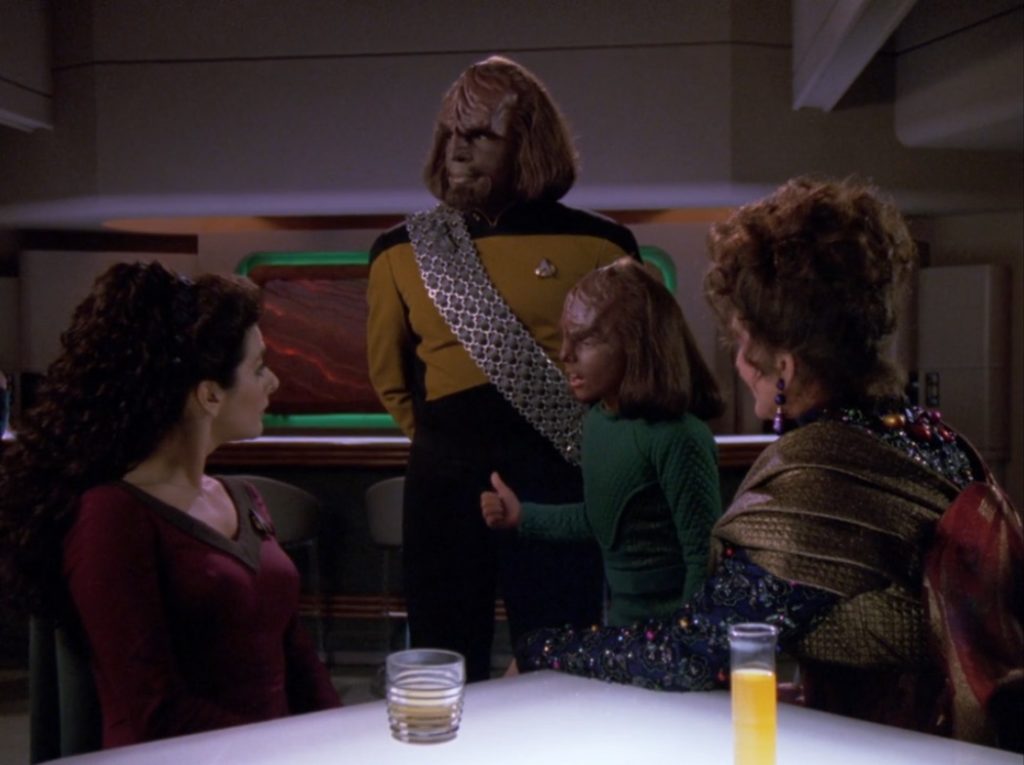
One is almost tempted to speculate that this episode was intended as a practical joke, as in: What would happen if we paired up our show’s two least compelling/palatable recurring characters, and made them the focus of a single episode? I mean, seriously—who could possibly have thought that that was a good idea? “Cost of Living” is a complete turd, and watching it right after watching the previous episode is enough to give a person whiplash.
I mean, okay, yes, I do get what writer Peter Allan Fields (who also penned the previous season’s Lwaxana episode) was basically going for here. Obviously, the episode is intended as a kind of meditation on the need to balance hedonism and responsibility, freedom and structure, etc. I say “obviously,” because the episode is full of one-dimensional, over-the-top caricatures representing one side or the other of this dichotomy, moronically dumbed-down conflicts between them, and heavy-handed moralizing about them. Counselor Troi is trying to help Worf and his son through their parent/child conflicts over rules and obligations, and in steps Lwaxana, blatantly undermining their efforts by encouraging the kid to rebel for the hell of it. Lwaxana, it turns out, has rashly agreed to marry a total stranger, and is acting out in an expression of her anxiety about what this will entail, exhibiting the maturity of a typical 12-year-old. The groom, it further turns out, is a propriety-obsessed stick in the mud who could scarcely be any more different from Lwaxana (especially the hedonism-bent version of her with which this episode presents us), and lest there be anyone in the audience for whom this is somehow too subtle, the groom’s “protocol officer” is an even more caricatured minion of decorum and propriety. Eventually, Alexander reflects Lwaxana’s lessons about free-spiritedness back on her, pushing her to realize that she shouldn’t be trying to remake herself in the image of some stranger just to stave off loneliness. How touching—except that scarcely a single moment in all of this rings true at all. We get one brief moment in which Lwaxana does seem somewhat “real,” when she’s reflecting dispiritedly on the need to “compromise,” but the rest of the time she seems infantile, oblivious, and utterly out of touch with reality. Meanwhile, Alexander is every bit as under-imagined and unconvincing as he has been in all of his other appearances to date, and almost none of his dialog is believable.
And then there’s that god-awful holodeck program, which the episode clearly thinks is quite charming and clever but that I can barely tolerate having to watch. Supposedly, it’s a simulation of a “colony of free spirits,” but it’s actually just pure whimsy and doesn’t represent anything that could ever exist in reality. When Lwaxana and Alexander first enter, it feels as though they’ve stepped out of Star Trek and into some kind of bizarre knock-off hybrid of Willy Wonka and Alice in Wonderland, except dumber. I have nothing against whimsy, per se, but tonally, this particular weirdness just does not work for this show. The denizens of the program are not “free spirits,” they’re ridiculous fairy-tale beings that can’t possibly be taken seriously, and are merely there to represent (poorly) the allure of an existence without rules or structure (or anything that makes sense). For no reason, one of them intones values opposite to what the scenario is supposed to be about, and everyone acts bored…but later, that same character is suddenly on the same page as all the others. Later, the juggler character is all dejected because he impulsively ate his props and now doesn’t have them anymore, which seems to want to be a comment that pure unstructured hedonism has consequences, but why is this a part of the program, exactly? Things could hardly be any more incoherent here.
Then, too, the episode raises issues that it appears singularly uninterested in actually trying to resolve. So, Counselor Troi suggests that Worf and Alexander draw up a “contract” delineating their mutual obligations and responsibilities, as a way to help them work through their parent/child conflicts. Now, in some contexts, this idea might have some merit—but it could be rather stultifying for a young child who wasn’t into the idea, and it also (as Lwaxana points out) runs a considerable risk of turning into little more than a disciplinary regimen in disguise, given the unequal power relationship between the “signatories” to the proposed contract. But does the episode actually pursue the idea at all after it has been raised (and criticized by Lwaxana)? Does it actually show us Worf and Alexander working through anything, or coming to any kind of new understanding? Of course not. Instead, the Worf/Alexander stuff just becomes collateral damage in what morphs into a mostly Lwaxana-focused story. Also, some of Lwaxana’s criticisms are just stupid. “Contracts are usually between people who don’t really trust one another,” she objects. “A child who is trusted becomes worthy of that trust.” Which is all well and good, but if trust is lacking between a parent and child, it somehow needs to be built, right? She seems to think that a more ideal relationship between the two can just be magically willed into existence. Mind you, I’m not saying that I like Worf’s approach to parenting, either, but just advocating its polar opposite doesn’t address the existing reality! The episode, though, has nothing more in the way of answers to offer than Lwaxana does. Following scene after scene of Lwaxana undermining what Worf and Troi are trying to do, and the latter both being exasperated with her, and Alexander taking to spouting nonsense at Worf in emulation of stuff he saw in the holodeck program, and zero progress or insights or meeting of minds, we get a final scene in which suddenly the four of them are all sitting together in the stupid holodeck mud bath, as though some sort of balance or reconciliation has magically been achieved. Lwaxana is still on the hedonism train, and Deanna speaks for the need to “learn how to live in the real world,” and Lwaxana grudgingly agrees, but there is zero substance to this faked resolution. And of course, the real punch line is that Worf is grumpy and unimpressed, with the episode (not for the first time) going for cheap laughs at his expense by putting him in the incongruous setting of the ridiculous holodeck program. Screw that.
Meanwhile, there is a phoned-in B plot happening here and there that spectacularly clashes with the main story. Some “metal parasites” are eating various parts of the ship, causing a Rash of Random Shipboard Malfunctions™ (a lamentably recurring TNG trope). We’ve seen this general sort of thing happen umpteen times before, but whereas in some episodes it has served worthwhile dramatic purposes, here it’s just sort of there. It doesn’t intersect with, or even impact, the events in the A story in any way. Either the writers felt like they had to include some kind of sci-fi/jeopardy plot to make it count as an episode, or they just needed to fill more time than they could manage with the Lwaxana/Alexander garbage alone. Whatever the case, the B plot is unimaginative, pointless, and dull, and in any other episode, it would try my patience—but here, when set against the hokey bullshit going on in the A story, one almost feels relieved each time the episode toggles back to it. Not exactly a ringing endorsement, but there it is.
There really are almost no redeeming qualities here. It’s just a shitty episode.
“Contracts are usually between people who don’t really trust one another”
In most cases, there’s not all that much you can do to enforce a contract that one party decides to break. They’re more useful as a way to define expectations between parties to the extent to which the people involved are willing to hold themselves to account. Contracts between people without integrity may not be worthless, but they aren’t worth much.
I always enjoy your taking to task the writers of the most abysmal episodes. I can’t wait until you get around (if you do) to taking to task some of the abominable DS9 episodes—the ones with the sophomoric, horrific sexism in particular. I don’t ever intend to watch those again, so you can do it for me. 😉