
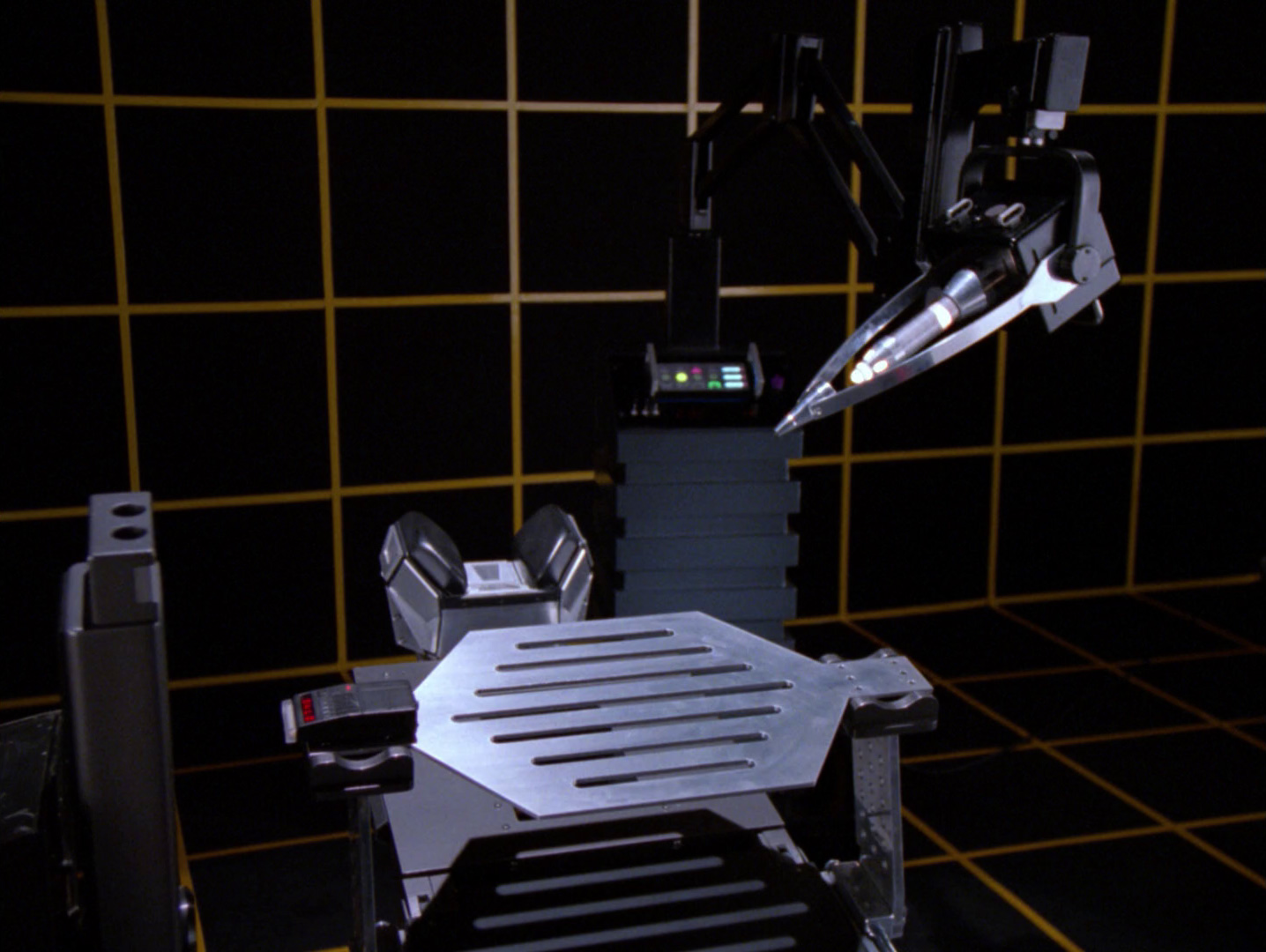
This is the third episode that I’ve rated with three stars so far this season, and each has been wildly different. The season premier was half-baked, frivolous fun; “Realm of Fear” offered a serviceable character story wrapped around a clunker of a plot. “Schisms,” on the other hand, hearkens back to a style of mediocre episode that I feel like we hadn’t seen for a while at this point in the series: the kind that has nothing really bad or wrong about it, but also just…isn’t terribly interesting.
Granted, some solid choices were made in putting the episode together, and there are some nice moments. I like how Riker serves as the primary point of view character, and how we begin with him having already been battling fatigue and “difficulty waking up” for a few days before anything else even happens. (It’s delightful how good Frakes always is at playing “disheveled and worn out.”) Before enough odd things have happened to alert the characters that something dangerous is going on, there’s a fair amount of “business as usual aboard the Enterprise,” and it’s always enjoyable to watch our characters just doing what they do. Mot the barber’s loquaciousness with Worf is good for a laugh. And then we come to what I would call the episode’s “centerpiece” scene, in which the various characters who have been experiencing disturbing memory flashes gather in the holodeck and try to re-create the scene they’re all flashing to. This scene wants very much to be awesome and spooky, and in spite of some missteps, it still manages to be fairly effective. I would have involved a more diverse mix of random crew members (as written, the participants are three main characters and one other person), and some of the steps via which they re-create the alien operating table thingy come across as awfully specific and abrupt (you don’t get the intended sense, after a certain point, that they’re dimly remembering vague, dreamlike impressions), and the holodeck seems to make a couple of weird intuitive leaps of its own…but even so, the scene ends with a pretty creepy feeling of “what the hell happened to us all?”
The trouble is, that very nearly sums up everything that the episode has going for it—and it’s just not enough. I suppose what the writers must have been shooting for here was basically a creepy mystery: evidence points to characters being abducted and experimented on in the night, and something weird is manifesting in the cargo bay, and they have to figure out what’s going on and free themselves from it. And the episode basically delivers that, although it’s not really the sort of mystery story where the audience can pick up on the clues and try to guess where it’s going. It’s fine, but I’m left asking “So what?” The episode has nothing to say; there’s no character story, no metaphor, no thematic takeaway. I mean, I’m pretty sure this was not intended as a cautionary tale about…modifying sensors in innovative ways? And we’re probably not meant, either, to go away thinking “If I find myself inexplicably tired for a few days, I shouldn’t dismiss it; it might be a sign that aliens are experimenting on me in the night!” On a plot level, I don’t specifically have any objection to aliens from another dimension (or rather, a “tertiary subspace domain”), but I also don’t find it inherently fascinating as a premise, so it really doesn’t carry the episode by itself (unlike, say, the time loop concept in “Cause and Effect”—a prior Braga offering that managed to excel despite lacking much in the way of depth). And what exactly is the point of that bit at the end where “something” comes through the rift before it closes? Were we meant to mistake this for a cliffhanger? A dangling plot thread that the show might pick up in some later episode? Because I suspect that anyone who had been watching TNG for the five-plus years prior to this episode could have confidently, and correctly, predicted that it would never come up again.
So far, I’ve purposely refrained from any mention of Data’s poetry reading. Here’s the thing: Minor quibbles aside, I pretty much love “Ode to Spot,” and on one level, the episode ought to earn some points for that bit of goofiness. (For that matter, the other poem that we hear a partial recitation of before “Ode to Spot” is pretty good as well.) But honestly, a few things work against this for me. The first is simply that the couple of scenes devoted to Data’s poetry have no apparent connection to anything else in the episode. “Schisms” is not a Data story, and neither Data’s poems themselves, nor the idea of his poetic aspirations (and limitations), have any thematic relevance to the rest of the story. (Spot herself doesn’t even appear in the episode!) Second, I feel that the episode (or at any rate, Geordi) is too critical of Data’s work! “Ode to Spot,” in my view, is not merely “clever.” Yes, it uses technical language rather than flowery metaphors, and yes, the joke that this is what poetry would sound like if written by an android is funny. But to me, the poem also successfully conveys Data’s affection for his cat in a way that I can believe (not unlike how, in other episodes, his “definition of friendship” was genuinely moving). Geordi’s claim that Data failed to evoke an emotional response thus seems way too dismissive. Plus, on a storytelling level, I have to question why the writers would choose to make the statement that Data’s efforts at emotion-evoking poetry would be doomed. After all, the show has handled most of Data’s other artistic endeavors quite differently: his painting, his acting, his musicianship. What makes poetry so different? And then, finally, I can’t help but to find Geordi’s specific comments on Data’s poem more than a little ironic. The android’s work is “a virtual tribute to form,” he allows, but it evokes no emotional response; if Data aspires to the latter, Geordi suggests that he think more about what he wants to say, and not merely how he says it. When it comes to “Schisms,” I would offer Brannon Braga this exact same advice.
Didn’t they always cast Data as being a bit “mechanical” in his art? I’m pretty sure that was the case for how they described his music, wasn’t it? I thought his painting, too, but I can’t remember what lines I might be thinking of.
Also, this line contains my favorite Trek line of all time: “There was something else there… A metal swing arm. Computer, create a metal swing arm.”
I mean “episode,” not “line.”
In “The Ensigns of Command,” Data says that he fellow musicians claim that his playing lacks “soul,” and he somewhat self-deprecatingly describes his own technique as merely an amalgam of the techniques of other famous musicians and nothing “original” or “creative.” But Picard pushes back on this, insisting that Data’s choices of who to imitate, and his successful blending of their styles, IS his distinctive contribution & his way of being creative. To me, the takeaway was “Don’t sell yourself short as an artist, Data.” As for his painting, I never perceived that the show or anyone on it was treating it as lacking or “mechanical”–not in epsiodes before this one, and DEFINITELY not in the still-to-come dream episode that features his paintings prominently.
As a poem depicted as written in a fictional universe by an android, “Ode to Spot” has value in that it’s amusing. In the context of the TNG universe, I agree it can be seen as having value in the way it successfully suggests something about how Data “feels” (or whatever the android equivalent of “feels” is) about his pet. Evaluated outside of consideration for the fictional author’s context (as art in the TNG universe), though, I would say it’s too literal and straightforward to have much literary merit, which could justify Geordi’s reaction. I’d call that analogous to the limitations of Data’s musical ability (even though, as Picard reminds him, that that doesn’t mean he isn’t creative, just as with his music). I see your point that the show’s overall message is more charitable with his music than with his poetry, though, if you compare Picard’s charitable reaction to Geordi’s entirely critical one, which are the perspectives that the show leaves us with.
Through another lens, as I’ve said before, TNG can be seen as crude anti-AI propaganda… in this case, always selecting something unique about the human experience that a synthetic mind cannot by nature experience, then defining that thing as what is most desirable and meaningful about living in order to establish at least one area of human superiority that AI can never achieve… but I digress. 🙂
Incidentally, aside from Spiner’s misreading of the opening line as a question (making it sound like Data is inquiring if the poem’s name is a quadruped), there is one other thing an android with sophisticated language skills probably wouldn’t write—there’s the redundancy of using “though” and subsequently “nonetheless” at the end in order to meet the requirements of the meter!
1. I would have said that Spiner’s misreading makes it sounds like Data is asking Spot (not the poem) whether her *taxonomic* nomenclature (not her plain old name) is “an endothermic quadruped, carnivorous by nature.” Which is muddled and not right, but not quite as nonsensical as how you seem to be reading it (?).
2. Really… You think “though…nonetheless” is redundant? I would write that and judge it acceptable. Admittedly, I can be a bit overzealous with transition words, but… (?)
3. If I haven’t already mentioned it, the clearest error in the poem as written, to me, is the misuse of the word “obviate.”
4. Too literal and straightforward, you say? Well, perhaps. Maybe I’m partly defending it b/c I perceive similarities to my tortoise sonnet. 🙂 I mean, my poem is *somewhat* less “literal and straightforward,” but not necessarily a LOT less…
You’re right, it is asking Spot that, not the poem. To be more precise about what I meant before, I read it as “is the name of your species a carnivorous endothermic quadruped?” I guess you could also read it as “is the name of your species ‘a carnivorous endothermic quadruped?'” which may make it slightly less nonsensical.
“Though you aren’t able to understand friendship, I nonetheless still see you as a friend.” I’ll concede that it’s not as bad as I was suggesting, but it’s definitely redundant IMO and it also feels stilted to me. If I were grading that essay, I’d be crossing out unnecessary words. 😉
“Too literal and straightforward”
I think there’s a role for different kinds of voices in poetry. I enjoy your tort poem! I think that poem works significantly because there’s a self-awareness about the literal/straightforward tone. There’s a humor and a playfulness associated with it, at least given that I know a human wrote it. If a computer (or indeed, an android) wrote it, I would tend to perceive the self-awareness to be lacking, and the poem works less well. If a poet wrote many poems in that style, I suspect would get a bit tiresome? I dunno.