
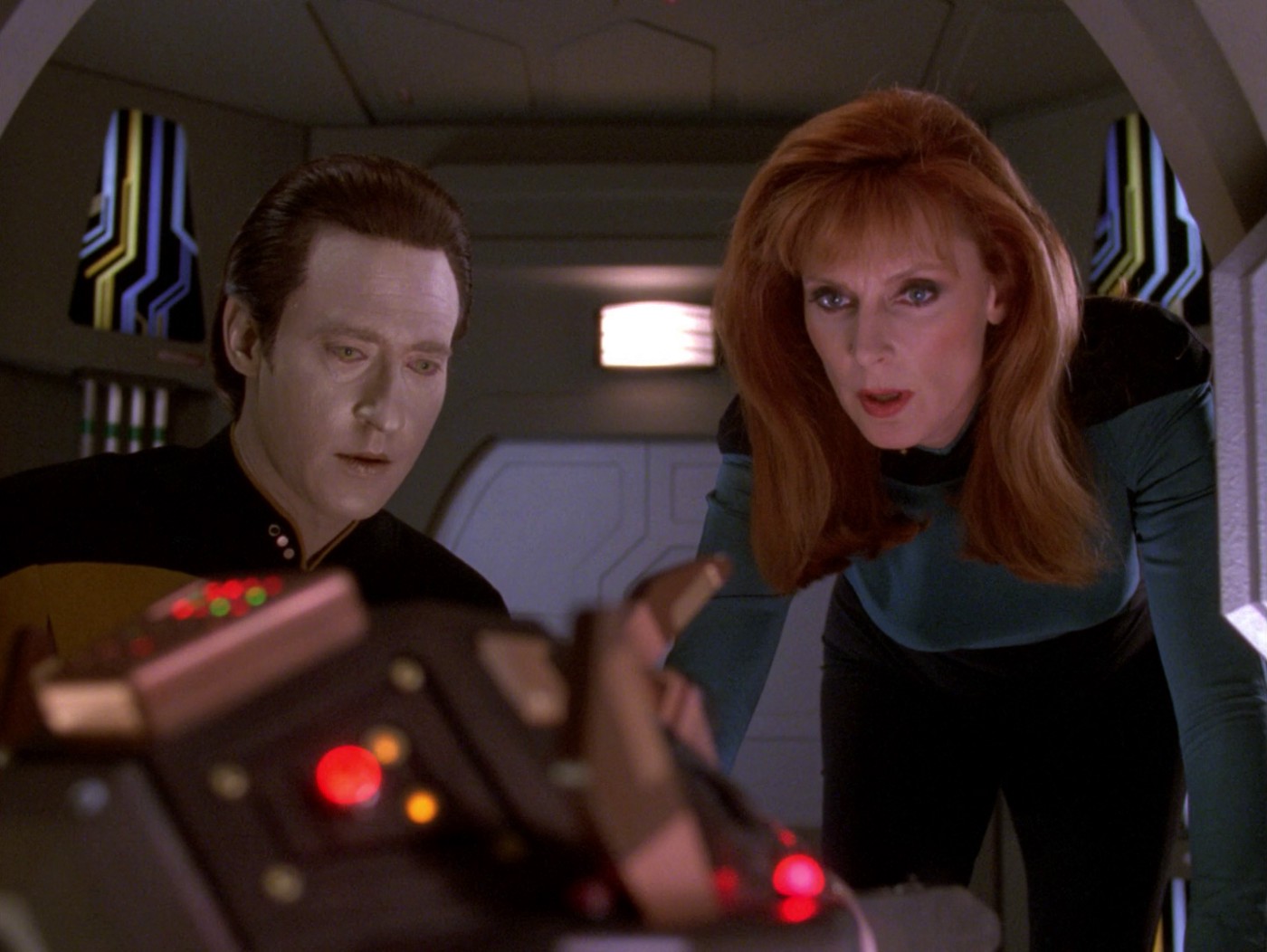
I’ve now given three-star ratings to a full two thirds of the nine sixth-season episodes that I’ve reviewed so far, culminating with this one. This wasn’t the first time that TNG had produced a distressingly long series of mostly mediocre episodes, but it was the first time (putting aside season one, which was just outright terrible) that a season began with such an uninspiring streak. Happily, things were soon to take a pretty impressive turn for the better—and in some ways, that actually begins with “The Quality of Life.” This is still only a three-star episode, but it’s one that I like better than any of the other five offerings to which I’ve assigned that rating so far this season. It’s an episode whose writing strikes me as disappointingly amateurish and inept much of the time, and one that arguably gave rise to fears that the show was running out of fresh ideas and beginning to outlive its potential—but also one whose heart is absolutely in the right place. There’s a solid story here lurking beneath a lot of pretty inept execution, and while I’m less than satisfied with a fair amount about how the episode gets itself to where it’s going, I very much love the destination itself.
At this point, TNG had already offered up numerous scenarios in which one or more of the main characters come into conflict with a guest character (generally an ambitious scientist type) over the rights and status of a novel life form of some kind. There were, at a minimum, “Home Soil” in season one, “The Measure of a Man” in season two, and both “Evolution” and “The Offspring” in season three (with arguments potentially to be made in favor of one or two other cases as well). Of these, obviously, “The Measure of a Man” was far and away the best, and it is both a strength and a weakness of this current episode that the events of “The Measure of a Man” are the only previous analogues to the situation at hand that get explicitly acknowledged. For most of its running time, “The Quality of Life” acts, to its detriment, as if none of these previous episodes ever happened. The plot unfolds in far too cautious and plodding a fashion, so that the audience easily pegs where things are headed long before any of the characters do—and even after the conflict finally emerges, no one thinks to bring up any of their previous experiences as reference points (you know, like “Hey, this situation is really a lot like that time when Wesley improved some nanites and they became sapient; I bet that’s what happened to the exocomps, too!”). What’s more, Dr. Farallon exhibits, to a depressing degree, the same unsympathetic pigheadedness that we saw with the lead terraformer character way back in “Home Soil” (and that season three’s “Evolution” mostly managed to avoid with Dr. Stubbs). One would like to see, first, a more consistent thru-line of the show learning from and improving on its early missteps and weaknesses, and second, a more transparent and self-aware approach to the show’s own history and continuity when (if) it chooses to revisit issues that it has addressed in multiple previous episodes. For it to fail at this, whether as a result of the writers not bothering to keep track of what the show has already done or because, for lack of new ideas, they chose to recycle old ones in the hope that the audience wouldn’t notice, is lazy and disappointing.
Both Dr. Farallon herself, and the character dynamic between her and Geordi, are in fact something of a mess. In their first scene together, I found myself a little frustrated with how the episode positioned Geordi as too much of a naysayer, pushing Farallon into a position in which she feels the need to prove herself and the value of her work. Since when has Geordi ever been anything other than excited and optimistic about the potential of a new technology? Yes, the setup of the situation called for him to provide an outside perspective on her project and be realistic about its weaknesses, but I wanted him to be more in her corner, not at odds with her right from the start. Later, after the initial setback with the exocomp, the two of them do have a nice scene together in Ten-Forward in which he empathizes with her; I like this scene, which (among other things) makes it clear that the writers do intend for us to sympathize with Dr. Farallon. But then, after Data throws a wrench in her plans by suggesting that her inventions are life forms, she takes a swing toward being decidedly unsympathetic. I get that the episode has established her as being driven and obsessed with her mining technology, but she also clearly has an avid interest in artificial intelligence, and after all, the excocomps are her pet project as well. What imaginative, forward-thinking, impatient-for-progress scientist type (very much the kind of person she is represented as being) wouldn’t be intrigued and thrilled at the possibility that she had inadvertently created a genuinely intelligent, “living” machine? Yet she scoffs at Data’s ideas, chafes at the “waste of time” involved in testing them, and gloats like an asshole when they initially seem not to be borne out (only to later, in a bit of oblivious projection, sullenly (and wrongly) anticipate a smug “I told you so” from Geordi when her confidence in the quick progress of her project proves unfounded). Overall, then, she comes across as inconsistent, self-involved, and two-dimensional—and again, I expect better characterization from the show at this point.
Much about the whole idea of the exocomps is handled somewhat ineptly by the episode, too. From the start, they just don’t seem quite as clever or innovative an idea as the episode seems to think they are, for one thing. I mean, sure, they turn out to maybe be sapient, and that’s cool—but at first, it feels like the writers want us to be all intrigued by the fact that this brilliant, cutting-edge, twenty-fourth-century scientist has built…robots that can fix things. Oh, they can replicate a variety of tools according to the needs of the task at hand, and are even programmed to know what kind of tool is needed for what kind of repair? Cool…but you know, I sort of took it for granted that such things have existed for centuries already in the world of Trek. Then, they’re talked up as being able to vastly improve the speed and efficiency of getting the mining technology up and running, yet what we’re shown is her and Data manually hauling one exocomp around (even though they are capable of locomotion on their own!), at a very casual pace, and individually programming it to go out and perform a single task at a time. This is the writers’ idea of highly efficient automation? And finally, it feels really weird that Dr. Farallon’s approach to scaling her little invention up and gaining broader recognition and acceptance for it involves showing it off to the crew of the random starship that has come to evaluate her progress on her primary project. Has she been in touch with the larger scientific and/or engineering community about these things? Published any papers on them, so that others can evaluate and possible replicate what she’s done? It’s all very inept.
The episode, of course, eventually brings the conflict over the nature and status of the exocomps to a head by means of a crisis situation that emerges and threatens the lives of Picard and Geordi. I like the way the situation is ultimately resolved, but getting there still requires a bit more character inconsistency. Dr. Farallon wants to send the exocomps on a suicide mission, but Data objects—although, actually, he predicts that the exocomps themselves will refuse to cooperate. Dr. Farallon, to be consistent with her position thus far (as well as the facts at her disposal), ought to consider the latter belief ridiculous—but instead, she suggests disabling the exocomps’ in such a way as to render them incapable of overriding her commands even if Data is right. Why would she do this? It clearly won’t mollify Data, and it ought to be entirely unnecessary anyway, from her point of view…unless, of course, she secretly thinks Data might be right about the exocomps, and simply doesn’t care about the ethical implications. In fact, her illogical plan of disabling the exocomps’ command pathways (which Riker, for some reason, agrees to) is what actually pushes the conflict to a head, since it prompts Data to his act of insubordination. He would have gone along with trying to get the exocomps to do the suicide mission otherwise; in fact, that’s exactly the “compromise” that is eventually reached! So, again, things are a bit of a mess here. And yet, the way in which events play out once Data and Riker have reached their agreement still ends up being pretty great. As foreshadowed when, earlier on, the one exocomp outsmarted the test that it was given, the three exocomps come up with an alternative plan for resolving the crisis—not refusing to help as Data predicted, but instead agreeing in a way that demonstrates their intelligence even more clearly. And then, when the characters realize that in the end, one exocomp sacrificed itself to save the other two, it’s a genuinely moving moment and a fitting capstone to the elements of the story that have been worthwhile (however muddled by ineptitude).
On top of that, we then get a final scene between Picard and Data in which, finally, (some of) their previous history concerning the rights of artificial life forms is brought up, and the episode’s subtext is made explicit in a beautiful way. I mean, yes, obviously Data’s position regarding the exocomps has been informed by his own status as an artificial life form, and his prior experiences with having his own rights and status challenged. But the irony of his resort to an act of insubordination in defense of the exocomps that puts the life of Captain Picard, of all people, in danger, needed to be acknowledged. (It’s a little sad that we don’t also get a scene between Data and Geordi; his act, as it happens, endangered both his captain/advocate and his best friend.) To a great extent, after all, Data was standing up here for values that he largely absorbed from Jean-Luc Picard (recall that in “The Measure of a Man,” the captain was less willing to see Data treated like property than even Data himself was). Data touchingly calling back to his gratitude at how Picard went to bat for him way back in season two, and Picard, equally, not even needing to hear Data’s explanation because he already understands and sympathizes with what Data has done (“the most human decision you have ever made”), is the perfect way for this story to end, and I absolutely tear up watching it. (For an extremely interesting take on this and other aspects of the episode that I would characterize as generally in line with my own views while also digging into aspects that I haven’t emphasized—including a sense in which Data’s actions also illustrate his alienness—jump over to Jammer’s review and search for the multiple posts by my favorite commenter, William B).
So, there is real merit in this episode, and even if it were only for a handful of good scenes near the end, I’m glad that it exists. As I said earlier, I feel like there are the bones of a really good, solid story here, but that the script was sort of phoned in and needed some serious polishing (or maybe “overhaul” would be a better word). A lot of the criticisms that I’ve brought up, after all, could have been addressed without necessarily altering the substance of the story very much. The same holds true for other issues that I haven’t focused on as much, such as, in particular, the episode mostly failing to distinguish between the questions “are the exocomps alive?” and “are the exocomps intelligent/sapient?”. The latter failing muddies the episode’s philosophical waters, but it also connects to another scene that I have yet to mention and that I rather like, in which Data asks Doctor Crusher to define “life,” and Crusher, after initially attempting a broad scientific definition that Data immediately pokes holes in, comes up with a more philosophical response in its place. Maybe there is no straightforward, factual answer to what does or does not constitute “life”; instead, maybe it’s something that (for sapient beings at least; again, there’s some muddle here) we each individually spend our lifetimes answering for ourselves. It may be true both that there is something about a plant or animal (including me) that make them significantly different from a rock, or a fire, or a computer…and that the said difference exists on a continuum that lacks any clear lines of demarcation—that life is not inherently “special” or sacred, but is just a complex natural phenomenon, having no “meaning” apart from whatever meaning we choose to imbue it with. Maybe “life,” in other words, is ultimately just whatever story we each tell ourselves about what it means to be alive. This idea connects pretty obviously both with Data’s speculations about the moment at which he went from being a collection of parts in a lab to being a person, and with his “most human” choice to risk his career and the lives of both his captain and his best friend to pay the said captain’s historic defense of Data’s own personhood forward by now playing the same role for the exocomps.
I’d like to end my review on that note…but I really can’t let the extremely irritating conversation about beards during the opening poker scene pass without comment. This scene, which has nothing to do with the rest of the episode and exists solely because a) Levar Burton temporarily let his beard grow for personal reasons and b) the episode was otherwise a bit short, features four of the regulars enacting disappointingly outmoded gender norms and being generally stupid. At first, Crusher seems like the unreasonable one when she comments that she is “suspicious” of men with beards because she feels like they’re “hiding something,” and applies descriptions like “fashion statement” and “affectation” to the choice to wear a beard, as though this were somehow different from any other choice that people make about how to groom, dress, or otherwise present themselves. But then the three men present, not to be outdone in unreasonableness, insist that beards convey “stength” and “courage” (implying that these are uniquely male traits, since—as Beverly makes explicit—women normally can’t grow beards). Also, they act all unmanned by the suggestion that their grooming choices imply a concern for “fashion,” and (in Riker’s case at least) pretend that they wouldn’t mind shaving them off. Then Beverly seems to walk back some of her own unreasonableness by admitting that even if beards are affectations, they’re no different from “feminine” affectations like makeup—which, I mean, yes, but also, did we really need a scene underlining just how thoroughly our supposedly enlightened twenty-fourth-century heroes still adhere to the arbitrary gender norms that late-twentieth-century Americans take for granted? But at least the doctor, to her credit, does make this concession, whereas the men don’t waver from their outraged “my beard is not an ‘affectation'” position. The subsequent gag wherein the poker game is turned into a men-vs.-women contest, with the loser(s) having to sacrifice their “affectations,” not only falls flat in light of how irritating the whole conversation has been, but also (and honestly, happily) goes unresolved.
I don’t remember the details this episode all that well, probably because it does indeed feel like a “sixth season does first season” approach to TNG. Definitely a stretch to imagine a 24th century society that thinks this kind of tech is remarkable!