
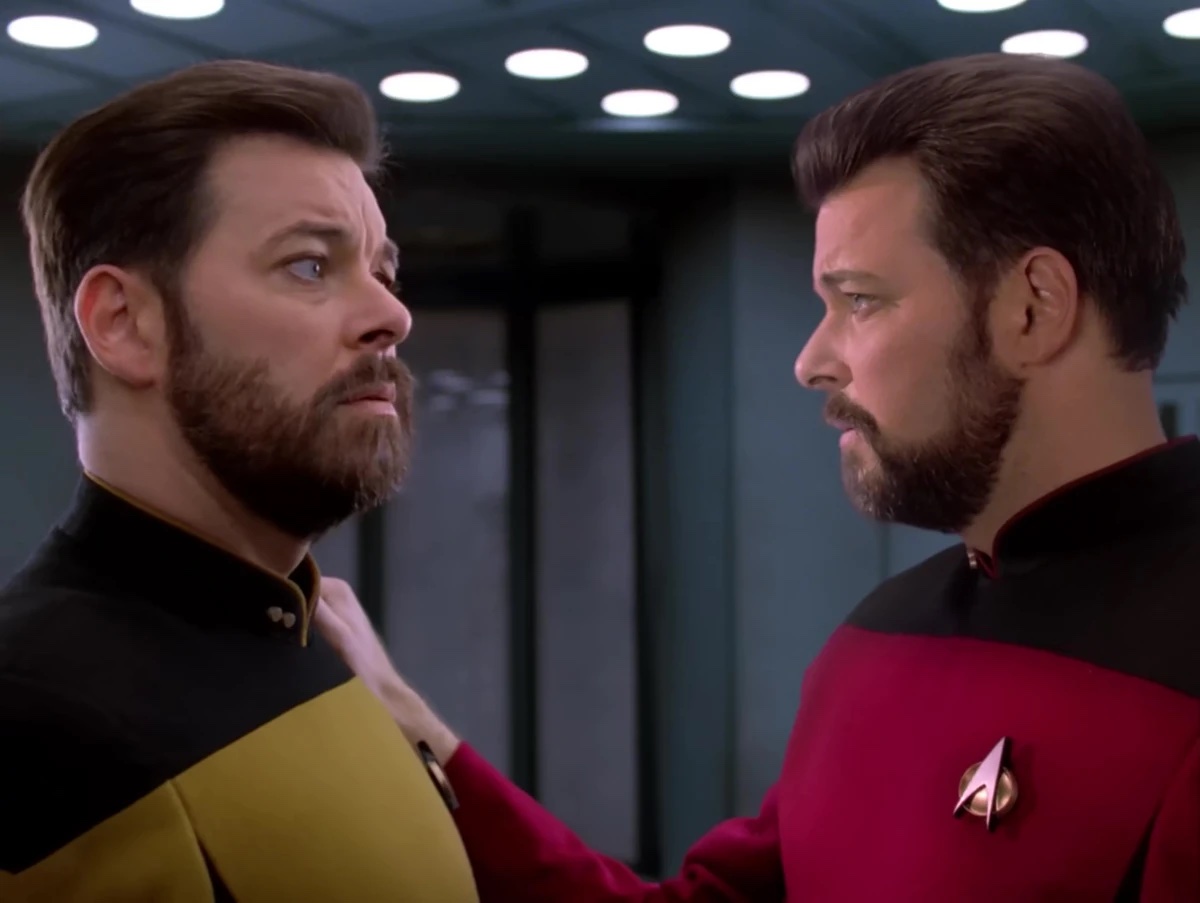
“Second Chances” is, in many ways, my kind of Trek. It starts with an awesomely out-there sci-fi premise (the transporter creates a duplicate of one of the main characters!), and then it uses that sci-fi gimmick as an opportunity to explore character and comment on human nature. That’s pretty much everything that I most want from Trek, wrapped up in one neat little package! I mean…this was not, of course, the first time that Trek had ever used the transporter in this sort of way, but all the previous analogues (“The Enemy Within” and “Mirror, Mirror” from the original series being the closest ones, but even “Rascals” from earlier in this TNG season is somewhat comparable), whatever their charms, are (let’s face it) pretty goofy. Here, though, is a transporter-duplicate type story that can be taken much more seriously, both in terms of plausibility (within the realm of general sci-fi suspension of disbelief, I mean) and in terms of characterization and tone. And then, from another perspective—whereas “Frame of Mind,” three episodes prior to this, was a good episode that happened to feature Riker, “Second Chances” is something even better: a good episode that’s about Riker. In my review of “Frame of Mind,” I talked about how much better it is than the superficially similar “Future Imperfect” from season four, even though the setup of “Future Imperfect” arguably offered greater potential. “Second Chances,” for its part, offers up a kind of inverted “Future Imperfect” scenario, confronting our favorite first officer not with a possible future, but with a blast from his past (or, from the other side, confronting a past version of him with his future-that-might-have-been)—and it delivers an engaging story from this premise. So this is very much an episode that I like, and one that I have been looking forward to as I have proceeded through my current re-watch of the series. My one caveat? Well, let’s just say that I can’t help but to wonder if there isn’t, somewhere out there, an alternate version of “Second Chances” that, rather than being confined by the parameters of 1990s episodic television, managed to beam through them successfully and grow into something even more impressive. 🙂 (More on this later.)
Despite its title, “Second Chances” is largely a reflection on the idea that people tend to be bound by their natures, and are going to make the choices that they’re going to make; regrets, and imagining that we would do things differently if we really did get a second chance, are a bit of a self-deceiving indulgence, it seems to suggest. This is rather interesting, and surprisingly cynical for Trek. It’s an idea that could easily be taken too far, I think, but there is wisdom in it, and I like that it’s present in the episode—and that the episode portrays Commander (but not Lieutenant) Riker as having the self-awareness to recognize it about himself. So, in their rather touching scene together in Ten-Forward, Troi and Lt. Riker try on the roles of star-crossed lovers who have each suffered due the absence (in different ways) of the other but who now, perhaps, have been given a “second chance.” But in the end, Troi ends up realizing that she has moved on and can’t really go back, while Lt. Riker… Well. In another very nice scene in Ten-Forward, featuring Troi and Commander Riker being adults together about the odd interpersonal situation (him assuring her that she doesn’t need his permission to pursue a relationship with his double), his warning to her to “be careful” amounts to both an acknowledgement of the hurt that he caused her in the past, and a reminder that his double is likely to do the same thing in the present/future. The implication is that William Thomas Riker is who he is, and was pretty much always going to be the guy who prioritized his career over his relationship with Deanna Troi. The episode sends Lt. Riker off to his next assignment at its end without definitively confirming this idea, and of course the lieutenant himself doesn’t accept it—but Troi seems inclined to, and it’s certainly easy to read their parting as the first step down the road of history repeating itself.
Somewhat connected to all of this, and definitely at the heart of what I think the episode is trying to convey, is Worf’s wonderful line to Data in which he posits that the true root of the antipathy between the two Rikers has to do with each seeing something in the other that he doesn’t like about himself. This is brilliant, and is true in all kinds of ways: Lt. Riker, paradoxically, seems to judge Commander Riker both for having turned down his own command and thus fallen short of achieving his ambitions, and for having prioritized his career over his relationship with Troi. Basically, he sees in the commander a version of himself who has had all the opportunities that circumstances denied to him, yet has seized none of them. Surely this must give him pause, and make him wonder (notwithstanding his declarations to the contrary) what choices he himself might make when put to the test. Commander Riker, of course, sees the lieutenant as someone who takes excessive risks and doesn’t respect the chain of command—but is he more annoyed with the recklessness of this “past” version of himself who has not learned the life lessons that he has, or insecure about being less of a brash risk-taker in the present than he once was? It seems like it’s probably a little of both. And then, too, there is perhaps an aspect of him seeing his younger self, as represented by Lt. Riker, as someone who wanted to have his cake and eat it too. Commander Riker’s life decisions have all entailed sacrifices, and he has accepted the reality that every choice precludes other paths; Lt. Riker may have endured an 8-year setback due to circumstances beyond his control, but he has yet to really face a situation that would force him to choose between conflicting life goals (like being with Troi vs. rising through the ranks). Also, though, any judgement of Lt. Riker by Commander Riker along these lines sort of overlooks how utterly the whims of fate have shafted the poor lieutenant. It isn’t even “just” that he got marooned alone on some random planet for eight years, whereas “our” Riker escaped and got to go on with his life; it turns out that Commander Riker actually received a promotion for his role in the very mission that left the lieutenant stranded! (Honestly, Lt. Riker probably should be a damn sight more messed up than he seems to be after his eight years of isolation and despair.) Lt. Riker missed out, through no fault of his own, on all the opportunities that have come “our” Riker’s way over the past eight years (opportunities that “our” Riker had the luxury of pursuing or passing up as he saw fit); now, just as much older as “our” Riker but no closer to achieving any of his life goals, he sort of has to double down on the kind of brash go-getterism that our RIker has somewhat grown out of, while the latter is able to rest on his laurels and play the older, wiser Will Riker. (This point is particularly underlined in the poker scene.) So many layers! This is all just rich, meaty, good stuff, and it’s what I love about the episode.
So, okay. Apparently, at some point during the genesis of this episode, the writers actually considered killing “our” Riker off, and letting Lt. Riker take his place as an ongoing main character, and (I think) having him and Troi continue to be romantically involved. This would certainly have been a bold, surprising choice…but personally, I think it would have been a mistake. The show’s audience (or, at any rate, I) was invested in the version of RIker that we already knew, and to end his story prematurely and replace it with that of an alternate version of him would not have been satisfying. Then, after rejecting this idea, the writers almost concluded that Lieutenant Riker would have to be the one to die—which would also have been very disappointing, but in a totally opposite (boringly obvious, inevitable reset button) kind of way. No, ending the episode with both William T. Rikers alive and well was definitely the right choice, as far as it goes. But what if, instead of killing him off, the writers had allowed Commander RIker’s encounter with his duplicate to shake him out of his complacency and push him to pursue a new career opportunity? I can, unfortunately, neither claim credit for this idea myself nor even give credit where it is due, as it’s something that a friend came across online somewhere whose source neither of us remembers (though I’ve since encountered it in multiple other places, too, so I guess it’s not all that unique a thought)—but since this idea was planted in my head (and especially after this last re-watch), I have come to feel that some version of it would have made for a perfect outcome for this episode (even if its impact on the show as a whole is something that I’m still wrestling with a bit).
It was the opinion of whoever I am borrowing this idea from that Riker’s career stalled after “The Best of Both Worlds,” in which he turned down (for the third time!) his own command despite having just proven himself more than capable of the job. Thus, “Second Chances” represented a…belated opportunity 😉? for the show to again kick him in the ass and impel him to move on, thus progressing his character arc. Michael Piller (who wrote BOBW), though, apparently felt differently. He is quoted on Memory Alpha as saying that in BOBW, he established that Riker had “come to a place in his life where he appreciates what he has and is comfortable with his friends and has achieved a great inner peace”; thus, Piller resented the idea of re-interpreting the decisions made by the character at that point as representing stagnation. As for me, I can appreciate both points of view, and I don’t think they need to be seen as necessarily at odds with each other. After all, no career decision that a person makes ever needs to be treated as “final.” For Riker to have preferred, at the start of season four, to remain on the Enterprise a while longer, was perfectly valid—and for him to decide, three years later, that now the time was right for him to move on, would also have been perfectly valid. Growth and change is a lifelong process! Maybe part of the younger RIker’s maturation entailed realizing that it was okay to slow down and learn everything there was to learn in his current position before moving up to something else, and the end-of-season-six Riker’s growth entails realizing that he has now done that, and is ready to resume the pursuit of his younger self’s ambitions. Personally, I would have totally dug this on a thematic level—and it could even have provided something of a counterbalance to this episode’s skepticism about “second chances” that I discussed above. We are who we are, and whatever decisions we have made are the ones we were always going to make…but, they don’t necessarily define us forever, because we’re still free to make different decisions in the future (and if/when we do so, it still doesn’t necessarily mean that the previous decisions were “wrong”).
If the writers had wanted to go this direction with the episode, they could scarcely have set it up any better than they actually did. Even apart from the very obvious ways in which Lt. RIker plays, here, the same role that Shelby did back in BOBW…look at the episode’s teaser. RIker is entertaining a crowd in Ten-Forward on the trombone, and Troi tries to get him to play a piece that he’s “been trying to get . . . right for ten years,” but he’s “never made it through the solo.” In other words, he’s still stuck on an obstacle that was already an issue for him back when his life diverged from that of his duplicate—and we see him here trying to get out of having to confront it. Then he’s called away to the bridge, where his dialog with Data references (in the context of the mission at hand, of course) three “windows of opportunity” that need to be seized, because they won’t recur for another eight years. Is it just a coincidence that three is also the number of times he’s passed up offered promotions to captain? (Probably, I guess, given that the writers actually didn’t decide to use this episode to push RIker toward a big career move…but it would have made for a nice bit of symbolism if they had gone that route!) Giving his (their?) trombone to his other self as a parting gift at the episode’s end, as he does, could serve as another bit of symbolism, representing the idea that he’s moving on, and handing off the challenges that he’s spent the past eight years working through for his other self to tackle.
Where, though, would going this way with the episode have led TNG as a whole? For starters, one imagines Data being promoted and replacing RIker as first officer for the remainder of the series—which would have been really, really cool. Lt. Riker (henceforth “Tom”) could have stayed aboard the Enterprise, and he and Troi could have become/remained a bona fide romantic couple; that might have been interesting, too. Hopefully the writers would, in this scenario, also have kept alive some tension around how long Tom would stick around, or if he really would eventually put his career ahead of their relationship. There was, I think, plenty of story potential here, all of which could have helped to keep the show feeling fresh and relevant through its final season. Still, I do also see down sides, and I can’t honestly say that I find it all that hard to understand why the writers didn’t decide to go this way. As I said earlier, I would still have felt invested in Commander Riker’s story, and it would have been hard for the show to continue to follow him in any real way once he left the Enterprise. Also, without him on the Enterprise, I don’t think “All Good Things…” could have been the episode that it was. This is true in multiple ways, but what’s especially on my mind is how his role as host of the officers’ poker nights kind of cements him as the social linchpin of the group; would the moment when Picard joins the poker game at the end of the finale have felt the same if “our” RIker, who has been hosting these gatherings since season 2, had not been present? (Also, “The Pegasus” with Tom Riker in place of Will just wouldn’t have been the same. There’s just no real substitute for the accumulated wealth of seven years worth of character history and relationships; an alternate version of the character, even if played by the same actor, doesn’t quite cut it.) Are these objections enough to justify not taking this episode in the direction that, the more I think about it, I increasingly feel like it ought to have gone? Or could they have been worked around? (Or would shaking things up by having Will go off to be the captain of another ship, etc., have been so productive of other good stories that it would have made up for whatever stories it forestalled—and if we lived in the alternate reality in which this had happened, would we thus not perceive anything lacking in how the show’s final season played out?) I don’t really have an answer.
In any case, though, even as it stands, “Second Chances” is a damn good episode—one that I cherish, and in which (obviously) I find much food for thought. It also, honestly, represents a second acting tour de force for Jonathan Frakes here in the final stretch of season six—not as overtly flashy as “Frame of Mind,” but full of opportunities to convey subtle differences between two versions of the “same” character through nuanced performances. (One that stands out to me is when an out-of-uniform Riker joins Troi and Crusher in their workout scene, and for a moment it seems like there will be uncertainty over which Riker it is, but you can actually tell before the dialogue gives it away. Also, this scene is notable for representing TNG’s third stab at a “girl talk” scene between the doctor and the counselor, and it actually not being terrible this time.) Finally, as a small aside: in the scene that I’ve already talked about where Worf brilliantly puts his finger on the character dynamic between the two Rikers, I love both his own self-awareness in acknowledging to Data that he is “not easy to get along with,” and also Data being Data by tacitly agreeing, instead of making the sort of tactful “oh, no, you’re not so bad” reply that anyone else might have. 😂 Good stuff.
Initial thoughts about the idea of a Tom Riker under Data—this would *seriously* have shaken things up. It’s pretty hard as a viewer to imagine Riker reporting to Data, isn’t it? It would have been great fun to see the characters in this context. I suppose it wouldn’t have been particularly weird *to* Tom Riker, since he didn’t even know Data from before, and since Data’s an android, he probably wouldn’t have had a hard time adjusting to this new role, either. So seeing the *other* characters cope (and Data not quite getting why it’s so hard for them, maybe, since they really are different people in a very similar way to the way twins are different people?) could have been really interesting! The writers would have had no choice but to write interesting scenes with this. It feels like it would have been unavoidable. And yeah, it’s hard to justify how AGT or other cool shit would have happened later, but there’s a good chance there would have been other stuff that was as worthwhile, as you say. Plus (as Strange New Worlds has been illustrating) you *can* treat non-ongoing-cast members as semi-regulars and bring them in as needed. Obviously Frakes was around to play Tom, and he could have played Will at any time, so there could have been all kinds of reasons to bring him back as the captain of a cooperating vessel. Or… shooting from the hip here… what does the Pegasus look like if both characters are forced to reckon with their past decision? They quite possible would have made different decisions from each other and that could have made for an even better episode, but of course, it’s impossible to say what would’ve happened in this parallel universe.
Frakes really does sell the difference between these two characters. You really believe they’re different people, though as you say, Tom probably should have been even more disregulated.
A story like this also really offers us the chance to confront our fundamental similarity to others and have empathy. Both Rikers have to know that they would be the other had they had the other’s experiences. Tom has to realize that he would have turned down Will’s opportunities in the same way… Will has to know that he would feel just as frustrated from the past looking at how his life turned out… and all that isn’t far from what’s true for all of us whenever we imagine how our lives might if we’d somehow made other choices, or even when we look at others who make choices we wouldn’t make, or that we wish we could make. It’s all very hard to encapsulate and put your finger on, and the very way it defies easy articulation is what makes it such a good subject for art. An episode like this offers the kind of stimulating thought experiment with which sci fi ought to be challenging us, to your point at the beginning of the review. And a TNG that continued to use this plot development clear to the end of its run… I think that could have been a very rich opportunity to continue to explore ideas in ways that might have led it to truly transcend its 90s TV medium more than it ever did.