
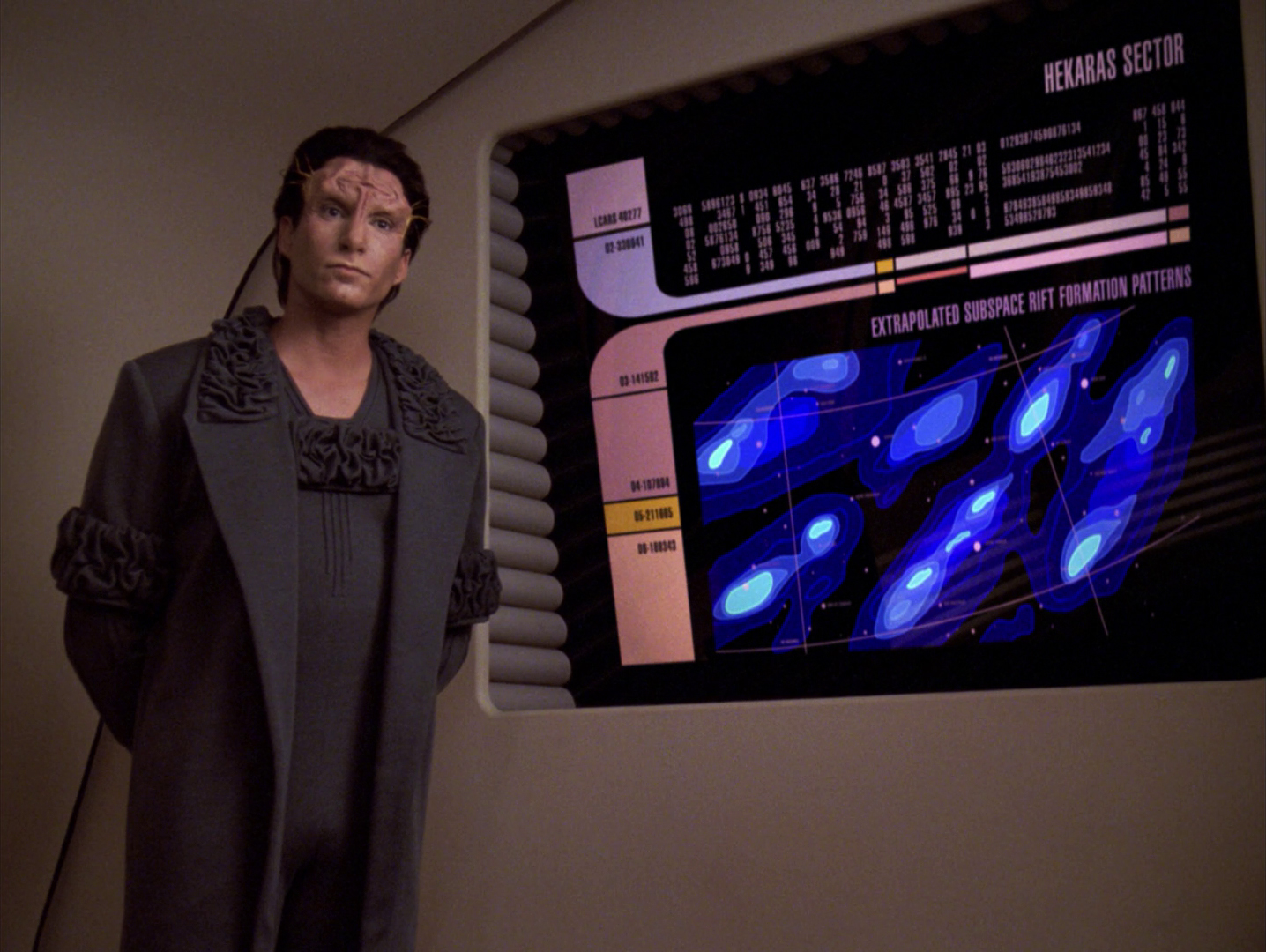
The infamous “speed limit episode” was intended, of course, as Trek’s contribution to the political and cultural conversation on climate change, which is certainly a worthy enough topic. Unfortunately, pretty much nothing about it works. I’m giving it two stars rather than just one because it’s merely ill-conceived and inept, rather than outright terrible—and also because it handles all of the main characters satisfactorily enough, avoiding any character assassinations. But other than that, I don’t have much good to say about “Force of Nature” (and neither, as far as I’m aware, does anyone else, really).
One of the two or three main problems with this episode is that it tries to introduce, out of the blue, a never-before-mentioned fundamental issue with the potential to unravel virtually the entire premise of Trek (and mission of Starfleet)…via two rando scientist-activists from nowhere, and a theory that they are convinced of but that (allegedly) no one else is willing to listen to. This is neither plausible nor narratively satisfying. If warp drive causes damage to the fabric of space, then more people in more places than just these two should be concerned about the issue. Also, in order to make any sense, the episode has to present the Federation either as bureaucratic and unresponsive, or as downright indifferent and mired in denialism. I don’t care for this. In the character of Serova, we have the militant activist who is willing to step outside the lines of proper conduct in order to get people to pay attention to her important cause—tactics that reasonable people disagree over in real life, and that could maybe serve as the basis for some thoughtful drama, if they didn’t come absolutely out of nowhere. But the Federation is not generally an organization that ignores inconvenient science (!), nor has there ever been the slightest intimation before this that anyone thought warp drive was harmful but wasn’t being listened to. (The notion that the Federation has been ignoring the Hekarans’ concerns is especially galling and implausible given that the episode seems to present them as actual members of the Federation.) Hell, when Data reviews Serova’s work and concludes that it does have merit despite there being no solid evidence, the captain’s response is to call for further study by the scientific community! One might think that this would be exactly what Serova hoped for…but instead, she “loses patience” and decides on a dramatic, sacrificial gesture to prove her theory correct. What, exactly, was she hoping for? Did she just want everyone to assume that her unproven theory was correct and immediately agree to give up warp drive? Worth noting, too, is how utterly the attempt at allegory fails (and, indeed, undermines itself), since the real-world problem that it is meant to address (climate change) is not some fringe theory, but a phenomenon about which a broad scientific consensus, supported by overwhelming evidence, exists.
On an even broader level: While I appreciate the idea of the show trying to make a statement about an important issue, the approach taken by this episode seems fundamentally ill-conceived. Star Trek can’t exist without warp drive; therefore, if warp drive is damaging and problematic, then for the show (and its spinoffs) to continue, the problem has to be either conveniently technobabbled away or largely ignored. Either way, the potential impact of the statement that the show is trying to make by introducing the problem can only be severely blunted. And indeed, apart from being referenced in a token sort of way in one or two future episodes, the silly “speed limit” that gets introduced in the final scene of “Force of Nature” ends up having virtually no impact on the Trek universe (nor would I have wanted it to, really). (Also, Worf’s confident declaration that the Klingons will abide by the speed limit seems dubious.)
Finally, this episode is also dreadfully dull, and suffers from both a meandering, padded screenplay and some rather dubious story logic. A huge chunk of the first half of the episode is devoted to Data and Geordi puttering around with sensors and talking about Data’s cat…and then there’s a completely pointless encounter with the Ferengi…and then, at long last, the actual plot (such as it is) kicks in. (I love Data and Geordi, and I also like Spot, but most of the cat-based humor here is tepid and cliched at best.) Serova’s big self-sacrifice, when it comes, not only lacks dramatic impact (we barely knew, and didn’t particularly like, her), but also makes very little sense, as it essentially amounts to proving her theory correct by causing, all at once, the very damage that she’s supposed to be so gung-ho about wanting to prevent. Geordi’s subsequent self-recrimination over not having listened adequately to Serova’s concerns plays into an established character trait about having his identity very much wrapped up in techno-optimism, but it still doesn’t really work for me, because he (and Data and Picard) did listen to her. In short, what little drama there is to be had here is all very forced and artificial. Then the episode segues into a rather boring sequence in which our heroes rescue the personnel from a disabled medical transport, but without the audience getting to even see a single person from the said ship, and with the “action” consisting entirely of technobabble problems and technobabble solutions. (And not to delve too far into the techno-BS, but earlier in the episode, Geordi has whined that it will take a week to “recalibrate” the engines after their disabling by the activists’ probe; then, just hours later, everything seems fine, and the ship is engaging in fancy warp maneuvers and stuff.) Routine and uninspired though this sequence is, however, the episode does kind of need it, because apart from it, there’s scarcely a plot at all, and certainly nothing actually required of any of the regular characters. The activists show up, one of them blows herself up, there’s lots of dithering, and then a directive comes down from the Federation Council instituting a speed limit; that, aside from the evacuation sequence, is pretty much all there is to the story. Not great.
This episode is a statement about taking Trek in a bold new direction that they never had any of taking it in. A strange choice.