
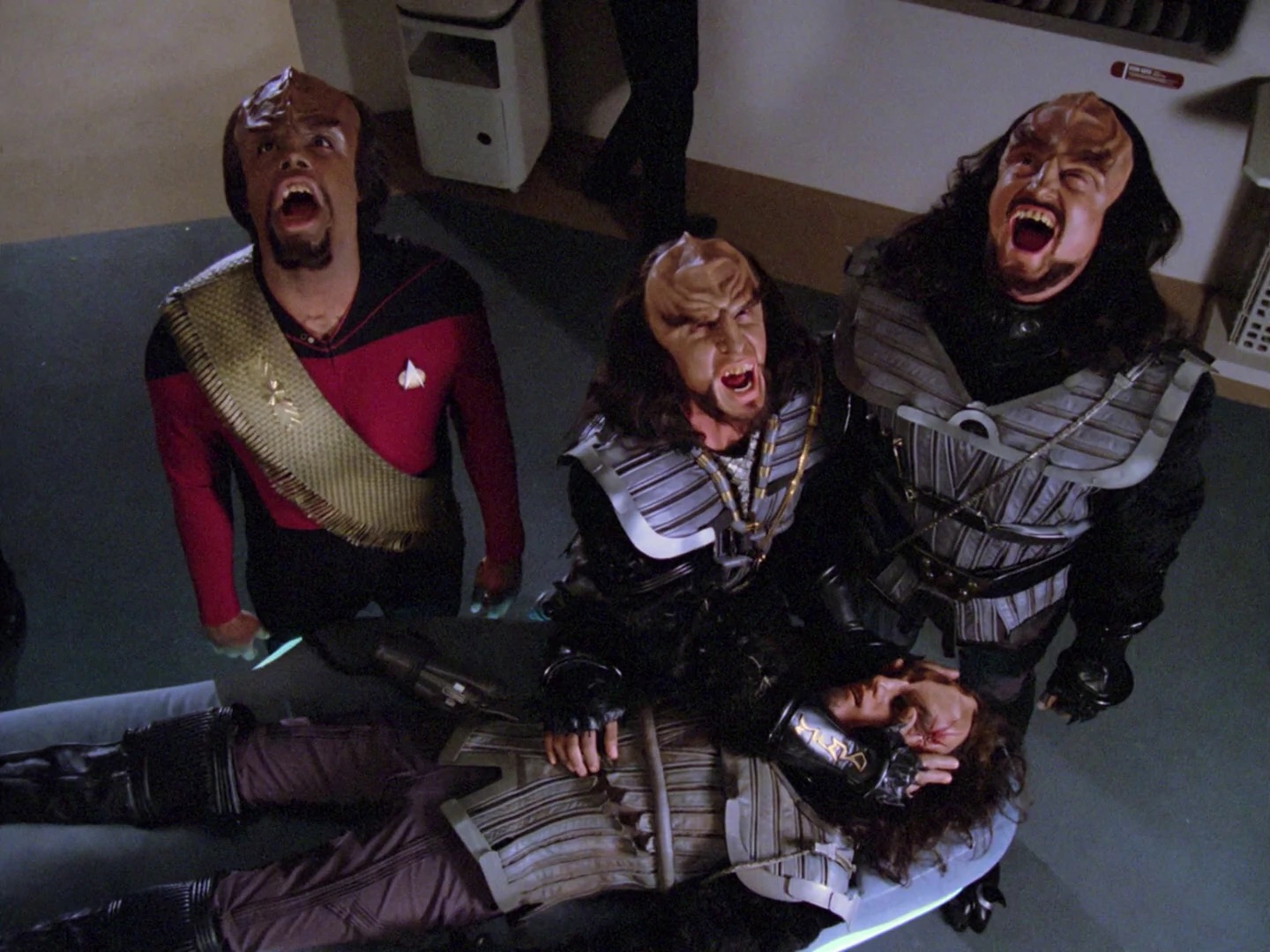
Another difficult-to-rate episode, this one is a clear example of ideas with merit being seriously botched in the execution. Nineteen episodes in, the writers finally decided to explain Worf’s presence in Starfleet and to actually do something with the character; thus, the episode definitely has a bone fide point, distinguishing it sharply from the who-cares drivel of so many previous episodes. Furthermore, the back story presented here for Worf sets up a lot of future good stuff, and his speech to the renegade Klingon in the end about duty and honor being as important as glory and conquest, and overcoming weaknesses within oneself being the true test of a warrior, redeems Klingon values somewhat and establishes the basic blueprint for the character. In terms of my TNG episode/story typology, “Heart of Glory” falls squarely in the “Personal/Cultural Encounter” category. The fact that some actual character development for Worf (and “culture development” for the Klingons in general) not only happens, but is actually the main story focus, of this episode is the reason why I judge it to warrant two stars—though it should be noted that it only just barely warrants that rating.
Before getting to the episode’s major issues, though, I have to dissect its unfathomable joke of a first act at some length. The idea of letting the other characters (and the audience) “see the way Geordi sees” is, in itself, interesting, albeit also rather dubious from a scientific and philosophical standpoint. The idea of futzing around with this in the middle of an operation to rescue survivors from a badly damaged ship, on the other hand, is flat-out silly. This whole sequence is one of my favorite unintentionally hilarious bits of any TNG episode. When Geordi lets his gaze linger on the structural defect in the ship’s hull so that Picard can get a feel for what it’s like to see the way Geordi does and even try his hand at interpreting the visual data (whose significance turns out to be that the ship is probably going to fall apart in about five minutes), it is impossible to fathom what the writers could have been thinking! In fact, this entire sequence has absolutely no sense of urgency about it. Characters—especially Picard, by way of Geordi—futz about endlessly (so much so that Riker actually has to intervene to get the operation back on track), as if they are basically just playing around with being Starfleet officers. Given that the sequence ends with the away team and the survivors being beamed off the damaged ship at the last possible second before it explodes into a billion pieces, Picard should be resigning his fricking command for nearly getting them all killed. What the hell? (In later seasons, something like the see-how-Geordi-sees idea would have been introduced as a side project that some of the characters were working on during down time—but such setups were too sophisticated and low-key for first season.) Then, too, there’s the idiotic exchange where Data tells Riker and Geordi that “all routes are equally dangerous,” to which Geordi responds by asking “Duh, what’s the least dangerous route?” Data then has to reiterate that “there is no significant difference” (you fucking dullard!). Then, when they get to the engineering section, Data suggests that he should proceed alone because he can handle the heat and toxic gases better than the humans. He does so, only to come running back a second later to get the others to come with him because he has encountered (gasp) a closed door. Once all three of them have traversed the dangerous area and are standing outside the stuck door…Data opens said door all by himself, since he is the strongest. What??
A few final criticisms of stuff that happens before the episode’s story really gets going: Why does the teaser end with a tension-building exchange between Picard and Riker about how the situation feels like a trap? It doesn’t—and it isn’t! Also, what exactly is the point of the Tarellian ship being in the neutral zone? And finally, how is Starfleet able to notify the Enterprise of the “disturbance in the neutral zone” at the start of the episode? The Enterprise is apparently in the immediate vicinity of the incident, with no other Starfleet vessels close by—and Riker later comments that communicating with Starfleet command will take days! The episode should have established that the Enterprise picked up a distress signal, or in some other way detected on its own that something was going on.
But anyway…although this episode, as I noted, admirably takes up the task of fleshing out the Worf character, it does so in a terribly clumsy way. From his initial, simplistic, “Ooh—Klingons! I should get personally involved in this!” reaction, to the fact that he has apparently never really checked in with his own kind before this, very little feels real about it all. The Klingons attempt to stir up repressed bitterness over having to live by another culture’s values—but it seems implausible that someone raised by humans from such a very early age would actually feel much of that bitterness (unless his Klingon values are somehow genetically programmed in), and it’s even less plausible that someone in Worf’s position would sympathize much with these renegade Klingons, despite their efforts to manipulate him. I mean, honestly: When the other Klingons show up to collect the renegades, why is Worf the one pleading on their behalf, and the Klingon commander the one who needs to be persuaded? Doesn’t Worf have more of a personal investment in the current status quo between the Klingon Empire and the Federation than just about anyone else? Don’t the renegades represent everything to which Worf presumably stands opposed? In later episodes, while Worf always takes particular interest in affairs involving other Klingons, he also displays a strong sense of self, and cannily evaluates the motives and character of other Klingons according to his own standards. Here, though, he allows himself to be manipulated like a child, and he shows more sympathy for the Klingons whose values least resemble his own than for those with whom he ought to see eye-to-eye. In short, Worf’s “tornness” lacks plausibility. Of course, even aside from the plausibility issue, his behavior is also inexcusable as a Starfleet officer. He finds out that the Klingons are renegades before the other Klingons show up to inform Picard of this—yet rather than immediately reporting this fact to Picard, he proceeds to take them on a tour of the ship! Then, when Yar is sent to take the renegades into custody, he hesitates cheesily between the renegades and the security contingent for several long seconds. A smackdown is in order!
There’s also the glaring issue of the renegades being tossed into the brig without so much as a cursory search of their persons, and their resulting ability to easily escape (though the blazing stupidity of the guard outside their cell helps with that, too) and make the Enterprise crew look like incompetents. And then there’s the episode’s utterly failed attempt to end on a humorous note (again!), with Worf “only being polite” to the Klingon commander who suggests that he leave the Enterprise to serve on a Klingon ship. First of all, nothing about Worf’s reply to the commander suggests to me at all that he is actually considering the idea—so I’m not sure what’s up with the bridge crew’s reactions. Second, Picard’s “the bridge wouldn’t be the same without you” quip falls completely flat, given that the character has been utterly peripheral and pointless prior to this episode!