
The plot of this episode doesn’t stand up to even casual scrutiny, and the backdrop is a typically hokey, first-season premise (a planet of arms dealers who destroyed themselves). But the characters have come into focus just enough by this point to be able to sustain my interest through an episode like this one, and some of the events of this episode do at least have some kind of point. It also shows more signs of structure than many other episodes have thus far, and at no point does it become embarrassing or painful to watch. Thus, despite being nothing terribly special (and having, to be sure, plenty of problems), this one holds together just well enough to be a cut above the season’s one-star norm.
To start by addressing the backdrop/premise: If the “arms dealers who destroyed themselves” concept was meant to have any real impact, the episode would have to have taken said concept much more seriously than it does. I mean, we see no actual signs of the destroyed civilization that supposedly inhabited this planet (no ruins, no devastation, no nothing)! And if we had been shown anything of that sort, there would have been a serious tonal clash between that and the cheesey, quippy holographic weapons salesman with his cracks about the value of “superior firepower.” Imagine, for a moment, something like this holographic sales pitch being viewed in the ruins of a city decimated by a nuclear weapon! Also, Yar’s point about how even in the worst cases of war or natural disaster there are usually at least some survivors is well-taken, but never addressed—and it points squarely at one of the major problems with the plausibility of the premise. The best thing, in fact, that can be said about the planet-of-the-week setting of this episode is that, since the episode doesn’t actually focus on it all that much (there being little to focus on, what with the lack of any living locals to interact with), it doesn’t suffer as much as it might otherwise have from what is really an all-too-typically under-imagined and hokey premise.
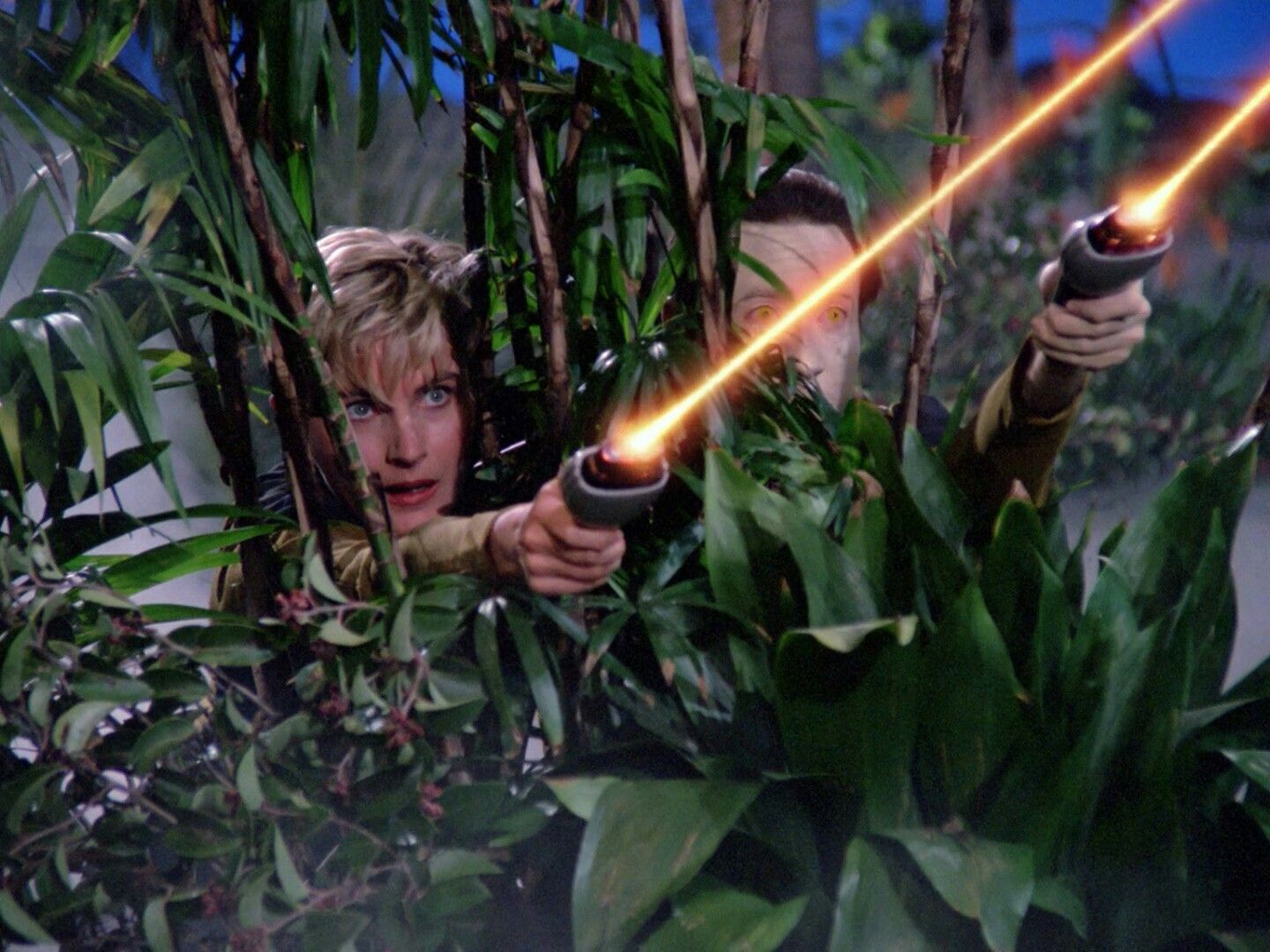
Let us consider, however, the sequence of events in this episode: An away team beams down to check out the planet (and presumably to look for survivors of the Drake), but before long they run into a weapon drone that bizarrely encases Riker in some kind of force field. This event seemingly serves mainly to provide a pretext (albeit a very thin one) for having the captain and Dr. Crusher beam down to the planet: the doctor, I guess, to examine Riker, though in fact Data seems to have gleaned what there is to be gleaned before she even gets there, and she accomplishes nothing at all; and the captain because…uh…well, because he up and decides to, I guess, and after all, Riker is not available to lodge his usual objection. Having these two beam down, though, both sets them up to end up falling into a hole and being stuck together at the bottom with Crusher seriously injured, and also leaves Geordi in command of the Enterprise. Once these plot pieces are in place, there’s no longer a story need for Riker to be in the force field, so Data chooses this moment to figure out how to release him—whereupon he totally fails to react in any way to the events that have transpired while he has been in “stasis,” and just rolls with the fact that the thing to do now is to go see where the captain and the doctor have gotten themselves off to! Meanwhile, the Picard-and-Crusher-stuck-down-in-the-hole story thread seems to be promising to go somewhere interesting, but never quite does. There’s some nice interaction among Yar and the other members of the away team, thinking on their feet as they try to cope with the increasingly sophisticated weapon drones—but most of the rest of the planetside portion of the episode is either disappointing or outright silly. And this definitely includes the typically first season too-easy plot resolution, in which it dawns on Picard to agree to purchase the weapon system that is being demonstrated in order to get the demonstration to cease. Boom! Problem solved.
Onboard the Enterprise, on the other hand, Geordi in command does prove interesting, even if the execution needed work. For starters, the usual first-season mistake is made here in the conflict between Geordi and the chief engineer character (the third such character, incidentally, to be introduced up to this point; just put Geordi in the role already!): artificially generating tension and conflict by making the non-regular-character a complete jerk from the outset. For chrissake—the character starts by berating Geordi for not breaking orbit immediately, but then when Geordi does decide to break orbit, he criticizes that decision, too! It’s odd; many of TNG’s writers have famously complained about how hard it was to generate drama on a show where conflict between humans (or at any rate, Starfleet officers) was supposedly banned by Gene Roddenberry, even though this complaint is belied by the fact that there are plenty of examples of such conflicts during the show’s run. But what’s more, in the first season—when Gene Roddenberry’s influence and control were the strongest—such conflicts seem both more common and much more blatant and hostile than later on! I’ve never understood this enigma. Anyway, also unsuccessful is Troi’s intervention in which she explains to Geordi how to work with the junior officers who are staffing the bridge stations. Nice try—but since Geordi is shown, in scenes prior to this one, already doing exactly what Troi gets him to “realize” that he needs to do, one is kind of left scratching one’s head! Still, watching Geordi handle the command role does prove interesting, and even though the use of saucer separation in this episode, when it’s virtually never used otherwise, makes it seem odd and overreactiony, this was a situation where it did make some sense, since it nicely resolved Geordi’s dilemma between safeguarding the ship and retrieving the away team. What’s more, the shipboard plot—in contrast to the planetside one—gets an actually satisfying resolution, with Geordi and the other officers coming up with a way to beat the mysterious attacker that has been making life difficult for them. Of course, this plus is rather seriously undercut by the fact that it makes no sense, since it occurs after Picard has gotten the “demonstration” to end (which one would think would include the drone attacking the ship!?).
All in all, then, this episode showcases main characters who are finally becoming less painful to watch and plotting that (albeit contrived in some places and nonsensical in others) is at least starting to have some structure to it—and some of the character interaction, while not dazzling, at least has a discernible purpose. This is not a great episode by any stretch of the imagination, but most episodes thus far have been much worse.