
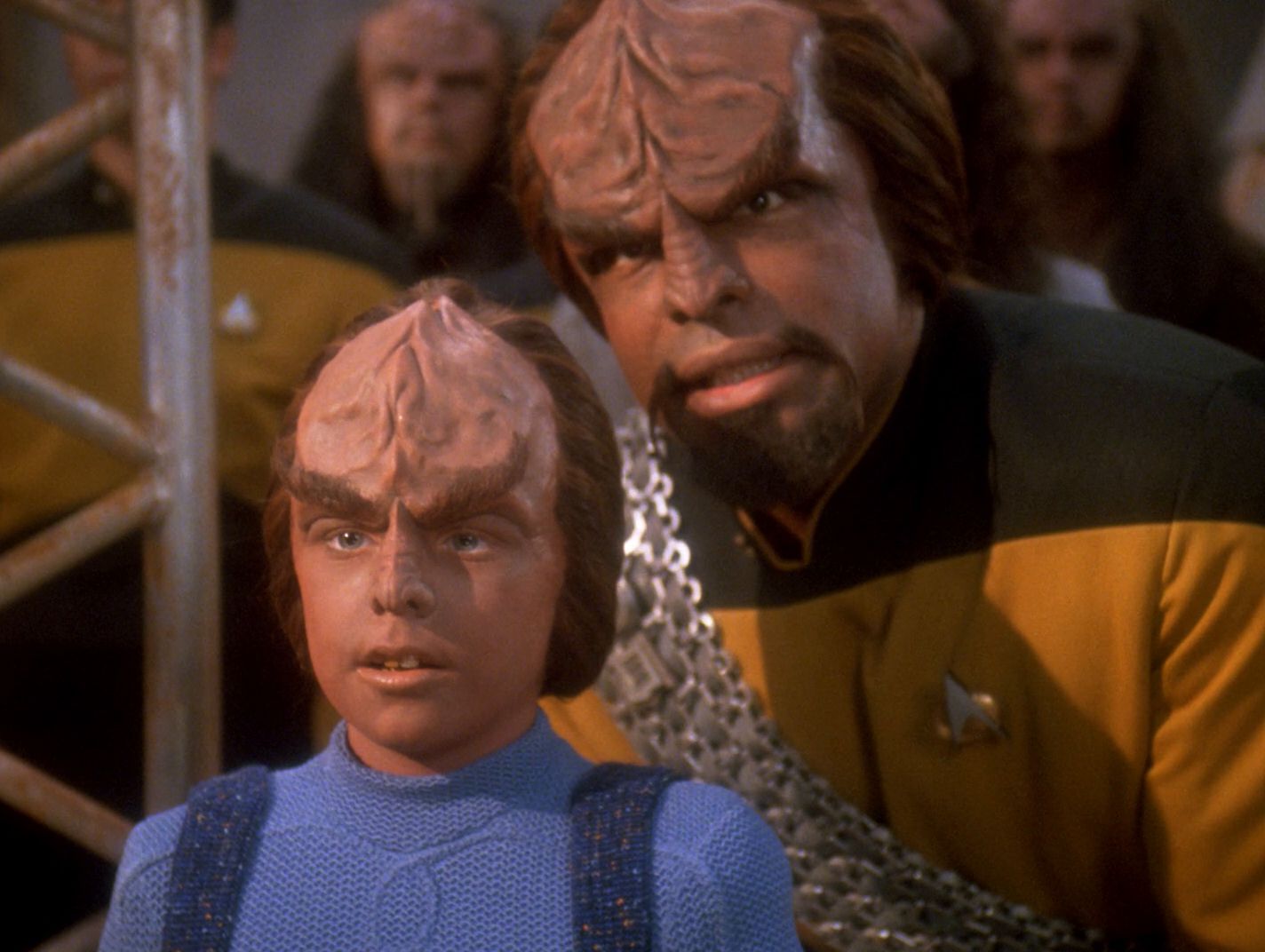
“Firstborn” is not a standout episode by any stretch, but it’s a reasonably enjoyable one. On one hand, it suffers from a lack of character depth and arrives at its resolution via too-easy writing shortcuts; but on the other hand, I nevertheless feel like it ends up elevating the whole idea of Alexander as a character to a degree, and even offers a more successful (albeit still not entirely successful) take than the previous week’s episode on some similar thematic material. It takes a clever premise and fails to entirely do it justice, but its heart is in the right place.
Unfortunately, TNG never managed to make Alexander a compelling character. Still, he was a part of the show, and of Worf’s story, so I think that taking a final crack at him, and attempting to bring some kind of resolution or closure to the story of Worf trying to raise him aboard the Enterprise, was called for and made good sense. So, for the second week in a row, we got an episode about a young person not wanting to follow the path laid out for him by parental (and/or surrogate parental) expectations. This time, I’m 100% on board with the idea at premise-level; I absolutely believe that Alexander would have no interest in becoming a “warrior.” He has never seemed remotely temperamentally suited to it, for starters, nor has living up to Worf’s expectations ever seemed to be a big motivator for him. I also like (despite questioning its plausibility) how the episode ties his desire to pursue a different course back to what he remembers of K’Ehleyr. It’s just too bad that, consistently with all of Alexander’s previous appearances on the show, neither the writing nor the acting succeeds in bringing him to life as a coherent character. In some scenes, we get the impression that Alexander couldn’t care less about “that Klingon stuff”; in others, it turns out that he actually does dig bat’leth sparring, and maybe could be persuaded to (or manipulated into) “following the path of the warrior.” But it’s not just that he’s conflicted, or that he’s a young child who doesn’t entirely know himself; these things would be fine. It’s more that he never quite comes across as psychologically real enough for any turn of motivation to feel specifically either plausible or implausible. Similarly, the relationship between him and Worf (both in this episode and in all previous ones) has never really felt like an actual relationship; it’s only ever been a sort of sketched-in idea that has felt like it could be made to serve whatever (usually very simplistic) story the writers have decided to impose on it. It’s frustrating, because like I said, I do think the idea of him rebelling against Klingon ways and refusing to “become a warrior” makes perfect sense for him and was the right way for the show to take him, and yet, it still doesn’t ever quite feel “real.”
The idea of an adult Alexander traveling back in time to try to change his past/our present, as a way for the show to be able to say something about the child Alexander’s future life path, is clever, though, and “K’mtar,” the (secret) adult version of him, does work pretty well for me as a character. At first, he just seems like a friendly Klingon who has Worf’s back (and is a bit weirdly interested in Alexander’s future); then, for a while, it seems like he’s turning out to be just another in a long line of Klingons who think Worf is too soft and human or whatever. If this had been all there was to him, it would have felt tired, even though it does give us a scene or two that I like in which Worf stands his ground and tells K’mtar to back down, or otherwise tries to shield child-Alexander from the pressure that K’mtar is applying. But anyway, the twist in which we learn that K’mtar is not just another “real” Klingon questioning Worf’s Klingon-ness, but rather a disillusioned and broken man who himself long ago embraced a non-traditional version of “being Klingon” but is now convinced that he was wrong to do so, and is trying to get his younger self to follow a different path…this made him genuinely interesting. On the other hand, his decision to murder his own past self is nothing short of batshit crazy, and the episode doesn’t manage to pull it off or make it feel believable at all. This should have represented a big emotional climax for the story, but instead merely feels like a plot device used to force the eventual confrontation between him and Worf that leads to the truth about who is is coming out. More generally, this relates to the episode’s number one problem, which is that it doesn’t really feel like it has a plot that leads, in a narratively satisfying fashion, to a conclusion; it just has a bunch of stuff that happens, and then in the end future-Alexander finally tells Worf the truth about what’s up and Worf talks some sense into him. It’s a too-easy resolution that doesn’t follow in any clear way from events in the episode; future-Alexander went to all the trouble to travel back in time to try to change his whole life path in the hope of preventing his father’s eventual untimely death, and was on the point of murdering his own child self in the service of the same goal, and then Worf manages to turn him around and set him straight with a brief talking-to. It just isn’t satisfying.
That said, I do like what Worf has to say to future-Alexander at the end of the episode After all, Worf is the one who is one of our show’s main characters, not Alexander—and what the episode is “about” is not really Alexander’s fate so much as Worf coming to an acceptance that his son might choose a different kind of life than he did. He says the words in the episode’s entertaining opening scene, when he’s rehearsing the talk that he means to have with Alexander: the boy will become a man, but the man will not necessarily become a warrior. But he doesn’t embrace that truth until the end of the episode. And in contrast to what I said about K’mtar’s lack of a plausible narrative arc through the episode, there is a pretty decent thru-line for Worf, with events leading him to curb his own initial instinct to push Alexander into the warrior’s path. So, when he tells K’mtar that even though the latter has failed to change his younger self via his time-travel, this may not matter, because he has succeeded in changing Worf—that resonates. So, on that level, the episode does “work” for me narratively, even if in other ways it kind of doesn’t (as I discussed earlier).
Also, I really enjoy the scene in which young Alexander deconstructs the story about Kahless and his brother Morath, to the consternation of his older self. Besides being a fun way to illustrate Alexander’s ambivalence toward traditional Klingon values, it’s delightful to finally hear someone question the accepted “meaning” of standard-issue, self-important Klingon mythological bullshit. Honestly, this scene might be my favorite thing about the entire episode!