
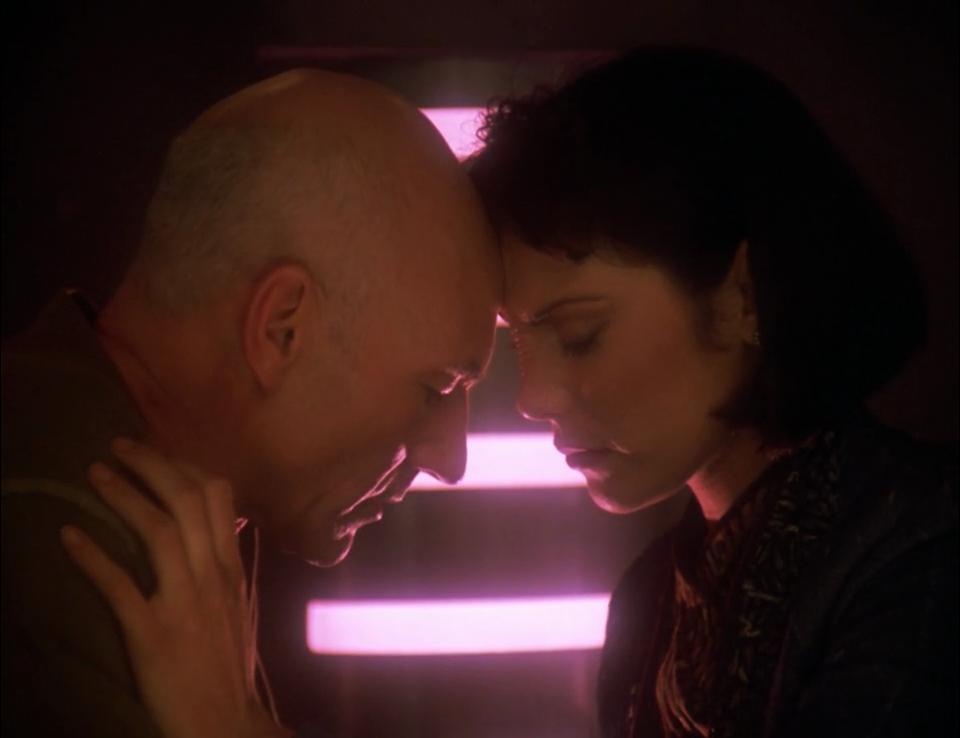
“Preemptive Strike” is a good episode, albeit one that has always struck me as a bit of an odd choice for the penultimate installment of TNG. I said in my review of “Emergence” that it really ought to have been the last episode before the finale, and that’s one part of what I mean; the writers came up with that slightly fourth-wall-breaking rumination on setting down the pen and stepping away from a completed act of creation, and placed it…third to last? So that in watching the show, we go from that, to what feels in many respects like one more “regular episode,” and then to the finale? It’s weird (and I’ll presently mention some other reasons that further contribute to my sense of this being an odd penultimate episode). Taken for what it is, however, what we have here is a solid little story that makes good sense for Ro as a character and serves as an interesting continuation of the developing Maquis arc (which began via the eponymous DS9 two-parter that aired a few weeks earlier, but also had conceptual roots in TNG’s own “Journey’s End”).
Of course, in a general way, this episode does fit into the series wrap-up run of episodes that started with “Journey’s End,” in that, like both it and “Firstborn,” it provides resolution for the character arc of one of the show’s recurring secondary characters. Ro Laren isn’t a young person needing to come of age and choose a life path in the way that both Wesley and Alexander are, but she is a character who has kind been adrift all her life, never really finding a place where she entirely “fit.” (She also, like both Wesley and Alexander, is someone who lost a parent at a young age; actually, in her case, both parents.) It would have been somewhat in character for TNG to try to sell the notion that her time on the Enterprise changed that for her (and to be sure, she did make meaningful connections there), but to their credit, the writers didn’t go that route. I do sort of wish that the show would have bothered to establish that she had left the Enterprise prior to this episode, rather than belatedly introducing the idea of her going to “advanced tactical training” here in order to explain why we hadn’t seen her for a season and a half—and it also comes off as a little “convenient” that an undercover mission for which she is (at least on paper) the perfect candidate (but that will end up leading her onto a radically new path) happens to land in the Enterprise‘s lap literally within hours of her return to the ship. But if we can overlook these incidental (and somewhat beyond-this-scope-of-this-episode) contrivances, the Ro character story in this episode is very well done. Right out of the gate, the episode reinforces the mentor/protégé relationship between Picard and Ro, underlining the extent to which his guidance and sponsorship have shaped the recent course of her life (and how grateful she is for that); then, of course, throughout the remainder of the episode, that relationship, and the identity that Ro was building as a result of it, unravels. It does so for reasons that relate to lifelong character traits of Ro’s (her childhood trauma, including the brutal murder of her father by the Cardassians; her rebellious streak and history of troubled relationships with authority figures; etc.), and these things are why deciding to abandon her Starfleet career and join up with the Maquis makes sense as the end of her overall character arc on the show. But within the scope of this episodes, her arc is about discovering that basing your entire identity and life path on validating one man’s faith in you (as she puts it when accepting the mission) is not tenable. Ro’s decision, at the end of this episode, to betray Starfleet and (in particular) Picard is, if we’re being honest, pretty predictable (it’s hard to see how else the episode could really have ended, for one thing), but it’s predictable in the best possible way. It’s so obviously consistent with who she is, and yet, because her connection to the captain has been established so well, it’s also heartbreaking. Watching her wrestle with herself over what to do is really compelling, and her final exchange with Riker in the shuttlecraft is wrenching (and beautifully acted). (Her asking him to tell the captain that she’s sorry, and coming to grips with letting him down, is the main thrust of the scene, but it’s also obviously deliberate on the part of the writers that it’s Riker who’s there with her, and the understated farewell between these two characters, with all of their history, is moving as well.) And then, of course, the episode’s closing image—that of Picard sitting in his ready room in grim silence, as he digests Ro’s betrayal and (presumably) chews on his own role in the events that have gone down—is a powerful, and surprisingly negative, final pre-finale moment for TNG.
There is some debate in the comments on Jammer’s review site, and by extension, presumably among fans in general, as to whether Ro will find, in the long run, that she “belongs” with the Maquis any more than she has elsewhere, or if her stint with them will prove to be temporary and she will eventually abandon it as well. I think this is an extremely good question, and one with no clear answer. As a Bajoran who grew up in refugee camps under brutal Cardassian oppression, internalized a sense of shame about being Bajoran, and eventually ran away from that whole life, a “fate” that involves making common cause with others who are suffering under Cardassian oppression does make a certain amount of sense for her. At the same time, however, ending up there is not the same as actually returning to Bajor, and making peace with her heritage and identity as a Bajoran. Also, her experiences in this episode involve adopting another mentor/father figure in place of Picard, which leaves room for the possibility that she is still, on some level, following a path laid out for her by someone else in lieu of looking inward and figuring out what path is right for her. However, in contrast to how I felt about Wesley doing something similar four episodes ago, the idea that where Ro lands in this episode may still not be her final “home” works for me. In part, this is because her decision is just handled much better than Wesley’s was; whereas Wes decided to quit Starfleet with no clue what to do instead of it, then glommed onto the next thing that came along, Ro made the agonizing choice to betray her mentor and abandon her career under the duress of an immediate moral crisis, and only after forging a connection with a new mentor and community. But also, Ro is a person who experienced profound trauma at a young age (much more so than Wesley), and who has spent her whole life either searching for or running away from various iterations of her identity. Not least because of the title of the episode, “Journey’s End” felt like the show presenting “goes off with the Traveler” as the definitive resolution to Wesley’s coming of age arc, even though it was a resolution in which I couldn’t fully believe. In “Preemptive Strike,” though, Ro leaving Starfleet for the Maquis makes enough sense that I totally buy it, even though I also remain uncertain as to whether or not it’s where she “truly belongs” or represents the “end of her journey”—and that ambiguity comes across as intentional, and as appropriate for the character.
I really like the Maquis as a concept/story element. Yes, I have reservations about the never-clearly-defined Federation/Cardassian war that led to the treaty that gave rise to the situation that birthed them; I wish the said war didn’t feel so implausibly retconned into the show, for one, and I also wish we knew more about what it was actually about…and why the treaty that ended it had to be so messy. Still, as a mechanism that allows for Trek to grapple with thorny political and moral complexities, without simply abandoning the premise of the Federation as a basically “benevolent” institution that pretty well has its shit together, the Cardassian treaty is brilliant: a deeply flawed agreement that the Federation has entered into not because anyone much likes it, but because it seems better than the alternative of protracted warfare, even though it kind of shafts the colonists living in the DMZ. The situation with the Maquis is a conflict between idealism and realpolitik in a context where no one is clearly right or wrong, and that makes it really engaging. It also makes “Preemptive Strke” a bit of an outlier as a TNG episode, which is by no means a bad thing…but it does contribute to my sense of it as an odd choice for the show’s penultimate episode. This is, after all, a story that puts Captain Picard in a position that isn’t entirely comfortable, morally speaking, and that features a known, sympathetic character betraying him (and Starfleet in general), and that is, arguably, a bit of a downer. Again, I like these things about it! But I’m just saying…tonally, “Emergence” is much more typical of TNG than this episode is, you know? I suppose, though, one might argue that “Preemptive Strike” makes perfect sense as the show’s penultimate episode if you think of it as TNG kind of passing the torch to DS9. (The Maquis, apparently, were originally invented by the writers as setup for the next Trek spinoff (Voyager), but to me, the whole concept of them always seemed much more at home, thematically, on DS9—and all the more so, of course, once Voyager opted to ignore them as an issue beyond its pilot episode). And after all, even if “Preemptive Strike” does take the show into somewhat darker territory than has been the norm for TNG, all the story elements upon which both it, and DS9 as a series, are built, were introduced into the Trek universe by previous TNG episodes. Thus, it made perfect sense for TNG to devote an episode to more fully exploring this territory before its end, and even more sense for Ro Laren to be the focal point of that episode. I still would have done it as the third-from-last installment of the show rather than the second-from last…but in the scheme of things, this is a pretty minor quibble about a really good episode.
The season seven slack aside, the Maqui (and other things about this episode that DS9 would follow up on) was the franchise struggling to grow up as it added more complexity to its premise and started to actually ask some questions about how a more ideal culture would in practice operate, daring to try to show and not just tell something about how a culture that has overcome prejudice and poverty might behave. I remember hearing before either show aired that Voyager was supposed to emphasize the more “fun” side of Trek and DS9 the more cerebral, but it might have better been summed up as Voyager trying to repeat elements of TNG (ignoring its premise to do so) and DS9 going forward to be what TNG might have become if it had more time to develop (not to say that the premise of DS9 didn’t provide opportunites that TNG never would have had). It’s like the evolutionary process. The organism that thrives in one period in history, if dropped into another, would die quickly, because the environment has changed, and other organisms now exist to fill those niches. In that sense, as you say, the episode fits well as the final episode of TNG.