
One of the biggest paradoxes of TNG is that it was a show that, at face value, no one would have expected to come up with a really satisfying, pull-the-whole-show-together finale…and yet, among shows that I have loved, it has a much better finale than most. “All Good Things…” is not flawless, but it’s a phenomenal piece of work that absolutely knocks it out of the park in terms of bringing the series to a narratively, thematically, and emotionally satisfying conclusion. This was a pretty amazing achievement for a show that, for all that I love it, was always fundamentally (and often frustratingly) episodic, lacking any kind of overarching storyline and exhibiting a dismaying tendency to “reset” at the end of each episode. (Of course, it may actually be that “All Good Things…” succeeds so well as a finale partly because the show had no overarching narrative to contend with: no ambiguous mythology to resolve, no puzzle-box mytsteries to provide satisfying answers for, no loose narrative threads to wrap up in ways that ring true, etc. Still, how do you write something that meaningfully feels like an ending for a show that lacks a narrative through line?) I’ve always said, and I will continue to say, that writers Moore and Braga pulled off a virtual miracle in coming up with a brilliant way to manufacture a retrospective unity for TNG as a whole with this inventive and heartfelt finale. Major kudos to the both of them!
Actually, in most other contexts, I might have said that the basic strategy with which they approached this task (go back to the very beginning, and write a story that, on multiple levels, “mirrors” the pilot episode—revisiting its themes, to be sure, but also juxtaposing what the show was at its outset with what it became over the seven years of its run) was a bit of a no-brainer. If it has struck me as rather less obvious in the case of TNG, I suppose there are two basic reasons for this: First, of course, there’s the fact that the show’s initial season was just so very, very bad, and that its writers seemed to have so very little clue what the hell they were doing. The show had grown so far beyond what it was in that first season that, at first glance, I might not have imagined that its pilot episode (itself of deeply iffy quality) would offer much to a writer seeking to tie the show together seven years later. And second, of course, there’s the fact that those first-season writers were long gone by the time the show was ending. Neither Moore, nor Braga, nor anyone else on the seventh-season writing staff, had been with the show since its inception. In a way, it felt (to me, and one imagines probably also to them) like “Encounter at Farpoint” wasn’t even really part of “their” version of what TNG was. Thus, it’s all the more to their credit that they thought to revisit it when it came time to write the finale. That they clearly have both an indulgent fondness for aspects of what the show was at it outset and an awareness of how cheesy it tended to be, and accordingly treat the Farpoint-era material with the perfect mixture of reverent homage and gentle self-mockery, also matters a lot. When Q says to Picard “What you were, and what you are to become, will always be with you”…well, the writers applied this idea to the show itself, and I profoundly appreciate that. (It calls to mind the themes that Moore explored back in “Tapestry,” as well as resonating with the whole notion of how Q put humanity on trial in the pilot.)
But with all of that said, I also have to give credit where due to D.C. Fontana and Gene Roddenberry’s work on “Encounter at Farpoint” itself, because, for all its flaws, there actually was a degree of brilliance baked into the Q portions of the pilot episode that made it ripe for revisiting here in the finale. Back then, Q putting humanity on trial (with the Enterprise officers serving as humanity’s representatives) stood in (as I noted in my Farpoint review) for the new show “putting itself and its characters on trial for the audience, as successors to past incarnations of Star Trek.” Now, in “All Good Things…,” we revisit that idea of evaluating humanity’s growth and maturation—but this time, the seven seasons of the show itself constitute the “evidence” (have our heroes, again as stand-ins for humanity, meaningfully grown since being provisionally acquitted in the Farpoint trial?)…and the metatextual aspect of the question now concerns the audience’s final judgement upon the show. Thus, we have Q disdainfully referencing Troi’s “pedantic psychobabble” and Data’s “witless exploration of humanity,” almost as though speaking directly to the segment of Trek’s audience that tended toward impatience with character drama and would have preferred more action and adventure and hard-core sci-fi. But of course, Q kind of means the opposite of what he says, since his point ultimately is about internal and conceptual kinds of “exploration” being more important than merely charting star systems (and Picard is defending the writers as much as himself when he declares, with no shame or hesitation, that “we are what we are, and we’re doing the best that we can”). On one level, then, this is the writers’ implicit defense of their own body of work. But even more significant is the statement (which Q makes twice) that “the trial never ends.” Q is saying that growth and self-improvement are not things that we are ever “done” with, either as writers, as individual humans, or as a species/civilization. (There is a connection to be made here between this idea and the episode’s three-time-period structure; it’s not just about looking backward and evaluating our progress to date, but also about looking forward, and continuing to change and grow into the future.) So, TNG as a show may be coming to an end, but its writers shouldn’t rest on their laurels, nor should its audience lose sight of the ideals that the show has, hopefully, represented for them over the course of its seven-year run. In case it isn’t painfully obvious, I hugely dig how the writers manage to work in all of these simultaneously self-reflective and universally applicable layers of meaning, leaving us with profound thoughts about the show, about ourselves, and about life in general. It’s fantastic!
(The whole of the scene in which Q finally shows himself, and Picard finds himself once again in the courtroom from “Encounter at Farpoint,” is just awesome, and most of its dialog is indelibly imprinted in my brain. I’ve already quoted several of the most significant lines, but it’s packed with great ones. When written well, almost everything that Q says has multiple meanings and should rarely be simply taken at face value. He may seem to be pointlessly lording his higher-being superiority over Picard as a mere mortal with a jab like “Seven years ago? How little you mortals understand time. Must you be so linear, Jean-Luc?”—but of course, this is actually a clue that he’s tossing the captain’s way. Also, despite his characteristic sarcasm and disdain, Q shows a confidence in Picard in this episode that is new for him, and that’s kind of fun. And then, of course, the writers have their fun with allowing Q to break the fourth wall just a bit here and there. I know that for some, his line about putting an end to “your trek through the stars” comes off as too on the nose, but for myself, I enjoy it. And then, in a later scene, Q even has the audacity to speak the episode’s title aloud…!)
There’s so much more to say about “All Good Things…,” and I scarcely know where to begin, or how to structure my thoughts…but maybe now is the right time to delve into “plot” considerations. There are, I think, basically three topics that I want to discuss that fall, generally, under this umbrella. The first concerns the central idea of the time anomaly, its creation via the tachyon beams in the three different time periods, and Picard’s momentary mind-expanding epiphany of realization about it. Part of me has always wanted to question whether or not this really “makes sense”—but the thing is, this is kind of an un-answerable question. I mean, for one thing, anti-time and inverse tachyon beams and such are all made-up sci-fi conceits, so wanting it to “make sense” is asking a bit much. But also, the whole premise here is that something is going on that’s a bit beyond ordinary human understanding, so that Picard has to have a mind-expanding moment to grasp it. As such, it feels like critiquing what we’re presented with, on a premise level, is almost out-of-bounds. But if I were to cut through all of that and just convey how I feel about the show giving us what it gives us…the answer is that I’m basically okay with it. Sure, I’ll buy that there is some kind of sci-fi beam thingy that the Enterprise can emit that both scans for, and can also end up triggering, anomalies in the space-time continuum, at least under certain flukish conditions (like three different versions of the same ship sending the same beam into the same spot at three different times). Honestly, though, once you accept that, the impressiveness of Picard’s mind-expanding epiphany is actually diminished a little. I don’t really care, though; the show gave itself a pretty tricky task in needing to present us with something that doesn’t just seem totally bogus, but that also is “paradoxical” enough to (supposedly) require a level of next-level thinking from Picard that would impress the Q. What we get is close enough to that, and Picard’s realizaiton presented effectively enough (especially with it being the older and slightly less coherent version of him who has to try to explain the concept to others), that I’m happy with it. Okay, but then the second topic up for discussion in this paragraph is that of the somewhat botched execution details concerning the temporal anomaly. For one thing, it’s explicitly stated when the convergence of three tachyon pulses is first noted that they all have some kind of identical signature, meaning that they all are coming from the “same” ship (i.e. the Enterprise, in three different time periods). However, in actuality, the future-time-period beam was emitted by the Pasteur, not the Enterprise. Oops. Also, there’s a fundamental error concerning the whole matter of when the anomaly initially forms. If it was triggered by the convergence of the three beams, and traveled backward through time from that point, then when the Pasteur first arrives in the Devron system, the anomaly should already be present—and it should vanish as soon as they start trying to scan it with their tachyon beam. But the episode gets this all wrong; it’s missing when they get there, and then later, after Picard figures it all out, they think that if they go back, they should be able to see its initial formation (which is what then happens). I’ll certainly grant that from a story perspective, it works for the anomaly to not be there at first in the future, so that the older Picard loses some credibility, which becomes an obstacle that he then has to overcome. But it makes no sense based on the sci-fi logic that the episode presents. So, some definite plot flaws there. For sure, it would be a better episode without these flaws, but in all honestly, this is a fairly minor issue for me. Finally, topic number three for this paragraph is the question of what “actually happens” in the episode, considering the involvement of the Q and the erasure, at the end, of the timelines as Picard has experienced them (except in Picard’s own memory). How “real” were the events that Picard experienced, and what actually caused all of this to happen (if, indeed, it did actually happen in some sense)? Q says at the end that he, under orders from the continuum, “got Picard into” the whole affair, but that giving him a “helping hand” by causing him to shift among the three timelines was his own personal contribution, over and above what the continuum required of him. But how should we understand this, since without Picard’s time-shifting, there never would have been an anomaly? I suppose we could infer that the continuum merely said “devise a scenario to test whether a human can expand his mind” (or whatever), and Q came up with all of the actual details, making sure that they would include providing the captain with multiple perspectives to give him a fighting chance…but that feels a little unsatisfying. Otherwise, though, I’m not sure how to make sense of things. Also, it seems that we have to understand the episode’s “future” timeline as, at most, merely one possible (but now foreclosed) future—and it may even be that we should just see everything that happened as “unreal” and in-Picard’s-mind-only (some kind of elaborate Q illusion). It’s all pretty unclear, and I have to say that I would find the episode more satisfying if these things were a bit clearer and made a bit more sense. So, as I said at the outset, the finale is certainly not without flaws (even though I still, overall, love it to death).
On a character level, the episode leans hard on the developing Worf/Troi romance, using it as the primary basis for the gathering undercurrent of interpersonal tensions among some of the regulars in the present whose ultimate consequences the captain gets to see in the future timeline. Obviously, I still don’t buy these two as a couple. However, it’s used to really, really good effect here, and the fact that it was actually set up in previous episodes, rather than just appearing out of the blue in the finale, definitely works in the episode’s favor. We don’t know exactly what is supposed to have happened between Worf and Riker (and Troi) in the future timeline, but one gets the impression that it wasn’t really about some big conflict, or anyone behaving like an idiot/ass, and more about resentments that built up due to poor communication, and I appreciate that. (There’s even an implication that Troi herself was partly at fault; at the beginning of the episode, Worf wants to address the potential for hurt feelings forthrightly, but the counselor (!) dismisses his concerns!) Paralleling all of this, I’ve never entirely been sure how I feel about the idea that Picard and Crusher eventually get married…then later divorced. It works as an element of the character dynamics in this episode, and the suggestion that finding out about the captain’s future Irumodic Syndrome is what impels the doctor to reconsider a closer relationship while there’s still time helps me to buy into it. But I have the same reservations about the idea of the two of them that I discussed in my “Attached” review—and as to the divorce, the episode gives us nothing about what that might have been all about. Of course, we needn’t assume that any of this will necessarily “really” happen in these characters’ “actual” future, so the episode can get away with doing stuff like this without having to commit to the canonicity of any of it, which is nice. (Similarly, I have qualms about the idea that Worf ends up as the governor of some Klingon colony…but maybe, if not for whatever went down between him and RIker, his career would have followed a different path? And then, the whole “getting the gang back together” thing in the future timeline is arguably a bit contrived…but it’s fun, and I’m very willing to give the show some leeway here.) Turning, though, to aspects of what the episode does with the future versions of the characters that I unambiguously like: For starters, I love future Data. It’s not clear (nor does it need to be) whether he has emotions or has just gotten a lot better at emulating humans, but his general demeanor is super fun. I also like the idea of him becoming a professor of mathematics at Cambridge, and I adore how he has seemingly taken to playing the English gentleman (and of course, the silly grey hair thing). The writers had some real fun with this, and I can’t help but to smile delightedly through the whole scene in Data’s house. Also, although his part is smaller, I quite enjoy future Riker. I’ve said more than once before that Frakes always excels at playing versions of Riker that are tireder, surlier, or otherwise less “put-together” than his normal self, so Riker as an older and somewhat embittered admiral, weighed down by the stress of responsibilities that regular RIker doesn’t have, really works. But in particular, I like the Ten-Forward scene where the characters discuss the beef between RIker and Worf, and Riker ruminates on the past. “You think you have all the time in the world, until… Yep.” It’s on theme, and a bit heartbreaking, but it’s also so RIker! Finally, it’s really gratifying just to see the respect and loyalty that all of the future characters accord to Picard, even though he comes across as half-crazy much of the time and they all have their doubts about his claim to be shifting through time and all (and in Crusher’s case, also despite whatever personal falling-out the two of them have presumably had, given that they were married and then divorced). The way that Data drops everything and commits to helping his former captain is cool, and Crusher’s line about how “he is Jean-Luc Picard, and if he want to go on one more mission, that’s what we’re going to do” is moving, and just in general the way that he draws them all together is fun to watch. (The scene where he persuades Worf to help him is a total classic, too. “Because it always works, Worf!” I love it.)
Indeed, though I can’t permit myself to mention every single one of them, the episode is just packed with wonderful little character moments. In the “past” timeline, I love that the episode bothers itself with portraying the various characters like the versions of themselves that we knew back in season one, and has them going about being concerned about the things that they actually were/would have been concerned about at the time. Bringing Yar back was crucial, and the scene with her shuttling the captain to the Enterprise just before he takes command of it is a beautiful touch. Having O’Brien on hand, in his red uniform, similarly helps create the illusion that we’re really back in early season one. The scene in which Troi feels the need to inform Picard of her prior relationship with Riker feels just right (and the clever use of a clip from a first-season episode when Picard communicates with Riker is fun), and Yar’s indignant reaction when the captain slips and directs a security-related order to Worf is in a similar vein. These characters don’t “know” that they’re in a story about a future version of Picard reliving altered past events, and it’s nice to see the episode giving them their due like this. Perhaps best of all, though, is the hilarious and deeply charming scene in which the captain first re-encounters Farpoint-era Data, who “helpfully” interjects “That would be inadvisable” while walking past O’Brien after the latter has employed a colloquialism, and then (upon being questioned) returns to explain what will happen “If you attempt to ignite petroleum product on this ship at zero hundred hours.” No question, this is the show choosing to go ahead and roll with an aspect of how silly it could sometimes be in its early years, and lovingly poking a bit of fun at itself. Spiner nails the reversion to Data’s first-season mannerisms and general cluelessness, and O’Brien is hilariously bemused by him, and the wonderful little smile that flits across PIcard’s face as he listens to the exchange stands in for the audience’s own fondness and delight. I absolutely love this scene. There’s lots of good stuff in both the “present” and the future timelines, too, much of which I’m going to go ahead and pass over…but I can’t neglect to mention the future-timeline scene in which a manic and barely coherent Picard tries to convey his epiphany about the time anomaly to Riker and the others. “It’s like the chicken and the egg, Will. The chicken and the egg!” The audience knows that he’s onto something, but he sounds like a total crazy person…and no one would have listened to him were it not for Data, in whose eyes you can see light dawning as Picard rants, and who then surprises everyone by coming to his rescue. This, too, is an awesome scene.
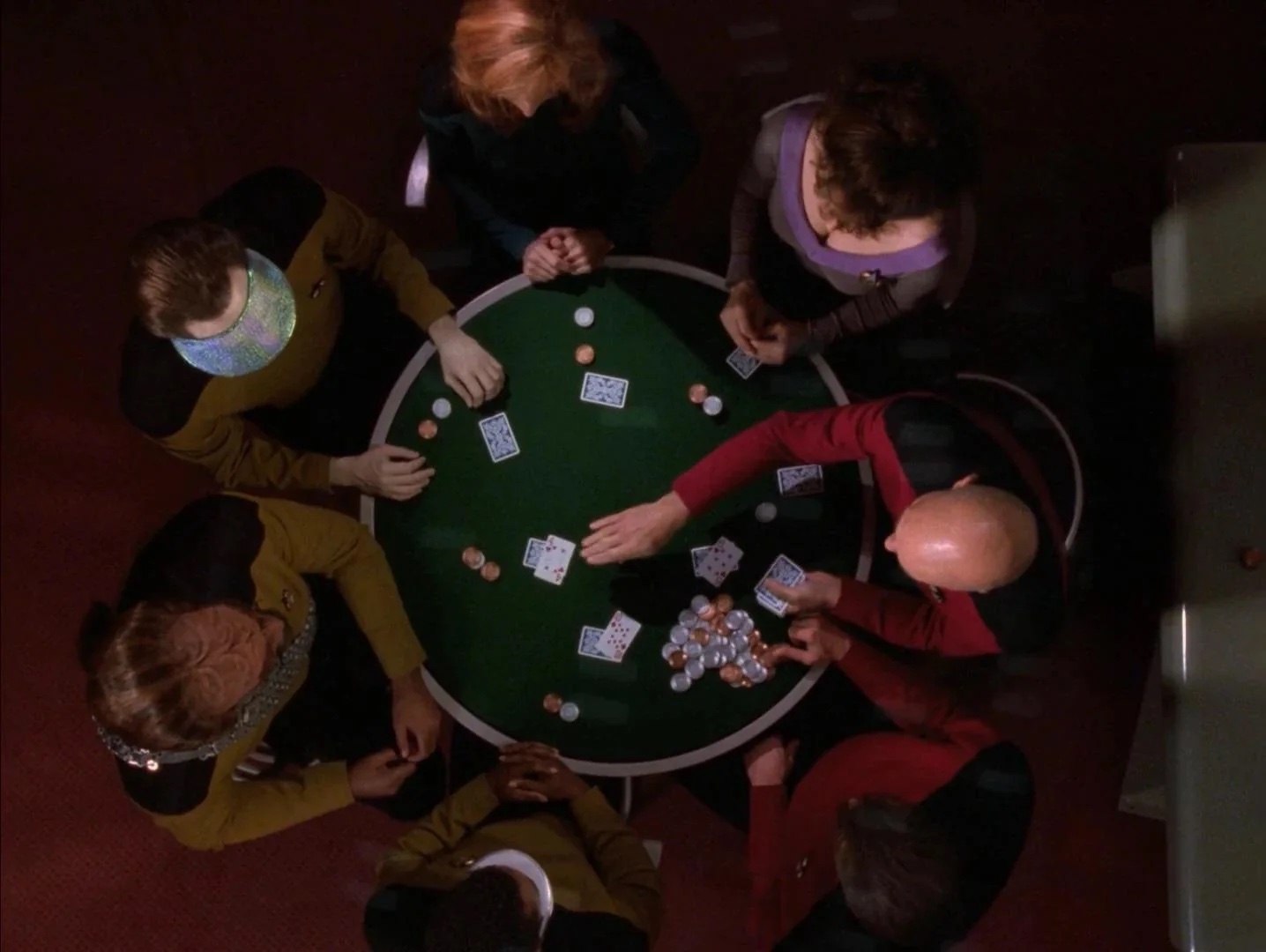
We come, then, to the episode’s (and the show’s) final scene…and I hardly even know how to talk about it. I’m acutely aware that this marks me as a huuuuuge nerd, but this scene had me fully in tears on this last re-watch. Jean-Luc Picard is a character who means a lot to me; in some ways I strongly identify with him, and in other ways I aspire to be more like him. He’s also a rare creation as a fictional character, in that he is, on the whole, a genuinely admirable person (almost a paragon, in some respects)—and yet he’s not without flaws, which keeps him relatable and interesting. And of course, his number one flaw has always been his hesitance about letting others in. He’s great at connecting with people on an intellectual level, and he also excels at extending empathy to others, which is part of what makes him an inspiring and effective leader. But when it comes to stepping out from behind the facade of captainly authority and being truly vulnerable with other people…he has always tended to hold back, and has usually convinced himself that this was for some good reason or other (it wouldn’t be fitting, etc.). Over the years, the writers have given us both stories exploring aspects of his past that have made him this way and stories that have pushed him to grow beyond it, and we’ve seen, little by little, how he has started to open up more as the series has progressed. Meanwhile, we have the long-established and much-loved motif of poker nights in Riker’s quarters, where the rest of the regulars gather to relax and socialize as a group, but always without their captain. When we join them this time, we hear them speculating about why the captain has gone ahead and told them about everything that he experienced in the “future” timeline—giving them, in essence, a peak into their own possible futures. Data provides an intellectual rationale for why he might have felt that it was okay to do so, and then Riker (and it had to be Riker) nails the emotional core of the captain’s motivation; he wants them to be able to make different choices, “so that some things never happen” (looking directly at Worf, who ponders his words for a moment, then simply replies with “Agreed”). In other words, the captain doesn’t want tensions and conflicts to creep in among them, causing them to drift apart (and in some cases, to grow increasingly embittered and lonely). He wants to offer them an opportunity to course-correct and choose to remain emotionally open with each other. (The focus, appropriately, is mostly on Riker and Worf, but if you think about it, it’s kind of remarkable that the captain has presumably told Crusher about their marriage and divorce in the future timeline; already, this is for sure a step toward being more open and vulnerable.) This, of course, is a Jean-Luc Picard who has just gone through a whole experience with the younger versions of these same associates—versions of them that don’t yet know or trust either him or each other, but whom he has been able to inspire with an impassioned speech, acknowledging their doubts but assuring them, with utter conviction, of their potential, and asking them for “a leap of faith,” and to trust him. Equally, it’s a Picard who has just spent time in the future, as a half-crazed old man whom others struggle to take seriously…a version of himself who has lacked the luxury of remaining dignified and aloof, and has had to cajole and persuade them all to listen to him and to help him…and who found that, in the end, every single one of them came through for him, and still respected and admired him. And so, in the final scene, it’s time for him to act on what he has learned, and to take his own leap of faith. Naturally, when he first appears at the door, there is a general stiffening in the room; the captain doesn’t normally drop by on poker night unless there is some problem needing their attention. But when he comes out, slightly awkwardly, with the fact that he actually just wants to join them, smiles appear on almost every face. There’s an immediate show of respectful deference (“Would you care to deal, sir?”), but everyone is clearly delighted to have him. He settles in, offers a bit of banter, begins shuffling…and then, that little, reflective pause, as he looks around the table at the faces of his officers/friends/surrogate family, and speaks aloud the rueful realization: “I should have done this a long time ago.” As always, Stewart is amazing here, and the emotions unleashed by this simple line… I don’t have the words. Troi, of course, speaks for everyone in assuring him that he “was always welcome.” And then, as he begins to deal, there’s that final line, which obviously resonates with his recent conversation with Q, his sense of the unwritten-ness of the changeable future, and his feeling of venturing into new territory emotionally, while at the same time functioning as a damn fine epitaph for the whole of Star Trek: “Five card stud, nothing wild…and the sky’s the limit!”