
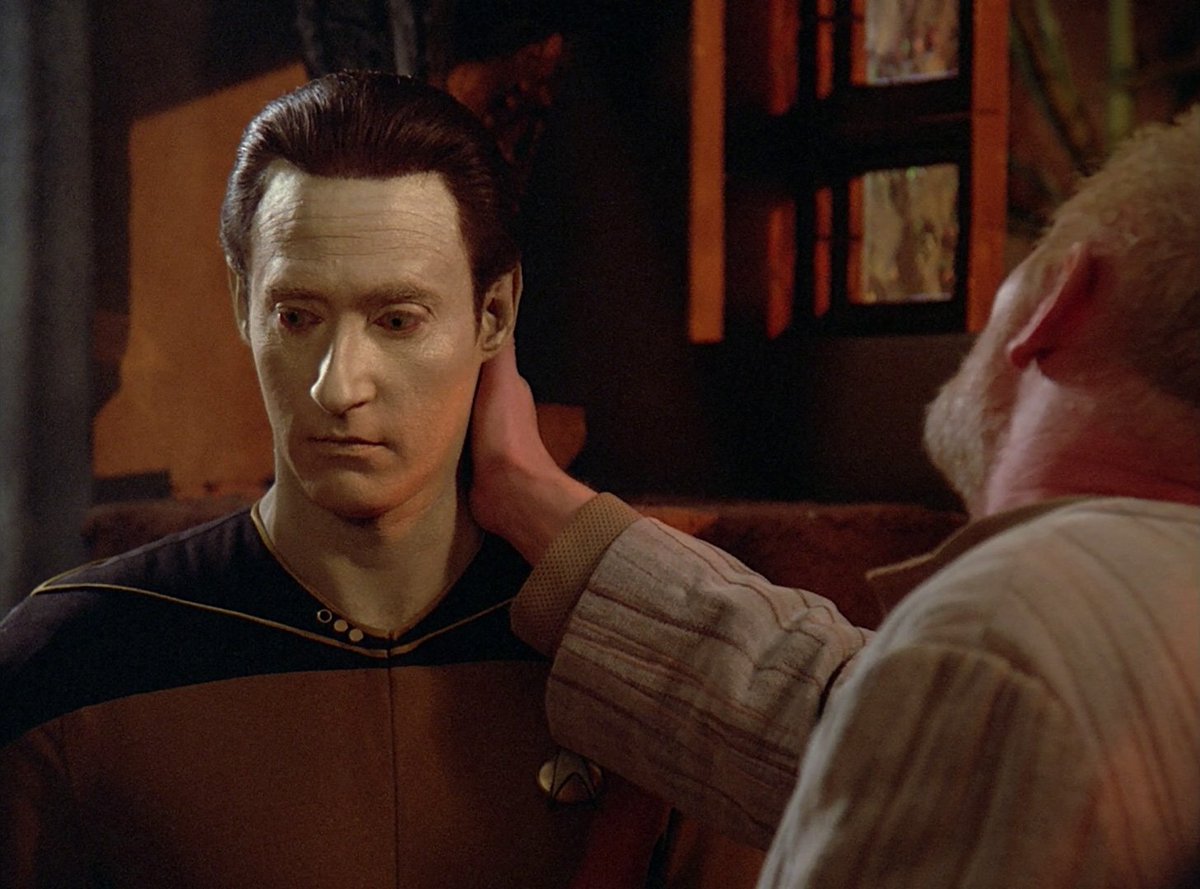
The third of the four early-second-season Data-focused episodes, this one is, alas, a complete bomb. Its few paltry redeeming features are these: 1. Dr. Selar, though the reason why she is introduced is not at all clear and though she would never be seen again, is an appealing character; 2. Data calling Graves “grandpa” is (mildly) amusing; and 3. in the scene in which Data wakes up and is himself again, his very welcome, amusingly Data-esque behavior manages to create a mildly entertaining, feel-good moment. Aside from these three tidbits, this episode totally sucks.
In general, I find that stories that revolve around one or more characters being “possessed” in one way or another are only occasionally compelling. There is a strong tendency for such stories not only to come off as implausible, but to disrupt my sense of the reality and continuity of the “violated” character. I can get past these issues if a story is done well and the “possession” element is used to some worthwhile end, but too often these things aren’t particularly the case—and this episode is very much an example of that trend. Sometimes, stories of this sort try to justify themselves by presenting the possessed character as a hybrid of the character’s normal self and the “possessing” entity, and using this hybridization to try to impart insights about allegedly repressed elements of the character’s “real” self; the previous season’s “Lonely Among Us,” for instance, tried to go this route. I almost never fully buy into these types of stories, but at least in theory, they represent one way of using “possession” in a pointful way. Alternatively, a story like this one can be structured as a mystery, with the audience unaware that the character is possessed and kept guessing about what is going on—or again, as a thriller in which the audience is in the know, and that knowledge creates dramatic tension as the possessed character puts sinister plans into motion while the rest of the characters suspect nothing. This episode, however, attempts none of these approaches. It’s blazingly obvious from minute one what is going on (even though it’s not technically “revealed” until much later), so there’s no mystery; Graves has no particular sinister agenda beyond merely hijacking Data in order to preserve his own existence (which he’s already effected), so there’s no dramatically engaging threat; and there’s essentially no plot, either. What’s supposed to be interesting, apparently, is watching Data not act like Data—but instead of being interesting, this is actually just painful and irritating. In the first place, Ira Graves is thoroughly unlikable even before he transfers himself to Data’s body—so watching Data-as-Graves means watching a character whom I usually like behaving like an ill-conceived and hateable character instead of behaving like himself. Second, while I usually have nothing but praise for Brent Spiner, his portrayal of Graves-in-Data’s-body is just way too similar to his portrayal of Lore; frankly, he doesn’t actually act all that much like the Graves we see in the beginning of the episode. Third, the other main characters’ reactions to his bizarre behavior are way, way too restrained; granted it’s still early in the show’s run, but they definitely know Data well enough that they should all realize immediately that this is not him. Their efforts to explain his odd behavior to themselves by theorizing about how Graves’s death may have affected him emotionally just fall utterly flat; they not only make everyone look like total morons, but they do a disservice to Data and the whole concept of his exploration of humanity as well.
I have to digress here, though, to acknowledge a huge milestone: In this episode, finally, it is pretty explicitly stated that Data lacks emotions! Troi as much as says it in the teaser, but Graves says it outright (and blathers about this shortcoming of Data’s in an extended fashion). True, Picard and Geordi both ponder whether Data might have feelings after all in the lame scenes where they are trying to fathom his odd behavior, but even so, the point is that this key character premise—which I’ve been so astonished to realize was not explicitly established earlier on—finally fell into place here! (Troi further solidifies it when she reports, sounding floored, that she felt “jealousy—a human emotion—coming from Data.”) Given that most of the episode stomps all over the real Data and seems to expect this to be entertaining, I can hardly count the long-overdue establishment of his lacking emotions as a point in the episode’s favor; still, it needed to be acknowledged. (As for the “Data with a beard” scene—I don’t buy it, frankly, and also, there is nothing even remotely funny enough about it to justify Troi’s reaction.)
I’ve already touched on this, but I hate the character of Ira Graves. The concept and the execution are thoroughly first-seasonish: This guy is brilliant beyond compare! Care about him! He’s a big deal! (I mean, honestly—”the greatest human mind in the universe”??) Then, when he actually appears, he’s portrayed in as off-putting a way as possible, and none of the hype is lived up to in any way. His contempt for both Soong and Data, and the lack of anything interesting about him, make me want to forget that his existence and his supposed role in educating Soong and therefore making Data possible were ever established. Also, the relationship between him and his “assistant” (who looks to be about 17 years old) feels totally artificial—something straight out of the first season. And of course, his takeover of Data’s body is pretty stupid; did he really think it would work out, and that others would let him get away with it? Graves is a megalomaniacal dick to begin with, but he seems utterly to lose all grip on reality once he’s “in” Data. And the more the episode tries to convince us that other characters (like Picard) feel something for the apparent loss of Graves, or admire his achievement in transferring himself into Data, the more I want the episode not to have been made, because none of it is convincing and the whole charade just dumps on the regular characters.
Also, what in the world is up with the business in the beginning of the episode about having to rush off to save some other ship and thus doing a “near-warp transport” (whatever that is), and sending a doctor other than Pulaski, and all? Is it supposed to create extra tension? Was it just thrown in to fill time? Is it (at least in part) a plot contrivance designed to get Data alone with Graves for an extended period? It might have been some of all of these things, but some elements of it seem not to have been necessary to any of these purposes (all of which are lame, in any case). The failed tension point of the tricky transport (and especially Troi’s ignorance about it) is especially weird.
One other brief comment: Despite everything that I said in my review of “The Child” about how much more sophisticated, in general, the show’s overall storytelling style is in season two as compared to season one, many second-season episodes (including this one) adhere to a dorky format in which, every time an away team beams somewhere, they immediately go through the motions of a pointless check-in with the captain (or whoever’s in command on the bridge), in which they report their arrival and the captain asks them to keep him posted on what they encounter, and whatnot. This always strikes me as very amateurish and awkward, and I eagerly look forward to reaching the point where they stop doing it.
Anyway, this episode sucks. Despite the huge leap forward that almost everything about this season represented as compared to the first season, and notwithstanding the enjoyableness of “Elementary, Dear Data,” there was definitely cause for real concern at this point in the second season. Fortunately, things would start getting better before too much longer!