
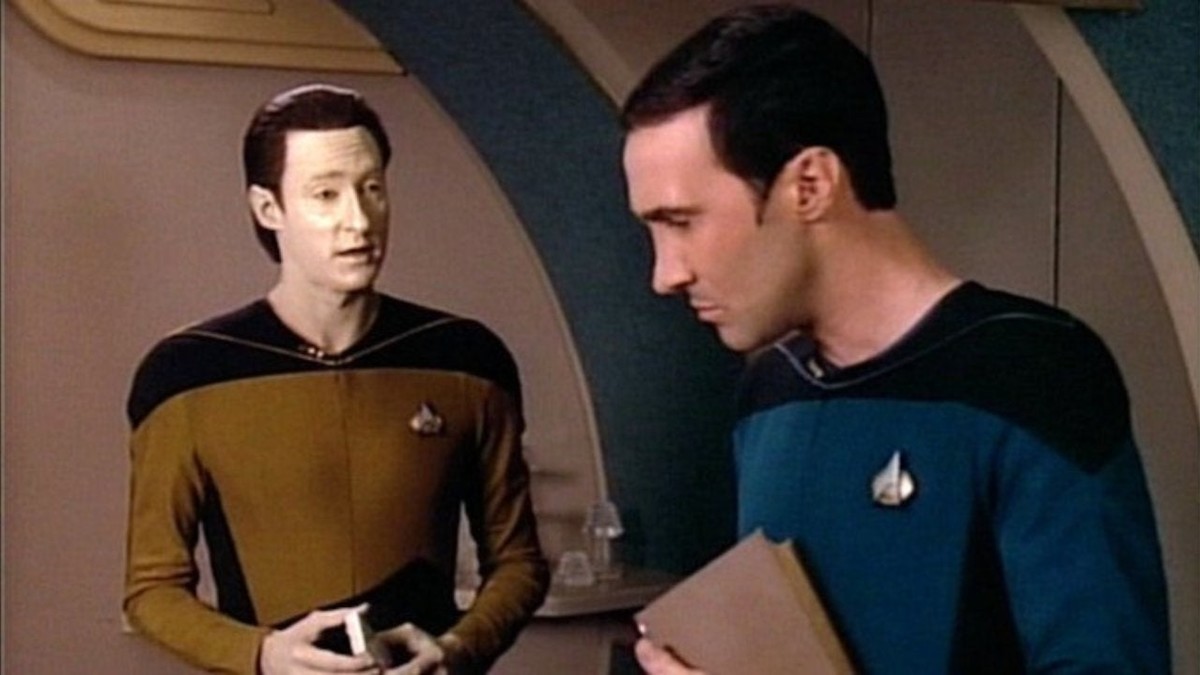
“A Matter of Honor,” the episode immediately prior to this one, was, when it first aired, the best episode that the series had yet produced—but this one easily topped it, becoming TNG’s first truly classic episode. This is not to say that it has no flaws (even five-star episodes can have those), but the core of what the episode is about is riveting, thought-provoking, moving, important, and executed extremely well, and the episode portrays its main characters deftly and fully follows through on every important aspect of the story that it sets out to tell. Episodes like this one are the reason why I love this show!
Before the episode proper gets started, we’re treated to a teaser that introduces what will become the recurring motif of the poker game in Riker’s quarters. As I’ve commented before, I always appreciate episodes that open with character-focused material and then ease into a plot. It’s a great way to work low-key character development in without having to either hang it on a main plot or find ways to wedge it in between unrelated events during a crisis. Plus, it adds realism and that touch of humanity, and it often serves to introduce stories thematically in a non-cheesy way (it can be an exercise of artistic license that adds a level of symbolism, introducing some theme or idea that the episode wants to explore). But on top of all of that, this first instance of what will be a recurring device throughout the show’s run (and one that will almost always be used well) functions as another one of those delightful moments of “arrival” for the show as I came to know and love it. Plus, poker as a metaphor for aspects of the human condition—symbolizing possibilities, the value of freedom to choose, and one’s potential to rise above the limitations imposed by outside circumstances—has just enough history within the Trek canon to resonate and feel right, without coming off as in any way trite. Data learns a simple lesson in the poker game that he later applies, both explicitly and implicitly/symbolically, as he faces the challenge represented by Dr. Maddox. I’ll grant that it strains plausibility for Data to have so thoroughly underestimated the complexity of the game before experiencing it, but the scene remains, for me, both thought-provoking and quite satisfying.
Moving on, the episode establishes some interesting background for Data in the idea that his entrance to Starfleet Academy was opposed by one of the people evaluating him. In light of that history, Data greets Maddox with just the right mix of self-assertion and android equanimity—a mixture that he will continue to exhibit throughout the episode, to the credit both of the writers and of Brent Spiner. Now, Maddox’s line about having become a student of Soong’s work after first encountering Data is inconsistent with the fact that the identity of Data’s creator was seemingly unknown until discovered by the Enterprise in the episode “Datalore,” but as the latter notion never made much sense to me—and since I much prefer the idea that his origins were inferred earlier—I am more than willing to forgive the inconsistency on this end. Also, it’s arguable that the question of Data’s legal status and rights should have, and realistically would have, come up and been settled prior to this point in his life/career—but it’s much more dramatically satisfying to raise and resolve the issue in an episode than to merely refer to its having been settled at some point in the past. The conclusion here is that even though there are definitely some questions about the plausibility of the episode’s premise, this one seems like a clear case in which suspension of disbelief is warranted by the quality of the story.
Here and there, previous episodes have gotten a start on exploring the potential of Data as a character, but this is the first one to really flesh out a personal life for him, showing us the belongings that he values and putting him in the position of having to make fundamental decisions about what course his life will take. This is a really important part of what the episode does right, and it’s both engaging and affecting. Through it all, Data walks that wonderful line that the show (and Spiner) developed so well over the years, finding ways to smuggle some trappings of human sentimentality and ego into the portrayal, but without straying into clearly emotion-driven territory, so that the character feels like what he’s supposed to be: a being with a consciousness, with goals and intentions and a sense of self, but without emotions as we know them, and thus both capable of, and limited to, reacting to things (even things that bear directly on his identity and fate) in a dispassionate and rational way. The fact that Data is at first intrigued by Maddox’s proposal—despite what, to a human, would be the “bad blood” between them due to their history—is a great example of this. Only when he realizes that Maddox has not done his homework does he develop objections. The scene between Data and Maddox in Data’s quarters is fantastic, too. Maddox barges in, then opens with a question that conveys his fundamental skepticism about Data’s consciousness and sense of self. Rather than deigning to respond to this, though, Data does what anyone conscious of his or her rights as a person would do: he calls Maddox out on having barged into his quarters without permission. Of course, he feels neither violated nor offended by the intrusion; he just recognizes that social protocol has been breached in a way that impinges on his personhood, so he exercises his right to object. He then goes on to present a cogent and succinct argument in support of his resistance to Maddox’s proposed experiment—even employing an analogy to drive home his point, much as a human might do—and along the way, he incidentally provides a pretty clear answer to the deliberately provocative question that Maddox posed when he first came in. Next, he explains that he is motivated by a perceived need to preserve Soong’s achievement—i.e. himself—and not by personal feelings. Of course! What’s cool is that he is essentially—and plausibly—arguing as if he were a disinterested party, who has simply judged that the risks of Maddox’s proposal outweigh its potential benefits. And finally, I have also always loved the scene at the end of the episode, in which Data tracks down Riker and asks why the latter hasn’t joined the celebration taking place over the vindication of his rights. Riker, of course, is feeling guilty about having played the “devil’s advocate” role, and is thus ashamed to show his face—but Data, being Data, doesn’t take it at all personally, or feel even the slightest twinge of resentment (as a human might). (After all, in the words of another famous Trek character—Data has “no ego to bruise”!). Instead, he just rationally points out that Riker’s action actually constituted a self-sacrificing favor to him, and thanks him for it! The scene is an insightful underlining of the greatness of Data as a character, as well as a nice feel-good moment on which to end the episode.
I’ll concede that one aspect of the episode that doesn’t quite work is the relationship between Picard and the JAG officer. It’s a nice try; I like the character herself well enough, and the backdrop of their different takes on the “adversarial process” does add to the episode thematically, but the relationship just never quite feels real. This flaw is not serious enough to detract much from the episode, though. On the other hand, I love what this episode does for the much more important relationship between Picard and Data. I think this is pretty much the first instance of the connection between the two of them, and of Picard’s role as Data’s guide and mentor in his exploration of humanity, which become increasingly significant elements of the show’s appeal as it goes forward. The scene in which Data assures Picard that he has “full confidence” in the captain’s ability to represent his interests at the hearing is especially nice. Also, in regard to the JAG office: I do appreciate how the episode establishes up-front that the Starbase the Enterprise is visiting is brand-new and that the JAG officer doesn’t even have a staff yet. Obviously, this situation is the pretext for having Picard and Riker serve as legal counsel at the hearing, but it’s set up in such a way as to not come off as lame, cheesy, or overly “convenient” from the story’s perspective. As I noted earlier, this is an episode that doesn’t leap headlong into its plot from minute one; as such, by the time the basic issues take shape, there has been enough deft and subtle setup that the means settled upon for resolving them seem natural. Very well done.
I could see an argument to the effect that this episode flirts with the central philosophical issues (both legal and metaphysical) concerning Data’s status without ever quite fully laying them out. For instance, during the hearing, Picard at one point challenges Maddox to prove that he (Picard) is sentient. Leaving aside the episode’s incorrect use of “sentient” in place of “sapient,” the captain’s point, presumably—and it’s an excellent one—is that even though he may not be able to prove absolutely that Data is sentient/sapient, this doesn’t actually differentiate Data from anyone else. Unfortunately, Maddox brushes off the challenge, and Picard then fails to drive home the point. He does go on to make a fairly convincing argument that Data probably is “sentient,” but his original argument seems like the better one. He also goes on to make—quite dramatically and effectively—a more legal/social argument about slavery, individual rights, and the implications of the case for larger questions about who the Federation is as a society and how it treats those in its power, and his line about Starfleet’s mandate to “seek out new life” has particular rhetorical force. Still, without fully making a case for Data’s equivalence to a biological life form, his argument does kind of founder on the very issue raised earlier by Maddox: Do computers have rights? Where’s the line? Greatly to the episode’s credit, though, the JAG officer, in issuing her ruling, does address the central issue head-on, and in doing so she acknowledges the point that exactly what Data is or isn’t can’t be determined with anything like certainty. When she initially phrases the question as “Does Data have a soul?” the secularist in me does cringe a little; but when she goes on to admit that she’s no more certain that she has one than she is that Data does, I want to break into applause. Her conclusion is essentially that in the absence of certainty, the legal question becomes “what kind of society do we want to live in?”—and that Federation values and tradition dictate a broadly inclusive answer to the question of who should have rights. Since, then, the episode does raise and duly consider the important philosophical points, I’m willing to forgive the less-than-perfect aspects of its handling of them. Besides, Picard’s case during the hearing is much sounder than Riker’s, any way you look at it. Essentially, Riker’s presentation amounts to no more than a dramatic illustration of Maddox’s argument that if Data were “a box on wheels,” no one would make a fuss over him. It’s a fairly effective demonstration, and it’s hard to see what else Riker could have done that would have been any more convincing (so he lives up to the task assigned him in a dramatically satisfying way)—but it remains, nevertheless, merely a manipulative appeal to gut-reaction-level emotions. Picard presents by far the more persuasive case (which is as it should be).
Besides, quibbles aside, this is just a terrific episode; important, engaging, character-centric, well-crafted, and moving. As I said at the outset, it’s TNG’s first true classic.