
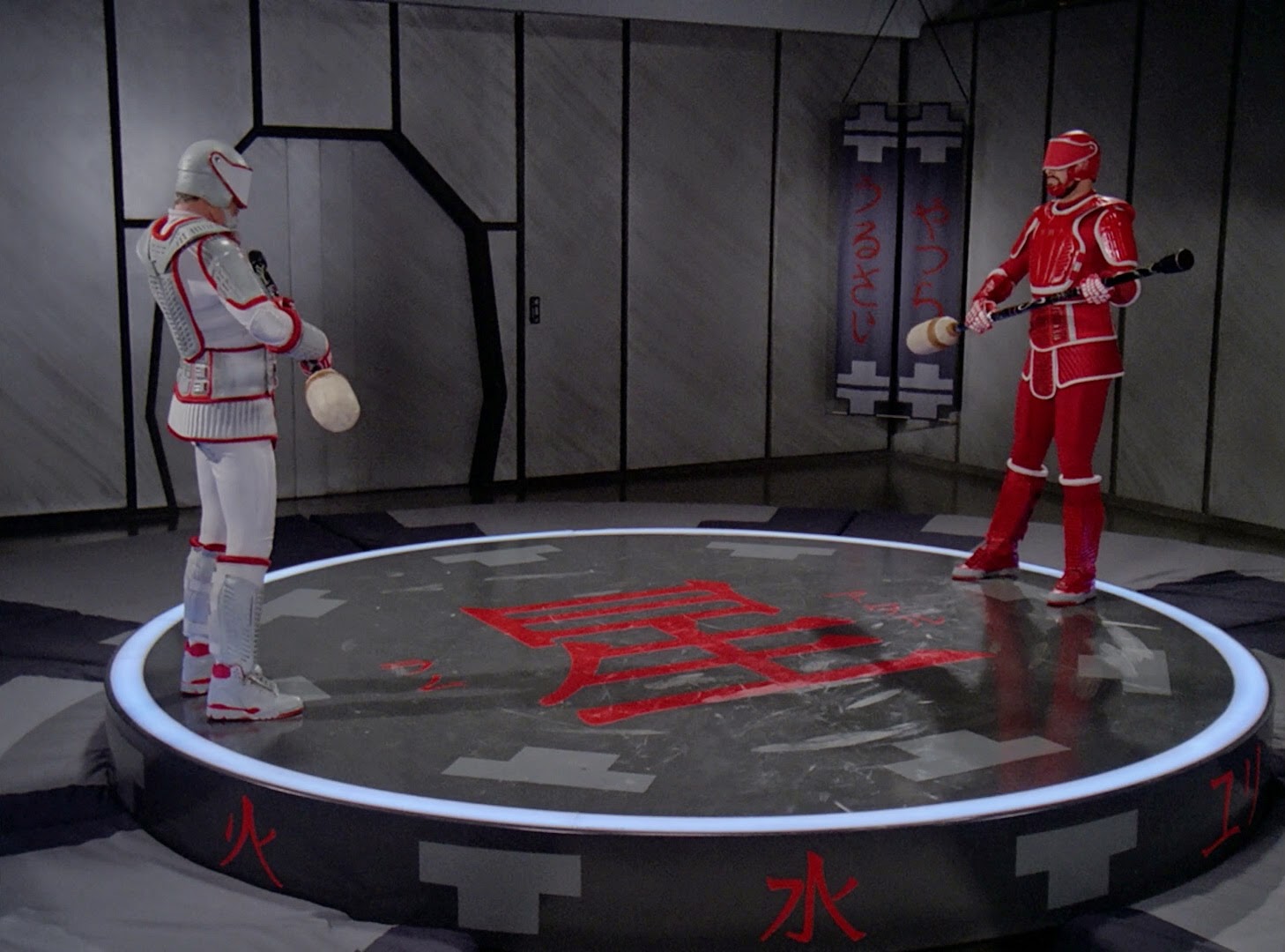
This is yet another episode that, based on what I’ve read elsewhere, I gather that a lot of fans don’t like very much, but of which I have always been quite fond. For me, “The Icarus Factor” is a nostalgia-inducing classic of the second season, with just enough flaws to hold it back from receiving a four-star rating. It’s remarkable (and, I think, often overlooked) for being, from start to finish, purely a low-key character-study, with only the most minimal framing scenario (a stopover at a starbase to look into a minor glitch in engineering) to justify itself in terms of what ship and crew are officially up to. (It seems to me that I’ve often seen fourth season’s “Family” described as TNG’s first and/or only episode to entirely forgo any sci-fi/ship-in-jeopardy type plot—but not so!) Riker being offered his own command is an interesting story hook that makes perfect sense given his back story (he’s already turned down one previous offer), and the episode uses it to take a look at Riker’s past and allow him to try to come to terms with some “emotional baggage” as he contemplates a possible new direction in his life; meanwhile, the Worf-centered subplot reinforces the family sensibility among the main characters that the show has been developing this season, provides humor, and tells a very worthwhile and successful story about Worf’s discovery that he can be who he is, culturally, and still find a sense of belonging aboard the Enterprise. As for that framing scenario, it doesn’t take up much screen time, but it still manages to humanize the characters a bit and provide a couple of humorous moments in the time that it does take up.
The Riker story has some unfortunate moments and is not without problems, but it also shows an impressive degree of sophistication in places. Although I personally completely sympathize with Will in the conflict between him and his father, the episode, hugely to its credit, doesn’t make his father an unlikable ass; Kyle Riker comes across as a surprisingly nuanced and psychologically real character (the show has gotten so much better at this sort of thing this season!), and the father-son dynamics are depicted as a complex, layered, and believable scenario involving two well-meaning but flawed human beings. The “anbo-jyutsu match” between them draws quite a bit of fan criticism, and at least some of it is deserved—but I’m fine with the concept of it (and not really one to care all that much about issues of the believability of a made-up futuristic martial art). I do think that the dialog during it needed work, though; the issues surrounding the death of Will’s mother/Kyle’s wife just sort of explode into the open out of nowhere, and Will’s “it should have been you who died” line doesn’t work for me at all. Actually, I think that the part of their conflict revolving around the dead wife/mother is underdeveloped in general; another scene or two delving into the back story a bit more would really have helped, and might even have set up the letting-out-of-steam outburst during the martial arts match more effectively. Apart, though, from a couple bad lines during the match, I like everything that the episode gives us of the father/son conflict; I just would like a bit more on this one aspect of it.
Other fans’ reactions notwithstanding, the worst scene in the episode for me is actually the Pulaski/Troi scene in which they talk about the anbo-jyutsu match, and in general about how barbaric and childish “human males” are. In the first place, they both seriously overreact to the match; it’s a competition, for heaven’s sake, not an all-out brawl or something! Second, while I don’t totally disagree with their characterization of it as a childish means of working through anger, it falls clearly within the realm of believable and not-totally-inappropriate behavior from flawed and emotionally scarred people. As such, I approve of it in the story—or at least I would, if the writers didn’t feel the need to throw in this really awful Troi/Pulaski scene in which they condescendingly make it a gender issue, and in the process reveal themselves, rather than the Rikers, as the ones whose attitudes seem out of place in the twenty-fourth century. (I’m pretty sure that, both in the real world of the twentieth/twenty-first centuries and in the Trek world of the twenty-fourth, there are women as well as men who have difficulty straightforwardly dealing with their anger and conflicts in rational and level-headed ways.) Incidentally, Troi and Pulaski are also at the center of two other quibbles that I have about this episode: First, I really don’t buy the “Oh, did I never mention that I know your father?” nonsense with regard to Pulaski; and second, Troi’s line to Riker about how her own emotions are irrelevant strikes me as totally implausible from a counselor (though otherwise, the scene between the two of them is nice).
Finally, probably the biggest flaw of the episode (aside from the Troi/Pulaski scene) is the lack of any clear reason for Riker’s final decision to turn down the Ares. I think the episode could have offered a workable reason without too much additional effort; the material about paternal expectations and the competitiveness between Riker and his father could have been used to suggest that reaching some level of reconciliation with his father, and coming to terms with old emotional baggage, helps him to clarify his priorities. Some semblance of this idea is kind of there implicitly, I think—and kudos to the episode for not going overboard with spelling out its thematic content in a really heavy-handed way—but as with the father/son conflict itself, it just sort of feels like another scene is needed to tie the whole thing together. After all, the decision that Riker makes—while predictable from the standpoint of the unlikelihood that the character is being written out of the show—is significant in that it represents a major change of direction for a character who has been defined up to this point as an ambitious, career-focused guy. If the episode did a little more to show us what prompts Riker to recognize and come to terms with his changed priorities, it would be that much stronger (and perhaps even earn that fourth star).
I feel like I haven’t said enough about the Worf story, but I’m also not sure that there’s a lot to say. I have no real complaints, and find it thoroughly enjoyable (and the scene between Worf and Riker, in which Worf asks to accompany Riker if the latter accepts his new assignment, is really a nice touch). I’ve already noted elsewhere that I think stories like this one represent the right way to use Wesley as a character, and as for Worf himself, I genuinely feel for him in this episode in a way that I haven’t in any previous ones; when he enters the holodeck and takes in what the others have put together for him, it’s moving. This was the other characters genuinely embracing what it means to make someone as different from them as Worf is truly a part of their surrogate “family,” and that’s pretty cool. Plus, it bears mentioning that this story (continuing a nearly season-long trend) gives O’Brien his most prominent role yet, in which he serves virtually as a full-fledged regular character!