
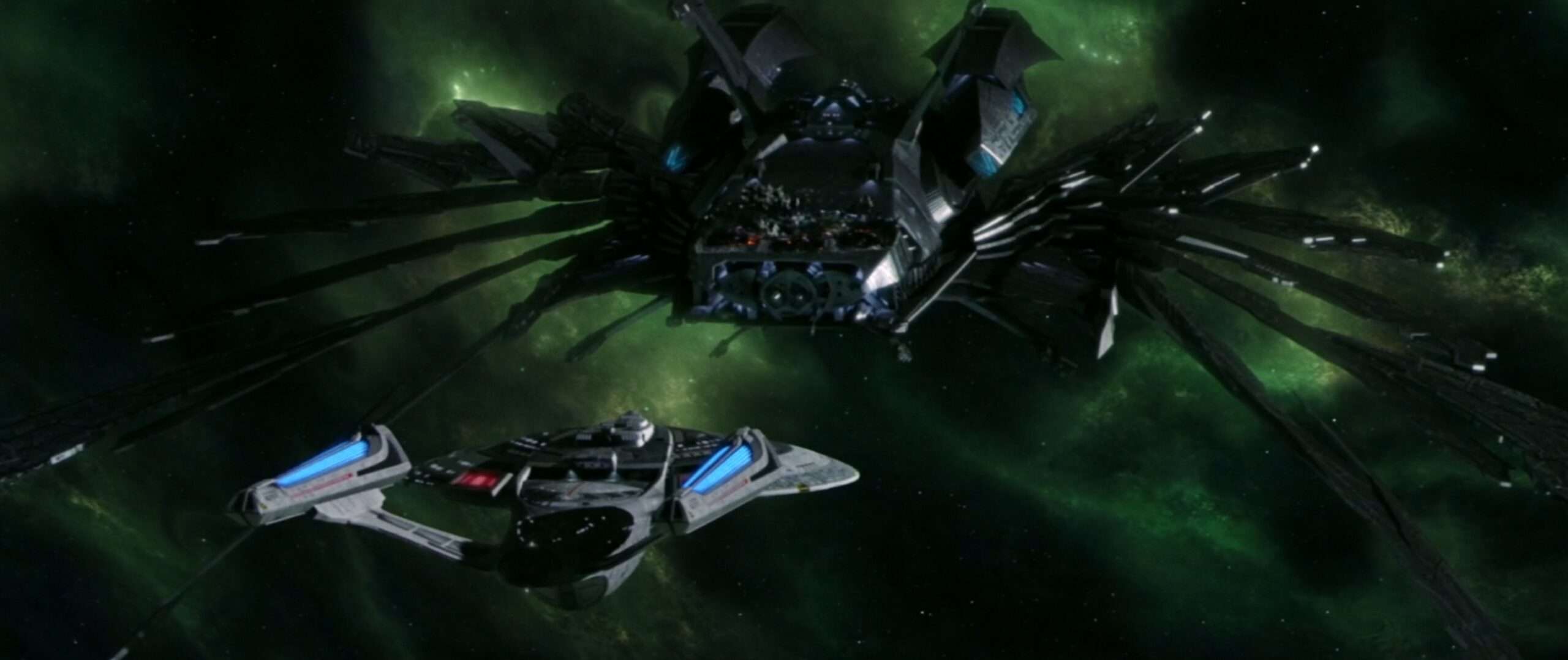
As with Insurrection, I’m pretty sure that I had only ever seen Nemesis once (in the theater, back when it came out) before re-watching it in order to write this review. Having now watched it again after all these years, it’s easy to see why I never bothered to revisit it before. None of the TNG movies after Generations is good, but…wow—this one is a disaster. First Contact was the one that always stood out in my mind as awful (because of what it did to the Borg and to Data, and because of the role that it played in crushing my enthusiasm for Trek at the time), but in retrospect, it had a lot more going for it than this hunk of junk (which seems to have done, for the general public’s engagement with these characters, more or less what First Contact had already done for mine, and thus ended the prospects for any more TNG movies after it). While First Contact was misguided and problematic, and Insurrection incoherent, dumb, and bland, Nemesis is just garbage.
The problems start with the writers’ deeply frustrating and unfathomable choices regarding the general subject matter of the movie. You know…as irresistible as it obviously was, after TNG proper had ended, for the writers to make a movie about the Borg, my personal dream at the time was that maybe, just maybe, we might at some point get a movie about the Romulans. At once the most cerebral and confounding of the Federation’s established “nemeses,” and also the one with the deepest roots in classic Trek lore, the Romulans had been featured much less often than I would have preferred throughout TNG’s seven seasons, but on a handful of occasions, the show had done really engaging things with them. How I would have loved a really meaty dive into the kind of political intrigue, and strategic gamesmanship, that only the Romulans can provide, in a big-screen context where the status quo of alpha quadrant politics might conceivably be altered in a lasting way! So, when it appeared that the fourth TNG movie was going to have something to do with the Romulans, some mostly-dead part of me stirred a little, and wondered if perhaps it should actually get excited. But, of course, the answer was: nope. Because instead of building on any of what the series had laid down concerning the Romulans (the stuff about the underground movement interested in their Vulcan past, say, or the tension between the military and the Tal Shiar)—or, for that matter, even actually focusing on the Romulans at all—the movie instead invented the notion of the Remans. We always knew that the heart of the Romulan Empire was a pair of planets that humans refer to as Romulus and Remus, but the idea that Remus was home to a distinct people was brand new in this movie. And, look, I’m not saying that it’s forbidden for a movie like this one to invent something so totally new (even if, in general, it does feel to me like the movies are better used to explore and/or shake up existing premises), but…okay, three things (in ascending order of importance): First, it definitely felt like a bit of a retcon to me, in that, while little had ever been clearly established about Romulus and Remus before, it had always seemed like they were relatively coequal, and like both were homes to the people whom we’ve always known as “Romulans.” Second, in the movie, it really felt to me like a bait and switch, where the writers held out the tantalizing prospect of a story about an established power that I was already invested in, and then gave me something else in its place. And third..frankly, the Remans as presented in this movie are just flat-out boring as hell. Oh, so the Romulans have a subjugated race/caste of enslaved beings who work dilithium mines for them? That could be an interesting idea. Are they biologically Romulan in some sense? Or are they natives to the planet Remus, whom the proto-Romulans found and subjugated upon arriving here after their exodus from Vulcan? Who knows; the movie doesn’t tell us (and outside sources that I’ve consulted provide conflicting answers). Will their introduction serve to reveal new things about the Romulans themselves, and/or be mined for potentially compelling analogies to real-world instances of imperialistic exploitation, or anything like that? No? Okay, well, will the Remans themselves prove to have a rich, compelling culture that has endured in the face of their oppression at the hands of the Romulans? Oh…what’s that you say? We aren’t even going to learn much about the Remans at all, because, in fact, it turns out that they somehow have a leader who is human, and the story is actually mostly about him, and no genuine Reman will receive enough attention to even meaningfully qualify as an actual character? And what little we do see of them will basically just make them appear to be standard-issue violent thug villains with no apparent personality or relatable motives, rather than downtrodden freedom fighters? Oh…uh, okay.
So, yeah: Not only is Shinzon, the big antagonist in Nemesis, not a Romulan; he’s not even a “Reman.” Nope, he’s actually (wait for it) a clone of Jean-Luc Picard, whom the Romulans created years ago as part of some abortive ploy, then dumped into their slave mines, after which he somehow emerged as a great military commander (deployed by the Romulans in the Dominion War), and then eventually rose to lead some kind of secret Reman contingent, with an uber-badass megaweapon of a ship, that’s bent on…well, we’ll get to what they’re bent on. See, there was this one Reman guard in the mines who was kind to him and helped him to survive, and somehow, this led to him being in charge of the Remans, with that “kind” guard as his main underling (though the movie doesn’t bother trying to depict their relationship in way that would make any of this at all believable). And then, we’re asked to believe that this guy manages to murder the entire Romulan senate, and install himself as the new Praetor of the Romulan Empire!? I remember a time when it was “always a game of chess” with the Romulans; here, it feels like the poor bastards could scarcely master the intricacies of tic-tac-toe. I’m sorry, but I do not buy that anyone in a position of any kind of power in the Romulan Empire would ever give this upstart human ex-slave of their own creation (who openly disdains Romulans, to boot) the slightest bit of rope, much less acquiesce to his leading the friggin’ empire. This entire premise is just absolutely dead on arrival, as far as I’m concerned—which is a big problem, since the whole movie is built upon it. Incredibly, though, that’s merely the beginning of my problems with Shinzon, because he’s also charmless, unlikable, incoherent, and generally ineffective as a character. Given his back story as a survivor of oppression and brutality, and his putative role as the liberator of the Remans, the movie really ought to be working as hard as it can to earn him my sympathies. It does sort of gesture in this direction, but the effort is so half-assed that it just doesn’t work at all. I mean: For no obvious reason, this guy’s goal is to literally destroy earth and wipe out humanity. Not the most sympathetic of goals, to be sure, but also—just, why? He has suffered all his life at the hands of the Romulans, and he hates humans because…? Anyone? The scene in which he and Picard sort of “bond,” supposedly discovering that they both felt similar yearnings in their youth and stuff, rings so utterly false that it’s laughable (and Picard’s subsequent earnest wishing that he could believe in Shinzon’s sincerity is not at all believable). Plus, he’s juist weirdly off-putting in various random ways that make it impossible to fathom what it is that actually motivates him. For instance, that he hates Romulans makes sense; but why, when he’s interacting with Commander Donatra (the female Romulan officer who is the movie’s closest approach to an interesting guest character), his ally whose loyalty he is trying to further secure, does he openly display his racial disdain for and disgust at her? Does he want to be betrayed and overthrown? Or, in the scene where he first introduces himself to Picard and his officers, why the absurd, grandiose, cryptic show of self-revelation, coupled with the random weirdly creepy behavior toward Counselor Troi? If you’re trying to convince these people that, as the legit new leader of the Romulan Empire, you’re interested in beginning a peace process with the Federation, why not behave like a friggin’ normal person would behave in such a situation (and reveal the weird secret about your being a clone of the captain, you know, straightforwardly, but also after establishing a base level of trust)? This all is one part “he’s the villain, so he has to be all melodramatic and grandiose and posturing” (a trope that I already hate), but it’s more even than that; it’s just nonsensical.
Because, here’s the thing: For the story that the movie seems to want to tell to work—for it to grab ahold of us and take us for the emotional journey that it should be taking us on—it’s imperative that we, the audience, like Shinzon, at least at first. We should be induced, as his story unfolds, to want to believe in his sincerity, just as we’re (unconvincingly) told that Picard wants to believe in him. But I absolutely don’t, ever, even for a moment, both because he never comes off as even remotely sincere (even when you’d expect him to be trying his best to do so), and also because, unaccountably, the movie gives us information about him that it denies to Picard; we know that he came to power by horribly murdering a bunch of senators, that he’s sold his Romulan supporters on a plan involving attacking the Federation, and that he acts like a goddamn supervillain whenever interacting with subordinates. So instead of seeing a charismatic figure dangling an irresistible possibility in front of our characters, but wondering in the back of my mind whether or not he can truly be trusted…I see a boring, one-dimensional, posturing, grotesque thug who is bent on an idiotically destructive course of action for no discernible reason, but in whom, for unfathomable reasons, the movie’s protagonist claims to see himself reflected in some way. I don’t buy it. I don’t give a shit about this guy, I don’t see any of the potential in him that Picard claims to see, and Picard’s efforts to get through to him just seem ridiculous. That he “turns out” to be nothing but a stupid posturing arch-villain bent on killing everyone for no reason is super-boring, and would be so even if it weren’t also blazingly obvious from the moment he’s first introduced. (There’s also a deeply half-baked premise about him needing Picard’s blood to stave off his death due to technobabble about the way he was cloned; this basically goes nowhere.) Plus, what’s even the point (narratively) of Shinzon pretending to want peace with the Federation? It’s not like our people have to agonize over whether or not to trust him, or like there’s ambiguity around his motives that the movie milks for either plot intrigue or exploration of interesting themes. He’s just supposed to seem badass (and frankly, he fails even at that).
Okay, so narratively, the story that the movie seems to be trying to tell just doesn’t work, largely because of how utterly it botches the Shinzon character. What of the movie’s thematic aspirations? This is a movie that is entitled Nemesis, and that goes to some lengths to introduce unsatisfactory doubles/alternate selves for both Picard and Data (the two regular characters about whom it mainly cares). What is it up to? Neither “double,” it must be said, particularly seems to constitute an actual “nemesis” for his counterpart, although I guess Shinzon does seem (for some reason?) to regard Picard as his nemesis. For sure, though, both the movie and Shinzon himself want to portray Shinzon as some kind of dark mirror for Picard. “Had you lived my life, you’d be doing exactly as I am,” he tells the captain during one confrontation between them. Picard, unconvincingly taking this to heart, later bounces the same notion off of Data. Meanwhile, the movie has also conjured forth a Data-prototype called B-4 (did Soong know in advance that this iteration wasn’t going to fully succeed, or did he rename the prototype after going on to create Data and Lore?). For most of B-4’s limited screen time, he seems like little more than a curiosity; he mainly gets used for light comic relief, except for when he’s serving as a plot device (being used by Shinzon to unwittingly gather intelligence). Then, following the latter incident, Data is suddenly declaring him “dangerous” and deactivating him (leaving me wondering how Shinzon’s use of him differed enough from the times when Data himself has been hijacked in various ways over the years to warrant this treatment). This, it turns out, is setup for the Picard/Data scene in which Data provides the answer to my question about what the movie is fundamentally “up to” with the whole doubles motif; seeking to put his captain’s troubled mind at ease, Data declares that both of their doubles are wholly distinct from them, by virtue of their different life experiences. And I wholly agree, except…isn’t that exactly what Shinzon said, and what Picard is musing about? That if his experiences had been like Shinzon’s, then he might be like Shinzon? So what’s Data’s point, exactly? He goes on to underline what he sees as the essential difference between himself/Picard and B-4/Shinzon, saying “I aspire . . . to be better than I am. B-4 does not. Nor does Shinzon.” I find Picard’s self-doubt overblown, but I feel like Data errs in the opposite direction; his distinction is far too neat. For one thing, his conclusion that B-4 does not “aspire” seems premature, and like something that the movie has not clearly demonstrated. For another, it comes across as smug and incurious (both very out of character for Data). Because, okay, let’s say he’s right; they don’t “aspire.” Why not? Again, aren’t the differences between them (or at least, between Picard and Shinzon) due to their differing life experiences? Data’s neat little distinction seems to ignore/attempt to sidestep the significance of what I like to call the “there, but for the grace of determinism, go I” argument. More broadly, the idea of trying to become better than what you are does seem to be central to what Nemesis wants to be about (not unlike First Contact before it), but to me, it feels like the movie for the most part offers a shallow and (again) smug take on the concept (we’re awesome, our enemies suck).
While by no means the whole of it, one big part of the reason why none of this works is that Nemesis is basically, at its core, just a big dumb generic action movie (far more so than First Contact, despite the latter’s reputation and despite how I myself have often thought of it). Sure, it throws in a few token scenes with characters trying to philosophize and have feelings, so that it can try to pass itself off as Star Trek…but it half-asses all of that, and totally fails to integrate it into its overall narrative, which really isn’t about dopplegangers, or nature vs. nurture, or liberation from oppression, or historic foes working toward a new kind of relationship1; it’s about shoot-outs and space battles and trying to stop an unhinged clown of a villain from going and destroying Earth for no reason. And on top of that, most of the action scenes aren’t even imaginative or suspenseful or (often) even particularly coherent or intelligible—nor do they tend to look or feel very much like “Star Trek.” Picard and Data charge around through the movie like some kind of action hero buddy duo having adventures together, and there are murky phaser fights in dark corridors.2 The space battle with Shinzon’s ship drags on forever, without any real tactical interest or plot progression or even sense of reality. (Even when First Contact was pulling bullshit plot/story moves in the battle against the Borg cube, what was on the screen at least “felt like Star Trek” in a way that this movie’s action sequences just don’t.) Visually, it’s often hard to tell what’s even supposed to be going on (this is true of the space battle, but it’s even more true of the utterly pointless and there-for-its-own-sake waste of screen time that is the fight sequence between Riker and the Reman viceroy). The bit with which the movie wants to especially wow us, as the pinnacle of all the blowy-uppy action stuff—when Picard has the Enterprise ram into Shinzon’s ship—feels over-the-top, takes me out of any sense of reality about what’s going on, and makes no discernible narrative or plot sense. (Why should it hurt the other ship more than ours? If it was such a badass, game-changing tactic, why do we still end up having to beam over and defeat Shinzon hand-to-hand afterwards? Etc.) Nor does it even, like, particularly look cool; the murky lighting, dark/”badass” ship designs, and probably other visual elements that I’m not well-equipped to identify or discuss knowledgeably, all detract massively from the movie, even on the level of pure spectacle. Then, of course, there’s the idiocy of the whole elaborate 7-minute rev-up sequence that precedes the Scimitar‘s use of its big badass superweapon, which is not only very cliche (the damn ship appears to grow claws, for fuck’s sake), but also makes the weapon appear awfully impractical. Naturally, this allows time for Picard to beam over and engage in yet another endless, dimly lit, poorly shot fight sequence during which it’s next to impossible to discern what’s happening, and which eventually ends with him impaling the villain with some kind of spike that he pulls off the wall. Over the top, you think? Christ. But more than anything, this whole climactic battle (both between the two ships, and then hand-to-hand between the two characters) is just exhausting and boring.
All that, and I’ve entirely skipped over the infamous, and abominably stupid, dunebuggy sequence! I’ve been bursting with contempt for this asinine nonsense (alas, one of the few bits that really stood out in my memory at all from this movie) for so long (and I’m not the only one, as seen here) that, incredibly, I actually ended up finding it a bit less over-the-top on this re-watch than I’d remembered it as being—though no less fucking dumb. (Mainly, I think, I was just surprised at how brief the stint of Picard gunning it like a maniac actually is.) That Picard is wildly out of character in that scene is beyond dispute, and that the whole concept of the idiotic dunebuggy makes no sense is a point that I can’t make any better than it has already been made in the article that I just linked to. But even beyond all of that, the entire section of the movie that is dedicated to Picard, Data, and Worf on Kolarus III searching for android parts is just an utterly pointless and thoroughly gratuitous action-schlock digression for its own sake that does nothing to serve the movie’s story, plot, themes, or characters, and does not feel remotely like anything Star Trek. (Since when are our Starfleet heroes the sort of people who beam down to uncharted alien planets in order to charge around recklessly and cavalierly exchange weapons fire with unknown (and pre-warp) locals, for fuck’s sake?) Just…incredible. And the fact that we get all this screen time devoted to fucking around on some random planet having dunebuggy chases with unknown parties, and none to justifying how the hell B-4 fell into Shinzon’s hands, or why he then scattered the android’s parts around on this planet, etc., says a lot about the insane priorities of this movie’s creators.
Perusing various online sources, I have learned that Nemesis was originally supposed to be, in part, about the “breakup of the TNG family,” with various characters going their separate ways, but a lot of that material ended up getting cut from the finished version. This is interesting, and might have made for a better movie if it had survived. About all that’s left of it in the movie we got are the Riker/Troi wedding (and the fact that they’re going to be leaving the Enterprise), and then of course Data’s death at the end (about which, more later). Obviously, every second that might have been devoted to this type of material but was instead squandered on either a) Shinzon or b) careening about in a dunebuggy for no reason, is yet another indicator of seriously misplaced priorities. But with that said…wasn’t it kind of late, by the time of the fourth TNG movie, to be getting around to this idea? These thoughts aren’t entirely my own, but they do connect directly to my frustrations with how First Contact skimmed right past the destruction of the Enterprise-D in Generations and presented us with a new Enterprise, and everyone but Worf already together on her, at its start. Various commenters on Jammer’s site (including, but not limited to, my favorite one) have long since beaten me to the punch in critiquing the TNG movies for their lamentably static presentation of the main characters, in stark contrast to how the original Trek movies foregrounded the passage of time and the characters’ efforts to deal with it. It just seems so obvious that if they were going to try to do a “breakup/going separate ways” thing with the TNG characters, the time to do it was right after their ship was destroyed! (William B even notes in his comment on Jammer’s review of this movie that if Riker had been given his own command back then, and Data had become the first officer of the Enterprise, it would make the Picard/Data team-up aspect that especially emerges in Nemesis seem more natural.) Then, too, we have Worf’s presence in the movie, once again back serving in his old role with no explanation, which seems to fly in the face of any “time passing, things changing” kind of motif. As for Riker and Troi, the movie seems to lean more heavily on the fact of them finally being together than on their imminent departure from the Enterprise (the wedding, for example, is (naturally enough) a joyful scene, despite Picard’s jokey complaints in his toast); also, as I commented in my review of the previous movie, I’m just not really very invested in the idea of RIker and Troi suddenly rekindling their relationship and getting married, in the absence of character/story material establishing what changed to make them (finally) decide to do so.
It’s also just hard to get emotionally invested in many of the lighter character bits in this movie because of how grossly Picard, in particular, is mischaracterized much of the time. I did want the movies to show us a somewhat less reserved, more emotionally open version of Picard than the one we watched on the show for seven years, in keeping with the growth that he exhibited during those years, culminating in the finale’s closing scene—but I also wanted him to still seem like the same person. The flamboyantly jokey captain who gives the wedding toast near the beginning of this movie (and tells Data to “shut up”) seems like a stranger, as does the captain who pokes fun at Worf’s discomfort with the prospect of having to appear nude in public, or the one who ignores/talks over the protests of his officers and beams over to Shinzon’s ship to personally stop him from deploying his superweapon (or, of course, the lunatic in the dunebuggy). (And while I’m on the subject, Data leaping through space to Shinzon’s ship to rescue the captain when he is supposed to be commanding the Enterprise in said captain’s absence feels wrong as well.) I’m not the first to make this observation, either, but increasingly, one comes to feel that the character being presented is more Patrick Stewart than Jean-Luc Picard.3 The movie also repeatedly makes light of TNG’s series-long motif about the captain not leading/joining away teams (and Riker objecting any time Picard seems inclined to do so), including in a farewell exchange between the two characters that I almost like, but that ends up hitting the wrong note, in my view: Picard, offering Riker some advice as he heads off to assume command of his own ship, begins “When your first officer insists that you can’t go on away missions…”, and Riker, grinning, cuts in with “…ignore him. I intend to.” Which is funny, sure, but what I wanted was for Picard to counter with “I was going to say, ‘listen to him.'” The whole exchange is a reference to these two characters’ very first scene together in the pilot, and it touches on the core of their mutual respect and working relationship throughout the entirety of the show (as well as Picard’s reasons for wanting Riker as his first officer in the first place), and this jokey dismissal of it does a disservice to their fundamental character dynamic rather than honoring it. Scenes like this one near the end of the movie, or like the wedding stuff near its beginning, feel more like the show I knew and loved than the tedious slog of incoherence and gloomily-shot action sequences in between, but even they hit as many or more wrong notes as right ones, and don’t really add up to anything meaningful.
There are a couple of meatier complaints about Nemesis that I still need to lodge, but before I get to those, I’d like to mention some of the movie’s many plot/plausibility problems, as well as sundry other isolated criticisms. First, this movie makes it seem as though neither the Romulan senate nor the Enterprise has ever heard of things like “caution” or “security protocols” or “thinking ahead.” Apparently, for instance, it’s trivially easy for a terrorist to waltz into the senate on Romulus, drop off what amounts to a smart bomb capable of instantly killing everyone present, and saunter out before it goes off. Similarly, when the Enterprise arrives at the planetary system of the Federation’s longtime enemies who suddenly want to talk peace, only to be ignored and kept waiting for 17 hours, until finally an overpowered and super-intimidating warship decloaks and issues cryptic instructions for them to beam aboard (with a notable absence of diplomatic niceties), the captain and senior officers just go ahead and guilelessly do as they’re told. Then, later, when the Enterprise is heading back to Federation space and a rendezvous with other Starfleet ships, knowing that Shinzon’s undetectable cloaked ship that could be anywhere will likely attack them before heading to Earth, their course takes them through a region of space (the “Bassen Rift”) wherein they will be temporarily cut off from all communications, and it only occurs to Picard and Data as they’re entering the said “rift” that this might, like, pose a danger to them (!). Earlier on, too, after Shinzon has made his appeal to Picard but the Enterprise finds evidence that he’s actually up to no good, do they get the hell out of Romulan space at maximum warp…or even, like, raise their shields? Nope. Instead, they purposely let Shinzon abduct Data via transporter (as part of a supposedly clever counter-ploy, after realizing that he intends to snatch up B-4)…and then, when Shinzon similarly abducts Picard, they act all shocked and aghast. Seriously!? The whole sequence that ensues, with Picard and Data escaping from the Scimitar, should never even have needed to happen, but for their general boneheadedness.
Another slew of issues surrounds the utterly tangential and gratuitous Troi mind-rape scene and its aftermath. This scene, in which the Reman viceroy (a pointless, barely-there character if ever there was one) uses telepathic powers to help Shinzon (a guy for whom I thought we were supposed to have some degree of sympathy?) invade Troi’s mind while she’s having sexy time with Riker and be horrifyingly rapey and creepy and dominating, seems both totally random and in rather poor taste when it happens. The scene itself is then followed by Picard for some reason denying Troi permission to go off-duty, and asking her to “endure more of these assaults”!? But that goes nowhere, because Captain Insensitive gets beamed over to Shinzon’s ship in mid-sentence, and the movie meanders on to other plot points, and pretty soon we have all but forgotten this completely plot-irrelevant horror.4 Much later, though, the movie does suddenly circle back to it. At the bleakest moment of the interminable ship battle, Troi suddenly, out of nowhere, has the idea of turning the tables on the viceroy and invading his mind in order to determine the location of the cloaked Scimitar. Never mind that this is not a thing that Troi has ever before had the ability to do; don’t ask why, after totally ignoring the fact that the mind rape even happened until this moment, the movie suddenly introduces this idea; pay no attention to how the Scimitar considerately stops its relentless firing on the Enterprise while the battle of minds is being fought. Also don’t question why this is so much more helpful than just shooting back in the direction from which the Scimitar‘s weapons fire comes. And certainly don’t stop to think about the fact that the movie apparently had its villain randomly mind-rape Troi in an early scene, for no character-based or otherwise narratively justifiable reason, solely as setup for this later scene in which she helps the Enterprise turn the tide of the battle. Seriously, what the fuck?
Among the many other things that Nemesis is, it is also a lame attempt to ape the greatness of that best of all Star Trek movies, The Wrath of Khan. There are numerous points of superficial similarity, some of which might be a stretch (Shinzon is a product of genetic manipulation and has a personal beef with our captain), while others (a battle in a nebula or similar, in which the enemy ship is hard to target, that culminates in the deployment of a superweapon) seem pretty obvious, and still others (the emotionless (?) outsider character sacrifices himself to save the day, but the movie hints at a way to bring him back in the future) scream “blatant rip-off” at top volume. And here’s the thing: Putting aside, for now, my thoughts and feelings about the movie killing off Data (don’t worry; I’ll get there), and even passing relatively lightly over my frustration with the unoriginality of just trying to recreate a previous good movie, and over what a laughable job of that this one actually does—what stares me in the face about this is that, if the writers needed to draw on one of the classic Trek movies for inspiration here, the obvious choice would have been The Undiscovered Country–i.e., the movie about initiating a peace process with a historic enemy. Nemesis does, after all, dangle the possibility of peace with the Romulans before us, and the bits where the Romulan Commander (Donatra) offers assistance to the Enterprise, and they team up to defeat Shinzon, are…well. Honestly, these bits mostly evoke frustration in me; they should be awesome, but instead, they feel kind of empty and cheap, because the movie hasn’t earned them.5 Donatra is an incoherent pseudo-character with no clearly established traits and no real arc, who starts the movie as a member of the small group of Romulans who want to ally with Shinzon (and help him to stage his coup), and ends by teaming up with the Enterprise to defeat him, because…? I guess it’s either because Shinzon was a prick to her in the scene where she tried to seduce him (!?), or because, although she did want to conquer Earth, she at least had enough of a conscience not to want to annihilate it (although when and how she goes from being on board with Shinzon’s plans, to realizing that they amount to genocide and thus changing her mind, isn’t clear). This is just garbage characterization. But if Donatra had been written as a compelling, believable, three-dimensional character (sympathetic, yet not necessarily trustworthy), with a genuine arc, and if the movie had established some kind of relationship between her and Picard, and had been about her being won over from enmity to the idea of cooperating with Starfleet in some way…? Well, that sounds like a movie that I would have enjoyed!
Finally, then, let’s talk about Data’s death. I’ll begin by acknowledging that, even though I’m about to criticize it, I would be lying if I said that I didn’t find it affecting while watching the movie. I wish they hadn’t done it, and don’t really want to accept it into my personal canon, but even so, I watched a beloved character sacrifice himself to save another, and the movie doesn’t get everything about it wrong, and it did hit me, at least to some degree. Overall, my feeling is that the movie isn’t sufficiently “about” anything to be able to make meaning out of something as big as the death of a main character; still, it does have that scene where Data talks about “aspiring,” and in the end, he lives up to his words, and that’s something, at least. Mostly, though, how I came away feeling after Data dies is like the movie is trying to manipulate me emotionally, such that I might overlook how vacuous it is as a whole. Also, I feel like his sacrifice is massively undercut, in terms of its meaning for him as a character, by the fact that it’s unclear throughout the entire movie whether or not he currently is using his emotion chip/has emotions. This, of course, is a continuation of the writers’ fundamental post-Generations stupidity in choosing to sabotage the whole emotion chip premise and abandon any ongoing growth arc for him around finally having, and gradually learning to integrate, the emotions that he spent the entire TV series “aspiring” to have. In this movie, Data’s demeanor not infrequently seems a little off-kilter from the familiar version of the character, but it’s never clear whether this is because we’re watching a changed, now-emotional version of him, or because the writers don’t really “get” him6 or care about fidelity to the established characters (as is clearly the case with Picard), or because he’s just getting better at emulating humans…or what. Given this, it’s hard to really connect with much of anything that Data says or does in this movie. Again…there’s no arc, no emotional core, no meaning, and no real story; a bunch of stuff happens, and then he dies. (It also doesn’t help that, what with all the plot randomness and general chaos, nothing about his dying feels particularly “necessary” or inevitable—which is very different, for instance, from how Spock’s death comes across in The Wrath of Khan.)
And then, layered on top of all of this, I have to confess that I just don’t want Data to die. I am in favor of the idea that beloved characters should sometimes be killed, but I don’t feel that this was Data’s time. Out of all of TNG’s characters, it just feels wrong for Data—this totally unique being (Lore and B-4 notwithstanding), who could have lived for centuries, and continued to grow and change in all kinds of fascinating ways that I would like to have been invited to imagine—to meet with an untimely demise. Honestly, if the movie had to kill off a main character, I would have preferred for it to be Picard, whom (as with Data) I dearly love, but whose death (if done well, of course) would not have felt like the writers throwing something away in the way that Data’s does, to me. (I know that some of this might seem a little moot in light of there being no more TNG movies after this one anyway, but this doesn’t really change how I feel about it. I’m taking the movie at face value, not shrugging and saying “who cares” because we weren’t going to get any more Data after this even if he hadn’t been killed off.7) And as for the movie’s attempt to end on a heartwarming note, and offer a ray of hope, by having B-4 (to whom Data had tried to download his memories) show a glimmer of his late brother’s nature, via a callback to the song Data sang in the wedding scene? Besides the Wrath of Khan ripoff problem, the other issue here is that I don’t want a Data reboot; I wanted to see our Data continue to grow and evolve. Sigh. I do appreciate Picard’s words to B-4 about Data in this scene, but the whole thing still just feels like wasted potential to me. (Likewise, while I appreciate Riker remembering first meeting Data in Encounter at Farpoint, what we get of the characters mourning Data’s loss at the end of the movie feels awfully brief and perfunctory, on the whole—and I hate that Picard raises his glass “to absent friends,” in yet another blatant fan-service mimicking of a line from the classic movies vis-a-vis Spock.)
So, that’s that, then. The TNG movies, which had started so promisingly with the (imperfect) brilliance that was Generations, then pretty much totally failed to develop any of that promise going forward, finally petered out with the dumpster fire that was Nemesis. It’s a good thing the show itself ended on such a high note, with a phenomenal two-hour finale that elevated the whole of what TNG had been, because the post-Generations movies leave one with a bitter aftertaste, and do a massive disservice to TNG’s legacy.
- The author of the Nemesis review at Reactor.com quips that the movie’s only “message” might be that “‘a duplicate of yourself can be a real asshole.’ Or possibly, “A great crew is like family. So it sucks when your asshole duplicate starts raping and killing them.’” ↩︎
- Much of the movie is irritatingly bathed in darkness, on the pretext that Remans shun bright lights because they live on the perpetually dark side of their planet—a premise that is obviously just an excuse for shitty mood lighting and a “dark” aesthetic. Also: when, exactly, did hand phaser fire take on a “pulsed” (like blasters in Star Wars), as opposed to continuous-beam, look? ↩︎
- Incredibly, there is even a scene in which Picard is looking at a picture of himself as a cadet…and he’s bald in it! This is a retcon; we know from “Tapestry” that he still had a full head of hair after his academy days. Patrick Stewart is the one who lost his hair at an unusually young age. ↩︎
- One commenter on Jammer’s site had this to say about the overall tone of Nemesis: “It’s dark. Not ‘mysterious and exciting and scary’ dark. It’s plain ‘mean and violent and depressing’ dark. It’s ‘Star Trek needs to be edgier! Let’s alienate everyone who does not love death’ dark. It’s ‘Troi gets skull-raped for no reason other than we wanted this to be a dark movie’ dark.” Yup. ↩︎
- Worf acknowledging to Riker (without prompting, no less) that the Romulans fought with honor is one tiny character beat that I actually appreciate. It’s entirely tangential to anything else in the movie (it’s not like Worf has a character arc, or like there’s any kind of theme about overcoming old prejudices, or anything like that), but it’s still a nice moment for Worf.. ↩︎
- In contrast to the previous movies (both the good and the bad), this one was written and directed by “outsiders” who had no previous connection either to Trek in general or to TNG in particular. ↩︎
- I also don’t care about any of the nonsense that would later be done concerning Data on the terrible Picard TV show. ↩︎
This is an extremely comprehensive analysis that definitively takes the movie down to the status it deserves. It’s hard even to add to it.
This idea of “aspiring to be more than you are” is fine as far as something to value about yourself, but it seems to completely miss the point of what actually distinguishes either of the would-be mirrors of our protagonists here. Doesn’t “not being genocidal” count as something one might reasonably put forward as a rock-bottom ideal for what enlightened beings should be striving for? And of course Picard and Data don’t just not murder people; they work to better other people’s lives, presumably; Shinzon, on the other hand, is murdering people in service of his own ambition (and aspires to kill many more for no particularly clear reason). I’d call that a sharp distinction that doesn’t need us to reach for an even more subjective standard of valuation. Picard might, I suppose, feel a little taken aback upon being shown proof that he would have been a real prick indeed if he’d had a totally different set of experiences (not that the movie really sells this very hard by showing us why Shinzon’s experiences would lead him to behave as he does), but at the end of the day, so what? You don’t even have to be a hard determinist to notice that we are all massively shaped by our experiences and that this is true for everyone, not just Picard and people with clones (or twins, for that matter)… and I’m not sure what theme this really illustrates anyway. As far as Data thinking he has characteristics that make him more admirable than B4… That feels a bit like being judgmental of babies or dogs for not having more integrity. Not that we really know who Data is as a person at this point, with the last seven years having passed without us watching and a total lack of clarity about the status of his emotion chips… but why exactly does he feel the need to think of himself as better than his predecessor, anyway? Is it ego? Maybe better advice from Data to Picard would have been something to the effect of “what could have been doesn’t matter. What matters is what is, and what you actually are.” I could really see a cool arc for Data going from emotionless in the TV series, to a bit out of control in the initial movies, to seeking a lot of support and counseling, to a kind of “zen” Data influenced by Buddhist traditions, and seeing him give advice to Picard on coping with feelings would have been pretty cool and a fair end-cap for the character (considering how Picard advised him in Generations) if there were about a zillion other things this and previous movies had done to earn that.
One thing I find interesting is how your analyses often yield the seeds of how one would go about rewriting a story to create something that actually works. Although it might be better to start from scratch in some cases, we do, cribbing from your review, have the beginning of a functional story if you start with the notion of some very charming person who presents himself as a Romulan idealist (not a clone of Picard and not a human) with some noble goal related to… well, certainly something other than genocide, but maybe like… ending the Tal Shiar, or somehow improving Romulan democracy, or unification with Vulcan, but who takes arguably-too-drastic steps to accomplish this (say, some kind of cleverly written targeted assassination that instead of being totally unbelievable and done on characters we have no stake in actually takes a few minutes to develop the Romulan(s) being assassinated). You have this character approaching the Federation looking for their investment in his plan; they initially kind of team up, but there’s some other Romulan commander with a complex set of motivations and deep reservations about what this idealist is trying to accomplish, and that’s the ostensible villain, but it becomes clear that the idealist has some major issues with being too willing to justify the means, or with confusing personal ambition with political aims… and then the Enterprise ends up having to team up with the villain to oppose the idealist, and this leads to some kind of change in Romulan/Federation relations. Granted, this is a very bare bones sketch needing a lot more development, but it’s not a dead-on-arrival premise like the movie’s.
I kind of get the feeling that killing Data was in partly deference to Spiner getting too old to play him, even though that’s somewhat at odds with the fact that B4 is also played by Spiner and is being set up to reboot Data. There was only so much more Data we could see without spending a lot of money on special effects, especially because Spiner seems to have aged quite poorly (in contrast to Stewart, anyway). I agree that Picard would have been the better character to sacrifice himself for Data, who still has centuries of potential, when Picard has fewer years left—and the thematic reason could be to illustrate how Picard distinguishes himself from Shinzon, who wouldn’t do that. Though since Shinzon is a cackling genocidal maniac, the point would still feel more than a bit belabored.
A good part of why it really hurts (in a bad way) here to lose Data, and why we don’t want a Data reboot, is that (unlike Spock in ST3) Data was right in the middle of a totally underdeveloped a promising character development when he was killed off. In contrast to the movie’s lip service to the theme of personal growth and self-betterment, we never got to see him change and develop at all once he started having human emotions. If not in movies, another series of stories set after Generations on a new ship (not another Enterprise, please?) with different characters but that included Data, either occasionally as a recurring guest star or as a regular, could have explored that. We got to see him wrestling with all kinds of initial emotion shock in Generations, but where did it go from there? Or rather, where would it have gone if it hadn’t been established that he can just turn his difficult feelings off? There are so many different situations we could have seen him wrestling with after that… like, how does he feel about Lal now? Imagine if he got a bug about bringing her back at any cost out of a sense of guilt. I mean, there’s a million things. It took me three seconds to think of that one. Growing up is fucking hard, and he has to do it on a ship while carrying out his duties. He should have gotten an adolescence and an early adulthood! Imagine Data in therapy or Data trying again at romantic relationships.
I laughed pretty hard when I read “Doesn’t ‘not being genocidal’ count as something one might reasonably put forward as a rock-bottom ideal for what enlightened beings should be striving for?” 🙂 To be fair, I suspect what the movie was going for re: “aspiring” is along the lines of…Shinzon gives in to his own worst instincts, rather than trying to rise above the shitty hand dealt to him by the world; Picard, on the other hand, does his best to learn and grow from his experiences, even when they’re pretty awful (as some of them, to be sure, have been!). But you’re right; Shinzon’s Evil Plan is so fucking unmotivated and over the top that his shitty life doesn’t meaningfully provide context for it (and also, on the other side, patting yourself on the back for not being a genocidal maniac hardly constitutes holding yourself to a high standard (!), and even if we didn’t have THAT issue, the whole “hey, I didn’t let my shitty life turn ME into an asshole” argument is pretty smug and dismissive.) The movie has nothing to offer here but a lame pretense at nonexistent depth.
Your comment is filled with awesome ideas. I love the arc ideas that you sketched out for Data’s emotional development, and the idea of him, in the end, giving advice to Picard; that could have been really cool. Also, you took my musings about how cool a fleshed-out version of the Romulan character (and a movie that focused on her) could have been, and turned them into the general outlines of a whole movie plot that could have been amazing! Why the fuck couldn’t they have made THAT movie!?
And you’re right about the Brent Spiner aging problem, of course. But I mean, if there weren’t going to be any more movies ANYWAY, then there was no need to kill him, and leave us with the disappointment of that being the end of him. Sure, technically we’re still free to imagine him not having died and having whatever future we might imagine for him…but only if we excise this movie from our personal canon. Why not leave off on a note of the possibilities that remain open to Data in a virtually unbounded future, y’know? Possibilities like the ones you mentioned plus a million others. And, then, alternatively–if they HAD made any more movies: Granted, they would have had to deal with an increasingly difficult problem of Spiner not looking like Data anymore, and I don’t necessarily know what the best approach to that might have been. I just think that killing him off for this reason alone is hugely disappointing (and also that doing it at all is a narrative misstep). Plus, as you noted–they’d have had the same problem if they’d tried to do stories about B4, so…
Yeah, why didn’t they make that movie? In fairness, there’s an awful lot left to sketch out in what I wrote, and there are plenty of other ways to go with this. It just seems like the writers that get hired for these projects so seldom have any idea what they’re doing at all. With a movie this incoherent, it almost seems like they’re making it up as they go along. It’s like an uninspired tabletop RPG session. When they need a character, they just scoop it out of a trope for that general type of character. I especially hate the “evil villain” trope; Picard (the show) also leaned heavily into that one with the Borg queen and another changeling villain and it’s so tedious that it drives me absolutely crazy. Anyway, I’m not an experienced movie writer, but I’ll be god damned if I couldn’t come up with pretty damn good movie if I got to sit down with you and maybe a few other creative people and just talked about it until we’d hammered it all out.
Honestly, literary analysis is probably one of the best ways to get good at writing stories at the high level—not necessarily in terms of which words go where in the screenplay, but at least in terms of understanding how character, plot, and theme all tie together and how you build something cool. I wouldn’t have thought of any of that stuff if I weren’t responding to what you said about why this movie didn’t work at all.
And as for moving on to better Trek content… I’m here for it!
But basically…fuck this movie. I’m ready to move on from it and turn my attention to Trek content that DOESN’T depress me with how bad it is.