
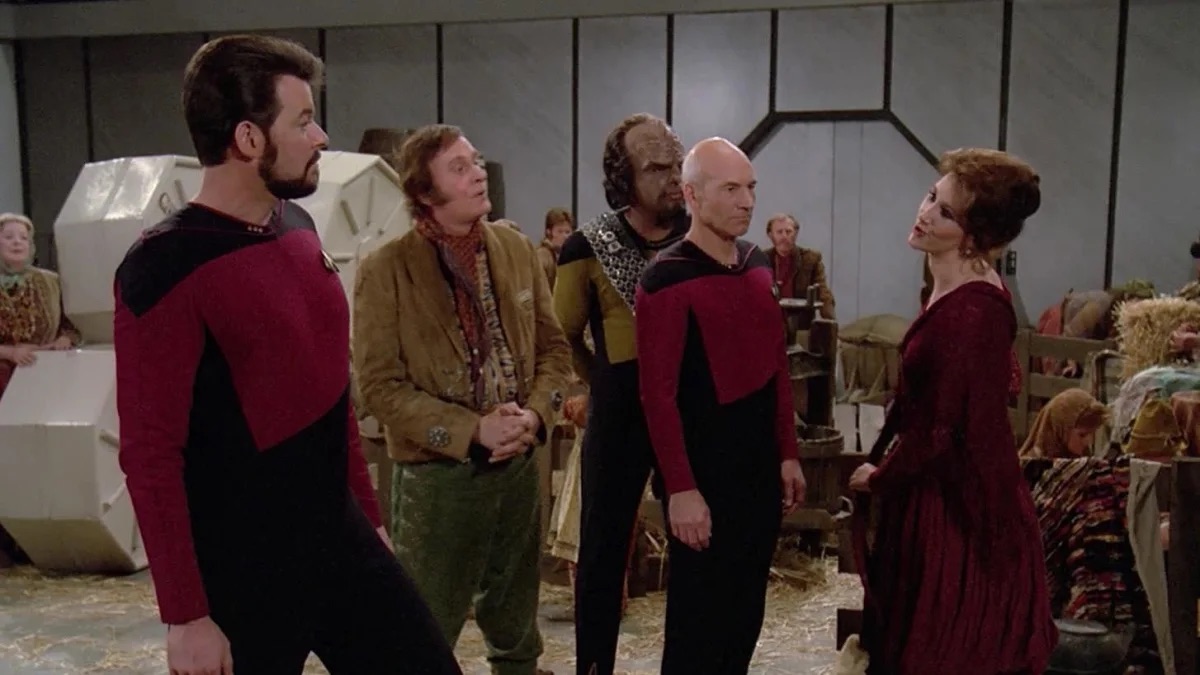
The thing about this episode is that—hmm, how can I put this?—it royally sucks. It’s a poorly structured mishmash of elements (a thoroughly stereotypical old-worldish colony that’s presumably supposed to be funny, a bit of romance that goes nowhere for Riker, Worf has Klingon measles, a society of clones…), it relies on cheap tricks to try to manufacture humor, it offers very uneven characterization, and it portrays two POTW societies in an all-too-first-seasonishly unconvincing way. Worse, it also attempts (so crudely as to be blatantly offensive) to shoehorn in a heavy-handed message that’s one part pro-choice and one part anti-cloning, yet would probably not sit well with most anyone who had strong views on either side of these issues. I probably hate this piece of trash even more than I hate “Pen Pals,” and I dearly wish that it had never been made.
Let’s start with the message. Frankly, this episode’s “argument” makes the pro-choice camp look so utterly clueless that it would probably be more effective as a satiric critique of pro-choice propaganda than as an actual pro-choice message show. To start with, the analogy that it employs doesn’t even come close to applying. Yes, I agree that it’s unacceptable for the colonists to assault Riker and Pulaski and take tissue samples from them without their consent; no one is arguing that assault is okay. At best, though, this makes the situation analogous to that of aborting fetuses conceived as a result of rape—a pretty weak foundation upon which to construct a general pro-choice message. But even if that point is conceded, the episode is still way, way off base, because once the crime has been committed and the tissue samples are in the cloning lab, the rest of what happens no longer poses any threat or challenge to Riker’s or Pulaski’s rights or freedoms. They can both go about their business, the ship can warp out of the system, and the fact that there are clones of them on this planet need never concern them again; it’s not even remotely analogous to the situation of a pregnant rape victim, who has a fetus actually growing inside her body. In fact, if you think about what Riker and Pulaski do in this episode, the implication is that if a woman is raped, gets pregnant, carries the fetus to term, gives birth, and then gives the child up for adoption, she still has a right, afterwards, to decide that she doesn’t want a person who is genetically her child to exist, and therefore to seek the baby out and kill it. If that’s the message that the writers of this episode intend to convey—well, kudos…I guess.
In addition, regardless of one’s take on abortion, for Riker and Pulaski to beam down to the lab and phaser the clones to death seems radically at odds with Trek’s usual “respect for all life” stance. Since the episode doesn’t even come close to raising the real issues that are involved in the abortion debate, nor does it otherwise bring up the idea that there might be circumstances that confound the simplicity and “moral certitude” (to borrow a phrase from Picard in an earlier bad episode) of the values that the show usually espouses, this reversal of those values constitutes a glaring inconsistency. To be clear, I am not arguing here that Trek’s “respect all life” values preclude a pro-choice stance. This is a messy grey area that is very much about resolving values that can be somewhat at odds with each other. Had the episode addressed this and really dug into the relevant issues, it could totally have had at least some of its main characters come down on the “pro-choice” side. But as it is, the effect is to glaringly disrupt suspension of disbelief—and to appear blatantly contemporary and political, rather than true to the fictional mythos and successfully allegorical. In fact, when you add in the casual advocacy of non-monogamous mating at the end of the episode (an issue that is mostly played for laughs), one wonders if the writers’ intent isn’t simply to offend conservative values and sensibilities for the fun of it, rather than to actually make any kind of point.
Another problem is that I just don’t buy (or care for) Riker’s childishly small-minded, knee-jerk reaction against the idea of being cloned—much less Picard’s complacently spewed-out-his-ass assertion that Riker’s attitude will be found to be universal among his crew. This makes the regular characters (and by implication, twenty-fourth-century humans in general) every bit as closed-minded and irrational as the episode would have us think that the “determined to be a society of clones even though it’s an untenable proposition” Mariposan colonists are. And on that last point, isn’t the potential sustainability of the colony’s way of life dismissed awfully frivolously by the Enterprise folks? Okay, sure, they haven’t solved a key medical issue that limits the long-term viability of cloning as a means of perpetuating a society. Still, they have built a clone-based society that has been functioning for over two centuries! Pulaski calls an infusion of DNA “postponing the inevitable,” but when the “inevitable” can be postponed for centuries—and then, if necessary, postponed again (via another DNA infusion), and so on, pretty much indefinitely—how “inevitable” is the catastrophic end that she foresees, really? And is it really unthinkable that in the centuries that an infusion of DNA buys them, no one will manage to come up with a solution to the underlying problem? Or that nowhere in the Federation can an available source of human DNA possibly be scrounged up that these people could use? Maybe the biggest irony of this episode is that for all its apparent embrace of unconventional mores, its writers seem so hysterically repulsed by the idea of cloning that they depict our heroes as willing to do almost anything—kill clones outright, stomp all over an entire society’s way of life and doom it to perish unless it radically changes its ways, etc.—to stop it from happening!
Then, of course, there are the numerous more “routine” bad things about the episode. For starters, scenes like the one in which Picard, for no reason at all, has a burst of ill-tempered impatience and won’t even listen to Riker when the latter is trying to communicate to him that there’s an issue to be dealt with, all so that the episode can get away with creating a “funny moment” when O’Brien beams up a bunch of farm animals, make me very angry. Later, sort of (but not really) to the episode’s credit, Picard deliberately chooses not to be Mr. Stodgy-Ass Irate Curmudgeon when confronted by the disorderliness of the colonists in the cargo hold. Instead, he bursts out laughing at them, and we are presumably supposed to not see this behavior as inexcusably disrespectful and patronizing. For that matter, everything about the episode’s portrayal of the people from the first colony is really pretty insulting. Not only is it a broad cultural caricature, but it also seems to overlook the fact that these are future-dwellers who have embraced a “simpler” lifestyle—not representatives of an actual premodern culture! As such, their depicted manners and worldview seem entirely anachronistic. And finally, picking up on what I said earlier about the extent to which the episode consists of an ineptly tossed-together mishmash of disparate elements: Just what is the point of the Riker/female colonist and Worf/Pulaksi subplots that fill time in the first half of the episode, then vanish? (The Worf/Pulaski material seems to earn the episode some points with quite a few fans, but to me it’s mostly just…weird—as well as a bit underdeveloped.)
Finally, we come to the matter of how the episode’s two storylines are resolved in the end. On the one hand, anyone who’s even sort of half-assedly trying can see more or less where the episode is ultimately going once the clone society’s problem becomes clear (and although we’re obviously meant to think that combining the two colonies is a clever and amusing notion, it just so, so isn’t). But despite being fairly obviously the plot’s eventual destination, the idea is not set up thematically in an at all successful way. I mean, okay, I’ve actually come across an intriguing interpretation to the contrary. My favorite commenter on another site argues here (first comment after the review) that the ending is actually the whole point of the episode, which is fundamentally “an allegory about how humans need both the unsophisticated carnal side and the sterile sophisticated side in order to live.” But I find this interpretation rather…charitable. Neither society is depicted as having any characteristics worthy of much respect or admiration, nor does either side’s problem actually stem from its lack of the other side’s characteristics (as even the author of this interpretation himself later acknowledged). However all of that may be, though, the “combine the two societies” ending also has glaring execution problems, in that the members of the two groups themselves don’t seem to see any shortcomings in their respective ways of life; our enlightened “heroes” more or less force them to combine and mutually adapt. Another commenter on the same site that I just linked to, indeed, characterizes the ending as “three men, including Picard, bargain away women’s sexual freedom in exchange for shelter”—and while this framing zeroes in exclusively on one (very egregious) aspect of what I see as a much more broadly problematic “solution,” it’s a solid point. The reality of what would lie ahead for this combined society (if one bothers to take the idea at all seriously) is deeply disturbing and unpleasant (probably involving a near-total sacrifice of individual freedom for many), but Picard and company pretty much chuckle their way through it and then head off on their merry way. Ugh.
In short, nothing about this abject crappisode works at all.