
Deep Space Nine‘s pilot episode is nothing less than a masterpiece. I could call it the best pilot episode of any Trek series (as many, though for some reason not all, other fans/critics do), but honestly, that kind of feels like damning it with faint praise. I mean, what’s even the competition? I’ve said my piece about not needing to trash TNG in order to acknowledge the distinctive merits of DS9, but when it comes to comparing their respective debuts? “Encounter at Farpoint” had some cool ideas in it, but much of it was terrible, and it kicked off an entire season of episodes whose writers clearly had almost no clue what they were doing. (I haven’t watched either of the original series’s pilot episodes recently enough to feel confident speaking about them, but I do know that neither is remotely in “Emissary”‘s league—and as for the Trek shows that came after DS9, I generally take a “the less said, the better” approach.) “Emissary,” for its part, isn’t “merely” a great pilot episode (though it absolutely is that); it’s a phenomenal episode, full stop. It had an enormous amount to accomplish just to successfully launch the series, and it accomplishes most of that brilliantly, while also telling a profoundly moving and thought-provoking character story on par with some of the best episodes from any Trek series, and offering up some heady and classically Trekkish science fiction. It does have a few rough edges, but honestly, most of them hardly matter to me (and they just absolutely pale in comparison to the polishing that TNG needed, upon its debut, in order to mature into something decent). Clearly a labor of love on the part of series co-creator Michael Pillar, “Emissary” is fucking amazing.
TV pilot episodes can be divided into premise-establishing pilots (those that function as the start of their show’s story, by bringing its characters together for the first time or showing the events that otherwise bring the basic situation of the show into being) vs. “typical episode” pilots (which merely aim to convey what the show will be like from week to week). Both TOS pilots were of the latter sort, whereas TNG and DS9 both have premise-establishing pilots. But although “Encounter at Farpoint” does fall into the premise-establishing category (Picard takes command of the new Enterprise, the main characters are mostly meeting each other for the first time, etc.), it doesn’t have to work very hard to establish that premise—partly because it was already familiar to the audience (being essentially a repeat of TOS’s premise), but also because its premise is really pretty straightforward (after all, TOS itself was launched via “typical episode” pilots). DS9’s pilot, by contrast, had its work cut out for it: like any pilot, it had to introduce the show’s characters to the audience, establish a tone and a style and a voice, etc., all while also telling its own particular story, but it also had to set up the idea of the Cardassian withdrawal from Bajor, the Federation establishing a presence there aimed at helping to prepare Bajor for Federation membership, Starfleet setting up shop on a formerly Cardassian space station for this purpose, what kind of a place that station is, a bit about the general political situation on Bajor, the Bajoran religion, etc. Also, the show’s cast of characters includes not just the usual Starfleet officers (and family members), but a Bajoran militia officer, a mysterious misfit shapeshifting constable, and (of all things) a Ferengi bar owner, all of whom are present for different reasons and on trajectories with uncertain futures that the pilot needs to introduce and pull together. And even with all of that on its agenda, the writers chose to start the episode with a flashback to the Battle of Wolf 359 (which has nothing to do with the show’s setting or premise at all, per se), in service of the character story that they wanted the pilot to tell—a gutsy move, for sure, but one that pays off brilliantly.
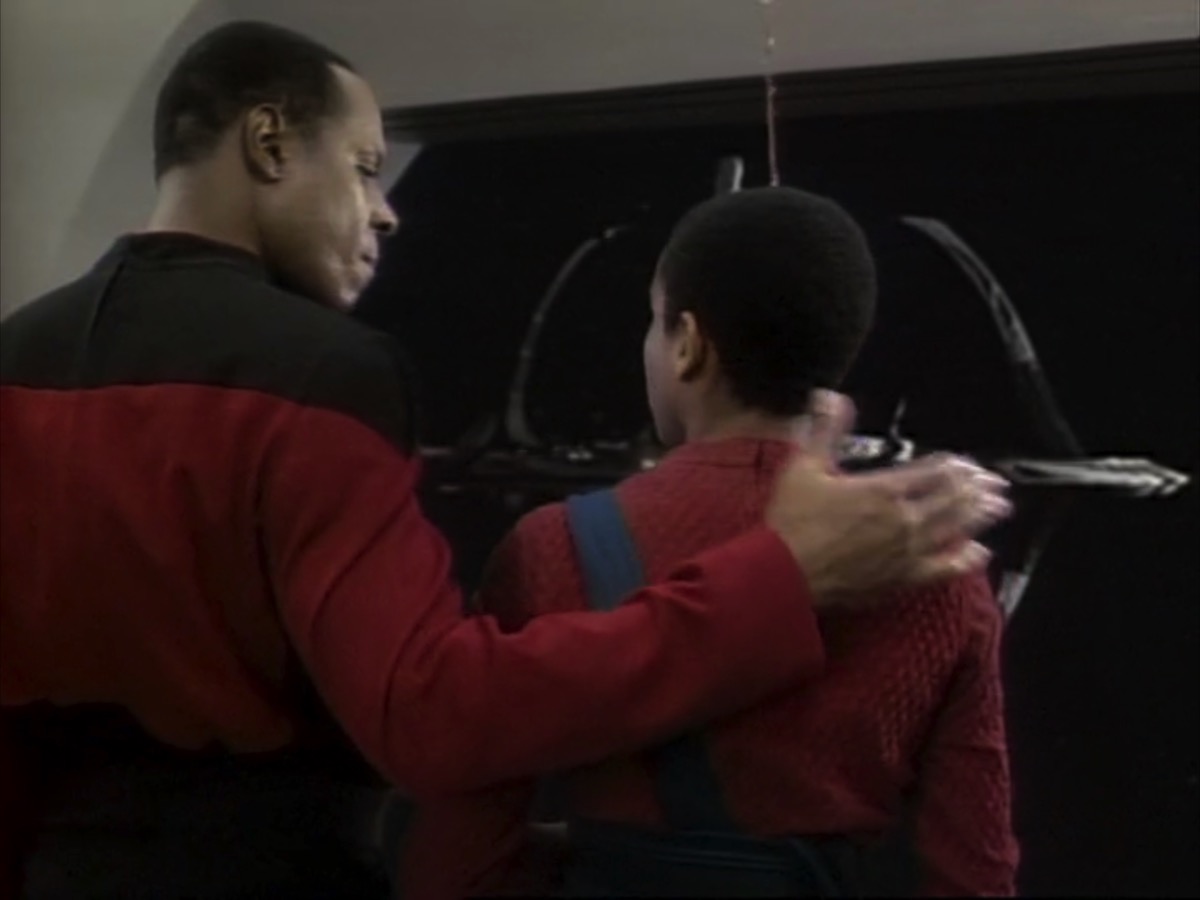
The entire pre-main-credits section of “Emissary” does so many things so right. The flip side of my observation that opening with a flashback to events unrelated to the show’s setting/premise was an audacious move is that it also amounted to starting off in a familiar space for the audience, both in the sense that the action takes place on a starship and in that the battle, of course, is a known event. We first meet our new leading man as the first officer of the Saratoga, a role that we all immediately understand from our previous Trek-watching experience; then, right away, we witness the life-altering trauma that he will still be struggling to deal with when our story proper begins. The episode sells the hell out of that trauma, in a gripping sequence wherein one minute he’s a heroic officer taking charge of evacuating a ship whose captain is dead in the few remaining minutes before it explodes (and rescuing his own unconscious son), and the next minute he’s reduced to a helpless, frantic husk of a man who has to be physically hauled away from his dead wife to prevent him from becoming a casualty as well. A lot of what’s to come later in the episode depends critically, for its effectiveness, upon the audience fully understanding what this experience did to Sisko, so it needed to be as intense as it is. Then we cut to three years later, giving the audience a chance to see him interacting with Jake in more normal circumstances and introducing the father/son bond that the show will consistently portray so effectively over the years ahead. Finally, the teaser ends with Sisko and Jake, and the audience, getting their/our first glimpse of the station that is to serve as their new home and the show’s primary setting. The characters aren’t yet sure how they feel about this strange new place, and neither is the audience, but the show takes the requisite moment here to allow both them and us to take it in, hanging majestically in space in all its alien glory, while the soundtrack provides us with our first taste of the show’s signature musical fanfare. It’s the key mythologizing moment for the new series—and it’s followed immediately, of course, by the show’s gorgeous opening credits sequence.1 (Again, I take no stance on which show (TNG or DS9) is “better” overall…but when it comes to their respective main musical themes, DS9 wins by a landslide; I love this show’s main theme, and it’s just so perfectly suited to the show that DS9 is.)
One of the many remarkable things about this entire episode is how well it manages to accomplish all of its essential tasks without feeling like it’s trying too hard to shoehorn everything it; the storytelling nearly always feels like it is just proceeding naturally from one moment to the next, with most of the exposition, tone-setting, and introduction of characters feeling like it happens organically. There’s a wonderful atmosphere of chaos and desolation when we first arrive, with our main character (and his son), on the station; the Cardassians have wrecked the place, its civilian population is mostly ready to pack up and leave, etc. As we watch Sisko take all of this in and begin to get a feel for the place, we also see him interact for the first time with various other characters. We have O’Brien on hand to show Sisko/us around (again, the writers use something familiar—in this case, a known character—to ease us into the unfamiliar setting that they’ve cooked up for us), as he’s already been here for a couple of days. We meet Kira (more on her later), and then we meet Nog and Quark and Odo via events that feel like part of the general chaos in which we find the station, but that also manage to communicate a fair amount about who these characters are. Meanwhile, we’re also still getting to know Sisko himself, and seeing more of his and Jake’s relationship, as he does his best to ease his reluctant son into this new chapter in their lives; so much character is revealed, for example, in the scene where O’Brien shows them their quarters. Through all of this, the episode is in no rush to get to anything that we would conventionally call a “plot,” and this is all to the good (though one quick moment of foreshadowing, when a vedek greets Sisko on the promenade, promises intrigue to come).
The scene between Sisko and Picard is a crucial one that does a lot of heavy lifting for the episode. First, it’s yet another example of using the familiar as a launching pad for the new, albeit this time with a twist, as the episode highlights explicit contrasts between what TNG was and what DS9 will be. The classic exchange here about serving in an “ideal environment” (or not) announces the writers’ intention to aim for a “grittier” tone for the new show, and helps to set up the idea of it being (as many others have observed before me) about “building the Federation on the frontier,” where Trek’s 24th-century ideals have not yet taken root. It also positions Picard a bit awkwardly (albeit through no real fault of his own), as he has to deliver the line about Starfleet officers not necessarily having “the luxury to serve in an ideal environment” from his cushy position as captain of the flagship. If he comes off as a bit less than sympathetic to Sisko’s concerns, though, it’s understandable, given that Sisko starts their meeting by being horrendously unfair to Picard (to the point of actual cruelty, in fact, considering that Picard’s experience as Locutus was at least as traumatic for him as the loss of Jennifer in the Borg battle was for Sisko), and continues to offer nothing but stiff, wooden hostility throughout their brief chat. The dialog also lets us in on the fact that, despite his efforts to sell Jake on the move to the station, Sisko isn’t sure himself that he even wants this assignment. The writers are again taking a bit of a chance here, deliberately making their protagonist hard for the audience to like…but it works2, thanks to the effectiveness of that opening flashback, and it serves to remind us that even though he appears to be functional and holding together well enough most of the time, Sisko is carrying a deep psychological wound that has, in three years’ time, not so much begun to heal as merely become superficially scabbed over. At the same time as all of this, the scene also lays out some key exposition concerning the show’s basic premise, including clarifying that Sisko’s primary mission/assignment, and the purpose of the Federation presence being established here, is to help prepare Bajor for eventual Federation membership. Plus, in doing these various things all in the same scene, some obvious parallels present themselves, which point to a major theme: Benjamin Sisko is a broken man; DS9, the station, is half-wrecked; Bajor is in ruins after sixty years of ruthless occupation by the Cardassians. This new show, clearly, is going to be a show about rebuilding.
Indeed, the very next scene is explicitly about exactly that. We learn that Sisko, despite not being committed to even being here himself, has immediately and instinctively grasped a core element of what the station as a community needs to move forward, so he makes his pitch to Quark about staying and serving as a “community leader.” It’s another moment that sets up what will be a signature theme for the show (about investing in and committing to the problems and needs of a particular place, over the long haul), and it’s also the first time that we really see Sisko acting decisively, taking a situation in hand, and “handling” people to achieve his ends. It begins the process of redeeming him after his poor behavior toward Picard in the previous scene, and is just generally awesome. This move on his part is also a first step toward winning a skeptical Odo over to him. Meanwhile, we also see him trying to build a bridge between himself and an openly hostile Kira (who, we learn, is here partly because Sisko requested to have a member of the Bajorian militia as his second in command on the station). Despite his own misgivings, and the negative attitude that he displays when talking to Picard, it’s clear from the outset that Sisko is the right person for this complicated and difficult job.
This feels like an appropriate place for me to go on record as saying that the whole idea of giving the series a specific narrative agenda—in that Starfleet is setting up shop here in order to help Bajor and prepare it to join the Federation, and the pilot sets this up as the goal of the show’s overarching story—is something that I have long regarded as a total stroke of genius. To begin with, it builds the potential for some degree of serialization right into the show’s DNA. It also gives the new show a specific thematic identity that helps it to carve out its own niche within the larger franchise, and creates openings for a wide array of individual stories that are different from most of what we’ve seen on previous Trek shows, yet still directly relevant to the familiar Trek universe and the franchise’s overall identity. Specifically, the focus on a civilization that has just emerged from a lengthy and devastating foreign occupation, remains torn by internal strife, and has to find a way to pivot from fighting an external enemy to rebuilding a functioning society—as well as the fact of the Federation being another outside entity, and needing to distinguish itself from the other guys and find a way to win hearts and minds, helping Bajor without being overbearing or impeding Bajoran self-determination3—is ripe with potential for exploring moral complexities. Again, it’s such a great setup for exploring the boundaries of Trek’s idealized future setting, and investigating how a troubled, divided, and war-ravaged society might possibly work toward becoming the kind of society that we’ve always been asked to believe that the Federation represents. So, for me, this aspect of having a kind of “mission statement,” and the specific narrative focus/goal of guiding Bajor along the road to Federation membership, is not only awesome, but is in fact what makes DS9 DS9. I’m aware, though, that not everyone shares this opinion; unaccountably, there seem to be no small number of folks out there who find the show’s Bajor-oriented stories “boring,” and/or are impatient with its exploration of the Bajorans’ religion, and/or feel that the show only “gets good” after the first few seasons, once its focus starts to shift away from Bajor and toward the Dominion and so on. Personally, I find all reactions of this sort to the show utterly baffling. Everyone is entitled to their own opinion, but if your take on the series is along any of these lines, then you and I are just not going to see eye to eye much of the time. For my part, while I find plenty to like about the show’s later seasons, I regretted every move that it ever made away from the core narrative concerns that it assigned itself at the outset. I don’t want to overstate this; I would never go so far, for instance, as to suggest that every episode should have been about the same thing, or that the writers should not have allowed the show to grow and change as it unfolded, finding new topics and themes to explore in addition to the ones that it started with. But I did always want the show to remain true to the distinctive identity that it had carved out for itself, and to follow its narrative agenda through to a satisfying conclusion—and the degree to which individual episodes do or don’t contribute/live up to this will absolutely be one of the criteria by which I evaluate them in these reviews.
Additionally, while I will eventually become frustrated with some of the ways that it gets handled in later seasons, I specifically find the Bajoran religious element of the show immensely engaging—and, to be clear, I say this as a staunch atheist who has always appreciated Trek’s secular humanist outlook and wanted each incarnation of the franchise to remain as true to it as possible. Star Trek is about a future in which humanity has grown beyond superstition and mysticism to embrace an ideal of scientific progress infused with humanist values…but it is still/also a cultural product made by and for real-life late-twentieth-century humans, who, on the whole, had not. This means that faith/spirituality, sectarian conflict, tensions between religious and scientific worldviews, and so on are all relevant aspects of the human experience, and I see no reason why Trek should hold back from exploring them. Such exploration has the potential, on the one hand, for meaningful commentary about religion that is in keeping with Trek’s historic secularist values. But also, the show would frequently prove (at least to my personal satisfaction) that it is perfectly possible to comment on these topics in ways that, while holding true to the aforementioned values, also remain respectful of contrasting values and worldviews. So, yes, the show can absolutely depict the Bajorans as (in Quark’s, admittedly mildly sarcastic, words) a “deeply spiritual culture,” and can explore the ways in which this both helps and hinders them in their struggles, and can mine the clash between their values/worldview and that of our more familiar Starfleet characters for interesting drama, etc., all while still being Star Trek.
In “Emissary,” Kira apprising Sisko of the importance of religion to Bajor, and its potential to unite the Bajorans and stave off civil war, serves as the entry point into the straightforward plot of the episode. Not everything about what follows fully works for me, in all honesty, but what’s there is intriguing, and lays a foundation (exactly how intentionally vs. accidentally has never been clear to me) for cool stuff that will come later in the series. From a story structure point of view, the vedek whom Sisko met earlier popping in again right after Kira tells Sisko about Kai Opaka, and then immediately taking him to see this important but reclusive figure whom Kira has just said rarely agrees to see anyone, is one moment in the episode that does feel a bit contrived. I like that all of this happens, but the manner of its happening feels a bit abrupt and convenient, with not quite enough connective tissue getting us from a to b. Opaka herself proves to be someone whom I would find infuriating as an actual person in real life, but she works for me as a character, and specifically as the mouthpiece and focal point of Bajoran spirituality. She’s the typical religious leader type—declaring that “the threat to our spiritual life . . . far outweighs any other,” making cryptic remarks, convinced that her beliefs (about pagh and so on) apply to everyone/Sisko whether they/he believe in them or not, etc. I sound critical here, I know, but all of this is actually fine with me; the episode doesn’t spell out what’s going on, but I’m on board with the idea that she has some level of awareness, derived from the wormhole aliens/prophets via the orbs, both of Sisko’s present inner conflicts and of his future significance to her people, and her assigning Sisko the task of finding the “celestial temple” before the Cardassians do pushes the plot/story forward. It’s just that, as a person, I find Opaka’s lack of self-awareness, and apparent obliviousness to the gulf between Sisko’s worldview and her own, rather irritating! But what doesn’t quite work in the story, again, is some of the execution details. The encounter between Sisko and Opaka feels awfully abbreviated; we don’t even see Sisko actually make his pitch to her, and her concerns about the orbs and the temple (and the premise that the Cardassians care about any of this) feel like they sort of come out of nowhere. Additionally, the episode skips straight from this (following some unrelated bits of business) to Sisko and Dax duly devoting themselves to the task of searching for this “celestial temple,” without showing us Sisko mulling over what the Kai has told him and coming to the decision to take it seriously and make it a priority, or circling back to discuss it with Kira, or anything. Again, this is a place where it does end up feeling like some shortcuts were taken in order to squeeze everything into the pilot’s limited run time. And then, on a more ambiguous note: It’s never really been clear to me exactly what was (or wasn’t) in the minds of the writers, as it relates to future developments, when Opaka says here that Sisko “is to be the emissary.” I mean, on one hand, the episode is entitled “Emissary,” so clearly this was intended as more than just some throwaway line; but on the other hand, at no point within this episode are the dots ever explicitly connected that the aliens whom Sisko encounters in the wormhole are Bajor’s “prophets,” or that Sisko, by his encounter with them, has become an important figure to the Bajoran religion. Indeed, I recall searching in vain (as I caught myself up with the show after becoming a regular watcher of it somewhat late in the game) for the episode or moment when Sisko’s role as “The Emissary” was initially, clearly established. Of more immediate concern, though, is the fact that the episode kind of seems to forget about Opaka in the end, and to skim over any religious significance to the Bajorans of Sisko’s discovery of the wormhole. It’s totally fine to leave some things for future episodes to develop and explore, of course, but it does feel like the story thread that Opaka sets in motions never really resolves, and that’s unsatisfying.
Following Sisko’s visit with the Kai, there is a bit of an interlude during which we see that his appeal to Quark has borne fruit, meet the rest of the main characters, and have a kind of handoff/torch-passing moment with the departure of the Enterprise. The thematic thread uniting these various scenes is a sense of things settling into place, and the station/show coming into its own. This feels like a necessary part of the pilot, and I like all of the individual moments here; still, when it comes down to it, I might have preferred for some of this material to be postponed to a future episode, to make space for some of the missing pieces that I identified above. That said, I might as well devote some space here to my thoughts about the various main characters, at least as introduced/presented in this episode.
- Sisko, of course, is the character whose point of view we primarily inhabit; much of what I have to say about him thus has/will come as part of talking about the main character story of the episode. But I should say explicitly here that I immediately like and empathize with him. He feels intriguingly different from the captain characters we’d known prior to DS9 (and, indeed, he’s not even a captain by rank)—not least in that he’s a father (plus, of course, there was the real-world significance of making the show’s leading character a person of color).
- Kira is the next-most-significant character to the story, in that she does, to a point, have her own little arc, but she’s also the character whose portrayal in the pilot is most in need of refinement. She comes across as a bit over the top in several of her scenes, and her hair-trigger temper doesn’t quite feel convincingly real. Also, and tying in with what I’ve already said about some bits that do feel missing from the episode, I wish for a little more integration between her character/arc and the main plot. I like watching her prickly aloofness start to give way a bit as she, O’Brien, and Dax start working together toward common goals, and I love the bit with her immediately grasping the potential significance for Bajor of the wormhole, and it bringing her around to seeing value (however grudgingly) in a relationship with the Federation. What’s missing, though, is any kind of reaction from her to Sisko meeting the Kai and deciding to search for the celestial temple; she tells Sisko about the importance of religion to the Bajorans, but the episode thereafter pretty much totally sidelines her as Sisko actually takes this to heart, and her reaction to the discovery of the wormhole is entirely about its strategic importance, with no attention to any spiritual significance. This seems like a real missing piece. (We didn’t necessarily need a lot here, but we needed something.)
- The episode doesn’t need to introduce us to O’Brien, but it does give us a fair amount of him, and he steps up nicely into main character status after years of being a fun recurring secondary character on TNG (going all the way back to its pilot!). The farewell scene between him and Picard is sometimes criticized for being a bit stilted and awkward, but I actually disagree; I interpret the awkwardness as intentional, and I appreciate how the show depicts them both as wanting to have a moment, but doesn’t try to manufacture some big bond between them that TNG had never established to exist. The banality of their exchange feels right to me, and makes, in its own way, for a relatable and human moment. (If I do have any criticism regarding the pilot’s handling of O’Brien, it would have to be that it’s a bit odd that we don’t see Keiko or Molly at all).
- Though we learn almost nothing about him or his back story, Odo is an immediately intriguing character, both in a “hey, cool, a shapeshifter” fun sci-fi way and also in that he’s this odd, curmudgeonly guy, who right away establishes himself as a force to be reckoned with on the station—and the seeds of the whole Odo/Quark relationship do get planted early on, which is cool. The scene wherein Odo adds himself to the party heading out to search for the vanished wormhole (and Sisko) is frequently called out as contrived by other reviewers, but honestly, it seems fine to me; it takes up only a few seconds, works in a key element of back story for the character, and feels plausible enough.
- Nearly everything about Quark is sort of baffling to me. On one hand: given how abysmal a failure the Ferengi had been, from day one onward, on TNG, the writers’ decision to create a Ferengi main character for DS9 is a hard one to understand. On the other hand: somehow, from his very first scene, and in stark contrast to every Ferengi we’d ever seen before, Quark manages to come across as an actual person, in whose reality I can readily believe, instead of as a god-awful, cringe-inducing caricature and/or ultra-lame, one-note joke. How…did this this happen? I scarcely have words to express how confounding it was, as DS9 unfolded, to discover that I actually liked Quark as a character. The writers, like Sisko, astutely realized that the station/show needed a non-Starfleet, civilian character and space to serve as the focal point for the idea of the station as its own little community, and Quark/his bar fit the bill perfectly. He’s a great addition to the show, and Armin Shimerman is fantastic in the role. That said, I do recall feeling, on past watches of the show, like its treatment of Quark often made little sense; if memory serves, the other characters tend to be rude and dismissive toward him without this being presented as problematic, on one hand, while on the other, he will also routinely be let off the hook for some pretty seriously unscrupulous acts. I intend to follow this closely as I progress through my reviews.
- Dax, like Kira, comes across in the pilot as somewhat unfinished; her demeanor feels stiff and stilted much of the time, and although the orb-induced flashback showing her memory of receiving her symbiont does establish some back story (and sets up the moment where Sisko first calls her “old man”), it doesn’t really develop her character meaningfully (and is, accordingly, probably my first choice for a scene that could have been cut to make room for other, more story-relevant, material). I like the idea of her character as sketched out in the pilot, though.
- Bashir plays the least prominent role in the pilot of any of the main characters, but nevertheless immediately emerges as distinctive and interesting, with his self-involved naïveté. Unlike the Dax flashback scene, the Bashir/Kira scene in which the doctor enthuses about “frontier medicine” does establish character, as well as helping to set up the show’s overarching themes, and for these reasons, I like it in the pilot. Still, it too is a scene that could have waited for a later episode.
Following the O’Brien/Picard farewell scene and the TNG-to-DS9 handoff moment as conveyed by the departure of the Enterprise (accompanied, in a nice touch, by a rendition of the classic Alexander Courage Trek fanfare that segues into the DS9 theme), “Emissary” has one more character introduction in store for us: that of Gul Dukat. From his small role here in the pilot, a first-time viewer might not guess the extent of the depth and complexity with which future episodes would imbue this character, but he emerges as an immediately likeable/hatable (and formidable) presence. The DS9 Companion notes that the role of Dukat was recast at the last minute, and that in contrast to the original actor (who “lacked a certain presence”), the amazing Marc Alaimo immediately embodied the character (which comes as no surprise to me, given what he brought to the Cardassian gul whom he played in TNG’s “The Wounded”4). Indeed, it’s easy to imagine Dukat’s whole friendly-yet-menacing, more-subtext-than-text presentation, when “casually” asking Sisko about the latter’s visit with the Kai and his possession of an orb (when the Cardassians had thought they had all of them), being played in any number of less interesting, more on-the-nose and/or one-note, ways, with some other actor in the role. As it is, though, we understand that Dukat is chagrined at this turn of events, and perhaps more personally invested than he really ought to be, despite his outwardly magnanimous and even amused demeanor. He’s a menacing antagonist, yes, but even here, he’s already just a little bit…more, if in an as-yet-undefinable way. Also, his entrance into the story is another example of the pilot juggling its various tasks deftly. We needed to meet the former Cardassian prefect of Bajor (and commander of the station) in this episode, as a part of its general establishment of the setting and the ongoing story of the show, and his little chat with Sisko serves to establish him as a distinct character and inaugurate the ongoing relationship that will play out between him and our central protagonist throughout the show’s run—but at the same time, his arrival (or that of Cardassians generally) kicks the pilot’s specific plot into gear.
The centerpiece of that plot, of course, is the discovery of the wormhole, which not only provides a brief (and triumphant) dose of classically Trekkish exploration/discovery geekery for our brooding, damaged central character (and his weird Trill science officer/sidekick), but also pulls together all of the disparate elements out of which the new show is being crafted: The wormhole is, on one hand, the Celestial Temple of the prophets, cementing the role of the Bajoran religion in the story. It also becomes Bajor’s claim to a new relevance in the larger world of alpha quadrant politics, as well as, of course, a source of ongoing conflict and tension with its recently departed Cardassian oppressors. It’s the show’s connection to a new frontier in the gamma quadrant, making the station a crossroads and focal point for new cultural encounters, and opening up all kinds of story possibilities (including, eventually, the introduction of the Dominion). It will eventually fill in Odo’s mysterious back story, and provide a path to his future self-discovery. And, in the immediate story, his encounter with its inhabitants is what gives Sisko the push that he needs to become unstuck emotionally and move forward with his life (including embracing his assignment to DS9).5 I have a fair amount to say about the Sisko/wormhole aliens encounter sequence, but overall, the main takeaway is that I consider it an absolute tour de force—the heart and soul of “Emissary” as an episode, and the clincher for its claim to a five-star rating, notwithstanding the flaws that I’ve acknowledged. It’s engaging, philosophically compelling high-concept sci-fi that also packs profoundly emotional punches, and it fully pays off Sisko’s character story in a way that exceeds any expectations I could ever have had (not that I can specifically remember having any, mind you; my recollection of seeing this for the first time is extremely dim, actually). Bizarrely, a lot of fans seem to see it differently; besides those who dislike anything to do with the Bajoran prophets, there are also many who, even if they appreciate some things about it, seem to find this sequence cheesy, talky, half-baked, repetitive, poorly acted, and/or overlong.6 I profoundly disagree; for me, it’s the absolute high point of the episode, and I feel fully engaged on every level each time I watch it.
Here’s something that I have kind of been bursting to expound about for years: Besides everything else that “Emissary” is, one aspect of this episode that rarely seems to get acknowledged is what a thoroughly Trekkish “first contact with a new life form” story it is. Anyone who doesn’t like Sisko, or who sees him as an unworthy successor to previous Trek captains (and there seem to be surprisingly many fans out there who feel this way), really ought to take another look at these scenes in which a lone Starfleet officer, lost somewhere in a wormhole and at the mercy of alien beings he knows nothing about, reaches out across the gulf in understanding between himself and them, and seeks to achieve a mutual understanding, in the best Starfleet tradition:
That may be the most important thing to understand about humans: it is the unknown that defines our existence. We are constantly searching—not just for answers to our questions, but for new questions! We are explorers. We explore our lives, day by day…and we explore the galaxy, trying to expand the boundaries of our knowledge. And that is why I am here: not to conquer you with weapons, or with ideas, but to coexist, and to learn.
It doesn’t get much more classically Trekkish than this, folks!7 The wormhole aliens’ initial distrust of Sisko, and his successful placation of them and establishment of something resembling the foundations of a relationship, is just one of several strands of what is going on in this sequence, and a possible criticism of it is that the straightforward resolution of this thread (wherein, per what Sisko says later in his log entry, the aliens agree to allow passage through the wormhole) isn’t actually shown (nor, for that matter, do we see anything about how Sisko comes to “rescue” Dukat). These are fair points, but they’re strictly plot concerns; on a story level, the breakthrough in understanding between Sisko and the wormhole aliens is communicated brilliantly.
Also, and contra anyone who finds the wormhole alien section of the episode muddled or repetitive or whatever, I find myself impressed by the skill with which multiple conceptual threads are woven together throughout it in an intellectually and emotionally compelling way. The encounter begins with the aliens being distrustful of Sisko, and the latter trying to convince them that he is not threatening. He seems to want them to examine his past actions in order to come to understand his good intentions (at least I assume this is why he brings up the idea that humans are defined by the sum of our experiences, right after offering to “prove” that he’s not a threat). But this sidetracks him into trying to explain the concept of linear time/a linear existence to them, as beings who exist somehow outside of time. This is an impossible task, realistically, as well as being impossible to depict, since (among other difficulties) conversation, and any movement from not-understanding to understanding, are inherently linear; still, as a sci-fi conceit calling for suspension of disbelief, the episode does a great job with it—and I’d argue that to some extent, the aspects of the sequence that some find disjointed or repetitive actually work to convey the idea that the encounter is, in some sense, happening somewhat “outside of time,” and that these beings are working their way toward grasping what Sisko is all about in a multi-threaded, non-linear fashion. So, in one thread, Sisko’s approach almost backfires when the aliens get hung up on the idea that if he doesn’t know what the outcomes of his decisions will be, then he must not be concerned about (or even capable of) taking responsibility for the consequences of his actions (which, of course, reinforces their initial view of him as dangerous). But Sisko responds by patiently explaining the idea of using past experiences as a guide in dealing with the uncertainties of the future. And then, in a semi-separate thread, the aliens’ struggle to wrap their non-corporeal heads around the idea of the past being inaccessible to a being whose existence is linear is impeded by their perception that Sisko himself is, in an emotional sense, stuck in the past. Meanwhile, on a sort of meta-level, all the talk about linear time, each day shaping the next, and dealing with consequences, serves to reinforce the idea that DS9 aspires to a more serialized form of storytelling, where the characters stay in one place and deal with its particular problems in an ongoing way.
All of this is intellectually engaging and thematically rich, but on top of that, the sequence is also both emotionally gripping and just plain fun. Because the aliens are manifesting as memories from Sisko’s mind, we get key moments from his past with Jennifer juxtaposed against Locutus of Borg and the cold brutality of the day when his life came crashing down around him. Watching our damaged present-day Sisko watch, in turn, a young, cocksure version of himself sitting in a park with his wife-to-be as the two of them, full of hope and optimism, tentatively begin exploring and imagining a future together, always kind of breaks me. Despite what some others seem to think, for my money Avery Brooks kills it throughout this whole sequence, selling all the emotional turns layered atop a general level of “what the hell is actually going on” confusion, and an anxiety about wanting to get it right and make something positive out of the encounter. Hell, even 14-year-old Cirroc Lofton, embodying a wormhole alien, nails the delivery of his lines about non-linear time that one can scarcely imagine coming out of the mouth of the “real” Jake (and it’s fun to watch the role reversal of him scolding his “dad” about taking responsibility for the consequences of his actions, too). It’s also fun to try to make meaning out of which person from Sisko’s life the aliens use as a guise when communicating different ideas/attitudes/questions. But above all, the part of the encounter that begins with Sisko trying to explain baseball8 is absolutely fantastic. Sisko just lights up in this scene; he’s in his element and full of passion and conviction, as though rediscovering something in himself that he’s lost touch with during the past three years, and the abstractions that he’s been struggling to communicate to the aliens suddenly all come together for him. Baseball becomes a metaphor for linear existence—for taking bold steps forward, embracing life’s uncertainties, and dealing with consequences as they unfold (and ultimately, of course, for space exploration and encountering new life forms)—and our wounded commander morphs, in these moments, into the best version of himself, the Sisko he ought to be, the classic Starfleet officer articulating the core values and mission of the organization that he represents. But then, wrenchingly, he finds himself abruptly yanked back to the Saratoga in the midst of the Battle of Wolf 359, with Jennifer dying before his eyes—the worst moment of his life—and the aliens demanding “then why do you exist here?” He runs an emotional gamut: first seeming disoriented and almost baffled, as though unable to reconcile this reality of his life with the person he felt like he was just seconds before; then frustrated and angry, lashing out; and then, finally, understanding begins to dawn, after the Opaka alien once again reminds him to “look for solutions from within.” Watching as the lieutenant drags him, flailing and protesting, away from his dead wife’s form in order to save his life, the wormhole aliens’ repeated refrain finally sinks in for him: “I…exist here.” The Jennifer-alien, who has started to understand him, calls back to a line of his from earlier to articulate the fundamental problem: “None of your past experiences helped prepare you for this consequence.” Sisko loses it, and the alien, driving home not only the moment of emotional catharsis but also the key philsophical issue and sci-fi conceit of the whole encounter, gets him to recognize that his inability to move on from this traumatic moment is “not linear.” Damn…it’s just so good!
Meanwhile, the confrontation between the Cardassians and the rest of the characters back on the station plays out engagingly enough, and even serves to do a bit of additional character work for some of the latter (Kira and O’Brien, mainly). In particular, I really appreciate that the pilot gives Kira a moment, at the end, when—despite all the anger and bravado that defines so much about who she is—she makes the first in what will become a series of “I’m a responsible leader now” decisions, and is actually about to call off the confrontation and surrender to the Cardassians in order to protect the lives of the people on the station, right before the wormhole reappears and disgorges Sisko’s runabout and Dukat’s ship, defusing the situation. If some aspects of the episode’s plot resolution feel missing/rushed/shortcutted, as I’ve already acknowledged that in fact they do, at least we do get to see our characters (and the station itself) bravely holding out as long as they can in the face of a Cardassian attack, and Kira swallowing her pride and acknowledging realities in a way that finishes out her little character arc within the pilot, before that happens.
Finally, the short end cap scene between Sisko and Picard ties the episode together nicely. Picard verbalizes the significance of the wormhole for Bajor, the station, and the show; Sisko, whose demeanor toward Picard is worlds apart from what it was in their previous scene, makes it clear that he has let go of his misgivings about his new assignment; and the two part with a respectful handshake. If one wanted to, one could even read the pair of Sisko/Picard scenes in “Emissary” on a sort of allegorical meta-level as symbolizing the tensions and uncertainties in the fan community over accepting this strange new show into Trek canon. The pilot initially leans into that tension, challenging the audience a bit by establishing disharmony between the known and beloved Picard and his counterpart on the new show; then, after taking us through the wormhole alien sequence, in which the show, in effect, proves its credibility as genuine Star Trek via Sisko’s passionate rhetoric about exploration, discovery, embracing the unknown, and peaceful coexistence, the two characters face each other again, and we see that the former hostility has vanished, and the tension between them has been resolved. I like it.
After that, all that’s left is to give us a quick taste of life aboard the station beginning to settle into its new patterns, and then we cut to closing credits, with a new show successfully launched!
- Or a version of it, anyway. A cool detail is that the usual bit where the wormhole appears/opens up is omitted from the credits sequence here in the pilot, since it hasn’t yet been discovered in the story. (Also and unrelatedly: Apparently I use footnotes for tangential comments and such in my reviews now. 🙂 It’s something that I started experimenting with in some of my reviews of the TNG movies, and it seems to have carried over to this review as well. We’ll see if this new habit persists when I get back to regular weekly one-hour episodes or not, I guess.) ↩︎
- Not for everyone, admittedly. The comments section of Jammer’s review, for instance, is full of people complaining about this and hating on Sisko over it, and it’s not hard to find similar gripes elsewhere online. To me, though, this reaction seems weirdly narrow and simplistic. We can recognize that Sisko is being irrational in this scene, and even feel the impulse to stick up for Picard, while also understanding why Sisko reacts the way he does and extending empathy to him. Characters get to have flaws, and can still be likable and root-for-able in spite of them! ↩︎
- Commenter William B on Jammer’s site finds yet another level of meaning lurking in the pilot, which relates to this while further tying the Borg stuff in the “prologue” to the rest of the episode. His thoughts (though I do strongly disagree with some of them) are worth reading in their entirety (see his comment dated June 23rd, 2015 under Jammer’s review), but to summarize this particular point: The Borg represent (as elsewhere) a dark mirror of the Federation (“a force which imposes a kind of homogenized order on the galaxy”), and similarly to how Kira initially fears that the Federation’s relationship to Bajor might not prove to be much different from that of the Cardassians, Sisko (whose Borg-inflicted trauma parallels Kira/Bajor’s Cardassian-inflicted trauma), too, perhaps feels some ambivalence at first about his/the Federation’s role—an ambivalence which is perhaps reflected in his conflation of Locutus (who seeks to forcibly assimilate) and Picard (who wants Bajor to join the Federation). Sisko’s encounter with the wormhole aliens, during which he reconnects powerfully with some of his own fundamental values (see the later sections of my own review for more on this), resolves this ambivalence, helping him to differentiate again between the Federation’s goal of peaceful coexistence and the Borg’s (or the Cardassians’) assimilationist/imperialist agenda. ↩︎
- It’s interesting that “Emissary” introduces both a Ferengi main character and a recurring Cardassian character (who would both become well-loved by fans), and in both cases, gives the roles to the same actors who had portrayed the very first members of each race that we ever met, back in TNG’s first and fourth seasons, respectively. Both were excellent casting choices, but whereas Shimerman succeeds by playing Quark very differently from how any previous Ferengi has been played, Alaimo takes what he did before and expands on it. One ends up feeling like he just instinctively “got” the Cardassians, and that he, as much as any of the writers, is responsible for the franchise’s successful realization of them as a distinct people. ↩︎
- There are a couple of plot questions about the wormhole, and the wormhole aliens, that it’s fair to ask. The biggest one concerns why no one ever discovered the wormhole/celestial temple before, given how quickly and easily Dax ends up managing to pinpoint a location. There may be no entirely satisfactory answer to this, but one explanation might be that the Bajorans lacked the freedom and resources during the occupation, while the Cardassians, perhaps, lacked access to the Bajoran monks’ historical database. (Yeah, it kind of seems like the Cardassians could have wrested the data from the Bajorans, and/or that the Bajorans could have found the wormhole sometime before the occupation, but… Well, like I said, this is probably a bit of a plot hole.) Also, when Sisko and Dax venture into the wormhole, why do the wormhole aliens eject Dax but open a dialog with Sisko? Here, I think several possible explanations do suggest themselves, ranging from “they wanted to engage with one person and just happened to pick Sisko,” to the idea that something about him in particular piqued their interest, and all the way to more outside-the-immediate-text and definitely-not-intended-by-the-writers notions related to things that the series would establish years later. ↩︎
- I’m by no meas the only one who likes it, but… Jammer, for example, calls it repetitive, albeit also “intriguing and cerebral,” and my favorite commenter on his site, though he has (as usual) some great thoughts about it, seems to agree with this assessment. Zack Handlen of the A.V. Club, on the other hand, considers it the worst part of the entire episode (!). Reactions elsewhere on the internet seem all over the board. ↩︎
- Something that never really occurred to me on prior viewings, but that was, I have now learned, apparently consciously intended by the writers, is that there is a definite parallel between Sisko’s defense of “corporeal beings” like himself to the distrustful wormhole aliens here, and Picard’s defense of 24th-century humanity when Q puts him on trial in “Encounter at Farpoint.” ↩︎
- Apparently some fans—including, surprisingly, my favorite commenter on Jammer’s site—are impatient with Sisko’s (or rather, Michael PIllar’s) “obsession” with baseball. I don’t really get this. I mean, I have next to zero interest in sports myself (though I do find baseball more tolerable than many others), but I always thought it a charming character quirk for the commander. The show never leans so heavily on it that it becomes tedious or anything, and it occasionally—as here—does really cool things with it. What’s not to like? ↩︎
I’ve decided to do a watch-along with you as you go through DS9. I’m also going to try to get down some of my own thoughts before I read your review, so we can see how they match up before I read what you do. I’m sure my thoughts won’t be nearly as comprehensive as yours, but it might still be fun.
I love this episode. Obviously it is, hands down, the best premiere of any Trek series of this era (well, almost certainly ever; I just haven’t seen all of the new ones). Voyager had all but abandoned its premise by its second episode, and the Enterprise pilot itself almost couldn’t have been better designed to suggest it wasn’t even remotely interested in its own premise. But this? It sets up all the main characters so well, giving us a decent sense of some of the important relationships of the show and the concepts behind all the major characters, and it introduces the premise of Bajor’s potential admittance into the Federation as well as all the obstacles to this (the political conflicts happening there plus Cardassian interference), all while giving Sisko an arc that manages to be extremely emotionally provocative. And it all adds up together into a great story. I’m amazed that they pulled this off so well. We also get a tempting taste of a few things that will prove to be very meaty as time goes on—Sisko’s relationship with his son, Dukat’s interest in the station and his arrogance and insecurity that make him the most complicated and best villain in all of Trek.
I do see some flaws. Probably the most obvious, if not the most serious, is that you have to suspend disbelief about how the wormhole aliens don’t understand the concept of time, yet they do have a lot of questions, and they are shown to be actively learning—not something that really makes a lot of sense on the face of it. That’s the price of admission to the episode, though, and I’m more than willing to pay it. I think of the way Sisko relates to the prophets here as being somewhat metaphorical, and that we’re meant to see it as the way his linear brain makes sense out of an instantaneous experience that colors the nature of the Prophets throughout eternity, forwards and backwards.
As far as at least somewhat more serious flaws go, though, the thing that immediately jumps out to me is the pacing. It feels as though a certain amount of padding in the form of spaces between moments that could have been trimmed in the editing room overall, and Sisko’s meeting of the prophets stands out to me in particular as something that would have had more emotional impact if it were trimmed up just a bit. Not only do I think we need a bit less of the the questioning (“what is this? what is that? brain and brain, what is brain?”) from the prophets, the whole scene where he and Dax find a habitable atmosphere and landing spot feels unnecessary. I get that the two of them seeing different things in the same situation is a metaphor for what they each bring to the situation, but that point already seems well-made, and the idea that there’s some kind of habitable planet or something inside the wormhole not only doesn’t make a lot of sense, it’s also inconsistent with how the wormhole will later be depicted (unless I’m greatly mistaken, don’t people having subsequent interactions with the prophets just go into a trance inside the shuttlecraft?). [Adding later: This is a bit different from your take, but it goes without saying I could not agree more that the whole sequence is amazing and the heart of the episode; I get emotional watching it. And the other side of the pacing issue is that other parts of the episode needed more time.]
I definitely agree with what you’re saying about the need for more time processing the question of what Sisko’s responsibility is as far as “finding the celestial temple,” relating with Opaka, and so on. There’s too much present in this episode about the concept of Sisko as a major figure in the Bajorian religion and yet also a Starfleet officer to imagine that they weren’t aware of this, but it’s also very weird that they didn’t do something to “finish” the episode in this respect.]
It’s a pilot, so of course, there are some stretch marks as it tries to figure out what it is. I adore Visitor as Kira, and this episode already starts to define her as much more than just a second-rate stand in for Ro. Still, I do notice her overacting here, particularly in the first scene in which she appears. After this episode, as far as I can remember, I never felt that way about her acting again, so it seems like she just needed to get her footing. [Edit: You seemed to interpret this as more of a writing problem. It might be that, but I’m inclined to think that if Visitor had just toned it down a bit, it would have worked okay.]
Brooks can also feel a bit wooden occasionally. [Some of this is intentional, as in his meeting with Picard.] I think that continues to be true for a while—is it just me, or did he seem to loosen up when they let him shave his head? (Either way, I really prefer post-hair Sisko.) Anyway, any criticism aside, I mostly do really like his performance here and in future episodes, and indeed, I can’t really imagine anyone else in the role of Sisko. Oh, Farrell does a good job of demonstrating the confidence of a very old being in a young woman’s body, and my memory tells me she only gets more convincing. [But yeah, apart from the “old man” aspect of her relationship with Sisko, they don’t do much with her.]
Other things:
Bashir’s portrayal as a naive genius is good. I’m not sure how consistent it is with some of the developments that come in later seasons are.
I love the scene where Picard says goodbye to O’Brien. This just feels so much like Picard the leader to me. He never really knew O’Brien that well, but as a great captain, he finds time to make a connection that feels real as he sends off one of his crew, and it feels real. [And yes, awkward in a real way!]
Also, seeing Picard from Sisko’s perspective, as something like a villain, is very cool. It’s a risky move to do something like this to a protagonist given how lacking in media literacy a good part of the fan base is about stuff like that, and it totally works for me. [After reading your review, I wanted to really emphasize that I see the fans that hate this as suffering from exactly that—a lack of media literacy. It’s the same trend in fandom of people who have built up the character of Luke Skywalker as some kind of unapproachable hero who, after he completes the arc they grew up watching and therefore take for granted as a part of their childhood, can no longer struggle significantly with anything ever again. They can only see the character as who he is before the beginning of his new arc, and they find the idea of additional arcs for this character unacceptable—he can now only serve the story by being a badass with a lightsaber, never mind how boring that is. The fact that he grows past his challenges over the course of the new story seems irrelevant to these people. The story of Emissary, likewise, is that of a man struggling to become better. He was absolutely shattered by this trauma, and he comes to develop a new relationship with his loss. It wouldn’t work if he didn’t behave imperfectly at the beginning of the story! The other thing that works for me especially about DS9 (in contrast to other incarnations of Trek generally) is that the characters are designed to a greater degree with flaws built in. TNG characters sometimes seem to have flaws almost accidentally, like Picard’s early-on irritability, or Troi’s lack of self-awareness. One doesn’t get the sense that these were consciously designed as much as that they were writing accidents. DS9 characters are more likely to have flaws that are complementary of their strengths—take Odo’s cynicism, or Kira’s perspectives on spirituality, for instance.]
On a more trivial note, why wasn’t Dax also an Emissary? I know they do things later that somewhat retroactively explain this why she might have been ignored in the shuttlecraft, though I don’t necessarily find those explanations the most satisfying, and at the very least I feel like it might have made more sense for her to have been teleported back to DS9 immediately. Also, the prophets can teleport people to distances far outside the wormhole? If they use this ability again, I don’t recall it. I know they make a whole fleet disappear at one point, but the fleet was in the wormhole.
Wasn’t Odo disabling Dukat’s ship awfully risky? It surely could have provoked war with the Cardassians, Also, like, wouldn’t it be against Starfleet regulations, if not just totally illegal? It also doesn’t really seem like Odo to cooperate with something like this, at least at this point in his development and with his lower level of trust of the Federation at the beginning of the series.
[Added after reading your review: The way Sisko responds to Kira’s hotheadedness is a really cool defining feature of his character. He doesn’t let her butt heads with him. He just kind of skillfully moves aside and refuses to become her enemy, making it possible for them to develop a working relationship.]
Your watch-along idea/plan is cool. This will be fun!
I don’t necessarily have a huge amount to say in response to your comments, but here are a few things:
-I totally agree with your take on the Sisko/prophets encounter as being kind of “metaphorical,” with what we see being “the way his linear brain makes sense out of an instantaneous experience that colors the nature of the Prophets throughout eternity, forwards and backwards.” I said something similar in the review, but you expressed it a bit more explicitly.
-I don’t know if I agree with your comments about pacing. Maybe if I watched again looking for this kind of problem, and/or if you pointed out examples, I would see the point (I dunno), but it’s for sure not something that jumped out at me at all. I do agree, though, about the bit on the “planet” in the wormhole, with Sisko and Dax seeing different environments: yes, I get the metaphor (as you said), but this really wasn’t needed/does nothing for me, and probably should have been cut. (I’m not really too bothered by the “there’s a planet in the wormhole?” issue, because it’s easy enough to dismiss as not “real,” in the same way that everything that Sisko experiences subsequently is non-literal; but still, this bit just takes up time without adding anything.) I still find everything between Sisko and the aliens AFTER this bit to be pretty much perfect, though; I wouldn’t cut/trim any of it.
-In regard to the “unfinished” feel of the Opaka/celestial temple/Sisko as Emissary aspects of the story: My guess is that earlier drafts focused more on this, and parts of it got cut/a bit lost as they revised to focus more on the Sisko character story. According to Memory Alpha, an early draft of the script was actually entitled “The Ninth Orb,” which kind of suggests to me a more plot/mythos-focused story. Interesting.
-You said that I seemed to interpret the off-ness of Kira in certain scenes (especially, I agree, her first one) as a writing problem, in contrast to you seeing it as Visitor getting her head around the character from an acting point of view. I’m not sure what I said that gave you that impression, but no–I agree that it was mainly an acting thing. (And we’ll see what we each think going forward, but yeah, I don’t recall ever having any issues with this beyond this episode, either.)
-“Brooks can also feel a bit wooden occasionally.” I would not have said “wooden.” For me, there are just a few isolated moments where his acting choices feel weird and off-kilter (most notably his little “ow!” or whatever during his orb flashback, when he meets Jennifer); outside of those, I think he’s awesome throughout.
-“Farrell does a good job of demonstrating the confidence of a very old being in a young woman’s body.” A lot of people say this, but if I’m being honest, I don’t really know what they/you mean. To me, in this episode, she often just comes across as reciting lines, and it feels kind of artificial. To be fair, she was apparently cast at the last minute (like after filming had already started), and had very little time to figure out how to portray a character with no real-world analog who also a) has to deliver a lot of technical dialog and b) doesn’t have much going on character-wise in the pilot. As with Visitor, I don’t remember ever finding fault with her in subsequent episodes.
On Odo disabling Dukat’s ship: I hadn’t really considered it from a character perspective (i.e., would Odo really have been likely to agree to this at this point?), but I think you’re right that it’s questionable. As to its riskiness and questionable legality, that feels a little more intentional on the part of the writers, but could perhaps have benefited from more explicit attention in the story (e.g. someone questions it, Sisko justifies it with whatever logic, and the whole exchange serves to both establish character traits and reveal things about Sisko’s motivations/mindset at this point in the story).
-“The way Sisko responds to Kira’s hotheadedness is a really cool defining feature of his character.” Agreed!