
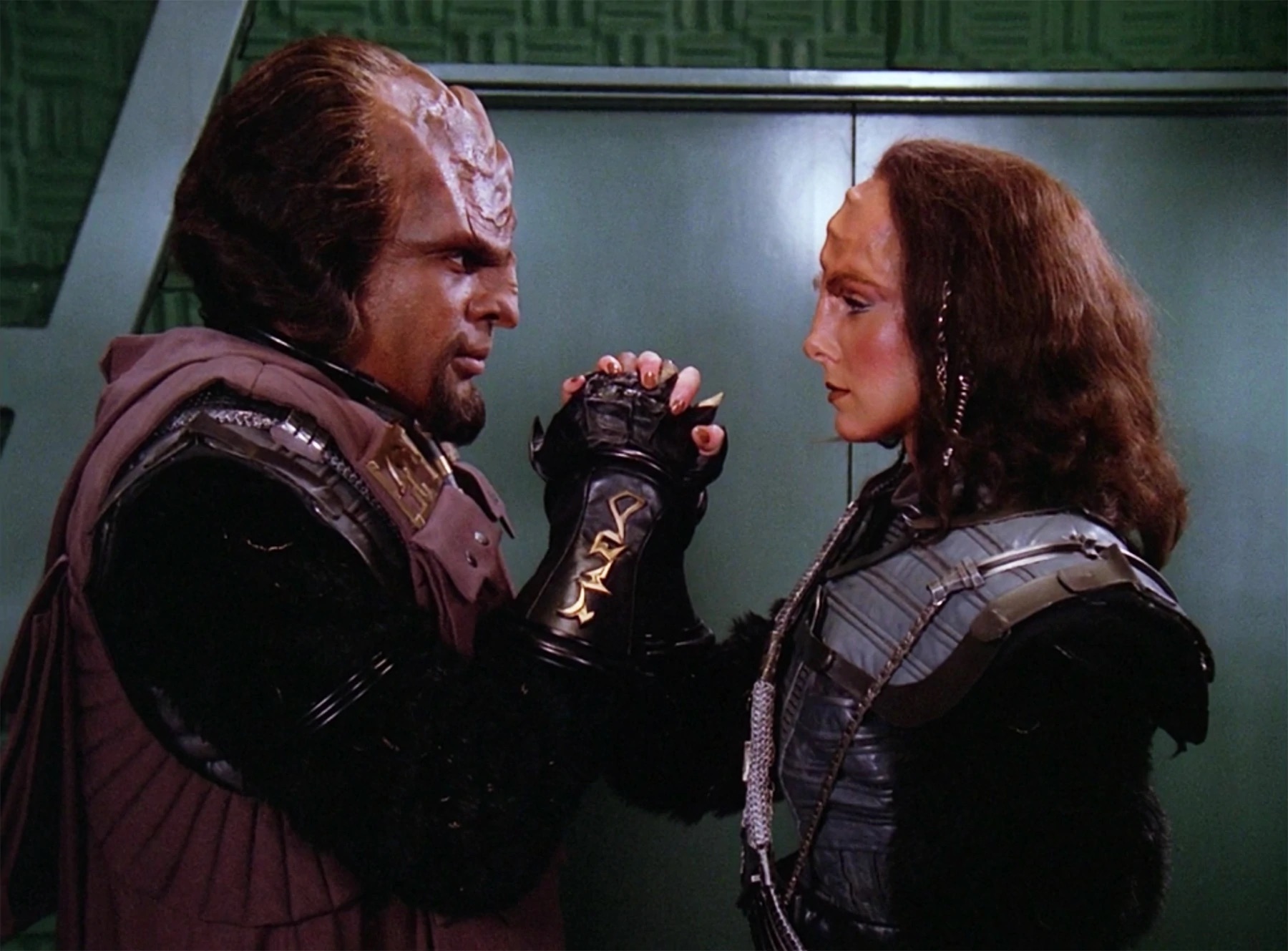
This episode is a strong enough character piece, and does enough other things really well, that it easily earns a four-star rating, even if its main plot is arguably a little thin. The characters spend most of the episode getting nowhere on the issue of how they’re going to cope with the Klingons, then Worf comes up with a plan at the last minute—and the plan, while both effective and fun to watch, is by no means so devious or involved as to justify how long it takes him to think it up. Still, the story premise is engaging and enjoyable. More importantly, aside from the first season’s deeply iffy “Heart of Glory,” this is TNG’s first full-on Worf episode, and given the way the character has often been treated thus far, it does him a surprising amount of justice as a character. Even better, it manages this without portraying him as a fundamentally different guy from the one whom he’s been in other episodes.
One of the nice aspects of the episode is the way it showcases how much Worf actually has, subtly, changed and grown since the beginning of the series; when he tells K’Ehleyr that his experiences on the Enterprise have taught him that “there are always options,” I buy it. The Worf of the final seasons of TNG will be a very different Worf from the one that we see in the early seasons, and this episode provides one of the first clear glimpses of that evolution. But even better is the fact that the growth is not merely one-sided; even though much of the character story is about K’Ehleyr being a catalyst who provokes Worf to open up (and loosen up) and allow himself some emotional authenticity in his interpersonal interactions, Worf teaches K’Ehleyr something in the process as well. Worf is portrayed as a man of extremes. Most of the time, he maintains (borrowing this observation from the ST:TNG Companion) a highly ordered and disciplined life, such that whenever something happens that disrupts his comfortably structured and solitary existence, it throws him all out of whack—but then, at the other extreme, he takes his beliefs and values (and even his passions) so seriously that when they seem to call for it, he’s willing to throw all else to the wind, as when he wants to take the marriage oath in this episode. K’Ehleyr accuses him of being motivated by nothing but “honor,” but there’s a clear subtext in which Worf, in this moment, is the one who’s authentically expressing his passions, and K’Ehleyr the one who’s hiding from hers. If you miss this in the moment (though I think it’s pretty clear), it becomes even clearer at the end of the episode. I was all ready to criticize the writing of K’Ehleyr in the holodeck scene (surely she should have realized that Worf would leap into the marriage oath, so why does she act so shocked and outraged?) until, in the final scene, she reveals that her reaction had actually been provoked by her alarm upon realizing how tempted she was to go along with the oath. When Worf then responds to her confession with one of his own—”I will not be complete without you”—I’m actually really moved. Very well done.
Approaching this material from a somewhat broader thematic perspective: Insightful frequent commenter William B on the Jammer’s Reviews site observes that TNG’s entire Klingon saga can be read as being about the struggle to integrate aspects of a pre-modern, traditional culture into a modern, pluralistic society—to embrace diversity, tolerance, and peaceful coexistence, but to do so without sacrificing passion and integrity, or becoming alienated from our deepest selves (in effect, becoming full-on relativists). I must say that I find this interpretation pretty compelling, and it definitely seems to be at play in the character dynamics between Worf and K’Ehleyr (two characters who both straddle the divide between these opposing cultural forces, each in his or her own way) in this episode. These dynamics play out in complex ways, though: Simultaneous with their personal conflict, in which Worf represents the side of Klingon passions and inflexible, traditional values while K’Ehleyr displays the more modern sensibilities, we see them each taking the opposite side in their disagreement over how to deal with the Klingons-out-of-time. In the latter case, K’Ehlyer is the one who insists (in full-blooded, single-minded, dogmatic Klingon fashion) that destroying the old Klingon ship is the only course, whereas Worf—having imbibed Federation values and ways of thinking over time—actually applies himself, per Picard, to the goal of “thinking outside the box” and coming up with other options. Neither character, then, is ultimately “better” than the other at integrating the two sides of the coin, nor does either of them represent one side or the other in any simplistic and straightforward way; instead, each is wrestling with the same broad issues in one way or another, and each serves as a foil and catalyst for the other.
Also on the subject of character dynamics involving Worf, another moment that has long stood out for me in this episode is the one in which Worf requests to be let off the hook of having to work with K’Ehleyr, and Picard prompts him to withdraw his request by means of two simple questions. The exchange, admittedly, does raise questions: if Picard means to imply that “personal reasons” would not constitute a valid basis for asking not to be assigned a particular duty, then I have to question the scene. I prefer, though, to infer that Picard simply wants Worf to consider whether he truly wants to let his personal discomfort over working with K’Ehleyr interfere with his duties. Interpreted in this way, I really like the scene—and it constitutes the first of what will be many instances, over the years, of Picard intuitively grasping Worf’s inner conflicts, and gently prodding him (in a Klingon-appropriate way) to confront his demons squarely, to be true to the best version of himself, and to grow as an officer and as a person. In “All Good Things…,” when Worf observes in semi-good-humored exasperation that Picard has “always used your knowledge of Klingon honor and tradition to get what you want from me,” he is referring to a character dynamic between the two of them that begins here.
On a world-building level, another cool thing about this episode is that in it, relations between the Federation and the Klingons feel really solid in a way that they rarely have before. Partly this stems from the implicit cooperation going on between the two, and the implication (even though we don’t actually see or hear from actual, present-day, Klingon-Empire Klingons) that the latter are, in good faith, as concerned about what their ship-out-of-time may do when it shows up in Federation space as the Federation is. Partly, too, it’s about K’Ehleyr’s presence; introducing another Klingon (or half-Klingon, anyway) who works for the Federation in some capacity lends verisimilitude to the idea that the two societies enjoy amicable relations (and the fact that she’s the product of a mixed marriage also contributes). Ultimately, the episode implies that the Klingons are actually willing to let the Enterprise destroy their ship-out-of-time, if it should prove necessary—and that says a lot. (As an aside, I forgot to comment on the fact that in “Samaritan Snare,” Wesley has a line referencing the time “before the Klingons joined the Federation”—which makes no sense, since the Klingons still haven’t joined the Federation! Fortunately, this episode has that sorted out, with the Klingons now merely referred to as “allies.”) Also, given the existence of K’Ehleyr, the backstory established here between her and Worf makes good sense, and fleshing out believable pasts for the main characters is always nice.
Apart from a brief comment of appreciation concerning the reprise of the poker game in the teaser, I think that’s about all that I have to say about this solid, enjoyable episode.