
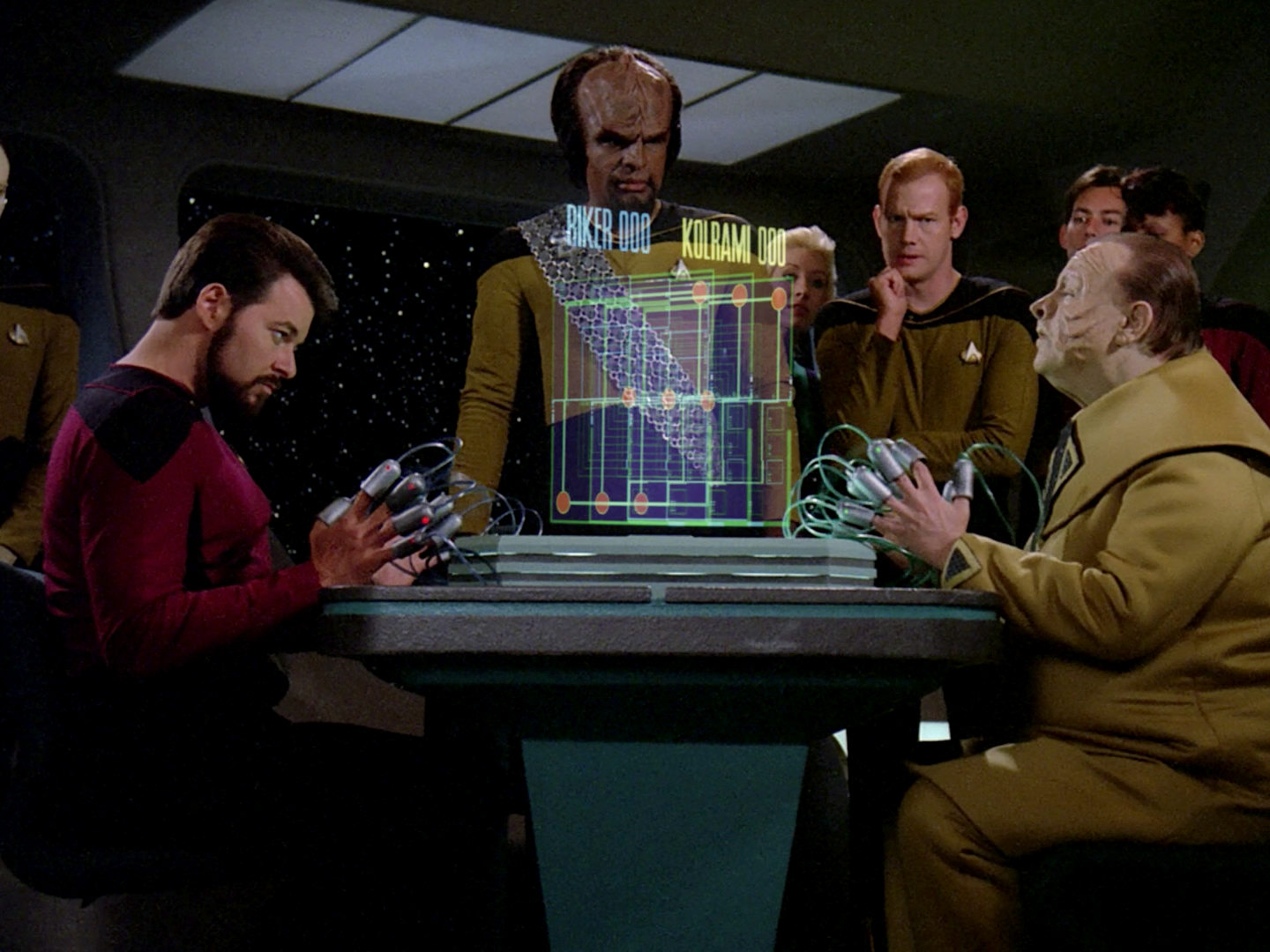
Apart from one bafflingly glaring, major plot flaw, this is a wonderful episode whose thematic depth/complexity, sophistication, and sheer enjoyableness surprise and impress me each time I watch it. It’s a really great example of an un-flashy, unassuming episode that totally delivers on what I want from the show on a week-to-week basis; every episode that isn’t the kind of “something really special” that realistically is only going to happen every now and then, should be like this episode!
Before getting into the specifics of what makes it so good, however, I do need to call out that major plot hole, which has annoyed me ever since the first time I watched the episode years ago: It makes absolutely no sense that Worf is able to create the illusion of a second Starfleet vessel arriving to trick the Ferengi into withdrawing at the end. The episode clearly establishes that the reason why Worf is able to fool the Enterprise in this way is because he knows its security override codes; since he obviously doesn’t know the Ferengi’s codes, he shouldn’t be able to do the same to them (and if he could, why wouldn’t he do likewise every time the ship is threatened by an enemy vessel?). I can’t see how the writers missed this; it’s glaringly obvious and just makes no sense at all. There’s a nice amount of clever, strategic thinking in this episode, so it’s disappointing to have the resolution ultimately hang on a cheat like this; it’s really too bad they didn’t come up with something workable to finagle their way out of the predicament with the Ferengi. Annoying.
But despite this glaring flaw, the “tactical simulation” is a super-fun story idea, and the episode uses it in the service of an interesting and layered reflection on competition and on how we as humans approach challenges. Also, by inserting a line placing the exercise in the context of the “Borg threat,” the writers, in effect, are saying to the audience: “Really—trust us—we truly and honestly are going to follow up on the implicit promise that we made at the end of ‘Q Who’ at some point!” This was a nice bonus! As a small caveat, though, I do think that Picard’s and Riker’s “military exercises are distasteful” resistance, in the teaser, is a bit overplayed. I like that the “Starfleet isn’t a military organization” perspective is brought up, but tactical proficiency is still more important than their protestations here would seem to allow—and their attitude is also belied by the obvious sense of fun with which they approach the exercise throughout the remainder of the episode (starting with the end of the teaser scene itself). I do like Riker’s “When I agree to do something—I do it” line, though; after his prosecutorial role in “The Measure of a Man,” he earned that one! Anyway, once the episode gets past its need to remind us that ordinarily, militarism is not what the show is about, it gets on with the process of being generally excellent—so this is really a pretty minor quibble.
This is a rare beast in that it manages to serve as an effective character piece for several different characters all at the same time. Riker and Data get the most development, but Picard also shines, Wesley is used well (and the Geordi-Wesley engineering improvisation team is fun to watch), and even Pulaski is more appealing and effective a character here, in my opinion, than in any other episode. The way she eggs Data on to challenge Kolrami is good fun, and the dry, sarcastic wit of her mock sympathy for Picard regarding “the burdens of command” when the latter is complaining about having to “hand-hold an android” is great as well. For that matter, the guest character, Kolrami, also works for me; in him, the episode actually successfully delivers up a perfect “character you love to hate.” He’s annoying and full of himself, sure—but that’s sort of the point (and it’s also not overdone, but instead actually used to good effect in several ways).
It’s questionable whether Data would really react the way that he does to losing the initial “Strategema” game, but I don’t mind suspending my disbelief a little on this point for the sake of what the episode does with it. Specifically, since it goes out of its way up front to remind us that Data has no ego—and that he doesn’t even entirely “get” the competitive spirit—I am left to assume that we’re meant to buy into the interpretation (even if Pulaski doesn’t buy it) that he is genuinely concerned that he may be malfunctioning in some way. This, for me, saves the episode from any suspicion that it is mischaracterizing Data as behaving too emotionally. The scene in which Troi tries to talk him out of his “funk,” then, is quite entertaining: “But Counselor, I do not have a -“! It makes sense, too, that it takes the captain—who, unlike both Troi and Pulaski, doesn’t seem to be hampered by the illusion that Data is behaving emotionally—to get him to realize that he’s all right. “It is possible to make no mistakes and still lose” resonates with the thematic focus of the episode on strategy and challenges, and is also precisely the fact that Data is overlooking (plausibly or not). The ensuing motif of Data formulating and altering premises further develops the theme, while also providing a hilarious moment (“knowing that we know that he knows that we know…”) and giving Troi a chance to make a worthwhile point about human nature that Data then uses to his advantage in his eventual rematch. Troi highlights a plausible difference between human and android: being without emotion or ego, Data can more easily “reformulate his premise” than Kolrami, who, like Riker, must on some level “be the man that he is,” no matter how smart a strategist he may be. To qualify that: I think it’s clear that the episode by no means intends to suggest that humans aren’t able to improvise or “learn new tricks” (quite the contrary, in fact); it’s just saying that, to a sufficiently analytical mind (like Data’s), there are still going to be underlying patterns, and thus that “know your enemy” (or “opponent,” rather) is advice that will always pay off. It’s actually kind of an interesting turning-on-its-head of the more usual idea of androids/computers being limited by their programming and incapable of the kind of creative and original thinking that we humans like to pride ourselves on! On another level, though, Riker and Data both (Riker with the assistance of Worf, Geordi, and Wesley) pull off instances of “changing the rules” in the best tradition of James T. Kirk in this episode. (Indeed, the whole combat simulation premise—in which Riker is saddled with a hopelessly outmatched ship—recalls the “Kobayashi Maru” concept nicely, yet without being so similar as to feel like a rip-off.) I should add, too, that I find Data’s solution to the challenge of Kolrami’s expertise at the strategy game quite ingenious, as well as being perfectly suited to Data’s unique strengths. Great fun!
Obviously, Riker is also a lot of fun to watch in this episode. I love him challenging Kolrami to the strategema game; it’s a perfect mix of ballsy and humble. He doesn’t deceive himself into thinking he has any chance of winning, but he also doesn’t see this as a reason not to give it a shot—which, of course, parallels the approach that he takes to the combat simulation (and his remarks to Wesley about it being the effort that counts), and speaks to the themes of the episode. It’s also just pure, classic Riker—reminding one, for instance, of his interest in serving aboard a Klingon ship “because no one’s ever done it before.” His choices of officers from among the main characters to take with him to the Hathaway make perfect sense, too. Geordi and Worf are precisely the two guys you’d most want in the situation he faces, and the scenes in which he recruits them both are fun. The moment when he and his bunch totally pull a fast one on Picard and score the first points of the simulation is a huge high point as well.
Despite the disappointing plot cheat that the episode pulls near the end, I do think that the fact that the battle simulation gets interrupted, rather than running its course and actually yielding a winner, is a smart move. A loss for Riker and company would probably have felt anticlimactic, but a loss for Picard and the Enterprise would surely have both strained credulity and made the captain look a bit foolish. Besides, establishing a winner and a loser might have undermined some of the thematic thrust of the episode, whereas failing to do so creates parallelism between the conclusion of the main plot and that of the “strategema” subplot (with the rematch ending in a draw).
Finally, before I wrap this one up, I have to call attention to the flabberghastingly thrilling nature of the action scene in which the Ferengi show up and catch the Enterprise totally off guard. In an instant, without skipping a beat, Picard shifts from a mood of complacent assurance about the Enterprise’s superior position vis-a-vis the Hathaway (albeit an assurance tempered by a sizable dose of impressed-with-Worf) to a more edge-of-the-seat, full-on, all-out fight for survival mode than the series has virtually ever delivered before, with Picard and Data barking out orders in alternating, rapid-fire succession amid a genuinely panicky sense of total crisis, and looking like utterly competent and professional officers. It’s great!
Regarding the “But Counselor, I do not have a -“ comment, it’s funny without any further context, but I have to believe the writers were hoping we would humorously notice data, as a tin man, nearly completing the phrase “I do not have a heart,” before Troi interrupts.
While I like how pithy Picard‘a pep talk was in seeing him straight, And his response went more to the episodes theme, I still wanted it pointed out to Data that every human officer is error prone, yet still contributes to a team effort in which those errors can be corrected. Even if Data were fallible, it does not justify his reaction.