
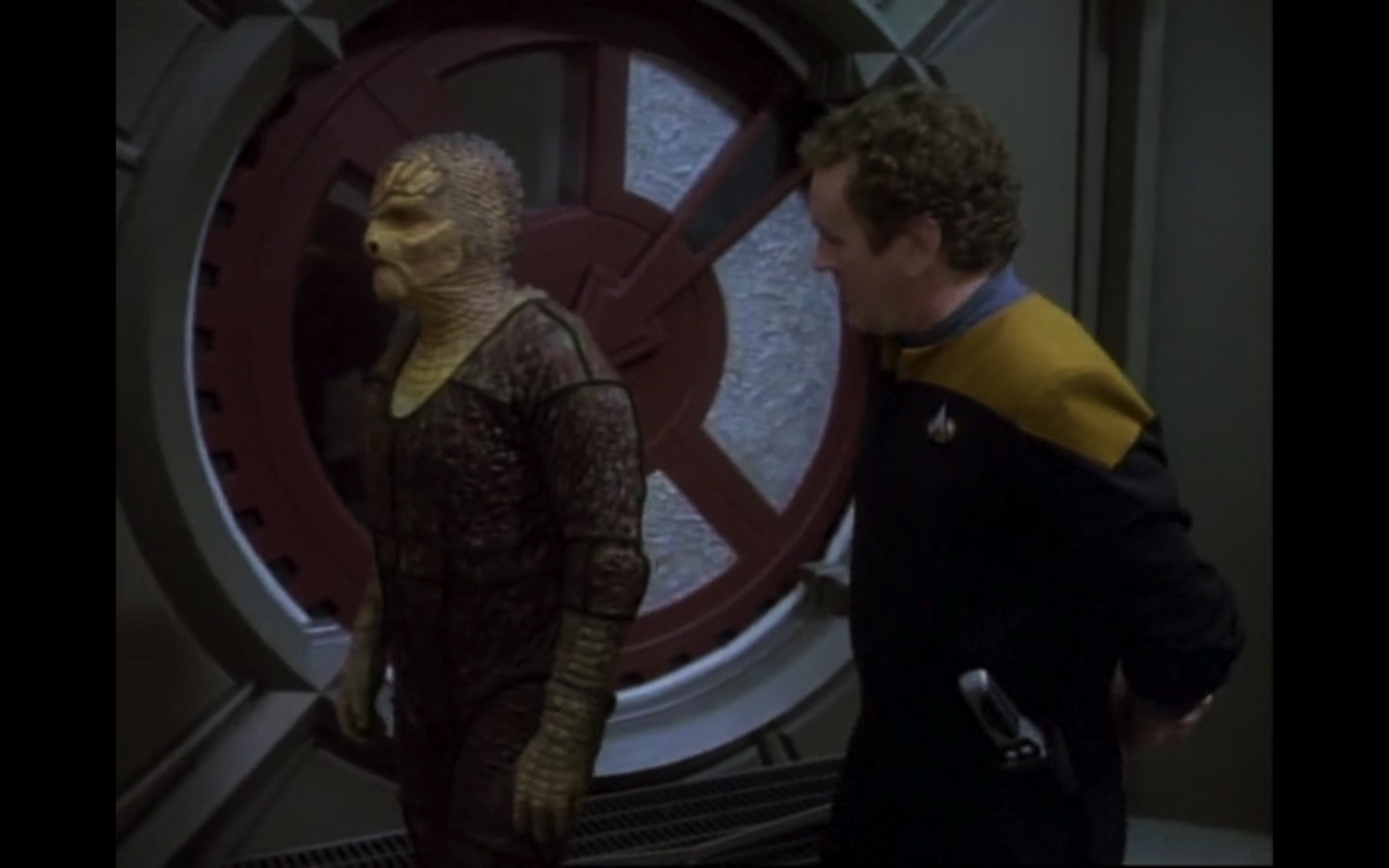
This is a perfectly serviceable little episode. It has modest ambitions, but it’s quite engaging, and I don’t have any major complaints (though I will have some things to say about the resolution of the plot). To be sure, the story told here has little to do with DS9’s premise, overarching story, or signature themes, and could just as easily have been a TNG story—and that does count against it, for me. I mean, “first visitors to come through the wormhole from the gamma quadrant” is something, but it would be a more significant something if it led anywhere (i.e., if the episode were introducing a new player to the Trek universe that was going to play an ongoing role in the series). Instead, what we get is just an encounter with some random new aliens, which (again) could just as easily have happened on TNG, with no wormhole. So, that’s a bit disappointing. Still, for a one-off episode that doesn’t aspire to a whole lot of depth, “Captive Pursuit” is pretty good.
The plot of the episode is honestly pretty minimal; in fact we don’t even find out what’s actually going on until close to the end. For the most part, what we have here is an opportunity to watch O’Brien befriending, and trying to learn about/understand, a somewhat cagey and mysterious, yet weirdly likeable, alien. Despite having very little in the way of common frames of reference for understanding the world or each other, the two of them manage to forge a connection that feels real and meaningful, and this alone goes pretty far toward justifying the episode as worthwhile. Then, too, when Tosk’s pursuers show up and we do finally learn what his deal is, the answer proves to be something unexpected and reasonably interesting (he does not, for example, boringly turn out to have some nefarious hidden agenda), which very much counts in the episode’s favor. Finally, in the episode’s final act, it becomes about Tosk’s fate and O’Brien taking matters into his own hands. Unfortunately, the way this is handled doesn’t really work, in my view. I’m fine with the ideas that a) our people have no business telling these hunter aliens what to do or not to do (the Prime Directive and all), and b) O’Brien nevertheless chooses to act, “changing the rules” to allow for a better fate for his new friend. I’m less clear, though, on whether defiance/rule-breaking was really necessary. The fact that Tosk ended up in (from the pursuers’ perspective) some random aliens’ brig is sort of arbitrary, and has already constituted “interference” (indeed, it has ruined their hunt); how, then, is it not (as O’Brien himself argues to Sisko at the end of the episode) in everyone’s best interests for them to just release Tosk and let them continue their “damned hunt”? Why does Prime Directive non-interference mean handing Tosk over to the pursuers to be taken home in disgrace? But also, even if I accept that O’Brien’s actions crossed some kind of line: For the pursuer aliens to then immediately resume hunting Tosk while he’s still on the station blatantly violates the understanding that they worked out with Sisko—and for them to be shooting up the station in the process (!) is way over any reasonable line. Why, then, does Sisko let them get away with this? And finally, any way you look at it, I feel like Sisko’s show of anger toward O’Brien in the final scene is misplaced/overdone. Yes, the episode undercuts it by having O’Brien essentially point out that Sisko let him get away with what he did, and then showing Sisko grinning to himself about it after O’Brien leaves his office. Still, it just doesn’t quite work for me (in ways that, to some extent, it becomes hard to articulate, due to the general muddle that the episode has already made of the situation by this point).
That nearly exhausts what I have to say about this one, other than to comment on a couple of incidental aspects of the episode. For example, it opens with a scene in which a dabo girl complains to Sisko about Quark having included a provision in her contract that requires her to permit his sexual advances (!). This does, I fear, make it harder to like Quark, and I rather wish that the writers would have given this idea a miss. I’m also not really sure what it’s even doing here. I guess you could say that there’s a bit of a thematic parallel between Quark sexually exploiting his employees and the hunter aliens breeding “Tosks” to be hunted; in both cases, our people (Sisko) can’t change elements of alien cultures that he (and we) finds reprehensible, but he can say “not on this station.” However, the story fragment about the dabo girl doesn’t go anywhere; Sisko assures her that he’ll talk to Quark, and that she won’t be held to this particular provision of her employment contract, but that’s the last we hear of the matter. Weird. Secondly, I’m entertained yet somewhat perpelxed by Quark’s sudden interest, in this episode, in playing the bartender (sorry, host) who lends a sympathetic ear to his customers. Like…I’m not saying it’s actually out of character, or anything (Quark, despite his somewhat antisocial profits-above-all instincts/philosophy, is clearly a “people person”), but I’m not entirely sure that it’s specifically in character, either. Isn’t simply getting their money usually enough, for him? And finally, there’s a pretty amusing bit at one point where the main characters are pondering Tosk and his secrets, and Bashir, wanting to feel important, inserts himself into the conversation to suggest that since people sometimes tell their doctors things they don’t tell anyone else, maybe he should take a crack at Tosk, and everyone pretty much just ignores him. Oh, Julian… 😂
Ah, Captive Pursuit, where the crew of DS9 goes to the restaurant at the end of the universe, and we ask questions about whether it is ethical to breed a sapient being that wants to be eaten/hunted and is capable of saying so, clearly and distinctly!
So the wormhole finally becomes a relevant part of the setting as a way to bring things to the station. Apart from that, this episode is also not super relevant to DS9’s unique premise in that a similar version of events could also have happened on TNG. But for some reason this episode sticks in my head more than most early DS9, and it feels like a fairly obvious three to me. It has an arc for O’Brien, albeit a pretty simple one that just consists of making a friend and deciding that helping him is important, and Meaney is pleasant to watch as he nurtures his friendship with Tosk. Tosk himself feels convincingly alien in his mannerisms (and also his makeup; they seemed to spend a bit more money this week on alien makeup for some reason, though it’s pretty obvious they were saving money with those helmeted suits of armor) while also being pleasant to watch himself.
Other takes:
I’m all for giving a strange alien a set of quarters and the ability to use the computers, but maybe someone should be checking to see if the first thing he does when he checks in is to look up where the weapons are? In fairness, I guess we could assume that Odo did do that, since he tracks Tosk down in short order. But that leaves us thinking that Tosk wasn’t too clever about this, since he should really have anticipated that his behavior would be monitored. I would think that a species designed to be hunted would be a bit more adept in such matters… and possibly more socially skilled, since prey that is capable of social engineering would probably be a lot more fun to chase.
The initial conflict where the aliens beam on board DS9 and start blasting feels like it’s missing a sense of realism and some stakes. There don’t seem to be any casualties at all, which is kind of strange under these circumstances. But if there had been deaths or even injuries, that would likely have escalated the conflict to something that would have gotten well beyond the story that the episode was trying to tell here. So I see why the episode avoided this, but it does undercut the power of the conflict.
Sisko cites the Prime Directive at one point, but just how exactly does that apply here, to a civilization roughly technologically equivalent to the Federation, that has stormed belligerently into their space?
Does Sisko really need to dress down O’Brien like that at the end? I mean, he *almost* winks at him when he says “I guess that one got by us,” but his language is still pretty harsh, considering that Sisko actually did agree with O’Brien about the best course of action here. If there’s something to criticize O’Brien for, it seems to me that it would be that he made the decision on his own instead of taking it to Sisko in the first place. I mean, there’s certainly some risk involved that his choice could have offended the aliens or that Tosk would have been like, “no, sorry man, it’s too late for me because I’ve already been caught.” But if the crew had cooperated with each other to choose an outcome, they could maybe have arrived at a course of action that makes it appear as though they weren’t actively sabotaging Tosk’s release to the aliens—ie to appear to be trying to give the aliens what they said they wanted—assuming that to just let Tosk go (instead of giving him to his hunters) would have offended the hunters somehow. Though if you really want to start off a healthy relationship with this new species, you probably ought to just set some limits and refuse to release an innocent hunted creature into their custody (unless that’s also what Tosk was asking them to do, and there’s a bit of a cheat in that the episode relies on no one asking Tosk what he wants in this situation after he’s caught).
On a different note: Odo should not have been knocked aside by a blow to the head. He avoided that in the pilot by changing shape, and even if he didn’t react in time here, it should have disrupted his form, not forced him to crouch and shuffle off like someone who just took a blow to the noggin. But what I do like about Odo’s characterization here is that he’s not thinking of the big picture like Sisko is at the end—he initially just wants to stop O’Brien, and it’s fun to watch him trying to work out what Sisko is on about when he tells Odo to take the pursuit slowly.
Besides having some horrifically barbaric traditions (the fact that they want to *humiliate* their prey when he fails to entertain them sufficiently seems to undercut their argument about how the hunt is a noble part of their cultural tradition with the full consents of all involved), these hunter aliens sure are presumptuous asses. They come busting onto the station in a part of the galaxy that is totally foreign to them with no sense of wonderment or humility, in what among almost any culture would surely be an act of war, displaying no subtlety or decorum. Then they act like they can simply demand that another culture, about which they know nothing, cooperate with their hunt. They are kind of up there with all those TNG alien species that are obsessed with studying humans and subject our crew to all sorts of bizarre conditions to do so, with little thought that this might provoke the species they are studying. Anyway, what if these aliens had encountered the Klingons, the Cardassians, the Romulans, or almost any other damn species in the Trek universe? If they were lucky, they probably would have gotten themselves killed, and if they were less lucky, they might have started a war. Actually, I wonder if exploring this side of the situation might have made a better episode. We establish this species as a player in the Gamma Quadrant (so we’re doing more to tie the episode to the premise of the show) and the need to develop a relationship with them, which is a major strength of DS9’s premise to begin with. I’d be curious if you have thoughts on where this might go.
“…maybe someone should be checking to see if the first thing he does when he checks in is to look up where the weapons are?”
Well, hmm. I guess I’d say, rather, that maybe this info shouldn’t be accessible to just any random person who asks the computer. Doesn’t seem cool to be spying on people’s computer use to see which publicly accessible info they do or don’t look up, right? But info like “where are the weapons stored” maybe shouldn’t be accessible in the first place?
“Sisko cites the Prime Directive at one point, but just how exactly does that apply here…”
It’s for sure not a question of messing with a “less advanced” culture, but there’s still “we don’t get to interfere with their cultural practices even if we think said practices are super fucked up.” The problem, though (and we each talked about aspects of this) is…these fucks invaded OUR station and started *shooting*. We definitely get to interfere with THAT! And they’re after someone who’s in our holding cell for trying steal our weapons. Wouldn’t Sisko have been on perfectly solid ground if he’d said “yeah, sorry, we’re not surrendering Tosk, who broke our laws, to you armed invaders”? And then, even if we move past all of that, I still feel like Sisko legitimately had options for what to do with Tosk. Like, I don’t see how just setting him free and allowing the hunt to continue would be any kind of prime-directive-violating interference–and if it is, then arguably, turning him over to the hunters is also interference.
You talked about an alternate version of the story that might have “establish[ed] this species as a player in the Gamma Quadrant . . . and the need to develop a relationship with them, which is a major strength of DS9’s premise to begin with.” And yeah, I both would have liked to see that happen for the sake of world-building and pushing the overall narrative of the show forward, and also am inclined to think that it could have helped with some of the things that don’t quite work (as we’ve both discussed) about the plot of the episode. Like, if instead of “oh, we can’t interfere; we have to give him up because, um…” it had been about weighing Tosk’s welfare (and what seems morally right) against the consequences of pissing off this new potential major player of an alien race…THAT would have been a genuine dilemma, with stakes and thematic relevance.
Yeah, the story kind of cheats to create drama at the resolution when there was an easier way to have solved the problem that would have seemed less interesting.
>>If it had been about weighing Tosk’s welfare (and what seems morally right) against the consequences of pissing off this new potential major player of an alien race…THAT would have been a genuine dilemma, with stakes and thematic relevance.
That’s one of the things that’s fun about bantering with you in these reviews—figuring out how they could have made things work that didn’t work.
>>I’d say, rather, that maybe this info shouldn’t be accessible to just any random person who asks the computer. Doesn’t seem cool to be spying on people’s computer use to see which publicly accessible info they do or don’t look up, right? But info like “where are the weapons stored” maybe shouldn’t be accessible in the first place?
Well, I see your point, but for the sake of argument… It might be awfully difficult to hide something like where the weapons are kept. Admittedly, it might have foiled *Tosk* if the computer hadn’t provided that information, but I doubt it would consistently fool more savvy individuals for long… and when someone from an entirely new civilization drops by and you know nothing about them or their interests, you could argue that having some kind of protocol for flagging concerning behavior could maybe be justified. This gets at some fairly basic questions about civil liberties and questions about how an “ideal” society functions, and whether or not (or to what extent) more cynical behavior might be justified. The show’s later exploration of Section 31 grapples with this question… and Star Trek does (at least so far as TNG and DS9 are concerned) consistently portray (even if accidentally) a world where people are *not* being spied on even in very sensitive locations (this era’s equivalent of military installations, meaning starships and space stations). I’m not sure we have any reason to think that video is available of things going on in public areas, even, do we? And it seems to take some pretty extreme circumstances to search people’s personal logs. You could even cite things that fall into the area of the ridiculous, like major lapses in basic security (the rash of shuttlecraft/runabout theft, for example) as more evidence of this (though you could also just call it sloppy writing when it goes that far). In any case, it’s clearly an age when we’ve somehow found a way to respect privacy despite the ubiquity of technology that could easily be constantly watching everything you do and making reasonably accurate predictions about what you’ll do next. In a world where our privacy is constantly invaded in some areas and very much under threat in others, that vision feels pretty utopian!
I see what you mean about Quark’s need to be a listening bartender here. I do think that Quark’s sociability is a key aspect of his character. Unlike most Ferengi that we ever see (and unlike *every* Ferengi we’ve seen at this point in Trek’s history), as I’m sure you’d agree, that Quark is pretty consistently depicted as more than just a sniveling, profit-obsessed lunatic. The core of his character, I think, is that he actually is a person who has relationships that matter to him, but he also struggles against Ferengi cultural expectations (as well as his own personal selfish instincts) to maintain them. I even seem to recall at one point he uses the explicit phrase “I’m a people person” to describe himself because he chose to run a bar rather than doing something more profitable. As much as all that is true, his behavior here does feel a bit random, and I’d like to see his desire to build relationships with the other characters in a supportive role expanded a bit if they’re going to do this here.