
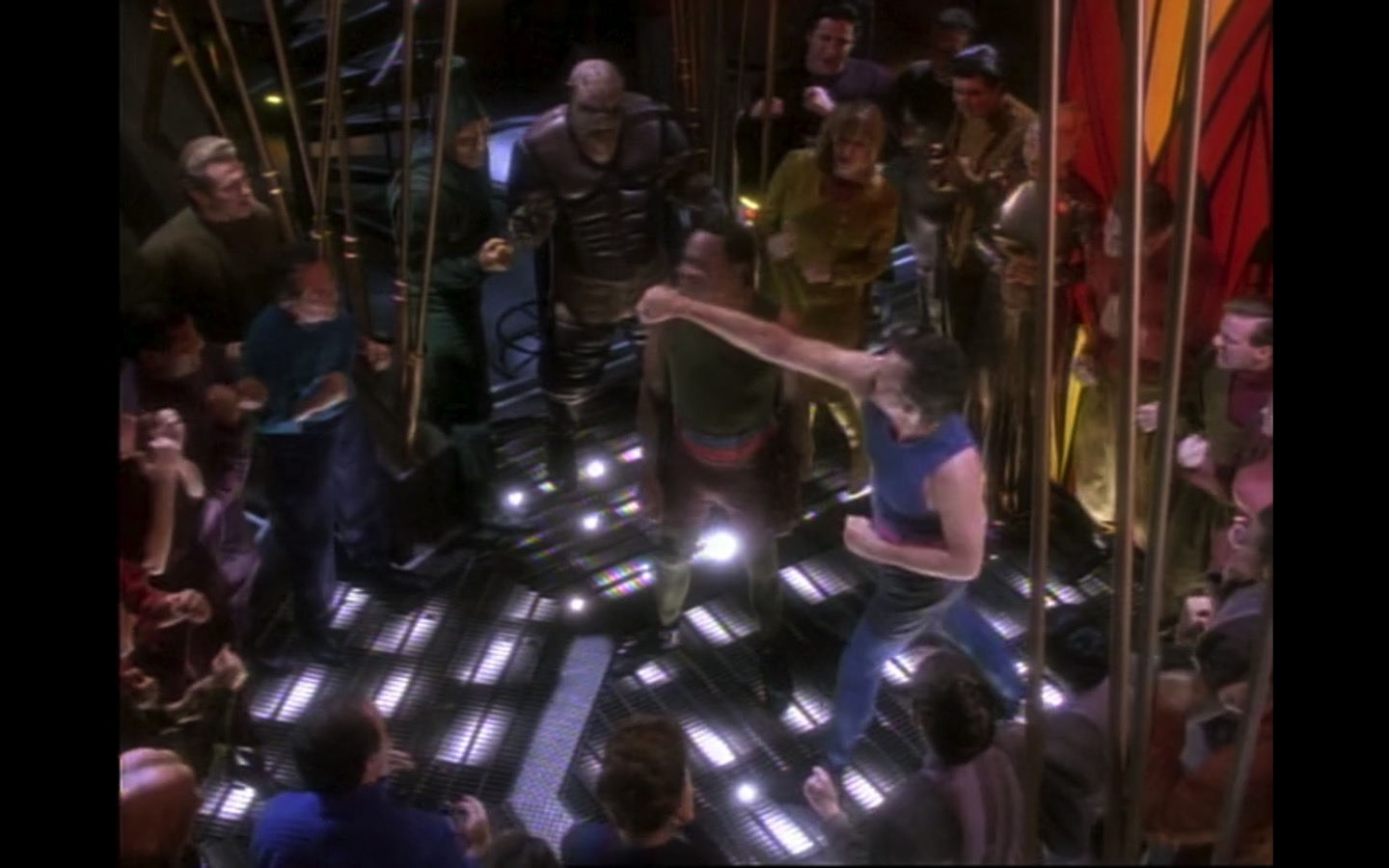
Nope, nope, nope, nope, nope. An episode written by Hannah Louise Shearer (who penned a number of terrible TNG episodes in its first few years, including “Pen Pals” and “The Price”), and starting from a deeply misguided TNG-copycat premise (“let’s bring Q—and Vash—to DS9!”), was bound to be terrible—but somehow, the end result is actually even worse than one might have expected. Alas, in “Q-Less” we have DS9’s first total bomb…though honestly, it hardly even feels like it is a DS9 episode.
Where to even begin? Well, with Q, I suppose. Before even getting to the more specific criticisms (of which there are many), there’s the general fact that, as far as I’m concerned, Q should never have appeared on any other Trek show than TNG. Look, crossovers and guest appearances can be fun, and I’m certainly not against them, but they need to a) make sense, and b) serve a meaningful narrative purpose—and if they don’t do both of these things, then they shouldn’t happen. Q is an enigmatic, quasi-all-powerful entity from some “out there” plane of existence who does not spend most of his time hanging around with ordinary humanoid life forms, or even in our galaxy. Among his (presumably many and varied) interests/pastimes/pet projects, he chanced to develop an interest in toying with and/or helping/guiding Jean-Luc Picard, and thus became an occasionally recurring visitor to the Enterprise. This, however, does not justify having him show up on other Starfleet installations. To depict him as doing so diminishes him, and makes him—a character who is already a bit much to buy into—strain plausibility even further. And of course, the meta-coincidence of him only popping in on those Starfleet personnel who happen to be the focus of a TV show (after all, he’ll eventually show up on Voyager (barf) as well) is dumber still. Interestingly, teleplay writer Robert Hewitt Wolfe (who would go on to become one of DS9’s most prolific episode writers) seems to recognize some of these points. In the DS9 Companion‘s write-up of “Q-Less,” Wolfe is described as relating that he found it hard to work Q, who was “so TNG-oriented, and so Picard-specific,” into DS9, and have him relate meaningfully to the show’s characters. So why even attempt it? Well, in that same write-up, eventual DS9 executive producer/showrunner Ira Stephen Behr (whose role on the show at this early stage was as yet smaller) explains that “At the beginning of the series, we were directed to ‘show that we’re still part of the Star Trek universe’ by bringing over people from the other series.” He doesn’t specify who did this “directing,” but I would have to go with Rick Berman as the most likely candidate. (That said, I hesitate to absolve Behr of blame for this episode; he’s not credited as a writer on it, but as the writer who is responsible for the existence of Vash as a character, I strongly suspect that he played some role here.) So, in any case, I strongly feel that bringing Q onto DS9 (as much as I do love him as a character) was a stupid idea from the get-go.
I mean, okay…they did actually come up with a rationale for his visit that makes more sense than just “he decided to drop in on the new show,” or whatever. Because, of course, the starting point for the story is that Dax finds Vash in the gamma quadrant and brings her back to the station; Q then shows up not because of any interest in our people, but because Vash has washed up here. But this is its own kind of terrible, and doesn’t actually make his presence any better. Again, Q is supposed to be an enigmatic and almost godlike figure who is “above the fray” of ordinary humanoid foibles and mundane interpersonal drama; he exists to challenge, provoke, and surreptitiously guide our people (well, Picard), and, as I’ve said before, he works best when his motives are kept somewhat ambiguous. What does not work at all is turning him into a sniveling whiner, reduced to doggedly pursuing some random human who wants nothing to do with him and begging her to be his companion for reasons that aren’t at all clear. I mean, what the hell? Q seems all too human, and frankly like a petulant loser, in this episode; properly characterized, he is so far above the kind of behavior he exhibits in it. (Incidentally, this was not lost on John de Lancie, who is described in the DS9 Companion as questioning the basis of Q’s interest in Vash, and even remarking “I think that Q is best used when he deals with large philosophical issues, and skirt-chasing just isn’t one of them.” Amen to that!)1 Plus…did we really need to watch Q and Vash engage in the exact same back-and-forth exchange of bickering something like four separate times throughout the episode? And if we had to have this story thread about Vash wanting to part ways with Q and Q pursuing her, couldn’t we at least have heard something from Vash about why she’s so fed up with Q, and what exactly made her decide to call an end to her time with him? As it is, she just keeps repeating the same generic cliches ad nauseam (“It’s over, Q! I can take care of myself!” etc.), while Q, for his part, persists in trying to tempt, cajole, or bully her into changing her mind. It’s repetitive, vacuous, and intolerable.
In between all of this drivel, the episode does, of course, also devote some time to having Q interact with the show’s regular characters, and in particular with Sisko. Unfortunately, this material is also terrible. As I mentioned, Robert Hewitt Wolfe acknowledged finding it difficult to play Q off of DS9’s characters. His “solution,” again according to the DS9 Companion, was to try to use Q to underline the differences between Sisko and Picard. But even aside from the fact that this pushes the motif of Q flirting with breaking the fourth wall too far for my tastes (again, creating the impression that the real reason he came to DS9 was to check out the new show and our new commander), it just completely falls flat. To be sure, the one bit of this episode that lodged itself in my memory from my first viewing of it (and I do think I saw this one when it originally aired, which is only true of a handful of this season’s episodes) was Sisko punching Q, Q exclaiming “Picard never hit me!”, and Sisko retorting “I’m not Picard.” The writers, and even de Lancie, seem to think this exchange clever, and to imagine that it conveys something meaningful about the differences between the two characters. But I don’t! I’ll grant that Sisko is a less “cerebral” character than Picard, but I think it’s wildly unfair to Sisko to characterize him as being more inclined to haul off and punch someone than to match wits with them. And notice how egregiously the episode cheats in order to set this alleged contrast up? Because it’s not as though Sisko just up and punches Q out of the blue, because his temper gets the better of him. For chrissake, Q conjures the two of them into a makeshift boxing ring, and then he punches Sisko no fewer than four times, all while taunting him and urging him to fight back…and only then, in self-defense and because it doesn’t appear as though Q is going to cut the crap otherwise, does Sisko eventually slug him. This context kind of matters, no? Or are we to imagine that Picard, in this same scenario, would have just stood there trying to speechify while Q pummeled him? What a fucking stupid scene. And most of the other Q/Sisko interactions similarly strike a discordant tone, for me. Yes, Q typically needles Picard, and hurls insulting remarks at the other TNG characters (“Eat any good books lately?” to Worf, etc.), but the barbs that he aims at Sisko land differently, to my ears. It’s partly that they seem gratuitous; he’s just indulging in this for the hell of it, as opposed to his usual TNG shtick of acting like he’s merely jerking the characters around, but doing so in a way that might be cover for a more benign agenda. But I think the difference also has something to do with the actual differences between the two shows. It’s one thing for a Q figure to show up and poke fun at the “best and brightest” officers of Starfleet’s flagship, who are all happy to be where they are; they can take a bit of deflation of their noble images. But to poke fun at Sisko over his assignment to DS9 (an assignment that he himself was none too sure about, at first), or to quip that “Picard and his lackeys would have solved all this technobabble hours ago,” and even add the stinger “No wonder you’re not commanding a starship”—all of this just feels cruel, in a way that isn’t really any fun. Honestly, it almost reads as the writers dissing their own show. It certainly doesn’t serve any worthwhile purpose, and I really don’t like it.
And then, you know what else doesn’t really work in this episode? Almost everything else, that’s what. For instance, the minute we learn that Vash has turned up in the gamma quadrant, any regular watcher of TNG ought to be able to guess that Q is going to show up—and even if not, the episode goes ahead and shows its hand by having him appear at the end of the teaser. But the regular characters don’t become aware of Q’s presence until about twenty minutes into the episode. To what end? None, other than to allow the writers to fill up time by having the characters spin their wheels wondering how some random human managed to end up in the gamma quadrant without going through the wormhole, while the audience already knows the (boring) answer the whole time. From a plot perspective, it seems like O’Brien should have been able to figure it out sooner; at first, you tell yourself “well, maybe he doesn’t know the details of what went down in “Qpid,” but then after he sees Q, he tells Sisko and the others about Vash meeting Q on the Enterprise (or rather, in Sherwood Forest). And sure, we can still fall back on “okay, but maybe he didn’t know that she went off with Q at the end”—but however any of that may be, from a storytelling perspective this is all just dumb and inept. The characters think they have a mystery to solve, but it’s actually just filler…and this ends up being the second consecutive episode to tease the idea of our beginning to learn about the gamma quadrant, only for this to amount to nothing. Then there’s Vash herself, who has always been a problematic character: a regular-ass Federation human who, for some reason, is kind of unscrupulous and is motivated primarily by the prospect of financial gain, despite living in a society in which (supposedly) this doesn’t really make sense. I experience actual embarrassment on Picard’s behalf in this episode when O’Brien tells Sisko (whose feelings toward the Enterprise‘s captain are already not the most charitable) about Vash and Picard having a romantic history—but Sisko’s response shows him to somehow be a good deal more perceptive than either O’Brien or the writers (well, Ira Stephen Behr, anyway), since he, at least, recognizes immediately that she hardly seems “his type.” I also never liked the idea of her going off with Q, as I talked about in my “Qpid” review. I will say, though, that one character that she actually does play reasonably well against is Quark. I always find “oo-mox” scenes to be uncomfortable and in poor taste, but apart from those bits, I don’t hate the parts of this episode that feature Vash and Quark dealing and scheming together (apart, that is, from my objections to the whole idea of Vash being such a profit-chaser in the first place). Still, when this is as close as an episode comes to having an engaging narrative thread in it, we’re not doing well. Q is weirdly incidental to the episode’s story, and the station-in-jeopardy plot that eventually materializes is lame as shit (endless dithering with sensors that for some reason suck too much to be able to pinpoint the problem, but wait, what if we do technobabble thing x, etc., all just to manufacture the moment where Sisko and Dax show up to the artifact auction and beam the thingamajig away right after someone has promised to pay Quark a fortune for it), so “Vash and Quark team up for mutual profit” is about as much actual story as the episode has to offer. That the artifact turns out to be some kind of life form comes out of nowhere and immediately goes right back there, narratively; it’s all a bit “so what?” (Also, shouldn’t there be sensors or security filters or whatever that notice when objects as dangerous as this one are brought aboard?) And in the end, even Vash’s basic motivations (I hesitate to go so far as to use the term “arc”) resist analysis. She spends most of the episode rebuffing Q’s constant efforts to tempt her into this or that adventure, and then, at the end, turns down a similar proposition from Quark…only to, just a moment later, reverse course and show interest in what Quark was laying down. Why? What changed, to make her uninterested one minute and pulled in the next? Who is Vash? What’s the story here? None of these questions have satisfactory answers.
There’s also a sort of tedious and un-funny thread with Bashir trying to woo Vash, and Q shooing him away and making him really sleepy, so that he apparently sleeps through most of the episode’s events. Whatever. On the other hand…I definitely did not remember that it was this, of all episodes, in which we first hear of the doctor’s having missed making valedictorian due to mistaking a preganglionic fiber for a postganglionic nerve—a bit of lore that, if memory serves, will resurface more than once down the road. So…there’s that, I guess?
- It’s wild that TNG’s “Tapestry” aired just one week after this piece of trash. The contrast between these two episodes, in terms of both Q’s characterization and the sorts of narrative purposes that he serves in each, could not be more stark. ↩︎
So I didn’t expect that I would like this episode on the rewatch, but damn, I did not remember that it was *this* bad. We have a plot about tech problems at the station, and I guess it’s supposed to be a mystery, but it’s extremely obvious early on that they’re being caused by Vash’s device. As always, everyone blames Q for the trouble, but as always, it’s not actually him (though I give them a little credit for having Sisko figure out that it wasn’t Q pretty early this time). No one can work out what’s actually happening for some reason, though, even though it’s not at all plausible that the device wouldn’t be emitting something pretty massive they could detect, nor is it reasonable that someone could get such a device on the station without being detected to begin with. And it’s all solved when there’s some technobabble and they figure out that it’s the device (well, a creature’s egg or whatever it ultimately is) that’s emitting whatever it it’s emitting and beam it into space. This plot all adds up to “so what?” It’s completely predictable and it’s about nothing. That leaves the quality of the episode to hang on the individual scenes and the characters.
Unfortunately for the episode in this respect, however, it features Vash as the main character. I’m going to have to disagree with Quark that Vash is “very very good” at negotiating… or that she’s very good at really anything at all that we can see. As a character, she may not have been interesting on TNG, but here, where she becomes even more of the focus of the episode, her one-dimensional characterization becomes even more obvious. The scene where O’Brien very dubiously assures Sisko that Captain Picard “likes a challenge” in his romantic relationships (um, does he, though?) has me even *less* convinced that Vash and Picard could *ever* have been a couple in retrospect even than when I was watching “Captain’s Holiday” or “Q-Pid.” Q’s banter with Vash offers nothing that we haven’t seen in a thousand other shows (or even previously on TNG). Q claims he used Vash to experience wonder and awe, which is fine, except I think the writers actually intended for us to buy this as his real motive. In a universe of trillions upon trillions of diverse beings, you really expect us to believe that Vash is who you would choose for that? By 24th century standards, Vash is basically a borderline sociopath in her obsession with accumulating wealth, and I’d be hard pressed to name any other personality characteristics she even has, other than that she’s also kind of sassy about being a corrupt ass in a way that starts to grate pretty fast. I suppose it’s possible that one could be an incredibly greedy fuck and also have a sense of wonder, but they still don’t strike me as traits that tend to go together.
What about the other scenes? Bashir cheesing it up to hit on Vash in two scenes is mildly painful to watch. Likewise, Q putting Bashir to sleep was annoying; I don’t recall him stooping to borderline mind-control in the past (and the follow-up joke at the end about having slept for days is quite tedious). I don’t care for the scene in which Q does some almost-meta-commentary on the various characters of the station. Oomox are as gross as ever—I remember Tim Lynch’s comparison to having a woman rubbing a man’s genitals as a way to manipulate him into doing what she wants, and I want to watch this scene about the same amount as I want to watch that. It plays heavily into a gender stereotype that’s degrading to both men and women.
Of course—and I’m guessing you’ll make this point also—it cheapens Q’s relationship with Picard to have him trying to do the same thing with Sisko *and* with Vash in this episode. Doesn’t Q do anything other than try to bond with/harass people? He knows everything and lives forever, but this is how he spends his time? And why does everyone here take the exact same strategy that Picard takes when dealing with Q by bantering with him, treating him like an annoyance, and sometimes decisively telling him to go away? This is an immensely powerful being. You’d think that some people might react to that with some humility, since he could easily make their lives a living hell instead of just being a pest. Or some people might try to play along to get him to do something for them. Some might be outright terrified and avoidant of him. Some might try just being more or less straightforward and sincere and not letting their ego get involved. Of course, Q never actually does anything to permanently harm someone, and the characters all know about that in advance.
While I don’t always totally hate Sisko’s reaction to Q (at least at times he seems to show a sense of being above it all), the only scene that really works at all for me is Quark trying to tempt Odo. I do feel like it would have been more interesting if Quark had tried to offer something that maybe could have appealed to Odo instead of things that obviously weren’t going to work, though.
Q’s comment about Watergate doesn’t work for me. Obviously Watergate isn’t a very notable historical event and doesn’t stand alongside countless events from the same century in terms of how noteworthy it is, and that’s the joke. But no one on the station would even understand the reference, so it makes no sense in the context of the show. So it’s actually just a wink at the audience… which just isn’t funny enough to justify the conceit.
Just how is Vash going to relax on Earth with her profits when Earth is post-scarcity and there’s no money? Did they think about this at all?
Finally, I know rich collectors really are probably mostly idiots, but the idea that they wouldn’t be at all interested in anything to do with the history or context of the items they are buying, or even in something that would actually guarantee their legitimacy, seems a bit ridiculous. It’s also silly how Q tells them that they’re all going to die soon in a station-related disaster and they start to panic, but when Quark assures them that they’ll be fine and they’ll have free holosuite access, their fears all immediately evaporate, and they all just go back to bidding.
I didn’t remember this one in detail, but I did remember loathing it—so I honestly was not surprised, upon re-watching, by how bad it is. I hardly even want to acknowledge this as a DS9 episode, and I’m really relieved that they never had Q show up on DS9 again. I find this episode inept, childish, occasionally mean-spirited, and (in its best moments) boring.
And oh yes: I neglected to comment on it, but I fully agree that its super-obvious from the get-go that the artifact is going to turn out to be the source of the tech problems. Yawn.
Wow, you’re moving quickly through these episodes! I was confident that you would rip this episode apart in your review, and you did.
Also, I’ve been checking out the Jammer’s Reviews site, and as superficial as “Jammer’s” commentary is, I sort of wonder why he bothers. Why put up a review site if you’re going to offer such cursory commentary? It’s kind of like William B is the real reviewer over there, and that the audience comments are the real point of the site.
After I wrote that, I was looking a little deeper, and I saw that he apparently has reviews of all the new Trek, too. And I didn’t read much, but based on what I did see, they seem to show all the insight of a Pakled engineer.
To be fair to Jammer, he does say at the top of his main DS9 page that he wrote most of the DS9 reviews while the show was airing…except for the first two seasons, which he “reviewed retrospectively during a brief period in 1997 (hence the shorter format).” So that gives some context for any perceived relative shallowness of these particular reviews of his.
Oh, and about “moving quickly through these episodes”: I mean, I had a long weekend (MLK) during which I was home alone, and I used some of that time to dig in. Don’t expect me to keep up this pace, or anything…!
I was just thinking about the idea that the writers of Q-less (shit, I just realized that’s supposed to be a pun on “clueless”—I guess that’s obvious in retrospect) thought they *needed* to create some kind of special contrast with Picard and how silly that whole idea is. Sisko is really different from Picard in just about every way, aside from both of them being smart and capable leaders. Pretty much every scene that Sisko is in establishes differences between them. Some of the obvious ones: Picard is reserved, Sisko much more in touch with his feelings. Picard has a way of going out of his way to maintain relationships even when he has to enforce discipline, while Sisko doesn’t seem to worry about making others feel bad if they screw up. Personal loyalty and friendship is more important to Sisko than Picard. I just have a feeling about who they are as people, and they are not very alike at all.