
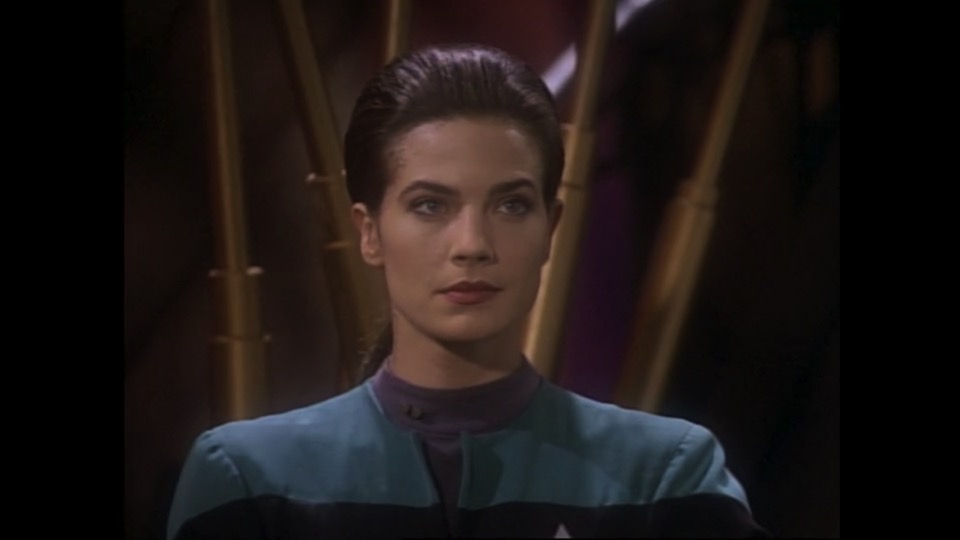
I find “Dax” both engaging and a bit disappointing as an episode, placing it pretty solidly in the three-star category. Going into this re-watch with only the dimmest memories of what it was about, I was expecting a basic character-introduction, back-story-establishing type of story, and while it is that to a point, it also somewhat frustratingly isn’t. It’s also a bit on the underwhelming side from a plot perspective. What it does give us, though, is a clear understanding of the show’s take on the Trill as a joined species, as well as some more background about Sisko’s friendship with Curzon Dax. I appreciate those things, and the episode also has some other nice bits that make it an enjoyable enough watch; still, it’s another one that kind of leaves me wanting more from it.
The most frustrating aspect of “Dax” for me as a viewer is basically the same thing that frustrates Sisko as a character in it: namely, its titular character’s tight-lipped refusal to say much of anything for most of its duration. Even if this makes sense from a character perspective (which I think is open to question), it strikes me as a very poor choice from a storytelling perspective. We, the audience, don’t really know Jadzia Dax very well yet, and in an episode that puts a spotlight on her like this, what one wants is to see her reacting to the trouble that she finds herself in in ways that would meaningfully reveal character. Instead, she spends most of the hour refusing to defend herself or really discuss the matter at all, leaving Sisko and her accuser to fill the time arguing abstractly about the nature of the Trill. Their arguments are interesting, and they do important sci-fi premise-establishing work with regard to the idea of joined Trill, but most of the time, they don’t really reveal much about the character at their center. Sure, we do learn some things, such as the fact that Jadzia “earned” the right to become joined through a fiercely competitive process involving rigorous testing, that she holds numerous impressive scientific degrees that she earned prior to being joined, and that, simultaneous with all of that, she also contains within herself the somewhat larger-than-life personality that the show is (successfully) working to build Curzon Dax up as…as well as carrying some degree of shame stemming from a few of his less admirable deeds. This is all reasonable stuff, but it’s very much told rather than shown, and leaves me trying to imagine an alternate take on the episode wherein Dax would play a more active role in extricating herself from her legal troubles, and would talk and react emotionally more to the situation, in ways that might dramatize the issue of how much she’s still Curzon Dax versus being a new person, rather than just having other people talk about that issue.
This is not an episode that engages heavily with DS9’s core narrative/themes, but it doesn’t feel like a “generic,” could-have-been-a-TNG-episode digression, either; as (at least theoretically) a story that seeks to fill in some blanks concerning one of the show’s main characters, it does feel like it “belongs,” and I give it considerable leeway to not be “about” Bajor and such. Also, at one point, it appears to be making clever use of the show’s general setup, when Sisko and Kira lean on the fact that the station is a Bajoran facility to hold up Dax’s extradition and place the matter in the hands of a Bajoran judge. However, this doesn’t ultimately mean much, both because the situation that it helps to resolve feels pretty artificial in the first place and because it doesn’t really go anywhere narratively. I mean, my feeling about the whole intro section in which the Klaestrons abduct Dax and try to make off with her is that it’s entertaining to watch, but nevertheless kind of dumb; it paints the Klaestrons as shady and thuggish from the outset, undermining their credibility as seeking justice for an old crime, and it also, in order to make any sense, requires the episode to put forth the absurd idea that this planet has a treaty with the Federation that allows for “unilateral extradition.” Seriously!? Why would the Federation ever agree to such an arrangement? (Also, treaty or no treaty, these guys assault Dax and sabotage the station. No consequences for this?) And then, Sisko and Kira using Bajoran jurisdiction as an end run around the supposed treaty with the Federation looks clever, and Kira’s spiel about how they must have gotten details on the station from the Cardassians in order to be able to pull off what they did even starts to make the plot feel connected to the show’s larger story for a moment…but it turns out to just be a plot device; Bajoran interests don’t come up at all in the ensuing hearing. Worse, if the episode hadn’t started by having the Klaestrons weirdly try to abduct Dax (but had instead just had them show up and demand that Sisko surrender her), then no plot device would have been needed to delay extradition and finagle a hearing; a hearing would just have been a given in that (more reasonable and plausible) scenario. Thus, in the end, all of these early machinations end up feeling like they’re really just present to fill time, which is…not great.
I also find what passes for the “plot” of the rest of the episode to be, honestly, somewhat lacking. Making the conflict play out primarily as a courtroom drama feels a little bit like a crutch, and for the arguments in said (makeshift) courtroom to never once make reference to any existing legal precedent regarding Trill being, or not being, legally responsible for the actions of past incarnations of themselves, makes no sense. (Sisko and Kira discuss searching for relevant legal precedents, but there’s no follow-up on that. Surely, though, at least on Trill itself, there must be clear, settled law defining the extent/limits of this kind of cross-host responsibility, right? And wouldn’t this, and maybe some question of whether or not the Klaestrons are willing to recognize its validity, really be the crux of what there is to discuss in the hearing?) The judge character has some real presence, and I feel like in a somewhat different context I would like her, but she also kind of comes off as more annoyed by the demands on her time that the case’s complexity is creating than concerned for any of the issues at stake, and (as I already noted) the whole idea of her representing Bajoran interests gets dropped the minute the hearing begins. Also, even though (as I’ve said) I do find the back-and-forth between Sisko and Tandro about the nature of the Trill engaging (and significant on a world-building level for the Dax character and the show in general), it’s a huge mark against the episode that from a plot perspective, it all proves meaningless in the end. Because, after all the arguments have been made, the outcome of the extradition hearing ends up being determined by something else entirely—namely, the new evidence brought by Odo that Curzon Dax didn’t commit the crime for which Tandro wants to try Jadzia! And Odo’s investigation itself (along with what he uncovers) is also fairly underwhelming. We go from the idea that Curzon and this general were the best of friends, to the revelation that the general was himself a traitor and that Curzon was sleeping with his wife, without blinking much of an eye, and we really only get there because, after keeping her secrets for decades (even in the face of her son going off on a crusade to bring Curzon to justice), the widow does an about-face under moderate pressure from Odo, without anything significant really having changed to motivate that about-face. (It’s not necessarily wildly implausible or anything, but neither is it a very involved investigation on Odo’s part, or particularly compelling drama that draws you in and helps you to empathize with the widow. It just…gets the job done, and not much more.)
Oof. I feel like my review is coming off pretty harsh, in a way that’s somewhat out of sync with my overall feelings about the episode. I do enjoy some of the Sisko/Dax interactions (the two of them reminiscing about times that Sisko and Curzon had together, and her ability to make him laugh even when he doesn’t want to be side-tracked, is consistently enjoyable), and the way that Curzon continues to emerge as this colorful character who had a really formative influence on Sisko (and who, increasingly, almost feels more like a legend than a person, the more we hear Sisko talk about him). Also, again, the show definitely needed to clearly establish some stuff about the Trill (that the personalities of the host and symbiont blend together, for instance), and I like everything that this episode lays down with respect to that. The final scene between Dax and the widow also manages to be reasonably touching. The whole of the episode, too, is thoroughly watchable, and I’m never bored or cringing or anything like that. I just wish, first, that the episode were actually more about Jadzia Dax than it really is (honestly, it kind of seems like we learn more about Sisko than we do about her), and secondly, that there were a bit more logic, substance, and direction to its plot/storyline.
Also, before I leave off, I’m afraid that I have a couple of side quibbles to register. First, I continue to not quite get what the show is trying to do with the Bashir/Dax romantic pursuit thread. On one hand, Bashir comes off as a little creepy, continuing to blatantly pursue her after she’s clearly told him that she’s not interested (especially with lines like “I can think of better ways of keeping you up”). At the same time, though, why does she appear to be continuing to hang out with him, despite this behavior? It’s just a little weird. Secondly, I really don’t care for the bit in this episode where Odo basically forces Quark to donate the use of his bar as a venue for the hearing, by threatening him with bullshit legal harassment unless he agrees to it. Like I’ve said before, I feel like too often the show treats Quark really weirdly—letting him get away with serious misbehavior on one hand, while having the rest of the characters casually treat him like shit much of the time (without implying that this is in any way problematic) on the other. In this case, too, one rather feels that the only reason this scene is even present is for the convenience of the writers, who want to be able to take advantage of the conveniently already existing set of Quark’s, but need to justify why the hearing would take place in a bar. Lame.
First of all, I just need to rant about the silliness of establishing that a station this big doesn’t have space for an extradition hearing. There’s no way the base of operations for a military organization occupying an entire planet wouldn’t have had *countless* rooms of varying sizes on it for a variety of purposes, and that goes double for a civilization as obsessed with law and bureaucracy as the Cardassians. It’s not like there’s no space available on the station; the place is huge compared to a Galaxy-class vessel, and those have way, way more space than its typical crew complement could even use. I absolutely don’t buy that Quark’s bar is the only place that could accommodate a court hearing even if there were going to be *hundreds* of people in attendance, and this hearing had what—six people? They could have held it in the auction hall from the previous episode… or in some unused quarters in the habitat ring… or in ore processing… or in Sisko’s office, for that matter. Okay, I know it’s not important to the story, but I just like to complain about stupid little things like this when it happens. 🙂
This episode is called “Dax,” but even though it’s ostensibly about her, she doesn’t ever exercise any real agency in it, unless you count as agency the deliberacy of her inaction (and the deliberacy of encouraging others to inaction) to protect her former partner. With the decision to do nothing to protect herself to save another, the episode offers a some insight into who Dax was/is… though not a tremendously large amount. The episode is a lot more interested in Sisko, and I do enjoy the characterization of seeing him refuse to give up on his friend. There’s obviously a parallel here between Dax’s loyalty to Enina Tandro and Sisko’s loyalty to Dax, and the bits with Sisko looking for ways to help are great (and they do a lot more to contrast him with Picard as a character than some goofy, contrived boxing match).
Given the nature of joined Trill, it really was just a matter of time before they did this particular episode. Obviously “Dax” has parallels to “Measure of a Man,” and in this respect I also find it to be an interesting watch philosophically, but the issues at stake has less clear implications than its TNG predecessor. With Measure of a Man, we’re considering what constitutes personhood; here, we’re considering the question of personal responsibility, and whether changes to a person over time bear on the way we assess people as responsible for their actions. Unlike MoaM, this episode doesn’t exactly ever point to answer the question it asks here, and that could be partly because there really is no clear answer, even if we’re just talking about moral or ethical answers. Ultimately, the issue of whether Curzon and Jadzia are the same person is entirely a semantic distinction, even if it does have practical considerations we could consider analogous to questions about what an ideal age of consent for certain things should be, or when someone should legally be able to drive… or more directly, to questions that we mostly ignore in our culture (outside of our concept of a “statute of limitations” for relatively minor crimes) about whether or not someone can change enough through the natural course of time to be unlikely to reoffend. I do wonder if maybe a bit more grounding in how the questions at hand might bear on our own laws real life might have been useful here? In fairness, I don’t really know how they would have done this, though at least some reference could have been made to old Earth laws that caused young people living under desperate circumstances to be imprisoned for life for things then did even when the course of becoming an adult made it so they wouldn’t likely ever do such a thing again. Okay, I’m starting to ramble here without a point (I, unlike Captain Picard, am not entitled)… but to risk venturing into incoherence by musing on this a bit without committing to any particular point of view or going back and revising (luckily for me, I have more latitude to do that here in my comments than you because I’m not the reviewer here and my writing doesn’t have to stand as quite so fully coherent as yours!)… realistically, in a fair society that isn’t motivated by retribution, surely what’s at issue in a trial is whether the problematic behavior/instance of illegality is going to recur, and also to provide some kind of disincentive for people to commit said crime. Could Sisko offer an argument along those lines… basically, that circumstances have changed so much from when Curzon was doing his thing, that’s no longer likely to happen? I guess that could be a murky road to go down, and I’m not sure where I’m going with this, but I would think that if the episode could find its way to an argument about the futility of *retribution* in justice that wins the day (instead of it being won by virtue of another (not a regular) character’s sacrifice, it might add some real weight to its theme here. Maybe it would have been better if Curzon had been actually guilty, and the issue is resolved by Sisko effectively making the case that Jadzia’s circumstances are sufficiently different such that she would never do such a thing? I don’t know. But the way it does play out, the whole problem is kind of solved by Odo digging up some new information rather than by any argument or ruling on the issue of personal responsibility. I guess that’s okay, but it feels like that makes the episode fall short of what it could have been by not saying all that much in the end, even if the banter is interesting the whole way.
In any case, as it stands, both arugments have legitimate points, and neither is really correct in any final sense, and as I noted, accordingly, the episode doesn’t really try to provide a particularly good rationale for why we should come to agree with either arguer. However, this does have a similar background logic issue (somewhat in common with MoaM, but to an even larger extent) which it waves away in the same way, which is that you would think that this would all be settled law on Trillius Prime (yeah, I looked it up, that’s what it’s called). Even if scenarios involving legal issues between hosts were a rarity (unlikely, unless joined Trill are a real rarity), one might ask whether joined Trill are considered to have their educational degrees when they move to a new host? Do their possessions transfer fully, or are some/all dispersed back into society or given away to loved ones? Do Trill maintain their existing relationships? (We know a bit about the answer to the latter question from things we’ve seen and will see in the future, and the answer is, it’s complicated—they can retain friendships, but they are expected to terminate romantic ones.) I’d call this a missed opportunity to do more worldbuilding about Trill society, and I’m always going to fault them for failing to do worldbuilding when the chance arises, not only because I think it helps to make the universe feel more real, but also because this almost always leads to further opportunities for new exciting stories and the exploration of themes, both immediately and in the future. In this case, they could have given some complicated answers to these questions to muddy the waters in this particular scenario… perhaps something about this situation could have been an exception, for some reason, to usual Trill law and custom.
As for Odo’s story, it’s interesting, and it fits with Odo’s characterization as going for the truth regardless of whether his employers are going to like it. I definitely enjoyed that they didn’t characterize Odo as knee-jerk defensive of Dax—he doesn’t necessarily believe she’s innocent—and that this creates a bit of tension between the characters. Still, his investigation feels a bit cursory and not as developed as it might have been; he gets there pretty fast, and without a ton of work. So the whole thing feels pretty three-ish to me, though it’s philosophically interesting enough, and has enough character stuff with Sisko, to be maybe on the higher side of that, I think.
Other points:
• The need for the extradition hearing is clever and the scene with Sisko and Kira uniting to make a point against Dax’s abductors (and being kind of snooty in the process) is fun to watch, but surely there must be a way to charge those guys with kidnapping given the way they did it? Wouldn’t the best course of action that Sisko could have taken to protect Dax have been to prosecute Ilon Tandro for his methods rather than go through formal extradition procedures?
• Bashir is really, really bad at action, to the point where it’s actually a bit amusing. For one thing, doc, call for help before you try to chase them down. Dax is also notably bad at not being abducted. She just walks along with her captors in a daze. Didn’t she learn in any of her seven lifetimes that the best response to being taken by someone is to go limp and make them carry or drag you? It took me considerably less than one to learn that, and no one has ever attempted to abduct me. Not even once!
I have more than just this to say in response to your comments, but as I’m pressed for time at the moment, I’ll leave most of it for later, and for now just agree with you 100% that it’s BS that there would not be any other space on the station “large enough” for the extradition hearing. What a crock.
So, again, we had mostly similar takes on this. You got a bit more into the philosophical issues about continuity of identity (both for joined Trill, and in real-life contexts for which joined Trill might serve as a sci-fi metaphor) than I did, and I agree with your view that both sides of the argument had legitimate points and that there’s really no clear “answer.” What I’m not sure about is to what extent the episode (that is, the writers) realized that. This connects to my dissatisfaction with it being a courtroom drama; ambiguity can work in other contexts,, but I feel like if you’re going to have the characters hashing it out before a judge, it ought to lead to some kind of conclusion. I mean, there could even still be ambiguity over whether the ruling arrived at is “correct” or not, but there should BE one. Letting the judge off the hook by having Dax’s salvation come from Odo just feels like a cop-out.
Also, the more I think about Dax’s passivity, the less sense it makes to me. This was (as the characters keep reminding each other) an extradition hearing, not a trial; it’s not like she would even have needed to get into the question of whether Curzon had an alibi for the actual crime, which would entail revealing the affair, etc. The hearing wasn’t even about that! And after all, winning this hearing would be the best way to avoid ending up in a situation (i.e. an actual trial) where dredging up the affair WOULD become relevant, right? In my review, I focused mostly on how I ddin’t like Dax’s silence on a storytelling level (because it makes the episode something of a missed opportunity to flesh out her character); now, I’m realizing that it doesn’t make much plot/character sense, either.
Absolutely on both counts. I do wonder what a non-courtroom version of this episode might have looked like, but courtroom or no, it would be interesting to play around with the story here and see if we could produce something better. Another version might involve more tension between perspectives between our regulars, with Sisko trying to exonerate Dax, Kira pushing for justice for the victims, Odo working impassively for the truth, and Bashir concerning himself with the emotional fallout on Jadzia. I think making Curzon guilty, though gutsy, and adding some ambiguity about whether the crime was actually justified for some larger political reason might have made the story more interesting. Suppose Sisko is able to interrupt the hearing before any results come out (perhaps by finding fault with the violent and unorthodox method of extradition they resorted to), but then Dax chooses to go forward with it anyway? She could be unaware of what Curzon did, having not chosen to examine it closely as Jadzia. You could use a Trill ritual where they relive aspects of past lives as a device here where she comes to terms with it, then subjects herself to judgment, but is ruled in the hearing not to be responsible for Curzon’s actions. This would change Jadzia and Sisko’s relationship in ways that would be interesting to explore.