
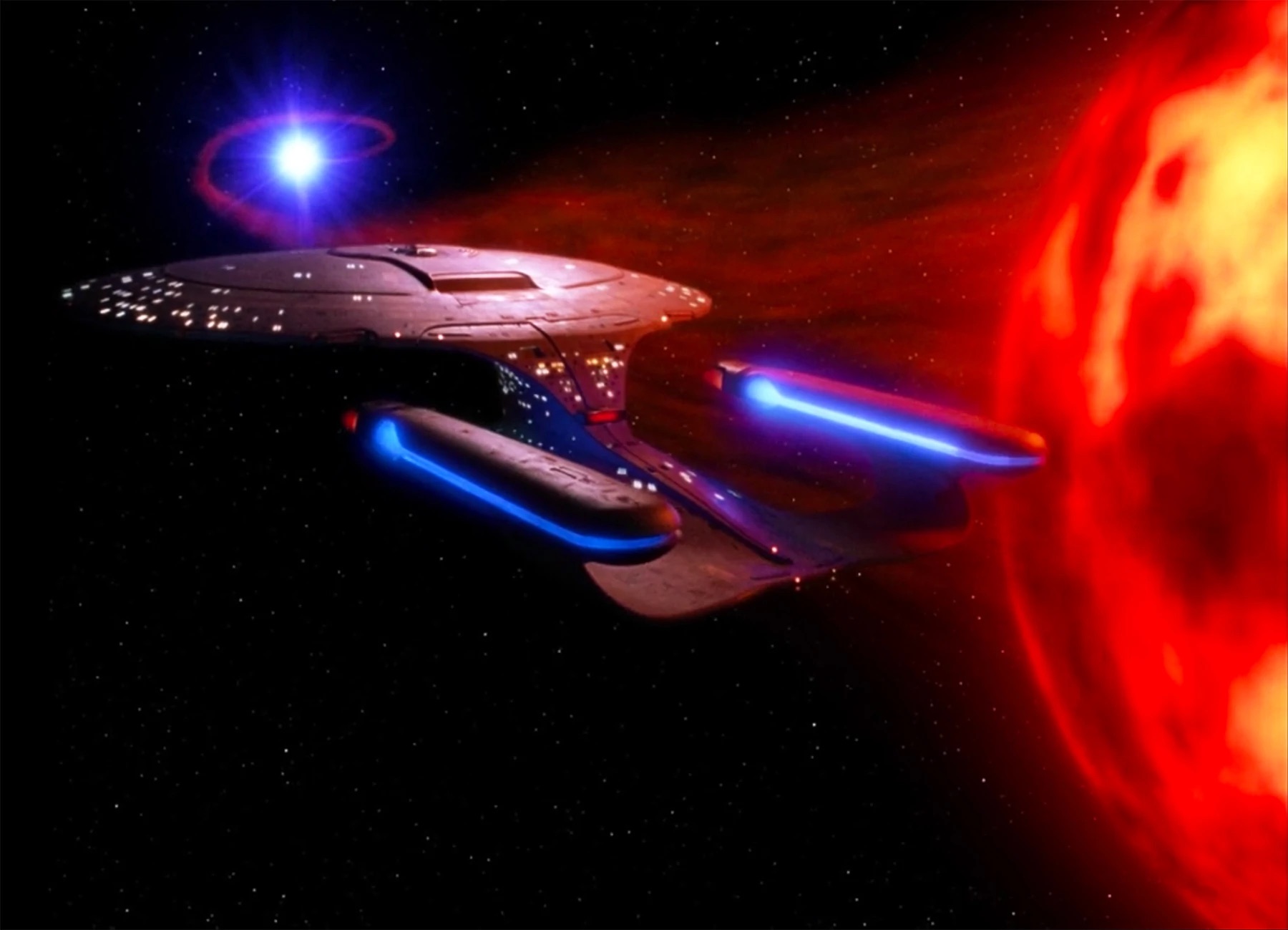
With the start of season three, TNG finally attains its full maturity. As with “The Child,” I can’t really discuss this episode without also offering some broader observations—this time about the show’s second “leap forward” in overall style and sophistication, which closes the remaining gap between TNG as it was in its second season and what the show would be for the rest of its run. Also somewhat reminiscent of “The Child,” alas, is the fact that “Evolution” is, on its own merits, nothing terribly special as an episode. It is, however, at least a solid and thoroughly watchable three-star piece of work, which represents clear progress vis-a-vis the previous season openers, even without taking into account the less episode-specific improvements that it debuts.
It’s difficult, from my vantage point, to assess whether second-season head writer Maurice Hurley deserves the credit for the strides made by the show during that season, the blame for its unevenness and lingering mediocrity, or some of both—but I have a strong hunch (and I am not the only one) that Michael Piller, who took over as head writer five episodes into the third season (and was also a co-writer on this first episode), played a leading role in making TNG the vastly improved show that it became from this point forward. These things are pretty difficult to judge from the outside, of course, but from various things that I’ve read, I have gotten the distinct impression that Piller really understood how to make storytelling character-centric. In this connection, “Evolution” exemplifies what would become a new norm for the show from this season forward, in that its main plot serves more as the backdrop for a character story than as “what the episode is about” per se. Obviously, many episodes will still have really cool plots (and as a caveat, the “plot in the background” style that becomes common from here on isn’t always an entirely positive thing)—but in general, starting here, the show will be more about characters, with plots more often serving as vehicles for character stories than as “ideas of the week,” and themes more often emerging from the characters’ stories than from a planet, crisis, or dilemma of the week.
Also, perhaps the single most important way in which the start of this season represents a leap forward for the show is that it is at this point that Captain Picard finally, fully arrives as a character. Gone for good now is the officious, short-tempered shouter of old, and here to stay is the character I know and love: a compassionate, inquisitive, diplomatic exemplar of humanity and of good leadership, whose reasonableness, judgement, humility, and restraint perfectly temper his confident decisiveness, and whose perceptive and firm-yet-sensitive mentoring of those under his command outshines his notorious reserve. We saw glimmers of this Jean-Luc Picard in the second season, but not until the third does the show achieve a full and consistent realization of the character. In this episode, for example, his handling of the difficult Dr. Stubbs, his reactions to the irritating malfunctions on the ship, and his complete failure to lecture Wesley after it becomes clear that the latter is responsible, all bespeak a different captain from the one whom we saw in most previous episodes—and this isn’t even an episode that particularly features the captain! In addition, even though the rest of the regulars mostly “arrive” during the second season, the portrayal of Data does improve again with the start of season three; he loses the lingering supposedly-androidy-but-actually-too-human quirkiness that would still sometimes surface during the previous season (his tendency to run on at times, for example), while retaining some of what I would consider his more unobtrusive, believable, and enjoyable “android quirks” (such as his trademark precision in stating time intervals and the like).
I won’t ramble on for too much longer about other changes that debut as of the start of season three, but there are a few items of which I do need to take note. First and foremost, I greet with enormous satisfaction the main characters’ new uniforms, which trade spandex for wool, eliminate that ugly stripe, and add smart-looking collars. This might seem like merely a superficial tweak, but it makes a huge difference in the extent to which the regulars come across as real, believable, dignified professionals. Whether it’s this visual change, something subtle about the acting, or a little of both (possibly along with other factors that I haven’t even identified), for instance, the opening scenes of this episode really have a different feel to them from most of what has come before; there’s just a confidence and professionalism to the way that the characters behave (and respond to the crisis that is quick to materialize) that feels so right! Other tidbits: The slightly-too-long-haired look that Data acquired during the latter part of the previous season disappears, and Worf’s overall look once again changes for the better this season. Also, although I liked the show’s original opening title sequence well enough, the new one that debuts here and will remain in place for the rest of the show’s run is definitely more visually impressive—and the second re-recording of the theme song represents another improvement as well.
Moving on, one way of summing up “Evolution” is to acknowledge that its plot revisits ideas very similar to those dealt with in the first season’s “Home Soil”: a microscopic and inorganic form of intelligent life is discovered, and our heroes’ insistence on making every effort to coexist peacefully with it tries the patience of a scientist with whose work it is interfering. The differences, however, are crucial. This time, the guest character is more three-dimensional and sympathetic; the life form itself is also more sympathetic; no ill-fitting, ripped-off-from-TOS moral hijacks the resolution of the plot; the danger to the ship posed by the life form feels more real, and isn’t melodramatically cheesed up; the characters all behave intelligently; and the story is used to dramatize aspects of the life situation of one of the main characters (Wesley). The return of Dr. Crusher dovetails nicely with this episode’s look at where Wesley is at in his life, too; the former serves to introduce and provide a point of view for the latter, and the latter provides the episode with a way to appropriately acknowledge the former (though in an unfortunate echo of the show’s handling of Crusher’s departure in the previous season, not a word is said here about what happened to Dr. Pulaski). Besides the parallels with “Home Soil,” moreover, one might also compare this episode to season two’s “Contagion,” in that (not for the last time!) a sudden rash of mysterious shipboard malfunctions figures prominently in the unfolding of the story. Here again, though, this episode handles the idea much more deftly. For one thing, rather than the malfunctions being the story, they’re merely symptoms that lead to the discovery of the nanite situation—and, accordingly, the problem is resolved not via a boring and obvious “duh, maybe if we purge the computer and reboot it, that will fix things!” epiphany, but instead via a classically-Trek effort of communication and understanding.
If the episode’s character material lacks something in depth and follow-through, and the plot is somewhat less than dazzling, these issues explain why it’s only a three-star episode. For example, Dr. Crusher seems to let go of her worries about Wesley awfully abruptly at the end. Yes, she now realizes that he has been under more stress than normal during the episode due to his screw-up with the nanites (and sure, she sees him hanging out with other teenagers—though that in itself seems a bit incongruous both with the rest of the episode and with what we see of Wesley in other episodes)—but surely there’s at least some real merit to her concerns? The episode does a good job of setting up Dr. Stubbs as a sort of cautionary example of how Wesley might end up if he continues to be so single-mindedly driven and overburdened with responsibilities and the weight of his own “potential”—but this never quite materializes into a clear character arc for him. Earlier, I praised the episode’s handling of Picard for not having him lecture Wesley about his screwup; still, surely there should have been some kind of fallout or ramifications to the whole incident! But with all of that said, this episode’s plot is adequate, its guest character is better than many (partly by virtue of being more nuanced and psychologically real, and partly because rather than being the focus of the episode, he’s used more as a foil for Wesley), the regulars are all appealing, and this kind of Wesley story is miles ahead of the annoying-whiz-kid-outsmarts-the-adults-and-saves-the-ship crap on which the first season tended to rely. It’s not everything that one could hope for in a season opener, but it’s thoroughly watchable—which is more than can be said of either of the show’s previous season openers!
Let’s test out the comments by posting this comment you’re already familiar with. On the rewatch of TNG season three, I am struck by a couple of things.
One, the show in some ways holds up remarkably well in some ways, in that they are actually telling cohesive stories. They are episodic, obviously, but they are relatively competently told, as a rule, as of third season. That is to say, the stories have acts with ring action in which characters usually learn things and in the end, “return to a state of comfort, having changed.”
This is in contrast to modern Trek (referring to Discovery and Picard here, mainly), which is bolder in ambition, with season-long arcs, and is much more realistic in presentation. It therefore would seem to have a lot more potential, but it can’t seem to get these basic narrative principles down. It therefore creates something that is, in the end, fundamentally quite unsatisfying and dull, even if the package it’s wrapped in is much prettier. (Of course, another issue I have with it is that they don’t have much interest in continuity with other Trek, so it doesn’t really feel like the same universe.)
Two, lots of ideas that TNG presents, and the tacit ideas about how things in the world “should” be and are, are often strikingly adolescent. All the characters have mostly very conventional twentieth century beliefs about relationships and race (species) and gender and all that, which is part of it; I’m sure a lot of this is an aspect of 90s network norms. There’s a little more to it, though, in that there’s just a very moral and personal simplicity to the perspective the characters have and that (to a great extent) the show overall espouses, and the show’s ideas about technology and politics, or how they understand situations, seem overly black and white and they sometimes draw naive conclusions that the show treats as correct. This was also true in TOS. As a result, the show works as a morality play for a teen audience or someone who isn’t all that sophisticated, but it fails to present something truly compelling in a larger sense—at least, as one matures. To my teenage brain, I see why this resonated with me, however.