
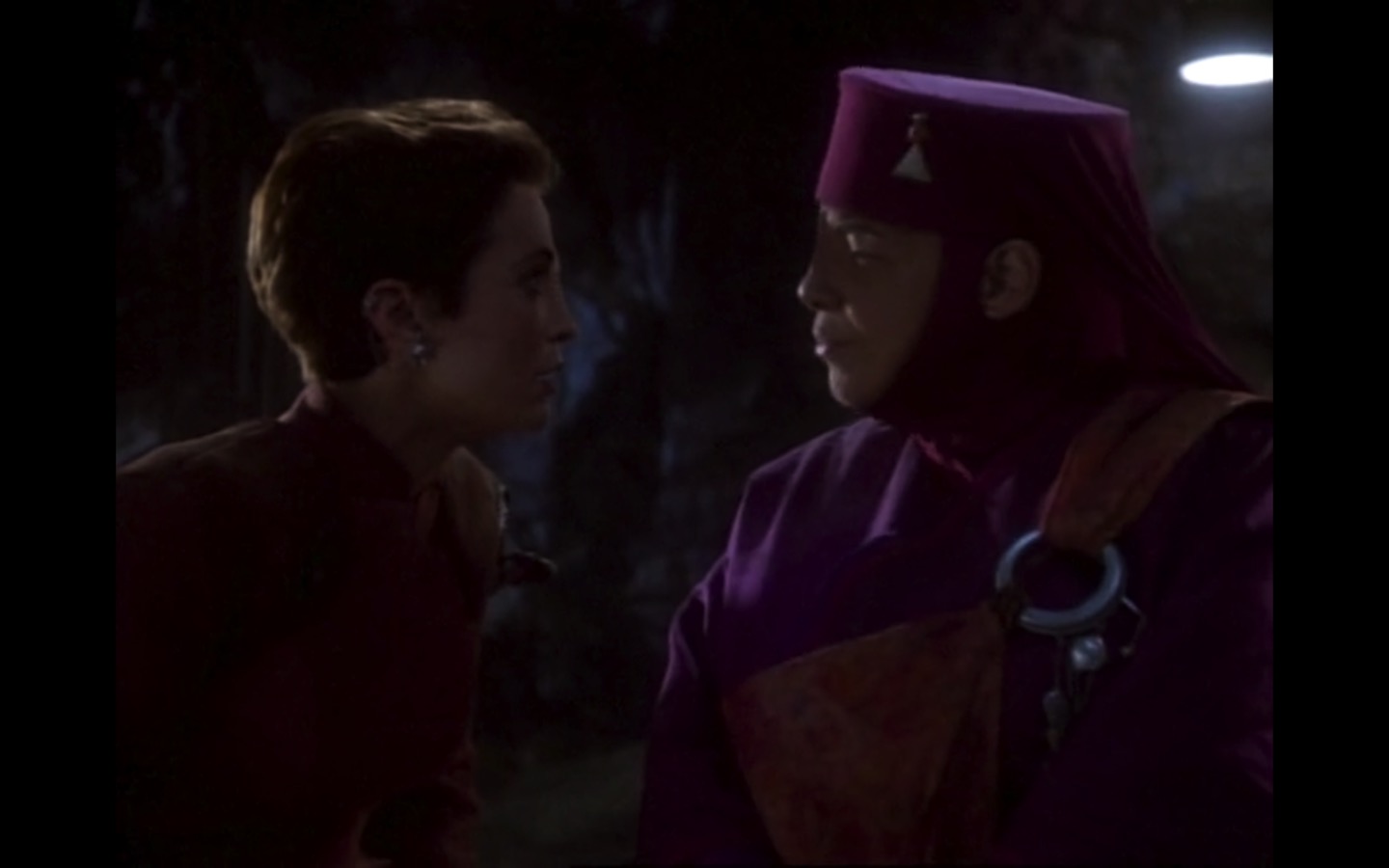
“Battle Lines” is a puzzling little episode that, while it has its moments, is ultimately hugely disappointing. It starts out seeming to represent the show finally turning its attention back toward Bajor, and to some of the ideas for which “Emissary” laid groundwork…and then it takes a pretty serious left turn, and quickly transforms into something else entirely. That something has some potentially interesting elements, but ultimately doesn’t amount to much, not least because the episode seems to come to a rather abrupt end before the story has played itself out. But even more importantly: This is an episode that hugely “matters” to the larger story of DS9 in that it disposes of Kai Opaka, thereby creating an opening for stories about Bajoran religious strife and political intrigue in episodes to come—but unfortunately, the word “disposes” seems all too apt a descriptor of how it treats the Kai. Indeed, in hindsight, it feels an awful lot like what happened here is that the writers slapped some random-ass story together solely for the purpose of getting rid of her. Based on what I’ve read, however, the truth is even more disappointing: Apparently, they needed for someone to be on the runabout with Sisko and the others whom they could “kill off,” but they didn’t want to lean on the old narrative crutch of bringing some random redshirt along…so someone said, hey, why not Kai Opaka? It seems, in other words, that with no thoughts in mind about what future stories it might make possible, the writers decided to throw the Kai into this one and have her be the casualty more or less for the hell of it–or at any rate, for no greater reason than shock value.
As I’ve mentioned elsewhere, I didn’t really start watching DS9 regularly until after TNG’s finale, so I only saw a handful of the episode from this season when they initially aired. “Battle Lines” was not among that handful; my first viewing of it occurred after I had already seen later episodes featuring Kai Winn. Thus, there was an interval when I did not know what had ever become of Opaka. Also, as I somewhat belatedly acquainted myself with the show, it came to seem as though there was a real missing narrative piece somewhere between the vague references in the pilot and the later premise about Sisko being “The Emissary.” So, when I first got wind of there being an episode in the middle of this season that featured Opaka, I remember having high hopes for it. Imagine, then, my surprise and dismay upon finally watching it, and finding out that it has basically nothing to do with Bajor or with Sisko’s role as The Emissary! Now, admittedly, my experience may have been somewhat singular, and I perhaps brought expectations to this episode that those who saw it when it first aired may not have had. Still, I have to imagine that even those viewers must have spent a good portion of the episode’s run time wondering, as the story of the Ennis and the Nol-Ennis unfolded before them: What the hell is Kai Opaka doing in this episode? The story executes a bizarre series of narrative turns, wherein at first it seems like it’s going to be properly about the Kai, but then she randomly dies, and we move on to learning about the moronic war that some random aliens are fighting…and then she suddenly comes back from the dead (!), only to be sort of sidelined for a while as the story continues to focus on the Ennis and Nol-Ennis, until finally it sort of circles back to her, except…not really.
I say “not really” because, for three distinct reasons, the conclusion wherein Opaka decides (?) to stay on this moon among the Ennis and Nol-Ennis really just does not work. Most immediately, it doesn’t work because the plot of the episode undercuts her decision to remain, by having her come to it immediately after we, the audience, have just learned (along with Sisko) that she in fact has no other choice. That she doesn’t yet know this when she makes her rather abrupt announcement doesn’t really fix this, in my view; it just creates a profoundly weird moment where we think that Sisko and Bashir are about to break the bad news to Opaka (and Kira), but then, instead, she ends up breaking essentially the same news to them. (Poor Kira; one imagines Sisko, after they all beam to the rescuing runabout, pulling her aside and being like: “Hey, just so you know, that decision that the Kai just made that you’re freaking out about? Well, even if she hadn’t made that decisions, we’d still have had to abandon her here!”) My point, I guess, is that for a character decision like this one to land with any real weight, it has to be made in the face of actual viable alternatives. Here, the episodes tries to sell us on the idea that she’s staying by choice, even though it also establishes that she has no choice. It’s just really weird writing. Secondly, this character choice doesn’t fly for me because the episode does essentially none of the work that would be needed to make it make sense. It doesn’t, for instance, establish that she has any special skills or insights that might make her a good mediator for these particular people, or show her beginning to build any kind of rapport or relationship with them. Sisko tries to provide the Ennis and the Nol-Ennis with alternatives to continuing their pointless war; Sisko gets them to at least meet and talk about potentially putting an end to their fighting. The Kai, for her part, mostly interacts with Kira, taking little apparent interest in the locals and their war (indeed, she barely says two words to any of them directly) until the moment when she suddenly decides that staying here to help them “begin their healing” is her destiny. But thirdly and most importantly, Opaka staying doesn’t work for me because it’s just so random. Okay, sure, the prophets told her that this was her destiny. But… Opaka, to borrow a phrase out of context from a later episode, is “of Bajor,” you know? She’s been established as the Bajorans’ indispensable spiritual leader, the one person who has held them together and given them hope through years of brutal Cardassian occupation. (She also, not for nothing, is the person who helped our commander to make peace with his assignment to Bajor, and who set him on the path that led to the discovery of the wormhole.) For the writers to want to replace her with someone who will be more contentious, and less of an ally, made good story sense. But for her “destiny” to have nothing to do with Bajor, and instead to be about helping these random dipshits stuck on a moon in the gamma quadrant pull their heads out of their asses and stop repeatedly killing each other for no reason? That just makes no narrative/thematic/character sense whatsoever.
As for the Ennis and Nol-Ennis, their story strikes me as a bit of a Trek cliche, in that we’ve certainly seen plenty of premises involving bitter rivals fighting a pointless war on previous incarnations of Trek, as well as more than one scenario wherein some sci-fi gimmick or other plays a role in perpetuating the said war. The story isn’t necessarily an obvious rip-off of any one specific TOS or TNG episode, but it does just sort of feel tired and underbaked, to me. It doesn’t help, either, that the Ennis leader (the main guy with whom our people interact) is not given much depth, or even a consistent/plausible characterization. On one hand, he seems resigned to his fate, and his little speech about how they used to “try” more (in response to Kira’s critique) until they realized how pointless it was does resonate, and make some sense. And yet, despite recognizing the pointlessness of continuing to fight, he’s nevertheless still invested in doing so, for the sake of a “vengeance” that just feels empty and under-motivated.1 If the story had developed this character into a sympathetic (even if still ultimately misguided) and genuinely tragic figure, I might have been able to get more emotionally invested, even if it still ultimately would have amounted to a “generic” Trek story (centering on a one-off guest character, no less) rather than one that DS9, in particular, needed to tell. But it doesn’t even go that far. Also, when the talks between the two sides break down because neither is willing to make the first show of good faith, for fear of being betrayed by the other…how does this make any sense? These guys can’t actually die! They have literally nothing to lose! And finally, as I indicated toward the start of the review, it feels rather as though this story ends abruptly, rather than actually coming to a conclusion: one attempt by Sisko to get the two sides talking to each other fails, and Bashir discovers that the combatants will die if removed from the planet, so…whoops, Dax and O’Brien have arrived to rescue our people, so I guess we’re done with the Ennis and Nol-Ennis. Sisko doesn’t try to convince the Ennnis leader to keep trying for peace (though I guess the Kai is going to do that after the rest of our characters leave), nor is there any consideration of maybe taking them off-planet despite the fact that it will mean their death (which surely many of them would welcome). There is a brief consideration of a tech solution for them, but when the Ennis leader boringly and disappointingly seizes on it as providing an opportunity to “win” their pointless war, our people drop it immediately. (One might expect that, when he realizes that they aren’t going to provide him with this “ultimate weapon,” he might try to take matters into his own hands—say, by murdering them in order to force them to stay and share in the Ennis’s fate. But nope; he just shrugs and goes back to killing Nol-Ennis instead.) The impression that I’m left with is that the story has been allowed to play out for only as long as the writers could come up with stuff for Dax and O’Brien to do in their fairly routine search-and-rescue story thread, and then is promptly abandoned (though with the assurance, I guess, that we needn’t fret, because the friggin’ kai of Bajor is going to stay behind—permanently—to tie up the loose ends)l
Along the way, the episode does attempt some worthwhile character development for Kira, and it gets some points from me for that, even though it doesn’t do a very good job of it. I mean, I very much appreciate what the show is trying to do with Kira here, both in showing us that Opaka (and Opaka’s approval/positive impression of her) is important to her, and in pushing her to introspect about her combative nature and her relationship with violence (including her unconscious guilt over the violence in her past). Again, though, it doesn’t feel like the episode puts in the necessary work to really sell this, or to put her through any kind of meaningful arc. The bit where she jumps in and starts berating the Ennis for half-assing their war efforts is a good start, serving to illustrate the idea that this is the kind of thing that she knows, and is where she feels in her element—and Opaka prodding her to recognize what she has in common with the Ennis is also good. But the scene in which she starts falling all over herself to assure the Kai that she abhors violence is overly verbose and too on the nose, and then her tearful breakdown and moment of catharsis erupts more or less out of nowhere. (Also, I’m sorry to say that her immediate anguish over the Kai’s death, earlier on, is overwrought and rather poorly acted; this is one of those situations, methinks, when less would have been more, and a more subdued/numb/shocked reaction would have felt more real.)
- In a bit of mind-blowing-in-retrospect casting, this character is played by Jonathan Banks of Breaking Bad and Better Call Saul fame. In his alien getup, I didn’t immediately recognize him; at first, I just found myself vaguely wondering why I sort of liked the guy, despite how incoherent and disappointing I found his characterization to be. But before long, I was like “Wait a minute…that voice! I know that voice!” ↩︎
This episode seems to be trying to do two things. The most straightforward one is that they’re trying to say something about violence and the general senselessness of it, and to that end, they’re drawing some kind of connection between Kira’s history as a fighter against the Cardassian occupation and what we’re led to believe is the tribal conflict of two factions of (forgive me) rival boneheads whose primary species trait that distinguishes them from other humanoid species is that their hair stays unusually thick and dark as they age. The less straightforward goal of the episode is whatever they’re doing here with Kai Opaka. They seemed to want to get rid of the character—perhaps they were thinking of future stories about who would succeed her as Kai—but this is odd, given that they really haven’t done much of anything with her to date. And the story here, I guess, is about Kira’s (and indirectly Bajor’s) grief and efforts to heal itself from the violence of the occupation.
Neither of these efforts works very well. The teaser opens by leaping right into the plot, and it becomes apparent fairly soon after that this was a bad move. To make this work, they needed, in the beginning, to be setting up something about the relationship of the Kai to Kira and to the Bajorans in general. They don’t even get around to *mentioning* it until Odo’s line about how important the Kai is to the Bajorans. But even if that had come earlier, it wouldn’t have been nearly enough; we needed to see her importance dramatized in some way. What exactly does the Kai symbolize? What role does she play in organizing or inspiring people? I have no idea, so I don’t really believe in the idea that she’s important to Kira, no matter how much that may stand to reason in a general sense.
To make things worse, Opaka is just a caricature of a person. Neither here nor in the pilot did she do much more than make mystical pronouncements while (as you pointed out in your review of Emissary) displaying no self-awareness that some of the people around her don’t share her religious beliefs. Frankly, if it weren’t for the fact that her otherworldly knowledge consistently turns out to be correct, she would have come across (both here and in the pilot) as a con artist, or as just straight-up mentally ill. Like you, I don’t actually *mind* that she has access to this knowledge, since Trek plays very fast and loose with science and we can attribute it to the timeless nature of the prophets and their relationship with Bajor, but her arrogance does make her insufferable, and there just isn’t anything else really to her personality at all to help make up for it. Because of all this, when Kira is grieving Opaka, her grief does not feel real. We have no reason to care about the Kai and no real reason other than “Kira’s religious” to believe that Kira does.
Kira’s protestations that she doesn’t want the Kai to see her as enjoying violence also really seem to come out of nowhere to me. Can I believe that Kira has some mixed feelings about some awful shit she did during the occupation? Absolutely; I would expect that. But the idea that she enjoyed being violent for its own sake? I just don’t think that’s part of her psychology. And why exactly would she think Opaka thinks that she does? Nothing about Kira’s characterization in the series to date suggests she loves causing harm or inflicting damage, much less in her interaction with Opaka. In this episode, she does seem to act impulsively, but even that doesn’t happen when Opaka is around. As a result, the whole scene where she expresses her fear about Opaka having the “wrong impression” of her just ends up feeling kind of melodramatic.
This gets me thinking about how they might have made this work, and I think the answer is, as it often is, that they needed to spend some time fleshing out the context more. What was the Kai doing during the occupation? I assume she must have been walking a pretty fine line between showing opposition to the Cardassian military and not being so openly defiant such that they let her continue to sit in the role, since she still has the respect of people who were radical enough to use violence to fight their oppressors. Were there moments where she showed some heroic leadership? That would certainly give me in an investment in her as a character. But if we knew almost anything at all about her role during that time, that would have been a major step toward showing us why Opaka *matters*—to Kira, to the Bajorans, and to the audience.
As for the general theme that’s being expressed here: While I can appreciate the point that people could sometimes be prone to trade violence out of a desire for revenge, leading to a harmful and unproductive feedback loop, the way this is set up feels too simple, without much history or context to the conflict. When you think about real life violence between two cultural groups that aren’t actually forced by geography to interact (as these people don’t seem to be, though this isn’t made explicit), I should think it usually starts due to conflict over resources, and for the tensions to maintain at a level where there is active violence, I also tend to think that there would tend to be some ongoing example of the resource conflict going on or it would eventually degrade into something a bit less overt. One party wants to take or have control over something that another has, and an interpretation of that is filtered through a variety of cultural and religious structures to become an ongoing pattern of violence… you know, the way Bajor and the Cardassian occupation are depicted? Because there’s none of that here whatsoever, it doesn’t feel believable, and these clans seem to be pretty seriously lacking in self-awareness, so the attempt to set up a parallel between them and Kira doesn’t work at all.
The one-dimensional nature of these aliens is worse than that, though. Even if they absolutely hate each other because they remember some old conflict between their cultures and they resent that the other side has been killing them all these years, just what exactly is the motive to enact revenge specifically by killing each other when killing each other doesn’t really *do* anything? If we are supposed to believe they are trying to cause the other to suffer, it doesn’t seem to really do that very well. Most of their suffering is just a result of being stranded here, apparently with nothing to do but kill each other—and if making each other suffer was their real goal, I seriously doubt that a status quo of two groups attacking each other would continue for so long. The more cynical take would be that they’d try to capture each other—either so they could avoid being attacked all the time, or (if they’re really twisted up) so they could torture each other. Less cynically—or, that is, if any of them had any sense—they’d be trying to get away from the violent ones and thinking about how to make more out of their lives here. Even if I absolutely hated the bastards in the next cave over, I don’t think it would take me long to start thinking about how I could set up a halfway decent life for myself, and I would definitely prioritize that over my vengeance, even if maybe I’d also still be thinking of ways to stick it to them once my life didn’t completely suck.
Anyway, it all just really seems extremely unbelievable. The writers should have thought a bit more about the situation at hand on this prison planet. Just for starters, how do they eat here? They don’t seem to be dedicating themselves to agriculture, and the place doesn’t seem very conducive to hunting and gathering as far as we can tell. If all their needs have been provided for by the people who incarcerated them, how do they spend their time? You’d think they would be more prone to casually killing Sisko or any of the rest of the crew, too, given that as far as they know death means nothing there. And for his part, Sisko is awfully casual about the possibility that someone could stab him even after he knows that it would condemn him to stay there, turning his back on them and not working very hard to avoid getting caught between them during the fighting—almost like he doesn’t really believe that any harm could come to him because nothing about this is real. Oh, Shel-la being extremely clueless when talking to Sisko and all about how great it would be to change the nature of the microbes so they could die so that he could weaponize it doesn’t seem right to me. Okay, he might feel that way, but is he a total idiot? Why disclose that this is your intent to Sisko et al? I could probably mention a lot more issues that cause this setup to feel fake, but I’ll just add one final one: I know it’s just a budget issue, but the whole place feels very, very much like a set—honestly, it’s on par with the persuasiveness of the planetary sets in TOS, and that’s not a flattering comparison.
Oh, and the ending feels incredibly forced. What prophecies is Opaka talking about that staying is supposedly in fulfillment of? As far as I recall, this was never set up at all except with her vague premonitions at the beginning of the episode. And nothing about the idea of her staying there to help the people rings true at all, especially since she doesn’t do anything on screen to build a relationship with any of them. I don’t think there was even one scene where she says so much as a word to any of them, was there? If that’s where you were going, why wouldn’t you have *her*, instead of just Sisko, engaging with them, and presumably finding some common ground? The confidence with which she accepts her fate to stay with these people at the end is also just not realistic or compelling. They don’t do the work to set it up, and we have no reason to care at all—not about the aliens, not about Opaka, and most especially not about whatever might happen as a result of their interaction.
I guess the episode hangs together as a one-dimensional morality play enough to make for a two-star ordeal, but I really can’t think of much that’s positive to say about it except to note that given the casting, I like to imagine Shel-la (since as you probably noticed he’s played by Johnathan Banks, who also played Mike on Breaking Bad/Better Call Saul) slapping Kira around when she’s sobbing over a dead Opaka and telling Kira to repeat after him: “I woke up. I found her. That’s all I know.” Since the writers lacked the precognitive powers of the Kai to give us that scene, the episode truly is a waste of a good Johnathan Banks, as far as I’m concerned.
Other thoughts:
• There’s no mention of Sisko as the Emissary here, which seems odd in retrospect. Obviously the writers intended Sisko to be the Emissary to the Prophets in the pilot, but it seems as though the idea that this translates into being an important figure in Bajoran religion was only added much later? I dunno.
• There’s an intriguing setup with the logs of Dukat (or whomever it is, since Dukat isn’t mentioned) being discovered, but it’s just used to make a joke at Kira’s expense. I don’t believe for a minute that Kira would give a shit about what the occupying officers thought of her. She didn’t become a terrorist so she could impress people—much less the Cardassian military leadership of Terok Nor—and I don’t see her as secretly insecure about whether her actions during the occupation made a difference. Even if I were willing to concede that she does care somewhat, her indignant reaction would still seem over the top here, and a little insulting to a character I love.
• Speaking of her being over the top, that’s how Kira is written for most of the episode. Besides her reaction to Opaka’s apparent death (which does at least make sense even if it’s not dramatized enough to feel real) and the insecurities she shares with Opaka, she’s rather insubordinate. While I see her as strong-minded enough to challenge Sisko when it matters (say, when she perceives Bajoran interests to conflict with Federation values), the way she does it here shows a level of lack of respect for the chain of command that doesn’t feel justified given the stakes. Why is she so hostile when describing the poor strategic thinking that the planetary prisoners are demonstrating? And I have to say, I don’t remember thinking Vistor’s acting was overdone after the pilot, but I do think it’s too much again here. In fairness, it would have been hard to sell these scenes because the writing just wasn’t there (even if despite this, I love Visitor’s version of Kira generally, and couldn’t see anyone else in the role.)
• So some of Opaka’s vertebrae have been crushed. I’m no doctor, but if that’s the case, doesn’t dragging her out of the shuttle seem like a bad plan?
• The people here are weirdly reluctant, initially, to talk about how they are automatically revived after they die. I know they’re jaded, but we don’t have any reason to think they would consider that normal to outsiders. It’s almost like they want the reveal come out more dramatically for their visitors later.
That really is ridiculous that they brought in the Kai just to kill her off for the sake of doing something surprising; I didn’t know that. Ironically, I think it really backfires, in that it doesn’t come across as surprising at all. It seems more like a traditional TV thing of not knowing what to do with a character, so they kill them off, and it’s really boring, not to mention a waste of potential. I guess you basically already said that.
I’d say once again we hit on a lot of the same stuff from a slightly different perspective.
Yep. However, for the sake of shooting the shit about it, here are two things that I would go slightly easier on than you did:
1. The character stuff that the episode tried to do with Kira. As I said in the review, I don’t think it actually succeeds at what it’s attempting—but I do think that what it’s attempting makes a bit more sense than you seem to be crediting it with. I didn’t read it as trying to suggest that Kira enjoys violence for its own sake at all. I saw it more as showing that she has (whether she likes it or not) a fairly combative nature, and how, upon finding herself in the midst OF violent conflict, those instincts automatically kick in. But also, and more importantly, what Opaka perceives and gets Kira to recognize are the feelings of guilt that she’s repressing ABOUT being a person who has those instincts—about being a person who has lived a violent life and is “good at” violence. (Kira wants to externalize it and insist that her critique of the Ennis’s lax defenses and whatnot is just what any competent person finding themself in this situation would do, because that’s more comfortable than the idea that her reaction has anything to do with who SHE is and the particulars of what her life has been like.)
(Also, this kind of connects with the bit in the teaser wherein Kira reacts to having been dismissed as a minor operative or whatever. I agree with you that her reaction was silly and over the top, but trying to see through that to what the writers’ intent may have been, we could understand it as a sort of “if I have to live with having done the things I did, I at least need for those things to have MATTERED” type reaction. It still doesn’t work at all; for starters, we don’t actually know what sorts of things she did (again, the show hasn’t put in the work to make any of this come to life), and also, even if everything else about it worked, it would be a super-weird choice for the episode to play it as a joke the way it does. So the execution SUCKED, but I do think there are actual good ideas underneath the ineptitude.)
2. For my money, you’re a little overly dismissive of Opaka as a character. To me, she has always seemed _potentially_ interesting, in a “I can’t wait for the episode that really develops this character” sort of way. It’s just, that, of course, that episode never came, not least because of the boneheaded decision to dispose of her in this, the second episode in which she even appears. So she never becomes more than a rough sketch of a character, but “caricature” still feels too negative to me, and I don’t feel like she comes across as a con artist or as insufferably arrogant. (_Mildly_ arrogant I’d grant, per my comments about her in my “Emissary” review, which you referred back to here. But I generally enjoy her presence when she’s onscreen).
For Opaka: I didn’t mean to say about her that she couldn’t have been developed or that she wasn’t potentially interesting… more just that in the absence of any of that development, since the only personality traits she is shown to have are ones that I find a bit grating. She could have been depicted the same way she is depicted here, but if they’d given us some details about who she is as a person and what she’d done during the occupation, they could have solved this pretty quickly, and that would have made it a much better show!
I didn’t mean that the episode was trying to suggest that Kira *was* violent, just that in that scene, Kira was expressing concern the Kai will see her as violent generally when 1) I don’t think she would really be worried about this and 2) nothing she’d done around the Kai that I recall even suggested that she has a violent nature. The way the scene goes down, Opaka asks if she recognizes herself in these people, and Kira denies it because she’s a fighter and they (apparently) aren’t… then worries that Opaka has the wrong impression of her “that l enjoy any of this. l… l don’t enjoy fighting. Yes, l’ve fought my entire life, but for our freedom… That’s not who l am. l don’t want you to think that l am this… violent person without a soul, without a conscience.” Perhaps the overall intent was as you suggest, but the scene needs to be rewritten to reflect that. Also, these warring factions don’t remind me of Kira at all—the situations just seem radically different, both in the generalities (nothing about this tribal conflict is rooted in any sort of logical result from the history that we know of, which is the opposite of Kira’s violence) and the particulars (the Ennis and the Nol-Ennis are mutually stranded on a planet and seem to have more in common than differences, and they have options they’re too blind to see). I don’t know how much I’m actuality disagreeing with you because I know you’re not saying it worked as written, and I’m not saying it couldn’t have worked if it had been written differently.
As I was writing this, something finally started to make sense to me that raises the episode in esteem to me. Look at these words: “Ennis” is likely a reference to “Penis,” and the “Nol-Ennis” a reference to “Nul Penis.” These two cultures are clearly manifestations of patriarchal violence over whether or not they have penises.
Uh… Yeah, that’s clearly it.
I guess Opaka just annoys me less than she does you. As for Kira, I think we basically agree. I feel confident about what I think the writers were going for in that scene, and I like what I take the idea/intent to be, but they definitely botched it. As written, nothing about it really works.