
How to succinctly sum up my thoughts and feelings about this episode? It’s a strange one, for sure, and there are questionable things about both of its storylines—but I must say that, quibbles notwithstanding, I find it quite enjoyable. Indeed, I would even call it the show’s best episode since “Past Prologue.” Even so, though, I can’t really justify giving it four stars; I like it, but it isn’t on par with any other episode to which I’ve given a four-star rating. To some extent, we’re confronting here the fact that three stars is (as I’ve noted before) sort of my catch-all rating for anything that falls between “deeply flawed” and “really good”; some three-star episodes are mediocre, but not quite bad enough to slam with a mere two-star rating, while others are pretty darn good, but still not quite good enough for four stars. Also, I think that this particular episode just stands out a bit because of the slog of mediocrity that precedes it in the middle run of DS9’s first season. However all of that may be, what it comes down to is that “The Storyteller,” while fairly simplistic and hardly brilliant, stands for me as a charming and somewhat easy-to-overlook pleasure from the show’s early days.
For starters, this episode earns some points simply for finally turning the show’s attention back to Bajor. We aren’t dealing directly, here, with any of the big ongoing issues that define the show’s premise, or with any thorny moral complexities, but this remains, nevertheless, the first episode of Deep Space Nine to mostly take place on Bajor (as well as only the second one that has been largely about Bajor and Bajorans). I love it for that, even though it must be admitted that both of its storylines present a somewhat different Bajor from the one that most other episodes (will) show us. The planetside story feels like it is taking place in some premodern society, and in a village that has no connections to any larger world (apart, that is, from its residents’ belief in The Prophets, and also the presence of an orb fragment—which, I must say, is a nice touch). As for the other story, I like the fact that it, for once, depicts a Trek world as being complex and pluralistic (here are two teeny little splinter groups embroiled in their own local disagreements), but it does seem kind of odd that the Bajoran provisional government is not taking any role in the mediation of their dispute. I actually like both the fact that the story is about issues local to this one isolated region, and the fact that their conflict nevertheless connects to larger Bajoran issues (in that their land dispute arose because of the Cardassians redirecting the course of a river)—but while I also dig the idea of them turning to Sisko as an outside mediator, in that it gives substance to the whole of idea of his mission here being to help Bajor pull itself together and get ready for Federation membership, it still seems weird that Sisko and Kira, and the leaders of the two splinter groups, are the only people involved in the negotiations. I’ll return to an aspect of this point later, but for now, all I’m saying is that, in concert with the other storyline, it all makes the Bajor of this episode feel more like a planet of isolated villages than like one that has a unified planetary government and a role in interstellar happenings. This is part of what makes the episode so singular within the larger context of the show. Bottom line, though: quirks aside, we have stories about Bajor here, and I deeply appreciate that.
I must admit that, ahead of this rewatch, I had exactly zero memory of the stationside portion of this episode. I enjoyed it a little too much to feel good about calling it “forgettable,” but in a literal sense, I guess I have to acknowledge that it does qualify for that descriptor, at least for me. I think part of the problem is that, whether due to budgetary constraints, time limitations, storytelling economy, or plain old lack of effort, the story feels awfully stripped-down. Like I said, we don’t even meet a single member of either faction other than their individual leaders. We also don’t learn anything about the stakes of their land dispute that would help bring it to life as a genuinely difficult or important problem. Instead, for the purposes of dramatizing its “dispute between rival factions” premise, the episode relies entirely on its characterization of Varis Sul as a strident, stubborn, yet still basically likeable teen-aged leader who is trying her best (seemingly with no input from advisors or other adult officials of any kind) to do right by her people. And, of course, it does so (at least in part) because ultimately, it’s actually more interested in the idea of Jake and Nog palling around with her than in the actual land dispute. One could see this as a tad disappointing, but at the same time, Trek episodes about factions who are at each other’s throats over some petty dispute or other are kind of a dime a dozen, and honestly, the stuff with Jake and Nog is pretty fun. The actress who plays Varis successfully embodies a character who feels like a real, whole person, despite having to adopt completely different demeanors in her negotiation scenes with the adults versus her scenes with the two boys. Jake and Nog, meanwhile, continue to be a fun pairing, and even though it’s a bit odd for a Ferengi adolescent to go all infatuation-at-first-sight over some Bajoran girl, Eisenberg’s tongue-tied, nervous teenager performance, layered atop his usual Ferengi demeanor, works for me (with Jake entertainingly playing his more relaxed, voice-of-reason wingman/sidekick). Nog’s prank with Odo’s bucket is also pretty good. The idea of Varis using her interactions with the boys as a way to gauge whether or not she should put her trust in Sisko is nice, too, and again ends up reinforcing the touching father-son bond that constitutes part of the heart of the show. So, yeah, the episode does kind of play the trick of turning a putative Bajoran story into a story about Jake and Nog, and Jake and Sisko, and that does, in some ways, feel a little hokey and cheap…but also, if I’m being honest, I enjoyed the whole of it.
Still, the planetside storyline remains both the meatier and the more memorable one (as well as, obviously, the one that gives the episode its title). The first thing that I want to say about it, though, is that the Bashir/O’Brien character interaction aspect is one piece of this episode that, while fun in itself, has doubtless become even more enjoyable on retrospective viewing than it was when the episode was written and initially aired, given how these two characters’ relationship would evolve as the series progressed. Were the writers in any way planning or imagining, when making this episode, the ride that they were going to take this character paring on in future seasons? I have no idea. But even if not, Bashir’s overtures to O’Brien here, and O’Brien’s eye-rolling tolerance of the young doctor, still make for a great starting point for what will come later! The episode plays it just right, too; it establishes O’Brien’s dislike for Bahir without leaning too heavily on it, and then it doesn’t even really try to sell us on any idea of them warming to each other as their little planetside adventure unfolds (!); indeed, by episode’s end, Bashir actually seems to be giving up on the idea of buddying it up with O’Brien. This strikes a rather uncharacteristic note, not just for Trek but honestly for any television show; either the writers were really planning for the long game here, or they were just looking to have some quirky fun with two characters who felt a bit like oil and water. Either way, I kind of dig it.
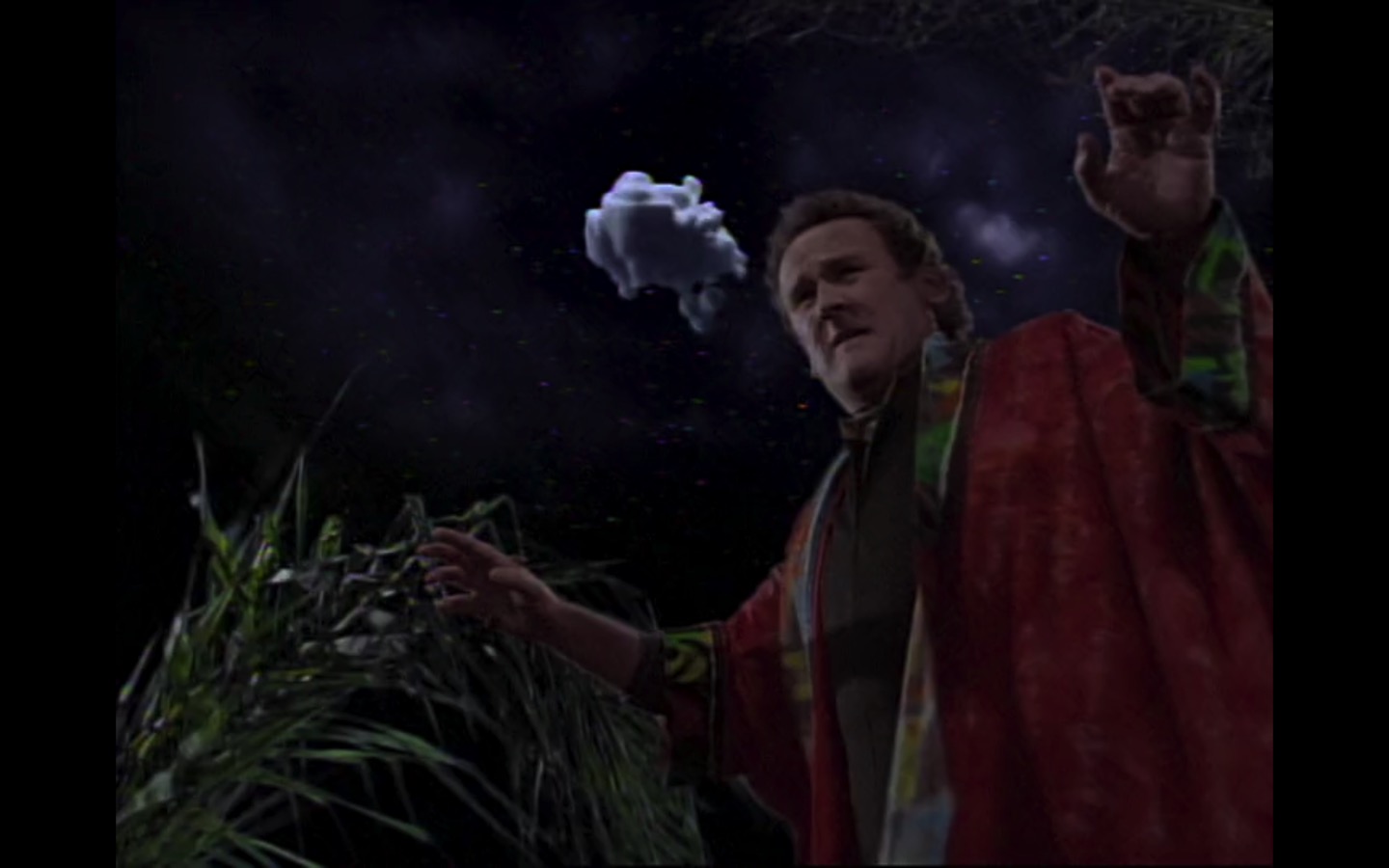
So, anyway: There’s this seemingly isolated village that, from time immemorial, has been menaced annually for five days by a weird supernatural beast, but has a kind of spiritual leader who presides over a communal ritual of sorts that always fends it off. That’s…weird. It’s interesting, but it’s also definitely weird, and to engage with this story at all, one for sure has to suspend a certain amount of disbelief. Like, yes, the Bajorans are a religious people, but they are also an interstellar-age civilization, not premodern superstitious yokels, you know? But, okay, fine, this seemingly anachronistic and not-terribly-plausible situation has somehow survived in this isolated village. If you’re willing to grant that, what you get out of this story is a provocative little allegory with multiple and overlapping possible interpretations. Obviously, the episode’s title invites us to read it as a meditation on the power of storytelling; here is a village, once riven by internal strife, whose residents managed, at some point, to put that strife to rest simply by (repeatedly, and in a ritualized way) telling themselves a story about their own strength, resilience, and capacity to unite for their common good. That’s kind of cool. It’s also a weirdly benign twist on the idea of uniting a divided people by giving them an external enemy to fight—except, in this version, the “fighting” is entirely conceptual, and the enemy isn’t really external, but is instead just a manifestation of the internal strife itself (thus rendering the tactic refreshingly victimless). That’s also kind of cool. On the other hand, the peace (and sort of the whole communal life) of this village is based on a lie that has been perpetuated through the ages, and that lie, in turn, props up the power and mystique of the village leader, which I find decidedly less cool. In this way, it does function as an allegory for the role of religion in society, but I’m not entirely sure what the episode means for us to take away from this. We do, for instance, see the apprentice Sirah character resort to violence in the face of his displacement by the interloper O’Brien, which perhaps suggests that the status quo is a fairly fragile basis for the community’s peace to rest upon. Still, I don’t come away feeling like the episode is in any way trying to suggest that a peace and unity that’s based on a lie is at all problematic, and as a person who very much holds that deceiving others “for their own good” is rarely, if ever, legitimate, that doesn’t sit right with me. In its defense, though, the episode also doesn’t specifically try to sell this village’s ritual as good or positive; mostly, it just presents it and tells an odd little story around it, and leaves things at that. I will say, too, that the idea of the old Sirah deliberately selecting a random outsider to succeed him, as a kind of doubling-down-in-microcosm on the story of the village and the Dal’Rok (to give the apprentice character an obstacle to (publicly) overcome in order to win the confidence of the villagers), is clever. Also, it resolves the apparent mystery of his choosing O’Brien much more satisfyingly than if he had just had some kind of mystical insight…especially since, let’s face it, O’Brien makes a terrible Sirah! That, too, is one of the things that makes the story enjoyable; O’Brien is just so wildly out of place in the role that he’s thrust into, and watching him grapple with it, and try to fill it, is entertaining. (“All right now! Let’s really focus, and send the Dal’Rok a message, okay?”1) Still, for the story to end by confirming O’Brien’s attempted murderer as the “true Sirah” and appropriate/rightful leader of the village is sort of weird and disturbing, right?
So: Again, this is a hard one to sum up. For sure, not everything about it works; still, enough things do (even if some of those things make hefty suspension-of-disbelief demands) that I can’t help but to mostly like it, on the whole.
- That said, in the moment when O’Brien first starts orating for the crowd, you can almost imagine him going off-script and “telling a story” about what’s really going on—i.e. spilling the beans to the villagers. “Once upon a time, there was a Dal’Rok—but it was really just a lie told by a conniving leader to unite a bunch of squabbling villagers, and cement his own position as their indispensable protector.” That could have taken the episode in a different direction, and I might have been on board for it…! ↩︎
The thing I really I like about this episode is the O’Brien/Bashir’s pairing. I like that Bashir rubs O’Brien the wrong way—the kind of tension Trek has been reluctant to allow among its characters—and the way the show gradually makes them friends, starting with this episode. The episode doesn’t try to do too much at once, nor does it just leave the relationship completely treading water. In this episode, O’Brien maybe grows to like Bashir just a little bit, while Bashir seems to accept the limits of the relationship and see on some level that O’Brien doesn’t entirely like him. It’s a complex relationship that’s a bit hard to put into words, and that’s what I like about it.
I appreciate that the show is returning to the too-often-neglected Bajor. I do feel like both of the stories here, however, feel more like concepts made for the planet of the week in the TNG format somewhat clumsily transposed to Bajor. So yes, theoretically, both plots in this episode are technically about Bajor, but the cases of the Bashir and O’Brien “A” story, a random new planet would have made more sense. It just doesn’t make sense that a village on Bajor is threatened in this way. Bajor is a technologically advanced civilization; they would surely have investigated a phenomenon where a weird psychic entity was threatening people like this long ago. Where is their scientific community? Where is their planet-wide media? And if all other efforts have failed, did no one give any thought to solving this problem simply by evacuating the area? Surely that would be better than having the village wiped out or hanging their hope of survival on this odd scenario. And why doesn’t the community itself display any sort of skepticism or apply any critical thought to a phenomenon any modern twenty-fourth century person would surely think is pretty freaking bizarre? Certainly I can believe that *some* people would take this psychic phantasm at face value, but everyone in the village and anyone passing through or who has heard about it? No way. I frankly feel a bit insulted on behalf of Bajorans, who are depicted here as a bunch of bumpkins and simpletons. This is reinforced further when later it turns out that the people are being consciously deceived as a part of some ploy to keep them from being hateful to each other… well, I guess that’s one way to deal with bigots! (Is there a way to make this work on MAGA cultists, do you think, or do we need an Orb fragment?) Mind you, there’s not even a faint hint of the past history of division among these people. Granted, we don’t spend any time with the actual people of the community, but that’s also part of why the story rings hollow. We needed to know more about these people if we were to care about their plight.
In any case, creating an imaginary enemy a pretty superficial (not to mention cynical and condescending, though I suppose I can excuse that part if it actually worked and there were no other good options) way of dealing with a problem like having a lot of hate in your community, and one that (if found out) would probably cause other big problems. The story of how this lie was used to protect the village could be interesting in itself—frankly, I think I find this more interesting than the story being told here—but even though theoretically DS9 is a show about consequences, neither of our Starfleet characters are remotely interested in that. They just want to get the hell away from this backward village as fast as possible. Do we blame them? Not really, if we take it as given that the villager’s cultural background can only be thinly sketched. If we had seen some of the division that was taking place in this community and the way the storytelling had helped with that, that might have gone a good way toward making this work.
The plot about the Paqu and Navot works somewhat better, and it does make sense that Bajor would have many disputes of this kind in the aftermath of the occupation, so that strikes me as a better realized aspect of the setting. However, I’m not sure why the negotiations are taking place on DS9 or why Sisko is involved rather than the Bajoran authorities. Of course, plotwise, the negotiations themselves are entirely secondary to Jake and Nog’s shenanigans, which themselves are somewhat entertaining, but don’t really lead anywhere or demonstrate any kind of arc for either of them. It’s just a couple of adolescent boys being adolescents. The real point of the “B” story, and the arc, goes to the guest star, who is pleasant enough, but the audience has no investment in and isn’t complex enough as a character to really engage my attention too much. At issue here is a young woman leader’s journey toward realizing how to compromise about important issues while retaining her community’s perception of her as strong. I think this could also be summarized as “fine.” Nothing about her realization at the end really rings particularly true, seems very clever, or represents an “aha!” level of diplomacy, and like so many of the instances in which Trek depicts geopolitical conflict, the power dynamics are flat—it’s simply a “he said, she said” situation where each side’s claim is really just as valid as the other and the real problem is as simple as “two sides represent competing selfish interests.” Basically, two assholes both want the same land, neither has a better claim than the other, and neither is willing to compromise, which doesn’t provide much room to develop the story. (Also, if the actor playing her seems a little more mature than a fifteen-year-old contemporary of Jake, it’s at least partly because she was twenty-three at the time.)
Back to the storyteller plot: Okay, the apprentice is desperate to keep a job he trained to be good at at for nine years, I get it. But rather than trying to talk to O’Brien about it, taking his issue to his community, or just doing his best to get on with his life… he tries to murder him (!). The apparent ease with which he gets to homicide would seem to say something rather negative about this man’s character, but Bashir and O’Brien don’t get much past indigence as a response, and they want to avoid dealing with the situation badly enough (apparently) that they don’t even tell anyone about it. Well, as the song goes… que sirah, sirah 😉
It all feels like a pretty clear instance of a “three” to me.
I perhaps liked this one a bit more than you did, even though I agree with most of your points (and once again, we hit on largely the same ones). Obviously I didn’t like it _enough_ more to actually rate it any higher, but the tone of your comments is definitely more critical than that of my review.
The only thing you said that I don’t quite agree with concerns the land dispute negotiations. You described it as a simple case of two competing and equally valid claims, with no one being willing to compromise, leaving little room for story development. It seems to me, though, that the Navot (Woban’s faction) has the clearly better claim; the Paqua’s claim is based on a literal reading of treaty language that ignores changed circumstances, and essentially takes advantage of a situation created by the Cardassian occupiers that would never have been envisioned when the treaty was made. The _story_ then, is: How can this young, inexperienced leader uphold her faction’s interests and not give the appearance of just capitulating, while nevertheless acknowledging that the other side actually is kind of “right”? Now, I agree with you that the eventual resolution, while fine, isn’t all that terribly clever—and also, I have to wonder what there was to talk about that could possibly have filled up all the hours that we’re told are being spent at the negotiating table offscreen (!). But having the story be more of a coming of age experience for the young Paqua negotiator than anything, in the context of a situation where although she is the party to the dispute that we’re following as a characters, she’s also the one whose kind of “in the wrong,” does work for me. (Although, of course, it still ends up being a story about a guest character rather than one in which any of the regular characters has a meaningful arc. Jake and Nog are fun, and Sisko contributes some fatherly advice, as it were, but it’s only Varis who learns/changes.)
(Also, I didn’t know that about the actor being 23. Huh.)
Well, I’d definitely say you dwelt more on the positive aspects of the episode than I did. It can be more fun to talk about why something is really bad or really good than when it’s only mediocre! I do find the positive things you point out about it interesting, and I do enjoy not just the Bashir/O’Brien pairing but also the “fish out of water” O’Brien part, even if I didn’t mention that.
Anyway, I hadn’t thought about the idea that one side had a better claim. I do think that interpretation improves the narrative, though I also think it really needed to be made a bit more explicit, if that was their intention. I mean, why say that a river defines your border when a river inevitably does slowly change direction over time, and when the flow can be changed by someone upstream? Maybe she could have at least acknowledged this in her conversations with Sisko. That would take a lot of maturity… more than most real life leaders have, that’s for sure.
I like the idea you had in the footnote…. though it’s hard to imagine that hearing this during such a sensitive situation wouldn’t lead to more chaos, so O’Brien probably would need some reason to say that! Such a climax might have worked in an episode that did more to flesh out the village and their previous history of division (or whatever it was they were struggling with in the past).
Oh, for sure—before O’Brien could have pulled a stunt like that, the episode would have had to set something up to make it actually work/be a good idea. I don’t have any specifics in mind for that, which is part of why I only said that I “might have” been on board for this alternate version of the story. I just… While watching, I didn’t actually remember how the story played out, so when O’Brien got up there an started “storytelling,” I had a sudden vision of him going rogue, and I kind of liked it. 🙂
As for the land dispute: I mean, LOTS of borders are defined, in real life, by rivers. There’s nothing remotely unusual about that! I think this makes perfect sense. Short of either a) some major event like an earthquake, or b) deliberate human intervention, rivers seldom change their course very much within the kind of time scale that really matters for such purposes, and of course, if either party to this dispute had ever tried to deliberately redirect the river, the other would surely have called a bullshit on it. But their treaty understandably never accounted for the unforeseen circumstance of Bajor becoming occupied by a foreign conqueror, and the river being diverted by that occupying force.
I’m not sure exactly what to say about whether it needed to be made more explicit that the other side’s claim was better. I mean, I guess the episode doesn’t emphasize it a lot, but it seemed really clear to me. Varis’s position struck me immediately as kind of bullshit, and the character is played as rigidly intransigent at the negotiating table but as sympathetic and reasonable away from it, and then she has her spiel to Sisko at the end about how she feels like she can’t compromise or she’ll be seen as weak and failing her peeps. To me, it all added up.
I think the thing that especially threw me on that point, if nothing else, was that the exact line spoken by Sisko is “the border separating the Paqu and the Navot shall forever be the river Glyrhond.” That the people who made the treaty (and more to the point, the writers of the episode) go out of their way to emphasize the permanence of the river itself as the defining feature of the border seems to suggest something special about the river, and not just that the people who wrote up the treaty were drawing the line arbitrarily where the river was at the time. That strengthens the Paqu’s case at least a bit.