
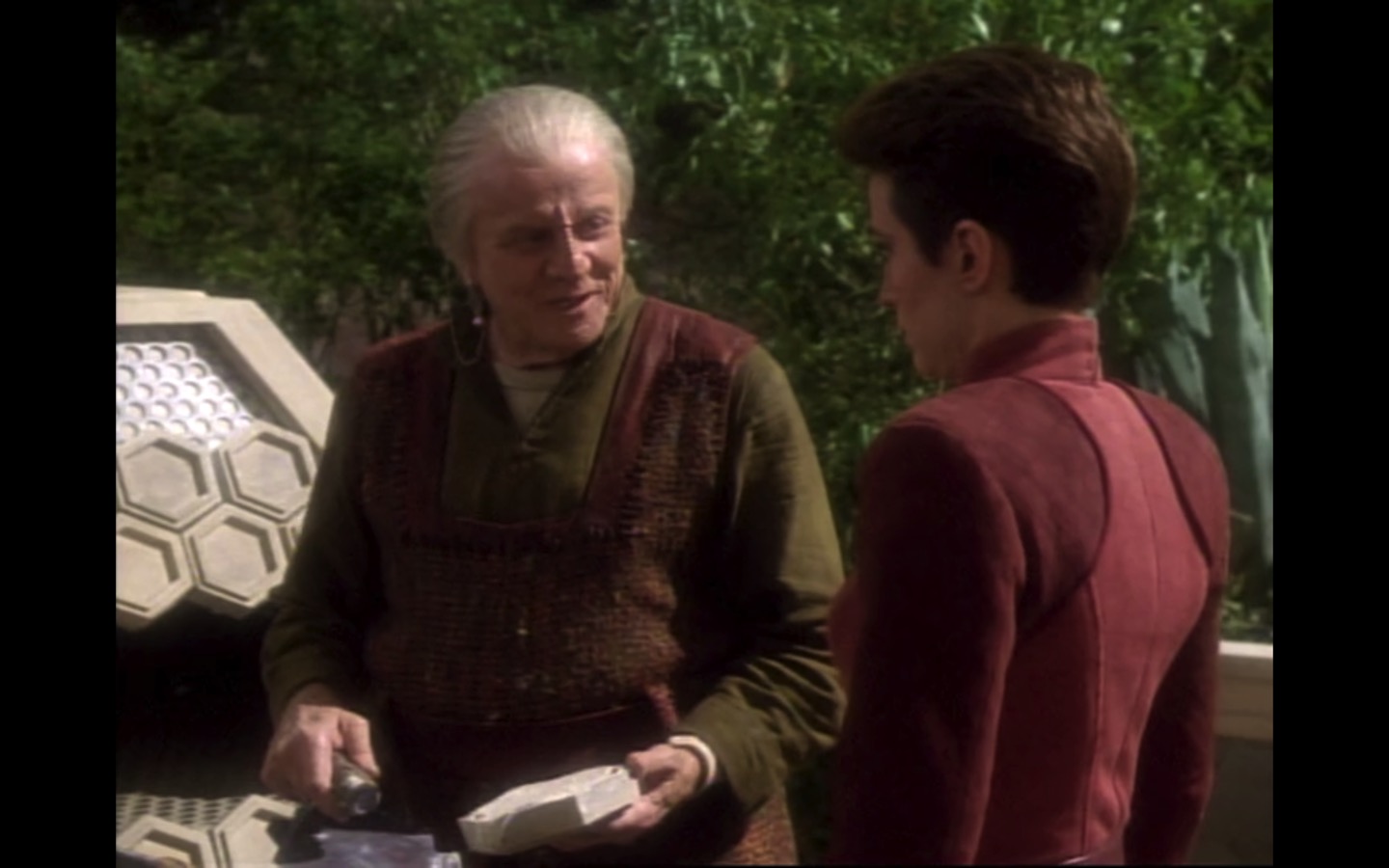
FINALLY!! This is the kind of DS9 that I signed up for: a story about Bajoran problems that has no good or easy solution and doesn’t pretend to, and one that puts one of the show’s most compelling characters in a hell of a personal dilemma and never gives her a way out of it. “Progress” is a pretty simple episode, and I’m not going to try to claim that it’s amazing or riveting from start to finish. It is, however, exactly the kind of story that I want from this show, and a pretty darn good one at that. It’s remarkable, too, for sticking to its guns and not manufacturing some feel-good solution in the end. I only wish that more of this season were made up of episodes along the lines of this one!
Something that I think is important to recognize about this episode is that it is not, I don’t think, really trying to be “about” the ethical dilemma of whether it’s right or appropriate or defensible to forcibly relocate Mullibok. We’re give enough context to understand that there are some stakes to the issue (both for Bajor1 and for him), but not enough to really chew on in a meaty “issue episode” kind of way—like, is this a case of weighing the good of a whole society against that of one guy, or is it more of a “the march of progress must not be impeded, and damn anyone who stands in its way!” scenario? I do think that we’re mostly meant to see the former, while perhaps still feeling uncomfortable about its surface resemblance to the latter (and even more specifically, to the Cardassians’ treatment of Bajor as merely a source of cheap raw materials, and their disregard for the welfare or self-determination of the people living there). But I don’t think that’s quite the point of the episode. Like, if the show had done a whole running storyline about energy shortages on Bajor, say, and how all other alternatives have been exhausted—and/or if there had been ongoing material about pockets of separatist refugees who fled from Cardassian brutality at some point and are now squatting on de facto land claims in outlying areas, and how the Bajoran government ought to interact with them—then we might have had the material for an episode that dug into the politics and ethics of the dilemma seen here. But as is, that’s not what we have, and as I see it, the episode knows this. The “issue,” then, is really just a backdrop; what the episode is actually about is watching Kira grapple with her feelings about being put in the position of having to enforce her government’s will on this cantankerous moon hermit.
As such, it becomes a piece of a larger character arc for the major—a person who has spent her life as an anti-establishment resistance fighter, and now finds herself making the difficult transition to an administrative role in support of the new order. All of her instincts align her with the underdog fighting a hopeless battle, willing to do whatever it takes to survive and defend an imperiled way of life, but as Sisko (in the episode’s most compelling scene) reminds her, she’s “on the other side now,” and she has to master a whole different set of skills, involving compromise and working within channels and, yes, weighing individual autonomy against the collective good. (One is reminded of a line from Hamilton: “Winning is easy, young man. Governing’s harder.”) Over the course of the episode, she vacillates back and forth a bit over how to respond to this challenge, but in the end, she ends up making the decision that her career, and the trajectory that she’s on as a character, require her to make—and feeling like absolute shit about it. This feels extremely real, and I love that the episode doesn’t try to paint her either as a hero or as a villain at any point, including in the end when she makes her decision. Kira’s arc here is, admittedly, essentially about the same issues the she was grappling with in “Past Prologue,” and even, in a smaller and more subtle way, in “Emissary,” but it doesn’t remotely feel like the show is just being redundant or having her “learn the same lesson” over and over again; it’s a big, complex life transition, and each of these episodes shows her dealing with it in different ways, which is exactly what one would expect.
Mullibok is an interesting character who manages to come across with a reasonable degree of complexity. From one perspective, he exists in a venerable tradition of Trek characters who stubbornly refuse to leave homes from which our people need to evacuate them (“The Ensigns of Command” from TNG’s third season leaps to mind). It can be difficult to prevent this type of character from just seeming like a fucking idiot, but while it’s certainly true that Mullibok has no feasible plan that would actually enable him to stay and survive, I feel like the episode gets away with his pigheadedness by conveying the impression that he fully understands that he can’t stay—yet still refuses to obligingly remove himself as an obstacle. One senses that the knowledge that he has to give up this home that he built for himself and has occupied for 40 years has kind of broken him, but that what “giving up” looks like for him is stubbornly refusing to budge until forced, and making whoever forces him have to live with the unpleasantness of that. When he says that if he leaves this moon, he’ll die, I think he really believes it. (Whether it’s actually true or not, of course, is another question, and one that the episode stops short of answering for us.) Also, if the episode at times seems a little torn between presenting Mullibok as curmudgeonly in an ultimately loveable way, or as actually a bit of a jerk…well, apparently that’s because its makers actually were of multiple minds on this. Specifically, writer Peter Allan Fields meant for the character to be less likeable, and even to come across as sort of manipulative, but the actor’s portrayal ended up softening him in ways that deviated from Fields’s intent. This is interesting, and I must say that I don’t entirely know what to make of it. On one hand, there’s the danger that portraying Mullibok as more of a jerk might have made forcibly relocating him not feel quite as bad…but on the other hand, as filmed, the warmth that develops between him and Kira itself might be said to let her off the hook a little (giving the impression that, yes, he’s probably mad at her in the end, but that he also kind of gets it and may forgive her). Regardless, I enjoy his folksiness, his general cantankerousness, and his obviously exaggerated/half made-up stories about his early days on this moon. (The latter might partly be simply the writers’ way out of having to flesh out his full back story in a plausible way, of course…but I’m mostly fine with that, even if I do also think that his house looks awfully nice for something that he built himself, in the wilderness of an uninhabited moon, without any advanced equipment at all!)
Sisko’s role in this episode, while small, is awesome. When he goes to the moon to talk to Kira, the episode sets us up to expect a chewing-out by her commanding officer of a subordinate who’s not doing her job. Certainly, for example, that’s what Mullibok expects, when he remarks to Kira that the commander doesn’t seem to have much faith in her. But Sisko doesn’t play into this expectation. I love, first, the bit where Mullibok starts to launch into Kira’s “story about a tree,” fully expecting Sisko to get frustrated and impatient with his bullshit, but Sisko just calmly prompts him to continue when he pauses, causing Mullibok to lost interest and give up. It reminds me of the first scene between Sisko and Kira in “Emissary,” in which she greets him with a hostile, confrontational attitude, but he (as my site’s biggest fan, WeeRogue, put it, in a comment on my review) “just kind of skillfully moves aside and refuses to become her enemy.” Repeatedly, what we see is that Sisko showed up to his assignment on Deep Space Nine fully prepared to be an ally to Bajor, but also understanding that Bajor might be hesitant to accept him in that role, and consistently demonstrating the patience required to navigate that conundrum. So, here, he takes Kira aside, and yes, he reminds her that she has a job to do, but he also recognizes that a lecture about duty, or the importance of that job, isn’t going to be helpful; after all, Kira is presumably more invested than he is in what’s at stake for Bajor! Instead, then, he makes a personal appeal to her: acknowledging the obvious parallels between Mullibok’s situation and her own life history, empathizing with how she must feel being “on the other side now,” and focusing on his concern for her, as a coworker and a friend. Watching Kira’s face throughout this scene, we can tell that this approach from her commander catches her off-guard; we watch it put her in touch with the core of what she’s struggling with emotionally, and we see just how deeply moved she is by his olive-branch-in-place-of-lecture. It’s a great moment of connection for the two of them, and I fully believe in her heartfelt “thank you” at the end of the scene.
(I do kind of wish, though, that this all had occurred in the context of a season that had been more consistently fleshing out their relationship over multiple episodes. The show got off to a really good start with this, both in “Emissary” and (especially) “Past Prologue,” but between then and now, pretty much every episode has basically ignored questions about their working relationship—very much to its detriment, I feel. But that’s not the fault of this episode, which represents a huge step in the right direction (“progress,” you might even call it).)
I don’t really have a lot to say about the Jake/Nog subplot in this episode. I like Jake, and I see value in the overall idea of his friendship with Nog, and I have no real complaints about their antics here, but there’s also nothing particularly riveting about them. Is it a little weird that Nog proves so easily discouraged in their little business venture, and Jake is the one who repeatedly has to push him from one step to the next? Yes. Is the way they luck into something, in the end, that is actually substantially profitable (enough to have interested Quark, at any rate) a bit of a stretch? Also yes. But neither of these points is really fatal. There’s some entertainment value to this little story…just, you know, not all that much.
Final tidbit: The exchange between Kira and Dax about Morn, early on in this episode, strikes me as a glimmer of the show starting to figure out what to do with Dax. She has, I feel, been a bit slow to come together as a character so far, but in this exchange, she feels more like the Dax we’ll know in later seasons than she mostly has up until now.
- Well, sort of. This is a minor quibble, but I did a bit of a double-take when the Bajoran minister said that they were counting on energy from the moon to heat “a few hundred thousand homes this winter.” Uh…just what is the population of Bajor? Because here on late-twentieth-century and early-twenty-first-century Earth, a “few hundred thousand homes” equates to, like, a single decent-sized metropolitan area. Did the writers really intend to limit the stakes to so small a scale? ↩︎
Now that’s more like it. This isn’t perfect, but it feels like DS9 telling the sort of story it was made to tell. So the setup doesn’t quite make sense: Why would they be cracking open a perfectly habitable (but somehow almost uninhabited) moon to mine it for energy? While Bajor may have energy issues resulting from fifty years of occupation, surely that’s insane. And the idea that this guy was first person to settle there, and that there are still hardly any inhabitants? No way. Even if it were hard to get there during the occupation, surely there would have been plenty of people in this idyllic location long before that time—weren’t Bajorans exploring their star system when “humans were not yet standing erect”? I am pretty sure that if Earth’s moon were easily habitable, even with all the political barriers to space travel, humanity would have long since started a colony there. And how is this satellite with enough mass to generate 1g of gravity in orbit around a body of roughly the same mass? I’m not up on my celestial mechanics, but that seems unlikely, as does the moon having an oxygen atmosphere and an environment that’s not just habitable but actually idylic to humans/Bajorans with no apparent notable wildlife. Even Earth was hostile to human life for the vast majority of its history. I know, I know, planets and moons that are perfectly identical par for the course in Trek. Hodgekin’s law of parallel planetary development in action, I’m sure.
All that is really beside the point, though. Kira’s banter with Mullibok is actually convincing and fun to listen to, and Mullibok is, despite being something of an ass, actually an appealingly written and acted character. A lot was going to hang on the casting of Mullibok, and I think they nailed it; he seems like he could be a real person. Kira’s empathy for the underdog is totally in character and also well-realized here. I really like Sisko’s talk with Kira—it feels absolutely real and walks a perfect line between too harsh and too lenient, clearly demonstrating his expectations for her while also showing his deep respect for her and an understanding of the worlds that she’s straddling. It speaks extremely well of Sisko’s leadership skills and it gives us a chance to ask: How does Kira resolve this impossible-to-resolve scenario? Well, she doesn’t, because there really wasn’t any way to do so, and the episode doesn’t cheat. Kira does the next best thing. She builds a relationship with Mullibok, which adds a lot of weight and poignance to her final decision to evacuate him by burning down his home at the end. And if you’re willing to buy either that she had no choice but to go along with the mining or that it was actually justified to force a few people out of their homes to provide energy for many more people, it’s pretty much the only place the episode could have gone. It’s simple, but it feels real, and by the end it feels earned.
Of course, if you think too hard about it, you might feel uncomfortable with the political implications underneath it all. I don’t fault the episode too heavily for this because it just wasn’t interested in this question, and because the questions it was interested actually paid off, but if the Bajorans have a capitalist society, this would pretty much be a question of a bunch of greedy assholes and their shareholder-equivalents wanting to profit off the energy reserves of the moon at these people’s expense. I guess we can go ahead and assume this isn’t the case, and that Bajor, despite its issues, is still a good way along toward having their inequality issues sorted out. We can further assume that its energy issues they’re having result from the aftermath of the occupation, and that they don’t have other options for getting people through the winters. Come to think of it, even if they hadn’t focused on it, establishing exactly that would *really* have helped anchor the episode. Along the same lines: why make the place so idyllic if you’re going to establish that hardly anyone has settled there? Its few inhabitants could still be deeply emotionally attached to a place that they had to make do with initially and that’s not very nice by other people’s standards, and it gives them a reason to have worked really hard to make the place habitable and built up an investment in the place. That would fit with Mullibok’s personality, and it would add some plausibility to the story of how he ended up there, give a reason for why more people haven’t settled the moon, and offer some insight into why the powers that be think it’s a good idea to use it to produce energy instead of getting them to live there. I’m giving the episode four stars, but maybe addressing some of these issues could maybe have gotten it to five, even with the B story.
Mind you, I don’t at all hate the story with Nog and Jake, but it’s also hard to imagine this concept being good enough to get past a three, even if it’s well done—it’s simply not that ambitious in terms of its theme or characters, even if it’s perfectly watchable. As with last week, where’s the arc for Jake or Nog? It really just amounts to a couple of kids fucking around. I also don’t buy the idea that they’re able to pull this caper off. Even if it wasn’t a great idea for Rom to buy the sauce (maybe Rom bought it because he’s aware that as a person, he doesn’t really have the sauce?), it clearly still has value to some people, so why is Quark so willing to shrug off the loss here? And Jake and Nog’s bartering is pretty haphazard, so the fact that they end up acquiring valuable land seems like either an extremely unlikely random accident or the result of some pretty major blundering on the part of the former landowner… especially since, being children, Jake and Nog didn’t even attempt to assess the location, quantity, or general value of the land before agreeing to buy it. And when did they sign the documents to take possession of the land? Can a couple of kids even legally buy land? Who incorporated their consortium? We aren’t supposed to think about it, because it’s just a joke, but frankly doesn’t stand up to scrutiny quite enough to land (so to speak). Anyway, my thinking is that this particular plot is not four stars, but it’s not bad, and it doesn’t really get the way of an otherwise well-above-average episode.
Other points:
• In the realm of command styles Picard wouldn’t use, since that seemed to be something the writers were interested in addressing ham-handedly as of the episode Q-Less, Sisko’s telling Bashir what he’s going to recommend is one; Sisko’s conversation with Kira also feels personal in a way that feels different from Picard to me. Overall, I’d say Sisko is both quicker to assert his authority than Picard without any concern for the feelings of his subordinate, but also more likely to rely directly on a personal connection when using his authority. Picard, on the other hand, resorts a bit less quickly to a brusque reminder of his authority to his subordinate, but stands on business for the entire interaction—until the end, where he often reminds his subordinate of their value and their personal connection.
• Nog and Jake can’t ask the computer what a self-sealing stembolt is? There surely must be a way to find this information out on the station.
• Oddly, there’s no mention of the Great Material Continuum here as the boys do things very consistent with this later-established part of the Ferengi belief system. I do like that Rom is finally being characterized as something other than an (attempted) ruthless capitalist, and his character at least reminds us a little that capitalism necessitates an underclass.
• I saved my most serious criticism for last: In the scene where Sisko talks to Mulibok, why doesn’t he try to get into his good graces by showing him a drawing of a man fuckin’ a horse? Seems like a plot oversight. (Yes, it *is* too much to ask for me not to fill up my reviews with BB/BCS references.)
Ah, I’ve reached the milestone of being quoted in your reviews! My fifteen minutes of fame; its hour come round at last.
I love your description of what works about the scene with Sisko and Kira. It’s a great scene.
“A few hundred thousand homes…” Yeah, that is weird, isn’t it? If you look at maps of Bajor, its land masses are clearly quite small compared to those of Earth, but surely the place would be home to many hundreds of millions of people at the most conservative estimate. If we are to believe that the inhabitants of Bajor number in the hundred of thousands or low millions… well, I think it’s actually *interesting* to create a difference between Bajorans and humans like this… but I’d like it to feel intentional, and not like someone is really misinformed about how large planets are. Alternatively, they could have established that Bajor’s population was small because the occupation changed their perspective on procreation… or because they reproduce in a way that’s very different from humans… or because Bajor has a core with huge mass but also a very small surface and that (between that and its small continents) it has limited space despite having a mass comparable to Earth… or all of the above.
If you remember the fan theory (one that I personally particularly enjoy imagining) that the universal translator works not merely by translating language but also creating a holographic projection that the viewer sees as a version of their own species but with slight modifications so that passersby know what species they actually are, I personally like to imagine Bajorans as about four-foot tall squirrel-monkeys with a lot of nose and facial ridges. Cardassians, of course, are grey lizard creatures that stand about five feet tall with spoons on their heads and massive necks that hold up heads that seem too big for their bodies.
“I love your description of what works about the scene with Sisko and Kira.”
Thanks! Likewise, I enjoyed your observations about the different command styles of Picard vs. Sisko.
This here was your most insightful comment yet. 🙂
I was trying to post a map of Bajor, but the site didn’t seem to accept the HTML. You should look at one, though. The scale actually would seem to imply that Bajor’s land masses are ridiculously tiny.