
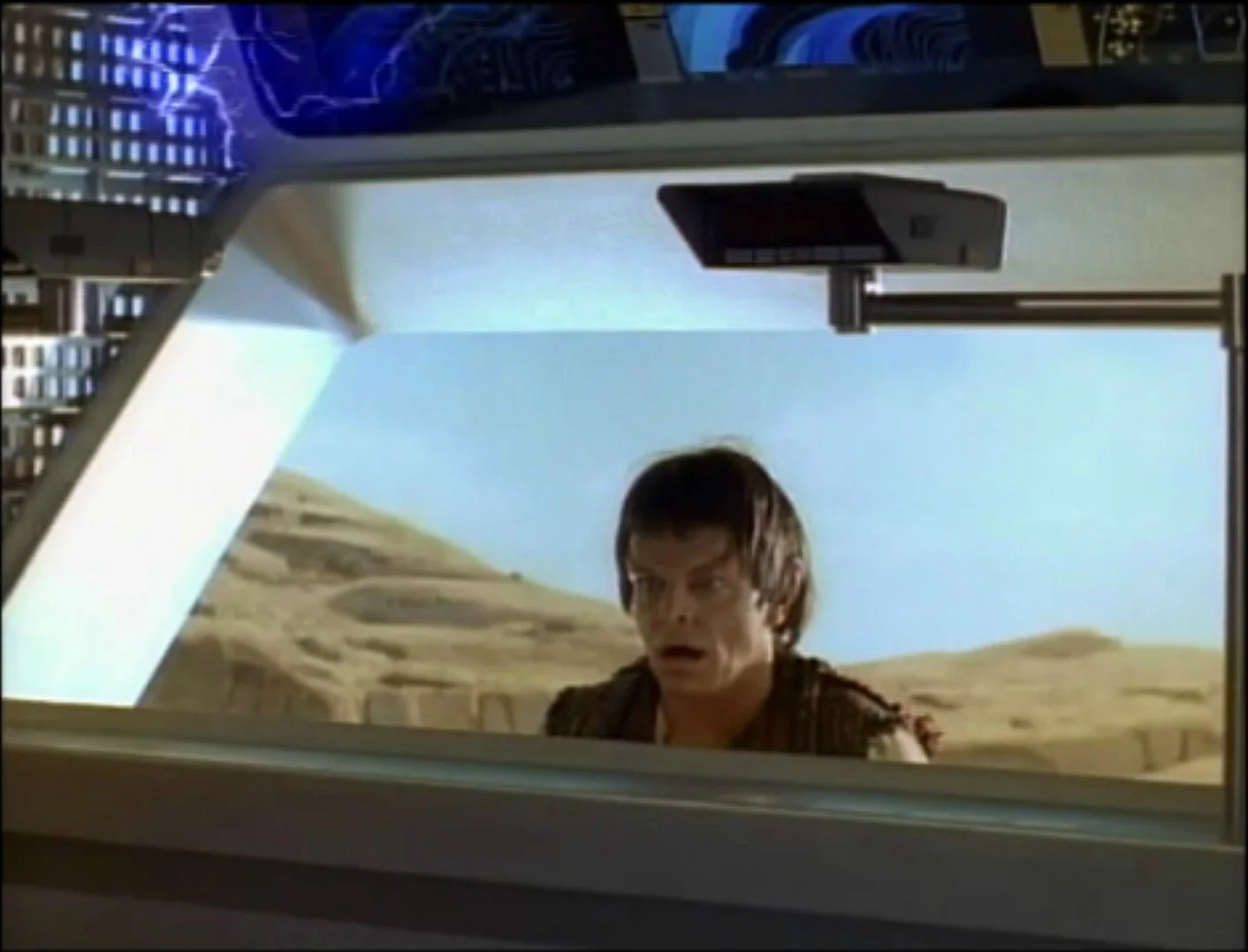
I wrestled with myself on this one for some while before deciding to go with my gut and award it a five-star rating. I’ve always regarded it as one of the classics, and I still do, but it does have some weaknesses, and I think that with a few tweaks, it could have been even better than it is. Still, it remains a great episode—one that tackles an inherently interesting story from an equally intriguing point of view, portrays engaging and likable guest characters while at the same time functioning as a great Picard episode, and dramatizing big ideas in a bold, deft, and thoroughly engaging way. In short, the good things about this episode are so numerous and so good that I find myself feeling pretty indulgent about its weaknesses.
In its overall structure and subject matter, this episode is reminiscent of the original series and/or the first season of TNG: the Enterprise visits a planet inhabited by a “non-advanced” civilization, and things go badly. It is, in other words, a “Planet of the Week” installment in terms of my “story types” categorization scheme. But in my opinion, this is the first TNG episode ever to actually do this kind of story right. For starters, unlike in so many first-season POTW episodes, it is actually recognized here (indeed, it’s central to the whole story) that the Prime Directive means there shouldn’t be interaction of any kind between the Federation and the Mintakans. Finally, the writers pull their heads out of their asses on this point! Secondly, the situation to be dealt with in this episode doesn’t come about because of anyone doing anything abominably stupid. Thirdly, the Mintakans are actually depicted in an appealing way, and feel much more real than any of the societies seen in first-season POTW episodes (though I will qualify this statement in a bit). And finally, the philosophical principle behind the Prime Directive is actually concretized in a way that makes the issues involved real this time. Instead of asking the question “should we intervene in the affairs of less advanced peoples to save lives, or would that be a mistake?” this episode asks “Okay, we’ve accidentally messed up a developing culture: now what?” Thus, we actually get to see the negative consequences of intervention, rather than just listening to the characters debate the issue in the abstract. As a result, this is easily the best “Prime Directive” story that TNG ever did, in my view.
To be sure, though, the premise of the episode does raise questions. How wise or ethical is it, really, for the Federation to be on Mintaka III in the first place, covertly watching the indigenous people in order to study them? Are the intellectual rewards worth the risks to the integrity and self-determination of the culture and people being studied? What right does the Federation have to trespass on this world like this? Letting these questions hang for a moment, I also want to say that the idea has nevertheless always struck me as classically Trekish, as well as resonant with the larger mythos of the show. I’m not sure, I guess, whether there was actually any canonical precedent for it prior to this episode, but the notion that the Vulcans covertly observed humans prior to first contact between the two peoples is a venerable one. Admittedly, the situation in this episode is pretty different, since the Mintakans are at nowhere near the level of the Federation and aren’t being observed in a spirit of preparation for first contact—but my point is that the general premise felt, at the time when this episode aired, like an implicit part of the established universe of Trek, and I responded favorably to it at the time. I still do—but I also now think that the episode would be an even better one than it is if it more explicitly raised the kinds of questions about its own premise with which I began this paragraph, and acknowledged the point of view that there is something rather arrogant about the Federation’s behavior in establishing covert anthropological research facilities on less-developed worlds. Relatedly, the episode seems to flirt with, but stop short of quite engaging with, the question of to what extent it is possible to observe something without influencing it—another potent theme that, if developed just a little more, could have further enriched the episode. And finally along these lines, I think the episode would benefit from a clearer acknowledgement, in the end, of the fact that even though Picard does manage to “undo” the damage of reawakening the Mintakans’ belief in the supernatural, the encounter is still bound to profoundly influence their future development—that, in other words, there is really no “undoing” cultural contamination. To be fair, I do think that some of the ideas and issues that I’ve brought up here are part of the subtext of the episode, and do contribute to its greatness; this episode is remarkable, after all, in part because it shows us an encounter between a POTW society and the Enterprise partly from the locals’ perspective, and actually puts our heroes in the position of being accidental transgressors, rather than morally righteous judges of others’ backwardness—which is very welcome! Still, I’m not convinced that anyone involved (meaning either the writers or the characters) see anything dubious either about the Federation’s policy of doing covert observation like this or about the likely effects on these Mintakans of their encounter with the Enterprise, and I would like to have seen these perspectives expressed.
As a second caveat regarding this episode, the Mintakans—although (as I noted earlier) much better-realized than most other POTW alien societies that we’ve thus far seen on TNG—still do fall short of feeling completely believable. While I appreciate the fact that a line in the teaser refers to the group of Mintakans being studied as an “extended family,” and thereby partially excuses the small scale and the informal feel of the settlement that the episode depicts, it still seems a little bit too small and familiar; seeing more random people in the background, more buildings than just the one main one where everyone gathers, and more of a sense that not everyone is necessarily on super-familiar, first-name terms with everyone else, would really help to sell the “extended” part of the phrase “extended family,” and lend some additional sociological verisimilitude. (I understand about budget constraints, but there are episodes still to come that more successfully pull this kind of thing off.) Also, at one point Nuria refers to her people as “the Mintakans,” as though she is speaking for all inhabitants of the planet rather than just for the small band of people of whom she is the leader—and the other characters also sometimes seem to be thinking about the repercussions of the episode’s events in planetary, rather than merely in local, terms. On the other hand, though, there are at least four different Mintakans who come alive as distinct characters with specific personalities, and the props and costumes convincingly communicate a sense of a distinctive culture. In the final analysis, the portrayal of the Mintakans, however imperfect, is good enough to enable me to engage with and care about them, and for this reason, I am willing to forgive the shortcomings.
Anyway, the whole idea of the Prime Directive almost demands that sooner or later there be an episode in which the kind of interference that it’s designed to prevent happens anyway, and the Enterprise has to figure out how to deal with it. Having the consequences of that interference take the form of the locals choosing Picard as their god is one of those classic ideas that make for great Trek. Picard’s approach to the task of repairing the cultural damage has the dramatic merits of seeming like probably the best thing that he can do in the circumstances, and yet also constituting, technically, a further violation of the Prime Directive. It’s simultaneously shocking and perfectly sensible for him to beam Nuria on board the Enterprise and teach her about who he and his crew are, and that’s why it’s great. Picard is in excellent form here, and the scene in which he tries to get Nuria to grasp that he is not a superior being by getting her to reason about her own people’s development over time is superbly written and a totally classic bit of Trek. (Watching it, too, I can’t help but to think that Patrick Stewart must simply have been more inspired by this season’s writing than by that of previous seasons; so much of the greatness of Picard is owed to his gravitas and nuanced acting, and these qualities shine out in scenes like this one to a degree that just didn’t tend to occur in the earlier seasons.) Also, the episode constitutes one of the best-ever expressions of the secular humanist philosophy implicit in Star Trek—and for my money, it succeeds in making a statement in favor of rational worldviews that reject belief in the supernatural, without condescending to anyone or being unpalatably heavy-handed. Admittedly, the statement being made jibes with my own views on religion, which naturally colors my reaction; I’m aware, for instance, that there are many who feel differently about this inherently controversial episode. For me, however, its critique of religious belief definitely counts as a pro and not a con!
Finally, the climax of the episode is fantastic as well. Picard, who has always been the hardliner for the Prime Directive—willing (at least in word) to countenance very unpleasant consequences in its name—puts his money where his mouth is and shows that he really is willing to die for the principles and ideals that it exists to protect. The irony, though, is that until the moment when he is actually wounded, the act of inviting the Mintakan believer to shoot him only reinforces his image as a divine being—which makes its sudden disproof all the more impactful an instant later. It’s just a great climactic scene. And the final conversation between Picard and the Mintakans, after the plot has resolved itself, leaves one with the sense that both sides in this cultural encounter have been enriched by it, and that a situation that began as a potential disaster spiraling out of control has, in classic Trek spirit, been transformed into a moment of coming together and even meeting of minds between two peoples—even if they are two peoples who should not, ideally, have actually ever interacted.
It’s definitely a classic sort of episode for Trek—one very consistent with the kind of story told in TOS, yet striking off in its own direction and doing something new. I definitely find the criticisms you highlight around how a single village seems to represent an entire planet (when there is no way a civilization at this level of development would even be aware of the scope of their world, much less think of themselves as “Mintakins”) to detract from a sense of plausibility, and you have the typical sci fi idea that an entire planet is culturally homogenous. There’s no reason I can see not to focus just on a specific culture. How much would it have opened up the story to throw in some mentions of some really different cultures and perspectives on this planet, but that they’re studying this particular one because of their similarity to the Vulcans, and maybe this culture is starting to gain traction over the planet? That would certainly lend plausibility to the idea that cultural contamination could make a major difference for them going forward.
So I do enjoy this episode, and while I agree with most of your general sentiments here, I disagree on a couple of points, the first of them this:
While I think the idea of introducing superstition back into a culture that had conquered it should definitely be taken seriously, the stretch to the notion that this will likely lead to some kind of set of holy wars and conflict strikes me as rather ridiculous. First, a few people developing a belief in the Picard is unlikely to spread over the world. I mean, most of the time IRL, when one person gets a crazy idea, it dies. Frankly, this happens all the time on Earth, and the overwhelming majority of the time, said person’s beliefs don’t end up leading to massive cultural conflicts, because it is hard to convince other people of crazy ideas. There’s just no incentive to believe something like that—unless there is, in which case, it was likely going to happen anyway. Second, the premise that Picard introduces here that a new set of superstitions is going to lead to violence seems pretty naively to be assuming that people do horrible deeds primarily *because* of religion. I will grant that to some extent, it’s true that “those who can make you believe absurdities, can make you commit atrocities,” but much more often and more compellingly, religions (or whatever implicit belief systems prevail in a culture, with religion frankly being only a tiny fraction of those) only serve as justifications for whatever cultural values are already considered desirable or normal. Christianity started as a religion about protecting the weak and turned into a religion of conquerers not because of the ideas of Christianity, but because of what it was in the best interest of powerful people in an overwhelmingly Christian culture to believe. They would have changed any philosophy dominant in their culture to accommodate their desire to colonize, enslave, or whatever. I would cite this as an example, personally, of one of the overly simple ideas that is taken for granted as “true” by the characters and the episode.
The other point I want to make is that Picard’s decision to beam the cultural leader to the Enterprise is, while cinematically quite engaging, is obviously stupid from a sensible point of view. Perhaps a person from that frame of reference would be able to understand Picard’s point that they are just mortal beings if you go about it right, like they kind of do at the end—by getting shot and injured. That scene that works pretty well, though if he really wants to convince them he’s mortal, maybe he should have faked his death instead of appearing healed in the next scene? That aside, though, what he definitely shouldn’t be doing is teleporting their leader around and showing her the planet from orbit. There is no way someone from a culture like that put in this position would be able to understand what he’s saying without using a supernatural framework as he simultaneously undercuts his own point by demonstrating mind-boggling abilities. The episode even validates this (obvious, I think) conclusion when she doesn’t get it even after seeing someone die.
Anyway, I see why you love this episode. The themes are almost defining ones when it comes to Trek, and even counting TOS, it’s one of the first times the series ever really did something like this really well. The premise is extremely intriguing (even if problematic for some of the reasons you point out), and the story is competently told (even if budgetary limitations and what I mentioned about cultural homogeneity detract from that). Still, for me, this is a very clear example of a four and definitely not a five. I maybe have high standards for a five, but the only thing that would propel me into that territory with an episode like this, given some of what i’ve mentioned here, would be nostalgia.
These are good points. Your observation about a handful of people adopting a crazy idea not being enough to change an entire culture is closely related to the problem of conflating one small village with “the Mintakans,” and was (I think) part of what I had in mind when I remarked that “characters . . . sometimes seem to be thinking about the repercussions of the episode’s events in planetary, rather than merely in local, terms”–though as you point out, even on a local level this would not necessarily spiral out of control. But basically, it’s the episode trying to dramatize a big idea in microcosm, and running into some plausibility issues as a result. I agree with the criticism, but I can also suspend my disbelief enough to overlook it.
I also agree 100% with your point that religion/ideology isn’t usually the root cause of violence, so much as something that gets co-opted to justify behaviors that would have happened anyway. I didn’t really think about this problem when writing the review, and it is definitely a weakness of the episode.
“Picard’s decision to beam the cultural leader to the Enterprise is, while cinematically quite engaging, is obviously stupid from a sensible point of view.”
I dunno. I guess. I mean, I appreciate that the attempt does initially fail–that it’s not portrayed as some simple matter, doing what Picard tries to do in beaming her up. But it’s pretty easy for me to inhabit the idealistic mindset that motivated Picard to try it, too. Maybe that just reveals the extent to which naive idealism continues to influence me, and maybe it’s even related to what you meant in suggesting that I’m motivated by nostalgia in giving this episoe 5 stars. I just love that scene, though; I find it moving and intellectually engaging and dramatic and just amazing. And however you judge the soundness of Picard’s approach, he was in a situation where there were no obvious or easy answers and he made a bold and intriguing choice. And surely one of Picard’s most human flaws, as a character, is a tendency toward idealism?