
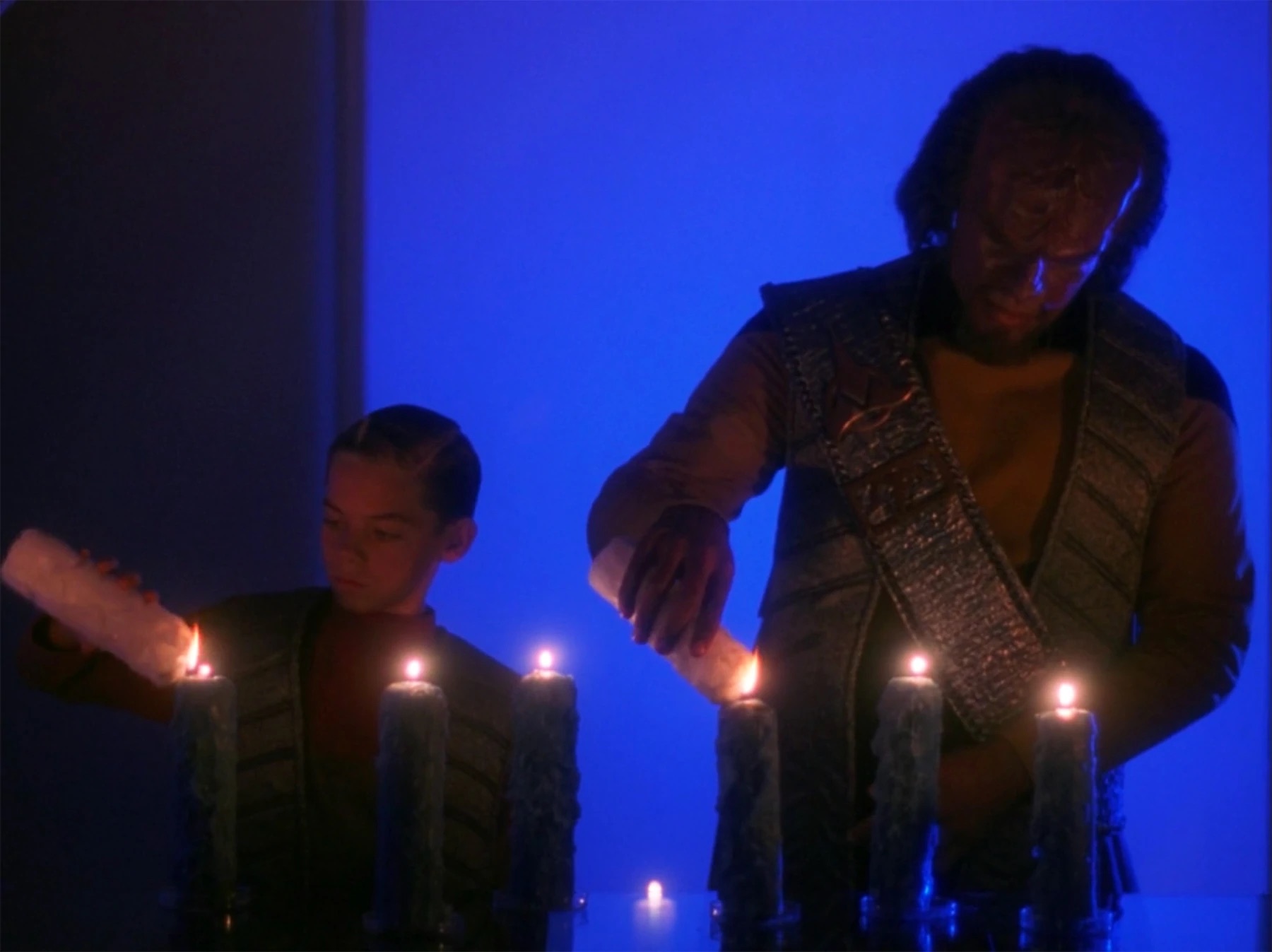
This is a rare instance of an episode that has actually grown on me over time. It’s far from perfect, but whereas it once stood out to me chiefly as the archetypical example of a particular type of TNG episode that I regarded as sort of dull and unremarkable, I have come to see it as an episode that does a lot of worthwhile things right, even though it also suffers from some flaws that keep it from being as good as it might have been. At its heart, it’s an episode that’s entirely about emotions and the human condition, and not at all about space travel, technology, and all the other stuff that, though integral to Trek and often to the brilliance of some of its best episodes, can also sometimes get in the way. It also represents one of the show’s most sincere and meaty attempts to explore the premise of the Enterprise having families on board.
Probably the episode’s greatest strength revolves around the way that it draws on the back stories of Worf and Wesley (both of whom lost parents at young ages) to make meaningful connections between each of them and Jeremy Aster. This was a deft and thoughtful piece of writing that provided TNG audiences with a first glimpse of the signature style and strengths of the episode’s writer, Ron Moore, who of course eventually joined the staff after contributing this story as a freelancer, and quickly became one of the show’s best writers and a major part of the success of the series. I also appreciate how this episode both “humanizes” Worf and at the same time develops his “Klingonness”, in that he is shown to be powerfully affected by the death of an officer under his command, even as he processes the experience in his own, distinctively Klingon way. In particular, Worf is consistently a guy who clings to ritual, and uses it to channel his most intense emotions (to a far greater extent, one suspects, than the average Klingon who did not grow up in isolation from his or her culture does)—so it makes a lot of sense to see him turning to the “bonding” thing for solace and to bring meaning to Lt. Aster’s death here. The scene in which Troi talks to him about his feelings, and about his desire to involve Jeremy in the ritual, is a rare instance of Troi functioning as a halfway decent counselor, too, and is just very well-written generally. (It also really grabs one’s attention both visually and from a directing standpoint. I’m not sure where on the ship it’s meant to take place, but it’s a nice visual contrast from the plush and comfy aesthetics of most shipboard locales, which feels right for the emotional tenor of the scene. Also, both Worf’s pacing and the camera angles—as well as the fact that the actors don’t look at each other for most of the scene—all help to make it compelling.) Additionally in regard to Worf, although one could argue that it’s really just a plot contrivance, having the episode open with an away team being led by Worf as part of a mission that’s way, way in the background changes things up nicely, and contributes (as this sort of thing always does) to a sense of the reality of the Enterprise. And finally, this episode carries forward the tradition of those mid-second-season episodes that successfully created a “family” atmosphere on the ship; from the general mood in the wake of the tragedy with which it opens, to the excellent scene between Data and Riker (right down to referencing the death of Tasha Yar), to Picard’s line assuring Jeremy that “on the Starship Enterprise, no one is alone,” there’s a tangible sense of community—which I really like.
Historically, however, I’ve been very much of the view that all of these positive things about “The Bonding” are seriously undermined by the rather cheesy and lame sci-fi plot about the alien who poses as Jeremy’s mother. I still see it this way to a large extent, but in fairness, I have also come to recognize this aspect of the episode as an attempt to use science fiction to illustrate human truths, in the best tradition of any good sci-fi show. The idea here would be that when someone suffers a major loss, one of the most difficult tasks he or she faces is that of accepting the reality of the loss, letting go, and moving on—and the alien who poses as the dead mother makes Jeremy’s struggle to let go of her in this way into a very tangible dilemma for him. Viewed in this way, the weird alien plot is central to what the episode is trying to dramatize, and not merely a bit of sci-fi nonsense thrown in to add tension and “make it Star Trek” (which is closer to how I formerly thought of it). This isn’t to say that I suddenly find the device entirely successful, by any means, but I do see what the episode is trying to do with it, and I approve of the intent.
Also on the down side, though, is the fact that despite the genius of the connections that it makes between Jeremy and both Wesley and Worf, too much of the meat of the story ultimately revolves around the feelings and choices of a guest character—and on top of the inherent problems with such a setup, the child actor who plays Jeremy isn’t really up to the challenge, either. Plus, it rings a bit false when, right after Wesley’s lines about how he harbored anger toward Picard for “a long time” after his own father’s death, it seems to take Jeremy about ten seconds to get over his anger at Worf (and the anger itself comes across as both unconvincing and entirely too “on-cue”). So, as I’ve said, there are definitely some problems here. Still, the episode’s heart is sufficiently in the right place, and there’s enough good character material along the way, that I’m willing to call it a keeper.
I agree with everything you say here. I lean a little bit toward liking the episode perhaps slightly less than you do—I just find it dull, perhaps in similar fashion to your reaction to The Survivors. Your commentary is 100% more insightful than anything I have to say about it, though, and it definitely deserves a three, even if it’s a bit of a grudging three, at least so far as I’m concerned.
Also there’s the whole matter of the “bonding” with this kid who not only isn’t very interesting or convincing, as you point out, but also, in spite of this supposed deep bonding, is never seen or mentioned again. I’m glad—pretty sure I don’t want scenes of Worf pining for this kid in season six of DS9—but still.
I dunno. I’d take an episode of Worf pining for Jeremy Aster over his behavior in “Let He Who Is Without Sin…” (which, okay, that was 5th season of DS9, but the point remains)!