
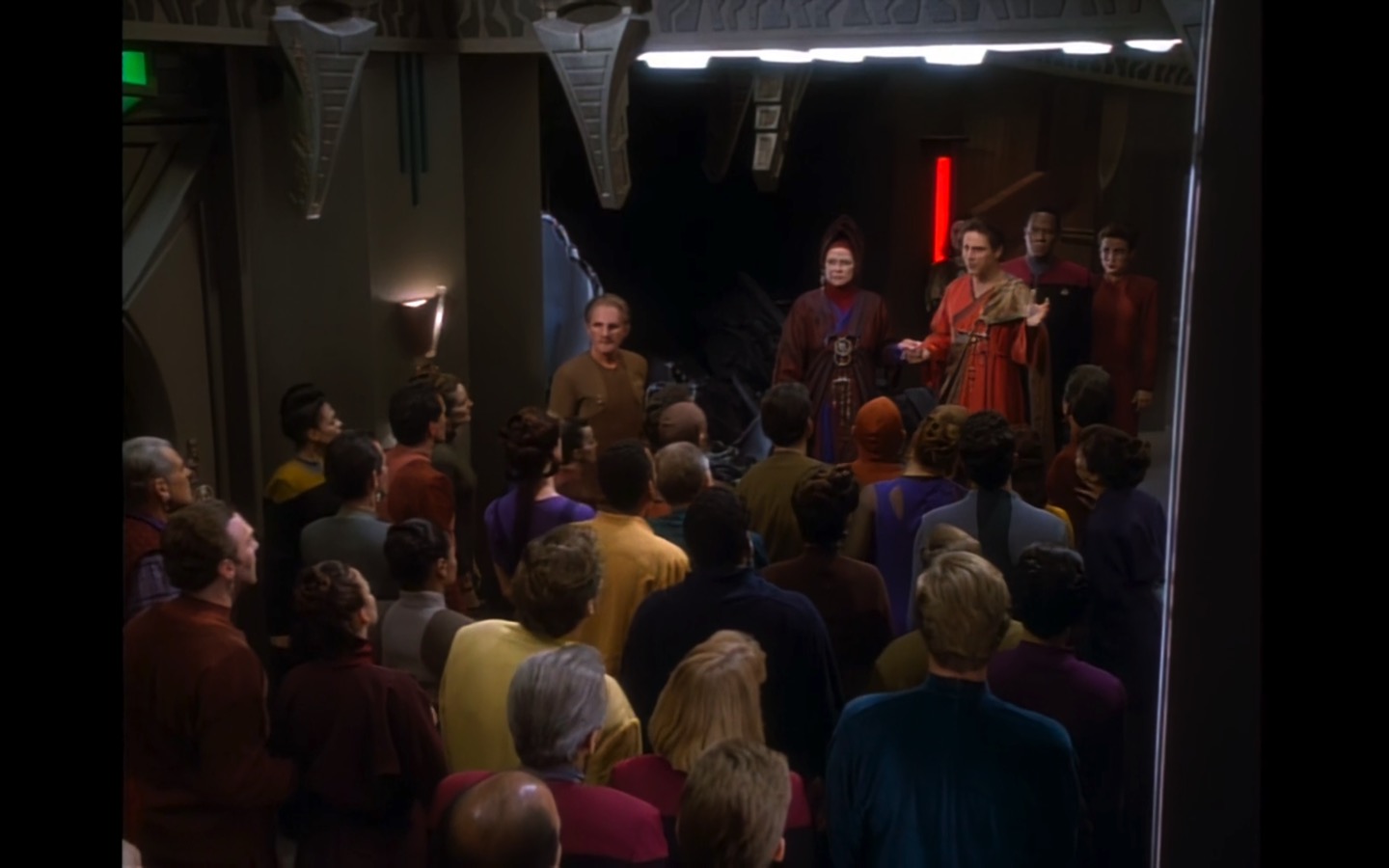
“In the Hands of the Prophets” is absolutely essential DS9. It’s the episode that I’ve been eagerly looking forward to re-watching and reviewing all season long. In a season that opened with “Emissary,” this episode functions as a terrific finale, in that it digs into and reinforces some of the key premises and themes that were introduced in the pilot, takes stock both of progress made and of obstacles still to be overcome, and introduces new elements that set the stage for story directions that would be taken up in the next season and beyond. Also, it’s just a very engaging and enjoyable hour of television. I find, though, that it is challenging me a bit as I sit down to write my review of it. This is an episode that I really, really like, and going in, I fully expected to award it five stars. Indeed, I even imagined myself remarking that though “Duet” tends to get more attention, I personally love “In the Hands of the Prophets” even more. And the thing is, in some respects, that does still hold true after this re-watch. Still, I’m finding that I actually can’t quite justify five stars. This is an extremely important episode of the show, and one that I care about a great deal (again, if I’m being honest, probably even more so than “Duet”), but I have to concede that it has some issues that keep it from being quite as good as I had remembered (or, perhaps, as I want it to be).
Even so, though, this is a fantastic episode. For the finale of the show’s first season, we get a story that looks explicitly at how Sisko’s mission is going so far: How well are the station’s Starfleet and Bajoran personnel working together? Is Bajor any closer to being “ready” for Federation membership now than it was at the start of the season? Stories that explore these questions are exactly what I most want from this show, so seeing them addressed almost automatically makes me happy. Plus, we get fallout from the mid-season loss of Kai Opaka, and the start of a recurring thread about Bajoran internal political and religious strife. “Duet,” masterpiece of an episode though it was, was a self-contained and essentially backward-looking (as in, toward the occupation) story; Kira goes through an arc, of course, and comes out somewhat changed by the end, but the events of the episode don’t directly set future story threads in motion. “In the Hands,” by contrast, is about Bajor’s future, and introduces two new recurring characters (Winn and Bareil; more on them later) and the question of who will become the next Kai. This is one part of what I mean when I say that even though “Duet” is a better episode by most measures, I get more excited, or sort of “care more,” about “In the Hands.” Also, in turning its attention specifically to Bajoran religious matters for pretty much the first time since the pilot (and no, “Battle Lines” doesn’t count for anything here, despite featuring Opaka), this episode also cements the idea of Sisko being seen as “The Emissary” by the Bajoran people. This is a premise that I have just always found really intriguing—the rational/secular Starfleet commander of the station, and unwelcome symbol to some Bajorans of their world’s continued dependence on outsiders who don’t always share or understand their values, being awkwardly (and unwillingly) thrust into the role of a kind of “spiritual leader” within their traditional faith, and all the tensions, paradoxes, and general cognitive dissonance that result from this strange situation. The writers clearly had this premise in mind when they wrote the pilot; it’s right there in the episode’s title, after all, and Opaka even muses about the irony that “one who does not wish to be among us is to be our emissary.” But in what I can only conclude must (?) have been the result of late rewrites/cut scenes, “Emissary” stopped short of clearly establishing the concept; Opaka talks about him being “our emissary,” sure, but you don’t really hear the capital “E” when she says the word. And then, for some reason, the idea goes un-referenced for the entirety of the season that follows, until the finale! Thus, it’s only here in “In the Hands of the Prophets” that the Sisko-as-Emissary premise finally gets spelled out—not to mention the whole secular/spiritual worldview divide wherein the wormhole is the Celestial Temple, and the “wormhole aliens” are the Prophets. That the show planted these seeds in its pilot but then ignored them for 17 episodes before finally returning explicitly to them here (and then in a way that kind of seems to take for granted that they have already been made clear!) is weird, but be that as it may, my main point here is that “In the Hands” gets major points from me for taking up these concepts.
“In the Hands” has some shortcomings in its own right that I’ll get to, but it has to be said here that one of its biggest weaknesses stems from the fact that so few of the episodes that came between the pilot and this one did their part in contributing to the overarching story. The story suffers, for instance, for the fact that Kira has scarcely ever seemed to give two figs about the Prophets before this. I’ll give the episode some credit for eventually contextualizing her early, out-of-the-blue statement of support for Winn by having her recognize that it was a kind of overcompensation for her perception that her own faith wasn’t very strong; still, Kira is supposed to be our representative for Bajoran concerns on the show, and the fact that we haven’t seen her clashing with the other characters throughout the season over questions of secularism vs. spirituality, or even taking any particular notice of the fact that her commanding officer literally had an in-person chat with her gods in the first episode, really undercuts what “In the Hands” is trying to do story-wise. Similarly, when Kira says (from the same scene in which she declares her support for Winn) “A lot of Bajoran and Federation interests are separate, Commander. I’ve been telling you that all along!”…the problem is that, no, she actually hasn’t. She said some things to this effect in the first two episodes, sure, but never once since then, as far as I can recall. This is the same point that I raised in my reviews of both “Progress” and “Dramatis Personae”; the show is asking us to believe that the Sisko/Kira relationship has been a contentious one all season long, but it has almost never actually shown us this. As a result, everything about Kira’s attitude in the scene that I’m mainly talking about here just feels…off—like she’s suddenly being contrary just for the hell of it, or because it’s what the plot requires. This is really unfortunate. Some other scenes suffer somewhat from this problem, too, albeit not as badly. The confrontation between Sisko and Kira in Ops concerning some Bajoran officers who didn’t show up for duty is actually quite effective; I like how Kira acknowledges the value of Starfleet’s presence insofar as it helps to stave off the Cardassians (something that she came to see back in the pilot), but Sisko responds by reminding her that what he’s trying to do goes beyond that, and conveys that at this point he expects a deeper commitment from Kira, too. Yes! But then we come to Sisko’s speech to Winn after the school bombing, in defense of everything that he’s been working to accomplish since he came to the station. The writing does everything that it can to sell what he’s trying to say, and it is a genuinely moving and uplifting moment, but the lack of buildup over the course of the season does, again, undercut its effectiveness somewhat. His reference to the Bajorans who have lived and worked with Starfleet on the station over the course of the past year, for instance, would hit a lot harder if we had actually seen stories about Bajorans and Starfleet personnel working together throughout the season (!). And when he turns to face Kira, and talks about how the Starfleet and Bajoran personnel on the station don’t always agree, and even “have some damn good fights,” but always come away from them understanding each other better? I really like how he’s consciously reframing the frustration that he felt in his confrontations with Kira earlier in the episode as simply a part of the challenge inherent in the work that he’s here to do, and acknowledging his underlying respect for her point of view even when he disagrees with it, and holding that up as a contrast to Winn’s intentionally divisive and demonizing (not to mention violence-inciting) rhetoric. But again, if the season as a whole had done a better job of showing us this contentious-but-with-slowly-building-respect relationship, his words would have even more force. In short, the slew of mediocre episodes that make up most of Deep Space 9‘s first season aren’t merely disappointing in their own right; they also end up detracting from the effectiveness of the mostly excellent season finale that followed them.
I hate to say this, but when it comes to weaknesses that are specific to the episode itself as opposed to the season as a whole, I found myself, on this re-watch, feeling that Keiko’s attitude and responses in the face of Winn’s interference in her classroom leave a lot to be desired. I “hate to say” this because, historically, I’ve looked to this episode as at least one shining example of a time when I actually liked and supported Keiko as a character, when so often I find the way that she tends to be written deeply frustrating and problematic. I do, of course, share her basic pro-science position here, but it seems to me that some of her undiplomatic responses to Winn rather cluelessly play into the vedek’s hands. Sisko, by contrast, conducts himself admirably; he has his own point of view and he never backs down from or apologizes for it, but he consistently shows a sensitivity to the cultural divide and a commitment to finding solutions that work for everyone. But when Winn, in her initial confrontation with Keiko in the classroom, asks her whether or not she believes in the Celestial Temple, Keiko’s “I respect that the Bajorans believe it” dodge comes across as condescending. Part of this is the delivery, and thus an acting concern; still, she could have just been straight with Winn and said “no,” but then elaborated that it didn’t matter—that she’s merely teaching the students what science reveals about the wormhole, and not demanding that they renounce any other beliefs that they may have about it. Also, she could have shut down Winn’s obvious attempt to pick a fight a bit sooner, rather than allowing herself to be baited into barely restrained hostility in front of the children. Then, later, when Winn is grandstanding in front of a crowd of students and parents, and asks Keiko whether or not there is a place for the Prophets in her classroom (with all the smug, holier-than-thou, faux-conciliatory charm that she has at her disposal), Keiko could have offered something more/other than just a defiant “No.” How about “Students who believe in the Prophets are absolutely welcome in my classroom, and I do teach about Bajoran religious beliefs in a neutral, cultural studies context—but as an outsider and someone who does not share your faith, and also considering that not all of my students are Bajorans, I don’t specifically promote your (or any other) religion in my classroom”? And then maybe add something about there being no need for conflict over the matter? I’m with Keiko when Winn proposes that she skirt the topic of the wormhole altogether, and Keiko replies that as an educator, her job is to expose her students to knowledge, not hide it from them. But in general, Winn is just so obviously using the issue to deliberately gin up controversy, and Keiko’s intransigent posture seems pretty obviously like the wrong response.1
It’s a little confounding, in that I’m not sure exactly what’s behind this on the part of the writers. Are they just having Keiko react strongly because they need to dramatize conflict, without giving much thought to the professionalism or appropriateness of her responses? Or…well, I don’t think it’s that the writers perceive Keiko’s attitude to be entirely appropriate, because they give us the contrast of Sisko’s more diplomatic approach—so I think we can rule that out, at least. Or, conversely, do they actually intend for us to see Keiko as somewhat intolerant and tactless!? Honestly, that wouldn’t be wildly out of line with how she’s written most of the time, although I’ve never had the impression that this was conscious or intentional on the part of the writers. (She also comes across, at least to me, as a pretty lousy teacher in the classroom scene near the start of this episode.) Actually, though, it’s not always that Keiko herself is portrayed in problematic ways; it’s more that the writers always seem determined to present the Miles/Keiko relationship as terrible, and often make one or the other (or both) of them behave stupidly in furtherance of this goal. In this episode’s opening scene, for instance, the way that Keiko playfully teases Miles about Neela wouldn’t really bother me by itself, but for two things: first, the fact that it just feels all too typical of the kind of mistrustful sniping that the writers are constantly making them engage in, and second, the way that Miles takes it seriously and immediately gets all defensive and indignant. (For that matter, Miles also loses his shit way too easily over the jumja vendor’s refusal to sell to him later in the episode.)
But to return to talking about things that I like about this episode: Vedek Winn! What a deliciously hatable, frustratingly believable, and narratively useful character to bring into the mix of the show. Opaka made narrative sense as the Kai who held her people together during the occupation, but as the show moves forward, introducing a divisive figure like Winn opens up so many more fertile story possibilities. A character who represents the elements within Bajoran society that are deeply ambivalent about the Federation, and someone who will function as an obstacle and antagonist to Sikso and the other main characters without (quite) being an outright villain, was a great idea, and Louise Fletcher portrays her smug, smarmy self-righteousness and fake-except-also-kind-of-real serenity sooo well. I said that she’s not quite just an “outright villain,” but the truth is that, at least in this first appearance, she does (among other things) orchestrate an attempted murder in furtherance of her personal ambitions (!). What makes her compelling, though, is precisely the fact that she can engage in egregiously corrupt and ruthless behavior of this sort, but still come across as genuinely believing in her own righteousness. She has, it seems, truly convinced herself both that her personal career advancement conveniently meshes with what is best for Bajor, and even that the importance of her agenda justifies both lies and cold-blooded murder. As such, she perfectly exemplifies every infuriatingly self-serving real-world politician whose motives defy straightforward categorization as to whether they are merely irrational/misguided, or actually, calculatingly, evil. And then, too, her show of deference to Sisko as the Emissary, which comes across as mostly insincere (she has, after all, clearly marked him out as an enemy) while nevertheless serving to elevate his role and call attention to his importance within the Bajoran religions, is intriguing, as is the way that she serves as a foil for Kira, simultaneously shaming her into focusing more on her own faith and disappointing/disillusioning her with her disingenuous and amoral hypocrisy. All in all, she’s just a fantastic addition to the show—and a taste of the knack that it will develop, over time, for cultivating an ever-expending cast of engaging secondary characters. Bareil is another example of the latter, even if we don’t quite get a clear sense of who he is yet in this first appearance. The introduction of both characters here just revs up my excitement for future seasons of the show!
I do have some questions about just how much sense Winn’s actions in this episode actually make. I mean, as a plot to lure her rival, Bareil, to the station so that she could attempt to assassinate him, said actions do add up, and are successful (even though our people manage to thwart the actual assassination). We have to take it on faith, I guess, that getting him to come to the station was really the best/only/most convenient way for her to get at him, but fine—I’m willing to roll with that. However, does it really seem believable that carrying off this plot would improve her chances of becoming Kai? It would have eliminated her main competition, sure, but under rather suspicious circumstances, no? Wouldn’t anyone with half a brain perceive that she was, in all probability, behind both the school bombing and the assassination? Would the death of the leading candidate for Kai not, most likely, simply have made a martyr of him, further sidelining Winn’s minor and rather extreme faction? I think we’re meant to see Winn as cunning and formidable, not naive and stupid, so I feel like there’s a real question here. Of course, Winn will end up becoming Kai…but I don’t remember enough about the relevant future episode(s) to comment, just now, on how much sense that outcome actually makes in light of what happens here. I guess that, to some extent, I’ll have to reserve judgement on that for now. Still, I’m left (as I said) with questions about how much sense her actions in this episode actually make.
The role of Neela in the episode is interesting. Historically, I’ve both appreciated her in general and found the “surprise, she’s the villain” reveal to be pretty effective. Apparently the writers intended to have her appear in multiple episodes prior to this one in order to make the reveal as non-predictable as possible, but various things interfered with this plan, so she only ended up being in one other episode (“Duet”—and she wasn’t especially prominent in it, even). Personally, too, I happened to miss “Duet” until long after I had seen “In the Hands…” multiple times, so I didn’t even know that she had appeared in any other episodes—and even so, the reveal here still managed to surprise me (though whether that means that it was effective or just that I was a bit oblivious back then, I can’t say). It helps, of course, that the scenes of her and O’Brien working together mesh with the episode’s thematic focus on the evolving relationship between the Federation/Starfleet and Bajor, so that she doesn’t just stand out as a random new character who serves no particular purpose in the story other than to turn out to be the villain. But in any case, on this re-watch, I actually came away questioning whether the writers perhaps attached too much importance to making the reveal surprising, in a way that ends up detracting from the theme and the emotional impact of the story. Neela is an agreeable enough minor character, but we get no real insight into her point of view, or what makes her tick; she’s an engineer (so, one would think, would not be especially inclined toward fundamentalism of an anti-science variety), and she seems to work effectively with O’Brien, so what is it that motivates her to support Winn—to the extent of being willing to murder a rival vedek, and potentially even to sacrifice herself? To what extent are we to take her comments to O’Brien about how Bajorans and Starfleet personnel mostly keep to themselves, but O’Brien himself is “different,” at face value? Is she being genuine, or just playing him? To be clear, it’s not that I object to anything about how Neela is portrayed, per se; I just think that if her perspective had been explored a bit, it might have deepened the episode’s portrayal of the progress made in, and/or the obstacles to, the development of common ground and mutual understanding between the Bajorans and the Federation folks (though of course, this would most likely have spoiled the surprise of the reveal that she was behind things). So, in the end, I guess I’m left with somewhat mixed feelings about Neela’s part in the episode.
A final point that I want to make about “In the Hands of the Prophets” is that with it, the show introduced us to a new, different kind of Trek season finale. TNG’s first two seasons can scarcely be said to have “finale” episodes at all, but seasons three through six each ended with a cliffhanger—the first half of a two-part episode, whose second part served as the next season’s opener. (Season seven was different, of course, because there was no “next season,” but it still ended with a double-length episode.) For the final episode of DS9’s first season, though, we got what might be termed an “ordinary” (single-hour, non-cliffhanger) episode…yet one that nevertheless feels like a genuine finale. In fact, “In the Hands” arguably fits the bill of a “season finale” better than most of the TNG season finales, in that it revisits story threads that were laid down in the season premier and provides a degree of closure, while simultaneously pointing toward promising future storylines. (With the exception of “Time’s Arrow,” TNG’s season finales did generally take up, and perhaps resolve, significant story threads that had been established in previous episodes, but not in ways that specifically “tied up” anything about their particular season as a self-contained whole; in fact, they all dealt with storylines that had originated in some previous season.) I’ll withhold commentary on the extent to which the rest of DS9’s season finales will “fit the bill” in this sense until I get to those reviews, but it’s worth noting here that this model—the non-cliffhanger finale—would end up becoming the norm for the new show. Does this suggest that a show that is somewhat more serialized overall has less of a need to conjure a heightened sense of continuity between seasons via cliffhangers? Well…eventually, perhaps. As of the end of season one, though, I can’t say that DS9 had yet actually achieved much in the way of increased serialization as compared to TNG. Still, “In the Hands of the Prophets” was a step in that direction…and the opening arc of season two would push serialization forward another step. (I’m not saying here that non-cliffhanger finales are “better” than cliffhanger ones, or vice versa; I’m just musing on this difference between TNG and DS9 and seeing what meaning, if any, I can tease out of it.)
- Not to mention the fact that the larger context, wherein Starfleet is operating a station that is under Bajoran jurisdiction and the Bajorans are recently liberated from foreign occupiers, calls for a significant amount of cultural sensitivity! To be clear, I completely see Winn is being “in the wrong”; she’s manufacturing a controversy where none existed before she butted in, and she’s doing so for entirely self-serving reasons. My point is merely that there are more and less effective ways of responding to her, and Keiko really doesn’t handle the situation very well.
As something of an aside, there’s an awful lot of what strikes me as misguided science-vs.-religion type debate in the comments section under Jammer’s review of this episode (which I tend, rightly or wrongly, to use as a gauge for the gamut of opinion amongst fans of the show generally). It’s all over the board, too, with some commenters feeling that the episode “panders” to religion and/or the “backwardness” of the Bajorans in an annoyingly PC way, while others accuse Keiko/Starfleet/the show of arrogance, intolerance, and anti-religious bias. Both of these criticisms seem wide of the mark to me (my own critique of Keiko’s response to Winn notwithstanding). To the extent that “science vs. religion” can even be said to be what the episode is about, I think it treats the matter in a very respectful and even-handed way, on the whole. Some viewers, perhaps, need to be reminded that there is a difference between diplomacy/tact/cultural sensitivity on one hand, and relativism, or the surrender of one’s own worldview, on the other. Sisko cautioning Jake about being arrogantly dismissive of the Bajorans’ beliefs as “stupid,” for instance, is entirely appropriate, and doesn’t mean either that Sisko himself accepts those beliefs or that the show is “pandering”; but at the same time, Keiko teaching her students about the wormhole from a scientific point of view, and refusing Winn’s demand that she teach a religious interpretation of it instead, is also entirely appropriate. And finally: Countless commentators, whatever their stance on any of the above, also declare that the Bajoran religion is an invalid or ineffective analogue for real-world religions because their “gods” demonstrably exist. This, to my mind, is way too literal and one-dimensional. Sure, that’s a difference between the Bajoran religion and, say, Christianity, but that’s why we call it a sci-fi metaphor. These beings *exist*, to be sure; but are they to be thought of in naturalistic/secular terms, or imbued with “higher meaning” and treated with reverence? Are they, in short, gods or aliens? How various characters answer these questions speaks to fundamental differences of worldview, and that’s part of what the show is exploring in the stories that deal with them.
↩︎
This episode is quite bold in its negative depiction of what is clearly an analog for fundamentalist Christianity; I can hardly think of anything similar to this in television, and kudos to the writers for it. I take the principles it articulates a bit more for granted now than I did when I watched it for the first time when I was much younger, so it maybe has a bit less resonance for me now, but it’s still really good.
Having said that, I’m finding myself struggling to really put together a comprehensive response to it for some reason. (Fortunately, as merely the commenter and not the reviewer, I have the luxury of getting away with a less comprehensive description.)
Winn is maybe a bit (only a bit) too clearly villainous from the beginning, and it would have been nice to have seen more from her in previous episodes behaving in a more understated fashion before getting as far as the most literal kind of terrorism. It’s not that her eagerness to resort to violence to achieve her political goals, which nestle comfortably alongside her personal ambitions, is an inaccurate depiction of the way True Believers behave in real life, even if I would imagine that Winn’s variety of belief would be more likely to align with state/corporate terror than with the underground variety she employs here. It’s just an extension of my usual frustration with the show’s undeveloped potential in its previous episodes this season, and a lost opportunity for more nuance. Notably they did make an effort to set up Neela as a character a bit earlier, though not quite early enough for her loss to really hurt in the way it should to make the episode work. Also, even having seen her once before, her prominent presence in this episode still makes her immediately conspicuous, which is a bit of a flaw. I had remembered what she was up to from a previous viewing, so I don’t remember what I thought the first time I saw the episode, but I really have to imagine it was pretty obvious she was not to be trusted here from the first. I also think this reveal would have been more interesting if she had
Louise Fletcher is awfully infuriating, in a good way, as Winn. I’m not sure that my concept of Kira at this point in her development would have included her being sympathetic to Winn’s brand of religious fundamentalism, but I suppose I can believe that she spent most of the first part of her life being too preoccupied with driving out the Cardassians to really get down into the details of what religious politics look like in a somewhat more stable and pluralistic society (quadrant?). She is certainly a person who has had to resort to extreme measures, no matter how justified they were under those conditions, and she comes around when she sees what a snake Winn really is (in being perfectly willing to assassinate a Vedek), but does Kira at this stage of her development really initially incline toward the idea that her own religious views should be forced on everyone else?
They could have given Keiko some better lines, especially when Winn confronts her at the school in an attempt to manipulate her into conceding and make her look foolish, because Winn does sort of score some points on her there… and not that she shouldn’t, but I do feel like the side with the far better argument should have been a bit better represented. It should be pretty obvious to anyone without a bias leaning toward a religion dominant enough to have confidence that it can suppress other schools of thought that it’s absurd for a public school to be teaching non-scientific religious principles, especially when not all the kids are even Bajoran (and also, why should we assume all Bajorans believe in this religion even in a weirdly culturally monolithic planet like those typically depicted in Trek?). And while Winn’s (not sincere) point that science without an ethical or philosophical context is problematic is certainly true, the point should be made—and Keiko doesn’t—that the Federation (at least presumably) *does* give people philosophical grounding—grounding based on an embracing of diversity, nonviolence, mutual aid, and truth, and not to one specific set of unsubstantiated faiths in an ocean of contradictory faiths. And even we presume they don’t, the idea that the failings of the Federation implies that you get to impose your own system of unsubstantiated truth claims is obviously ridiculous. I say it’s obvious, but of course, it’s quite plausible that there would be Bajorans advocating this point of view. Anyway, I feel like the episode works overall, but that there is something a bit missing from it that I’ve found it hard to put my finger on.
Other points:
• Bareil is immediately likable and well-written here, in deference to a concept of religious belief that is much more grounded, and it makes me want to see much more of him.
• The information Keiko gives the kids at the beginning of the episode would go right over their heads if it’s not even clear that they’d even know that the wormhole is special because it’s stable. One would think that would be pretty much DS9 101 for those living there. I’ve noticed this season that the show often tends to depict the adults in charge of the classroom as rather confused about developmental stages and their associated ages.
• The “spiritual types love those dabo girls” line from Quark is on point. Fundamentalist religious types, who almost universally twist themselves into knots to arrive at the conclusions they decided in advance they want to believe for cultural and political reasons, are almost always therefore out of touch with their own deeper needs and feelings… but our needs don’t go away when we ignore them, and their lack of willingness to grapple with this often explodes, harming others.
• So Winn calling Sisko the Emmisary seems to be where this concept becomes a big deal, yes?
• I find the jealousy banter at the beginning a bit grating. It’s certainly not unrealistic for many couples, but as I’ve said before, so much of the time, it feels as though they’re trying to depict the O’Briens as a “normal” married couple experiencing “normal” married life, and the idea that healthy couples would relate in this way—jealous of each other, without feeling safe enough to share their feelings and receive comfort—is really tragic for a depiction for an optimistic twenty-fourth century future. In terms of depictions of maturity, Miles also escalates things *really* quickly with the jumja stick merchant. Damn, O’Brien, you’re gonna attack him just because he’s being a jerk? I really don’t see Miles as quite *that* impulsive.
• “Maybe we have made some progress after all” is a great way to end the first season of DS9—and even if it doesn’t feel entirely earned, it’s what sets DS9 apart from every other incarnation of Trek in its reach toward, if not its grasp of, greatness.
“I’m not sure that my concept of Kira at this point in her development would have included her being sympathetic to Winn’s brand of religious fundamentalism…”
I hear you, but what largely saves this for me (as I mentioned) is her line at the end, where she recognizes that her leanings toward Winn were really a kind of overcompensation for the comparative weakness of her own faith.
I actually 100% do buy that. Also, I hadn’t really thought about how little Kira’s beliefs *were* explored this season. It’s funny how much we retroactively impose on the characters at this point that really only becomes clear in their development from later seasons.
I like the idea that Kira has not, up to now, been especially faith-focused, but IS a believer and feels some guilt/inadequacy about it. However, like I said in the review, I’d like it even better if it had ever come up before now, instead of it seeming like she barely cared about religion/the Prophets *at all* prior to this episode.
That makes sense for her as a character. The weak points of this episode really are almost entirely contained in the previous episodes of the season, and not really this one at all.
…”would have been more interesting if she had been more fleshed out.”
Just to add: Once again we hit on a lot of similar things, though you’ve fleshed them out much more than I have. I agree with your thoughts about how less emphasis on the mystery aspect of Neela would have made the episode better. Also, just knowing who she was—how did she become an engineer who endorses religious fundamentalism to the point where she’s willing to die for it. It just isn’t enough to *see* this character. We needed to see who she was, even if only one episode explored this. I also think you’re very much on point when you talk about the weak point of this episode essentially being the rest of the season—not enough of what plays out here has been adequately set up before. If it had been, this really would resonate more.