
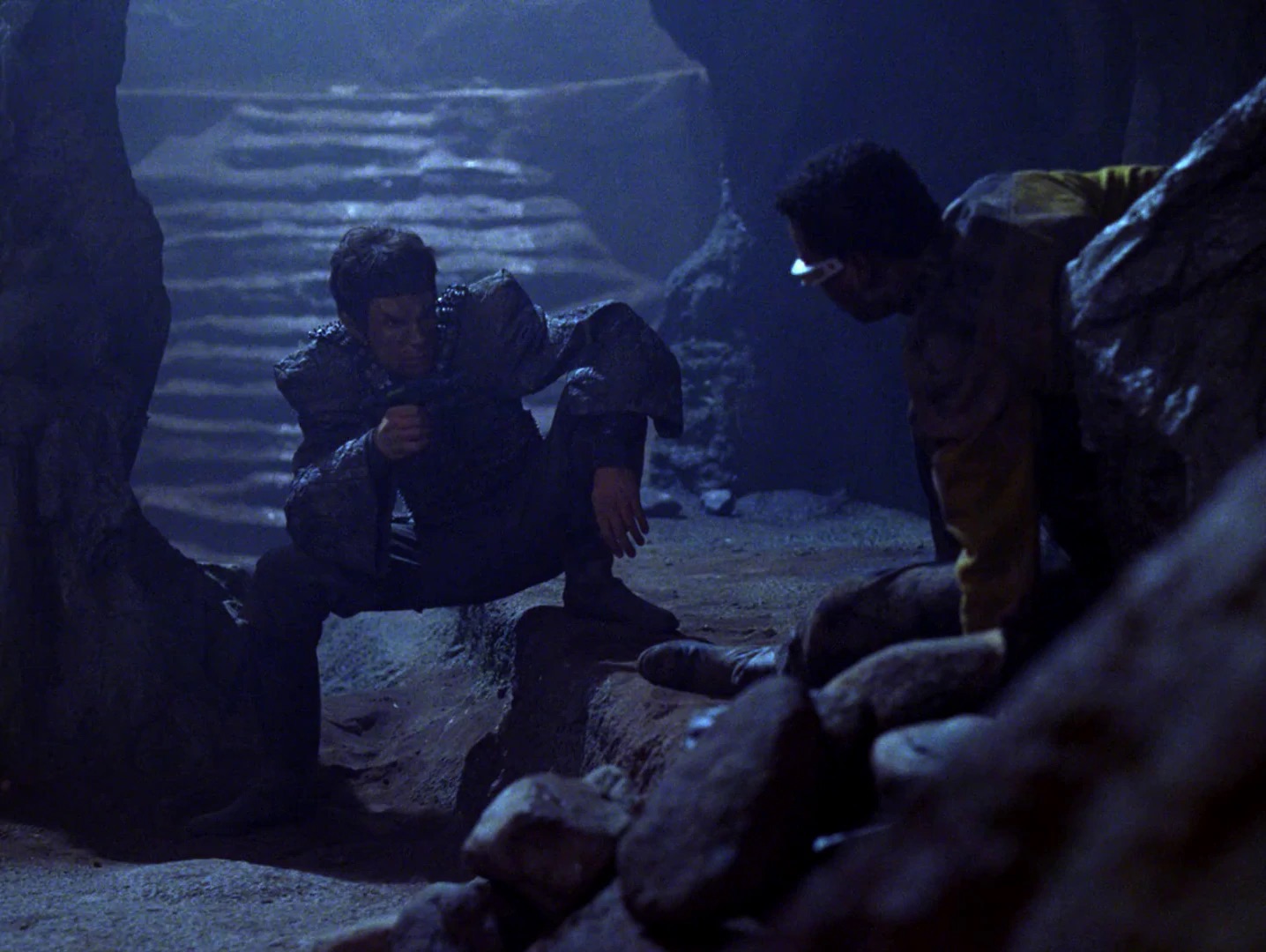
“The Enemy” has proven to be the episode that forces me to define exactly where the line is between four and five stars. I’ve gone with the lower of those two ratings, but not because I esteem the episode any less than previously. I have always loved this one, and there isn’t really anything that I would change about it even if I could; still, it’s not quite on the standout level of those episodes that I think of as all-time classics. It is, however, suspenseful, sophisticated, tightly plotted, a strong character piece, and an episode that makes daring choices and explores important thematic material from multiple angles—all while scarcely having any flaws to speak of. It’s just a quality piece of work in every way!
Though Romulans have appeared in two episodes prior to this one, this is the episode in which TNG really gets a handle on how it wants to portray and use the Romulans. It’s also one of the best Romulan episodes of the entire series. Captain Picard is magnificent in this episode, too; without being at all the strident, blustery guy that he too often was in confrontational situations early on in the series, he adopts just the right demeanor of zero tolerance for Romulan incursions that his position and the circumstances call for, while at the same time (as he comments to Riker and Worf) “measuring his response” in an effort to avoid provoking out-and-out hostilities. His “brinksmanship is a dangerous game” remark at the end is apt, but he demonstrates that he plays said game well. The balance between his not-putting-up-with-any-nonsense responses to the Romulans throughout most of the episode, and his daring “gesture of trust” in the climax once the discovery of another Romulan on the planet puts an ace in his sleeve, is fantastic. Then, too, Picard’s handling of Worf is also commendable—a classic example of the greatness that made him a beloved character to me. Having him talk explicitly about the difficulty of weighing Worf’s rights against the ramifications of losing the Romulan patient is a great choice, and coming at Worf with an argument about the tactical merits of keeping the patient alive, rather than one about moral issues, demonstrates not only brilliant leadership, but depth and insight. That is just a great scene in every way.
Obviously, the dramatic choice to have Worf refuse to donate blood to save the Romulan patient’s life is a huge departure for the show, and a very welcome one. And as a result of it, the episode ends up telling parallel and contrasting stories about adversaries who find themselves in situations that call for cooperation and the putting aside of differences: the “idealistic” one down on the planet between Geordi and the Romulan centurion, who succeed in working together to get themselves rescued; and the grimmer one on the Enterprise, with Worf unable to overcome his bitterness and prejudice (and the Romulan patient equally unable to put aside his own hatred). This “show both sides of the coin” approach is really quite effective. TNG is often accused (not without cause) of being too “tidy” much of the time, with things always working out for the best and the main characters all being squeaky-clean and invariably doing the right thing. This is an undeniable counterexample. As for the planetside story, it features believable characterization for the Romulan, is set up effectively enough that the “trapped on the planet” situation doesn’t feel contrived at all, and makes good use of Geordi as a character (both as far as his blindness/visor is concerned and in taking advantage of his “everyman-ness”), and the “human and Romulan working together” theme is generally really well-executed. The “neutrino beacon” is an instance of a tech plot device that is used really well, too; it’s clear and comprehensible, and the idea of Wesley as the one to come up with it—and Geordi immediately recognizing it as a Wesley idea—is cool (and an instance of Wesley’s smarts coming into play without being annoying or silly).
A few minor notes: The “jump right into the action” opening of the episode is good, and in general, this is an example of a great teaser; it’s tense and atmospheric, and it puts enough elements into play to hook you into the show, but it doesn’t really tell you what the episode is going to be about, either. Also, I really appreciate Riker’s demeanor after beaming back up to the ship. Without beating to death the point that he’s concerned about Geordi by having him harp on it, we are instead shown that he’s frustrated and angry about how things went down, and worried about losing Geordi, by the entire way he speaks, talks, and generally emotes as he ostensibly focuses on the moment throughout the next several scenes. This is just the kind of writing and acting that was so sorely missing, say, in the first season, and that TNG really mastered this season.
By third season, Picard has mostly gotten a handle on his issue with chronic pain and the resulting irritability.