
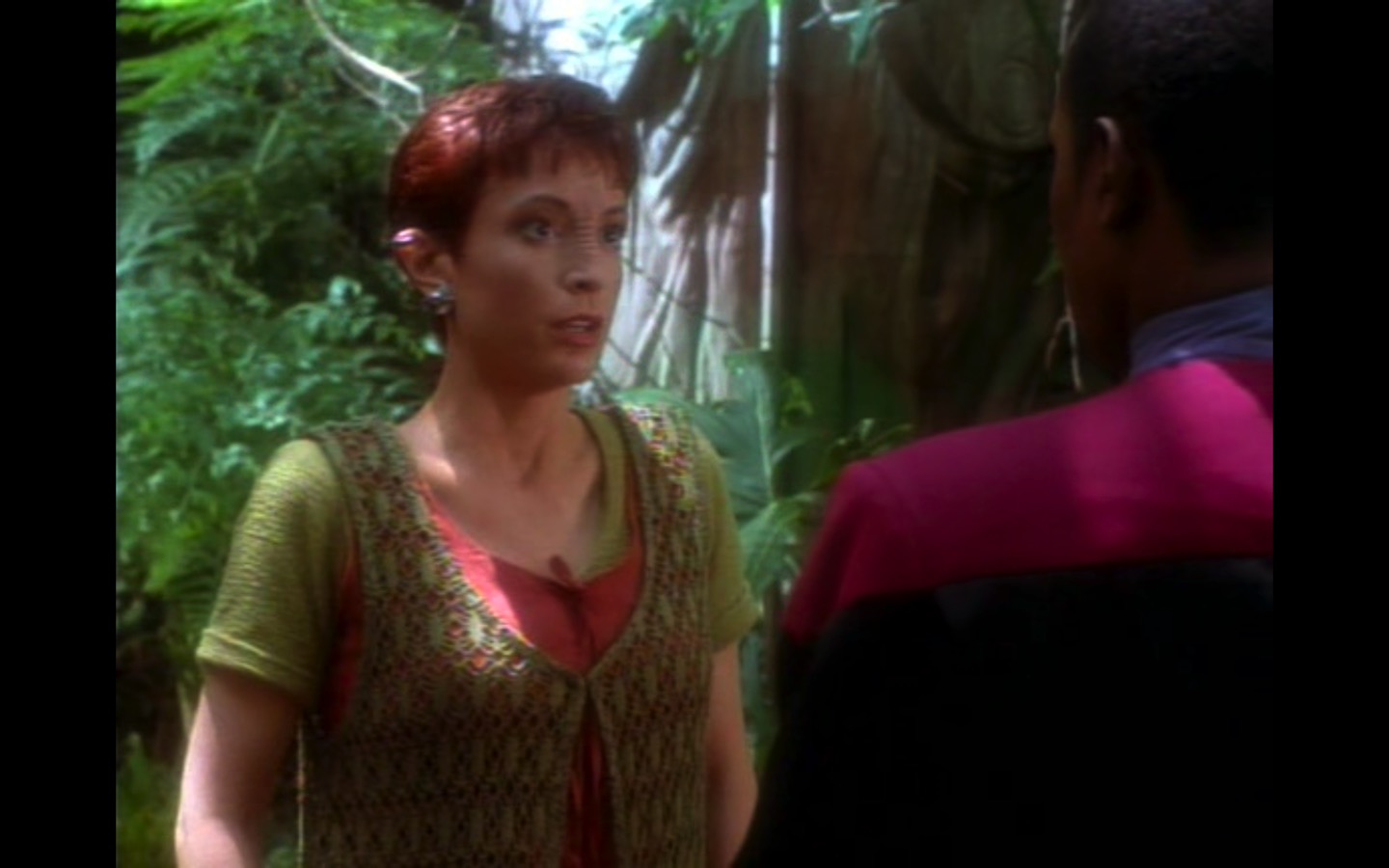
“The Circle” is about as thoroughly “classic DS9” as it gets. It’s an extremely engrossing episode that not only digs deeper into the Bajoran political turmoil introduced in the previous episode, but also really brings several of the show’s characters (both regular and recurring), and their relationships, into focus in a delightful way. As the middle segment of the season’s opening three-part arc, it doesn’t exactly tell a “complete” story in the way that most single episodes do—but it’s also easily the best of the thee episodes in the arc, and just represents DS9 completely delivering on the show that it promised to be from the start.1 I restrained myself with “In the Hands of the Prophets,” only giving it four stars despite my love of it; “The Circle,” though, ranks among DS9’s finest, and I’m rating it accordingly!
I said that “The Homecoming” felt like a fresh start and a moment of “arrival” for the show, but “The Circle” really takes that and runs with it. I don’t think it would be going too far to say that whereas in the first season, the regular characters were merely coworkers (who functioned well enough together, sure), it’s at this point that they start to feel like a family. The episode’s opening scene, with Sisko expressing his displeasure to Minister Jaro about Kira’s sudden recall from her assignment on the station, is one piece of this; Jaro’s surprise at Sisko’s reaction speaks to how far Sisko and Kira have progressed past their early mutual wariness. (This scene is also enjoyable for how Sisko allows Jaro, slick politician that he is, to placate him for the moment by spinning the recall as a promotion, but still makes it clear that he doesn’t necessarily believe or trust the minister.) But the next scene—with most of the other regulars showing up at Kira’s quarters, one after another, to wish her well—takes things to another level entirely, and is absolutely priceless; I can’t watch it without both grinning and tearing up a little. Everyone is in great form here, from Odo’s fired-up distress, to Dax’s calm, supportive demeanor, to Bashir’s initial cluelessness and then increasingly snarky commentary. This scene actually breaks down into three distinct sections, each of which is brilliant in its own way. The first, just between Kira and Odo, showcases what I love about both characters and about their relationship. Odo is clearly upset that Kira is leaving, but being Odo, he expresses it more by going on the attack then via anything heartfelt or sentimental…at least, until he arrives at the point where he’s hurling at her, as though it were a dire insult, the observation that unlike many people, “you have a personal code that’s always mattered more [than rules and bureaucracy]!” Kira allowing this display to cut through her own anger and defensiveness, and responding with “I’m gonna miss you too, Odo,” is perfec, as is their subsequent exchange about smoothing each other’s rough edges. Then everyone else starts showing up and the situation becomes comically chaotic, with Quark, of all people, capping things off and pushing them over the top (“A party!”)…until, finally and totally unexpectedly, none other then Vedek Bareil appears at Kira’s door and, being the deep well of calm and serenity that he is (to say nothing of the respect and reverence that his presence tends to elicit), utterly transforms the energy in the room. The moment when everyone is surprised enough by his arrival to finally shut up, and then Kira’s wonderful “These are my… these are my friends,” beautifully cuts through all the goofiness to land on the truth of the moment.
Bareil’s arrival launches an intriguing and rather surprising character journey for Kira that one would not have seen coming based on the events of the previous episode, but that ends up becoming a major and very memorable focus of this one. Not that, watching her journey unfold, you ever actually think “gee, is the show really replacing Kira with Li Nalas as second in command on the station?”; to its credit, the episode does not at all try to play it up that way. Instead, it’s more just a kind of pause, during which she spends some time outside of her comfort zone and explores who she is apart from her job. Well…that, and she’s also confronted with an altogether unexpected degree of personal (and perhaps romantic) interest and attention from one of Bajor’s most prominent and respected spiritual leaders! There’s so much to appreciate on a character level here: her discomfort with being “useless,” her mixture of awe and awkward humility at the prospect of an orb experience, and how weirded out she is when her orb vision ends up including a sensual, erotic encounter with the vedek. When she first realizes that Bareil is offering her the opportunity to experience an orb and she says that she’s dreamed of this her whole life, I believe her, but what I imagine is that she’s dreamed of it in a kind of separate, closed-off part of herself to which she’s never given much play. I’ve talked before about my frustration with how the show’s first season largely neglected to convey any sense of Kira as caring much about religion and the prophets—but starting with “In the Hands,” I feel like the writers got it together and ran with the idea that she wants to be a spiritual person, but has usually felt sort of unworthy and/or has scarcely allowed herself the luxury of it, and this very much comes through here. As for her orb experience itself, I confess that I’m not entirely clear what to make of it. From Kira’s perspective, the Prophets—whom she no doubt imagines as relatively all-seeing and as taking direct interest in her concerns, future, and personal life—are cryptically guiding her; but what’s the non-mystical interpretation? The orbs, being artifacts of the wormhole aliens, have some kind of access to information that is not constrained by linear time, and they also clearly draw out, or in some way reflect or respond to, a person’s unconscious thoughts and feelings…but beyond these very vague observations, it’s not especially clear to me what exactly is going on here, nor (for that matter) what it all means. This isn’t a criticism, exactly; it’s okay with me for this to be a bit vague and mysterious. But it’s interesting to ponder. Anyway, besides the interesting Kira character stuff, I also love this part of the episode for giving us more of Vedek Bareil after the all-too-brief introduction to this new character that we got in the previous season’s finale. Here is a religious leader who genuinely inspires reverence in others and yet can himself be refreshingly irreverent at times, and who entirely avoids the usual holier-than-thou posturing and condescension (contrast Winn’s habit of calling Kira “my child”). Bareil is just such a fascinating combination of near-superhuman serenity on one hand, and perpetually surprising ordinary-guy-ness on the other, in a way that keeps Kira entertainingly off-balance.2 Then, too, we also get more of the deliciously annoying Vedek Winn here, expertly playing the role of the serpent in the garden in greeting Bareil and Kira as they stroll through the monastery’s arboretum; virtually every word that leaves her lips sends the thinly veiled, passive-aggressive message that Kira is not welcome. Obviously, I really like both of these characters. They’re well-crafted, well-acted, and play interesting roles in the story—but also, I just love the fact that the show is not only beginning to develop an expanded cast of recurring characters, but specifically, with these two, fleshing out Bajor by investing in specifically Bajoran recurring characters.
Meanwhile…remember how this is a story about Bajoran political strife? 😂 (Again, I’m not criticizing here; the episode successfully serves its various narrative threads. It’s just that Kira’s spiritual/personal journey, as I noted earlier, was a much less expected aspect than the political storyline, after the events of “The Homecoming.”) Sisko going to meet with a Bajoran general (Krim) makes for an interesting scene. The writers clearly want to leave us uncertain as to how we should feel about Krim and whether or not we can trust him. He’s conspicuously avoiding confrontations between his troops and The Circle, despite a growing sense that the latter may be planning a coup. Is this prudent caution, and an effort to avoid escalating an unstable situation? Or is it a foolish lack of resolve? Or, worst of all, is he secretly conspiring with The Circle? He comes off as closed and cold in his conversation with Sisko, showing no sign of interest in working with him at all, and yet he also indicates a level of respect for the commander. Their scene together could work as a prelude to the two of them later coming to trust each other and develop a working relationship, or it could be setup for a more antagonistic relationship, and even an eventual reveal that he’s up to no good. It’s to the episode’s credit, I think, that it doesn’t tip its hand to reveal which way this is going to go. On the other hand, the reveal that Jaro is the leader of The Circle is not much of a surprise at all; he has not seemed particularly sympathetic or trustworthy any of the times that we’ve seen him in these two episodes. As one might expect, he reads as equal parts uber-patriot with fascist tendencies who’s willing to take extreme measures to achieve ends that, in themselves, we can sympathize with, and opportunistic politician riding a wave of popular unrest in pursuit of personal power. Interestingly, he’s also consistently characterized as a black-and-white thinker who doesn’t grasp nuance; it’s “common knowledge” that Sisko and Kira have not always seen eye to eye, so he assumes Sisko will not care about “losing her”—and similarly, Kira has been outspoken in criticizing the provisional government in the past, so he half-expects her to roll with his goal of overthrowing it by force. Kira, meanwhile, pivots unhesitatingly from her stint as a rogue officer who defied orders and went off to rescue Li Nalas on her own, to responsible Bajoran citizen defending the duly elected government (whether she likes it or not), because that (not treachery and coups d’etat) is the only real path toward stability and self-determination. And then, back on the station, we have our people uncovering a secret pipeline of weapons flowing to The Circle from the Cardassians. I’m glad that the episode makes it clear that The Circle doesn’t know they’re being supplied by the Cardassians; they may be getting used as pawns (rather ironically, given that Bajor throwing out all external parties and standing on its own is what they’re all about), but it would be deeply disappointing if they were, like, flat-out hypocritical traitors to Bajor. The cultural trauma and resulting political strife that the show is exploring needed to be genuine, not manufactured by outside parties. The involvement of Cardassians behind the scenes walks right up to the line with regard to this, but doesn’t cross it.
The episode’s various narrative, character, and thematic threads come together beautifully in the scene where Sisko drops in on Kira in the monastery’s gardens. Earlier on, before Kira left the station, Sisko flatly declared (nominally to Li, but looking directly at Kira) that no one could ever replace her as his first officer/Bajoran liaison officer, and she took this in and was visibly moved by it; then he vowed to her that he intended to “get her back.” Now, when he goes to see her, in his mind he’s clearly checking in with the person who he still thinks of as his partner, chief ally, and right hand in the work of shepherding Bajor toward stability—”still,” but also to a degree that feels kind of new as of the recent run of episodes. Like I said earlier, there’s a real sense of the DS9 team/family coming together throughout this three-part arc. But the Kira that he finds in the garden is one who has actually started to embrace “uselessness,” per Bareil, and is kind of a million miles away from the strife and troubles that Sisko is contending with. When he half-apologetically brings her “back to reality for a minute” via an update on how quickly the political situation is deteriorating, it clearly unsettles her (Bajor is on the brink of a military coup, and here I am obliviously basking in the peace of this beautiful arboretum and exploring my pagh, or whatever!); but equally, Sisko appears to end up feeling a little guilty for interrupting her retreat (unwittingly playing, in his own way, another version of serpent-in-the-garden). The scene ends, though, with Kira both re-shouldering the burden of her commitment to the goals that she’s spent her life fighting for and, for the first time, claiming the role that Sisko has attributed to her as his relied-upon partner, and affirming, from her side, a commitment to somehow winding up back in her job on the station. The whole scene is just really affecting.
Some people take issue with Starfleet command ordering Sisko to abandon the station when The Circle ends up seizing power and sending assault ships toward it, but it absolutely makes sense. It might be perfectly legitimate for them to, after evacuating the station, continue working to expose the Cardasians’ behind-the-scenes involvement, but remaining on a Bajoran-owned station after being ordered to leave by the regime currently in power, and directly fighting on one side and against the other in an internal revolution/civil war? The situation is directly analogous to the outbreak of the Klingon Civil War back in TNG’s “Redemption,” when the Enterprise reluctantly left the fray (but then proceeded to expose the Romulans’ involvement)—except, of course, that Sisko chooses to defy his orders (I mean, he theoretically exploits a loophole, but lets call a spade a spade). But even though I accept the logic of the admiral’s position, I also completely get Sisko’s point of view. For one thing, the Bajorans are not the Klingons—a wholly independent power, with whom the Federation has established friendly terms, sure, but whose internal affairs are definitely their own business, and who also are powerful enough to pose a real threat to the Federation if relations turn sour. Bajor is a candidate for Federation membership, and Starfleet’s presence in the system is all about supporting and helping to prepare the Bajorans to reach that status. Additionally, it’s pretty easy to see the power struggle that emerged within the Klingon Empire as a kind of business as usual for them, not really much outside the norms of their political culture; after all, they’re a people for whom personal advancement via killing your superior officer is considered glorious, and who generally get all excited at the prospect of warfare. Bajor, on the other hand, arguably has just suffered the overthrow of its legitimate and duly elected government by something akin to a fascist coup. It’s still murky waters (the Federation technically shouldn’t be in the business of deciding which governments of independent planets are or aren’t legitimate), but like I said, I get it. More important, ultimately, than any of these political, strategic, or moral arguments, though, is the plain fact that Sisko is invested in his mission here. This makes sense in a way that connects back to “The Emissary,” when the task of helping to rebuild Bajor became connected, for him, to the project of rebuilding himself, but it also grows out of the relationship that he’s built with Kira, and just the fact that he’s come to care about this place and its people and their fate. Then, too, he may have in mind the fact that, whereas the Federation’s hands were definitely tied with respect to helping Bajor while it was under Cardassian occupation, they aren’t similarly tied now—and that if the Federation (and specifically he and the other Starfleet personnel on the station) truly hopes to prove itself a friend to Bajor (and not just another self-interested imperialist power, which is how The Circle sees them) and earn the Bajorans’ trust, they have to stay and fight alongside the station’s Bajoran personnel, not cut and run, leaving them to their fate. Right before Sisko delivers his episode-ending “Then I guess some of us won’t quite be done by the time they get here,” he turns away from Chief O’Brien and looks out toward the main part of Ops…where Kira and Li Nalas are both standing; he’s making a statement to them (and any other Bajorans who might be present) as much as anything. And finally, there’s this: When DS9 debuted, there was lots of talk about the idea that setting a Trek show on a space station instead of a starship could be conducive to a kind of storytelling that emphasized sticking with a particular set of issues over the long haul, rather than warping off to somewhere new each week. With the climax of “The Circle,” and its lead-in to the third and final installment in season two’s opening arc, the show went all-in on that idea in a deeply satisfying way—and it’s satisfying partly because of the ambiguities and complexities surrounding Sisko’s decision. Again: This is what it means to be “on the frontier” of the Federation, engaged in the messy business of forging the kind of society that Trek represents out of the chaos left behind by imperialistic exploitation.
- I never knew this before now, but the MemoryAlpha entry for “The Homecoming” relates that “at the end of season one, Michael Piller directed the writing staff to concentrate on the show’s uniqueness for season two and to let go of the links to the universe of The Next Generation.” Well, the opening arc certainly shows it! Kudos to Piller, whom I have always both generally respected and specifically credited with making DS9 the show that, at its best, it was. ↩︎
- Contrarily, it seems that a lot of other people perceive Bareil (at least in this episode; not sure about others) as horribly stiff, wooden, and boring. I’ll grant that the actor’s performance is very understated, but to me, it comes across as a) intentional and b) effective. Where others see woodenness, I see quiet intensity (as well as, in this particular episode, an element of mystery). ↩︎
****
I gather that my reaction to this episode isn’t the same as a lot of folks, but for me it’s a bit mixed. The character stuff is fantastic. Sisko is his usual effective but not-Picardlike self in talking to Jaro, then the scene where all the crew comes to talk to Kira—though a bit over the top with respect to the rate people come to visit Kira—still works really well, and demonstrates a great grasp of the characters, especially Odo and Kira. I enjoy Kira’s walk around Ops and her conversation with Li, and there’s some real payoff here in the Sisko/Kira relationship that we never would have gotten if their relationship hadn’t started in a more adversarial way. Then we get a great scene about Kira learning to be useless from Bareil, and the romantic tension between them is well done (though the effectiveness of all of it is very noticeably undermined by the actor playing Bareil doing so in an inexplicably wooden way). [Later added: he played it a bit this way in earlier episodes and to me it comes off there as appropriately meditative; here, though, he just seems sedated.] I don’t like Odo abusing his power to manipulate Quark. I mean, the scene is good otherwise, but Quark would quickly learn to avoid Odo entirely based on this sort of behavior, and it’s part of an annoying pattern of the characters thinking that because Quark has problematic aspects, it’s okay to exploit him. But then we move on to Winn, who is really well written and as condescending and irritating as ever as she talks to Bareil and Kira, apparently seeing what the two of them have yet to acknowledge to each other, that there’s an attraction between them. And what a great scene with Sisko and Kira coming together to discuss daydreaming and affirm their relationship and her desire to return. Kira says here she has a lot to think about. I’m not sure that she has quite as much to think about as I’d like, to be honest, because the episode sort of glosses over her time at the retreat other than her conversation with Bareil and the orb encounter, but I do like the affirmation that getting in touch with her meditative side hasn’t really changed who she is.
The next bit is where things fall down, because the episode starts to lean on the plot, which I find unconvincing. It’s complicated to the point of being a bit dull, and yet somehow, it manages to be a bit confusing what is even happening sometimes. There just aren’t enough characters in this episode other than the regulars to make it surprising that Jaro is the villain, and he isn’t developed enough for me to really care one way or another about him or what this revelation means. We find out the Circle is getting supplies from the Cardassians, which is honestly the twist that the whole episode hangs together on (though I’m not sure why they don’t make this information public; surely that would cause some swings in public opinion, but it’s not even clear enough to me what’s going on for me to be able to say for sure that this would make sense to do). Other than that, there’s just not enough going on here to bring me in. The idea that Jaro turns out to be the leader of the Circle doesn’t ring true—apparently a major minister apparently in control of the military is also the singular leader of an extremely powerful terrorist organization? It’s a caricature of a political movement and it might even be too charitable to say the cultural context behind it is thinly sketched. I’m not sure I’m even entirely understanding what’s supposed to be happening here. The Circle seems to have taken over the government, but how exactly did this happen? What happened to the provisional government; did the former politicians all go into hiding, or did they join the Circle? It might make more sense to me if Jaro were just a government official using the opportunity of the chaos provided by general social conflict to stage a military coup, but apparently he’s also been behind the scenes organizing a lot of the chaos the whole time—all by himself as the leader of the Circle, no less—which doesn’t track at all, and it just seems like this all comes out of nowhere. In the previous episode, we have the Circle causing some serious mayhem, which seems quite realistic, but they didn’t seem to be in a position to take over the government, did they? Even if that’s what they meant to convey, I still would need some of this takeover dramatized, not just explained. All of this xenophobia should be indicative of broader Bajoran cultural trends that would be interesting to zoom in on, but they just feel much too far away and unreal. Then, of course, because the episode doesn’t really seem to know what to do next, Jaro kidnaps Kira on the pretense that… he wants her to explain whether the Federation will continue to back the provisional government!? Really? Surely a lot of people would be able to weigh in on this that he wouldn’t need to torture. The answer doesn’t exactly seem hard to have at least some sense about for a person in his position to begin with, and would Kira really have that special of a take on it? Of course, in the process of interrogating Kira, he unnecessarily reveals himself to her as the guy in charge. Does the revelation that Jaro is in charge of the Circle make any difference here? I’m not really sure if it does or not, but if so, then he was a fool to reveal himself to her, and if not, then it just seems irrelevant that he is in charge at all. I think the episode might have been better without such a clear villain, Instead, show some more complicated figures with different, and perhaps somewhat relatable, perspectives on Bajoran independence. If Jaro *is* to be a villain, I’d like to see him actually standing for the kind of nationalistic perspectives that are threatening Bajor instead of just being kind of a generic dude without either principles or mostly even disingenuous attempts to sound as if he does. I want to see evidence of the deeper cultural trends that are rooted in a divided society trying to recover from half a century of occupation. Anyway, then we have a very convenient and dull-to-watch rescue made based on information acquired offscreen by Quark, who just happened to have the right contacts. The conversation between Winn and Jaro about helping each other is fine, but pretty two-dimensional, and I don’t find it very interesting. And finally, they’re also really just treading water with the Li character here.
All this leaves me really split on the episode, because the plot pushes me toward a three at best, but the character stuff is a five. So let’s call it a four, even though in some ways, that’s a very generous rating.
Small takes:
* In the conversation between Winn and Jaro, the dialogue is mid, but their backdrop is surprisingly convincing. Well done to. the special effects department on that one.
* I’m not sure how Kira would have heard phaser fire from miles away. Later in the episode, the Bajorans are using energy weapons, not ballistic ones.
So yeah, we definitely have some different takes on this one. I agree with some of your points, and as is pretty much always the case, I can imagine versions of this episode (or maybe, of other episodes leading up to or following after it) that dig more deeply into the cultural and political strife underlying the events, and for sure, that would be better. But I still really love what we do get, and I also feel like at least certain aspects of the story/plot hold up better than you are suggesting.
For example, while I agree that Jaro turning out to be the villain is not much of a surprise, I think I find him more interesting than you seem to. You said both that you would have liked it better if he were just an opportunist taking advantage of the chaos rather than the one who orchestrated it, *and* that you would have liked for him to stand for specific principles rather than, in effect, just being an unprincipled opportunist. How do you reconcile these complaints? I’ll allow that his characterization isn’t terribly deep, but he IS established to be someone who is a) impatient with the provisional government’s paralysis and indecision (and perhaps generally with the slowness and messiness of democracy), and b) eager for Bajor to stand on its own rather than leaning on and/or being exploited by outside powers, but also c) hugely ambitious and prone to self-serving rationalizations to justify a personal power grab. They could have gone the route of making him less “villainous” by excising that power-hungry side, and I can see an argument for that…but also, this mix of characteristics feels pretty realistic, no? Then, separately (?), you also questioned the plausibility of him being both a major government minister (“apparently in control of the military”) and also “the singular leader of an extremely powerful terrorist organization.” First, he definitely isn’t “in control of the military” (before the coup, anyway); he’s just one government minister among many, seemingly on some kind of council (granted, the structure of the provisional government is never really spelled out). Second, I don’t see why a government figure couldn’t be secretly organizing a coup; there are certainly real-world examples of legitimate government figures having secretive organizations that they control and that agitate public opinion and ultimately enable them to seize total power. I imagine The Circle itself as a relatively small organization (maybe think of the Bolsheviks in the Russian revolution), both fomenting and riding a wave of general nationalism/xenophobia/impatience/frustration. This seems plausible enough to me. (I do, however, question Jaro’s “I AM The Circle” line; why have him imply that it’s practically a one-man show?)
You also talked about it being less than clear what is even going on. Now, I for sure have some criticisms along these lines when we get to the NEXT episode—but in this one, everything seems clear enough to me. You said these two things:
-“The Circle seems to have taken over the government, but how exactly did this happen? What happened to the provisional government; did the former politicians all go into hiding, or did they join the Circle?”
-“In the previous episode, we have the Circle causing some serious mayhem, which seems quite realistic, but they didn’t seem to be in a position to take over the government, did they?”
The Circle didn’t take over the government until the very end of this episode. Prior to that, the episode keeps emphasizing how unexpectedly swiftly events are moving; Quark tells Odo that he’s hearing about The Circle arming for a coup, and then we’re hearing about Circle-armed forces threatening the capital city, and there’s the scene where Sisko talks to Krim about why the military is repeatedly backing down from confrontations with them. When Sisko fills Kira in on what’s going on, she’s stunned at how serious things have gotten in a short period of time. So yes, The Circle does go very quickly from “extremist group stirring up trouble” to “armed insurrectionists,” but the episode acknowledges this, continually making the point that events are unfolding faster than anyone expected (which no doubt also helps to explain The Circle’s success). As for the politicians of the provisional government…they’re presumably still around and nominally in change for basically all of this episode, until a coup happens offscreen near the end. (Again, though, this all does become a lot less coherent in the NEXT episode, as I discuss in that review.)
Why don’t our people make the info that the Cardassians are supplying weapons to The Circle public? Well, as soon as they learn this fact, they decide to do exactly that—but it turns out to be too late, as they find that the coup has just taken place and communications have been cut off. Hence the whole Kira/Dax storyline in the following episode, about getting the evidence to…someone. (Again, for me, a lot of this does really fall apart once we get to “The Siege.”)
“I still would need some of this takeover dramatized . . . All of this xenophobia should be indicative of broader Bajoran cultural trends . . . I want to see evidence of the deeper cultural trends that are rooted in a divided society trying to recover from half a century of occupation.”
To a point, I agree. It would have been great if the show had explored this kind of thing more in the first season, but it didn’t. Whatever—I’ve complained about that, but now it’s season two and the show is starting out by paying more attention to its core premise, and I’m rolling with that. “In the Hands” did some work to start establishing the idea of division and xenophobia, and then the first part of this trilogy picks that up and emphasizes it more, and then this episode runs with it. I do very much wish, though, that the cultural tensions that boiled over into an actual coup here wouldn’t have seemingly evaporated into nothing as soon as “The Siege” ended. That’s a huge strike against the show…but not against “The Circle” as an individual episode.
Three other points of yous that I fully agree with are 1) that Jaro kidnapping Kira is a pretty lame plot contrivance without a convincing rationale; 2) that the Kira rescue sequence is very rote and uninteresting; and 3) that Li Nalas falls by the wayside too much. (I don’t see any problem with Jaro revealing himself as the leader of The Circle, though, because he’s only revealing this to *his prisoner*…and also because, as it turns out, he apparently was pretty close to being ready to actually seize power anyway, at which point secrecy no longer serves him or is possible.)
Finally, I want to talk about this:
“I don’t like Odo abusing his power to manipulate Quark. I mean, the scene is good otherwise, but Quark would quickly learn to avoid Odo entirely based on this sort of behavior, and it’s part of an annoying pattern of the characters thinking that because Quark has problematic aspects, it’s okay to exploit him.”
Initially, I had all of these same thoughts and reactions to that scene, but then, the more I thought about it, the better I felt about it. Is Odo actually abusing his power? Quark knows people who have information about the flow of illicit weapons to The Circle, but he refuses to identify those people to the authorities, so Odo threatens to charge him with impeding an investigation. I don’t know exactly how the legalities fall out, but that doesn’t strike me as wildly unreasonable. The overall pattern that you reference here, of the other characters feeling free to exploit and abuse Quark just because their values and his differ, is one that I’ve criticized myself, but I’m not sure that this is an instance of it. And as for your point that Quark would learn to avoid Odo if Odo pulls shit like this…I see that, but we could also read the scene as being about Quark’s own (less than entirely conscious) inner conflict between his greedy/self-interested/quasi-criminal tendencies and his people-person desire to feel connected and be respected (perhaps especially by Odo, for whom he obviously has considerable affection despite their rivalry). So in this view, we might imagine that Quark somewhat unconsciously puts himself in a position to be coerced by Odo because part of him actually WANTS to help, but the ruling greed-and-Ferengi-values part of his self-concept can’t justify doing so “willingly.”
Anyway… To be sure, this episode isn’t perfect. But damn if I don’t love it in spite of its flaws!
I can’t edit this, so to clarify: I meant to say “uncomplicated to the point of being dull,” not the opposite of that.
As far as how I reconcile those complaints, I didn’t really mean to suggest that he had to be any of the things I mentioned specifically–more that I’m frustrated by the fact that the episode himself doesn’t seem to have much of a concept of who he is or what motivates him. You do, in fairness, point out some features of his motivation, but… it’s really kind of just the obvious things that one would think to add to a character in his position with nothing that surprises or suggests much personality beyond that, and I just can’t escape the fact that it’s all so generic and just fails to come across as psychologically complicated. I do think that a version of him who genuinely believed he was doing it for Bajor could have given him an actual weakness that could be exploited and that would have been a bit more interesting, especially if they decided to use him in future episodes, but even that probably wouldn’t be enough to save the character for me, if I’m being honest.
As for my comments about what was going on, I added some of these thoughts after I’d seen the trilogy and was modifying my previous reviews, so maybe they belong in the next episode’s response.
I’m not sure in retrospect why I said he was in control of the military there; I don’t recall being under the impression that he was prior to the coup. I just garbled that somehow.
“I don’t see why a government figure couldn’t be secretly organizing a coup”
The issue for me isn’t that a government figure couldn’t be involved with organizing a coup (although the fact that it’s seemingly just one guy doing it and we don’t see anyone else involved (unless you want to count Winn, who isn’t in the gov’t) makes it feel really unreal). It’s that a government figure is ALSO the sole head of a major terrorist organization and that he is seemingly single-handedly portrayed as organizing the bulk of the work of both sides of this. I would find it much more plausible if they split up some of the responsibility here. He could be cooperating with an unrelated-to-him terrorist organization or using chaos to exploit his own ends, but c’mon, he’s running both sides of the situation?
“The Circle does go very quickly from “extremist group stirring up trouble” to “armed insurrectionists,” but the episode acknowledges this, continually making the point that events are unfolding faster than anyone expected (which no doubt also helps to explain The Circle’s success”
They do. It’s just that the impression I was left with at the end of part one feels completely different than the one where this group is organized enough to swiftly take over the government, and because it’s happening so far away and is only gestured at with no specifics being offered, it just doesn’t feel remotely real. In the first episode, they were spraying graffiti. By the end of this one, they’re marching on the government. It’s just too fast and too easy–I have no sense of what obstacles they had to overcome to accomplish this or how it happened.
But my main complaint, really, is that almost everything to do with the plot in this episode is just kind of flat for me.
Stuff about Quark: I can buy that to some extent, since I agree with you that the version of Quark who does struggle with moral questions is dramatized in other episodes. For it to really work for me here, I’d need to see a little more evidence that Quark is struggling with that–say, a quick scene prior to this where Quark is shown to consciously choose to go see Odo after mulling over whether he should do something about this situation just to hint at some complexity for him there. That, to me, would add some real depth to the character, even though as I said, other episodes do suggest this as a part of Quark’s personality.
I guess I’m just not sure what you mean about Jaro “running both sides.” He’s a government offical (not THE government official, not solely running the government, nothing like that), and then he’s revealed to secretly be the leader of The Circle (which is not necessarily a “major terrorist organization”; again, I see it as more like a small but well-armed group seeking to foment anti-government and anti-non-Bajoran sentiment, and use it to gain support when they pull off a coup). I’m just not seeing “one guy implausibly doing everything,” which seems to be your complaint (?). I mean, sure, there’s the usual TV shorthand where we’re asked to believe that a whole organization exists but we really only see the single character who is its leader. But you are seeing a bigger issue than just that?
“In the first episode, they were spraying graffiti. By the end of this one, they’re marching on the government. It’s just too fast and too easy–I have no sense of what obstacles they had to overcome.” I would agree with this criticism if The Circle were the protagonists and we we following THEIR story. But as it is, I feel like the thing that you don’t like is actually something that the episode does intentionally; we are *supposed* to be caught off-guard, just like the main characters are, by how serious and well-prepared The Circle actually is. When Quark comes to Odo in a panic, Odo initially dismisses his concerns, saying that The Circle are just a bunch of hooligans trying to get attention; then Quark tells him that The Circle has enough weapons to supply an army, and Odo suddenly sits up and takes notice. Now, for sure, we should *eventually* have gotten to see more of the conflicts dividing Bajorans firsthand—perhaps in part 3, or at the very least, in later episodes, where we might have seen that even though the coup fell apart, the underlying issues persist. But in this episode, to me, the *point* was that the characters whose perspectives we’re following are caught off-guard by a threat that they underestimated.
Re: Quark: I would suggest that the mere fact that he goes to talk to Odo at all is evidence of his motivations. Otherwise, why stop by your arch-rival’s office to let some intelligence slip and encourage him to bail before the revolution comes? Why not just skip this and get out while the gettin’ is good?
Jaro is running both sides in the sense that he’s the singular leader of the Circle and (seemingly) the main person in the government to whom the people in the government staging the coup report. Perhaps you’re seeing the Circle’s militaristic action as the entire means by the coup occurred? I was assuming there was some inside cooperation from gov’t officials led by Jaro as well, and these together resulted in the takeover. If it was just a bunch of troops marching on the gov’t as instructed by Jaro and he wasn’t also using his gov’t connections to stage the coup, why is it important that Jaro is a minister at all? The only reason would be for a very underwhelming reveal that a character we’ve already seen is in charge of the Circle. (And sure, you could call some of this TV shorthand, but TV shorthand does tend to flatten drama.)
“‘I have no sense of what obstacles they had to overcome.’ I would agree with this criticism if The Circle were the protagonists and we we following THEIR story.”
I’d argue that the coup and associated events constitute an important enough part of the story at hand to require more development, and a better story would have had our protagonists involved with that process in some way, making decisions that contributed, however inadvertently, to that outcome. But even if our characters weren’t going to be involved with that part of things, the absence of seeing any of it seriously undercuts the sense that this is really happening for me. Even a conversation that involved a description of something tricky and intriguing that was taking place or how they pulled it off would have really helped. At least come up with some cool tactic they used that illustrates something about Bajoran society. What if they used Bajoran citizens as meat shields in the process? What does that tell us about the Circle’s sincerity and their motivations? What if they were successful because they captured a site that contained an Orb and used it to leverage the vedek assembly’s power over the provisional gov’t? We’re now exploring how Bajoran society actually functions and the relationship between religion and political power. There has to be some reason that no one saw this coming.
“I would suggest that the mere fact that he goes to talk to Odo at all is evidence of his motivations”
Honestly, the reason I initially assumed was that the writers like the Quark/Odo pairing and they wanted to do something with it even if it doesn’t necessarily make sense. I know that’s pretty meta, but I’m not convinced that the writers really thought through the reason why Quark would do that. Whether or not they did, Quark’s conscience does provide a good story reason; I just want another scene to hint at that more than this. Otherwise, it just seems to me like Quark’s doing it against all reason… well, I guess, because he’s a people person.
“Perhaps you’re seeing the Circle’s militaristic action as the entire means by the coup occurred?”
Indeed. The episode talks about The Circle being well-armed, and Sisko worries that the army might not defend the provisional government when/if The Circle makes their move. So yeah, I assumed that The Circle marched on the capital/govt buildings, either met no resistance or defeated whatever resistance there was, and then took control. I mean, sure, I guess we can also imagine that Jaro used power/resources available to him as a government minister to make the takeover easier…but that thought hadn’t specifically occurred to me.
“…why is it important that Jaro is a minister at all?”
I mean, there’s taking over the government by force, and then there’s having enough legitimacy in the eyes of the public to maybe be able to hang onto power and govern effectively, right? Surely being an experienced minister who is known to the public, and not just some nobody, means quite a bit. But also, there’s just the idea that this guy is power-hunger, ambitious, nationalistic, etc., so it stands to reason that he would have already been a politician / involved in govt before seizing increased power via a coup. And then finally, yes, there’s the “TV shorthand” factor of having the antagonist be a character we’ve already met; that’s for sure in the mix as well.
“I’d argue that the coup and associated events constitute an important enough part of the story at hand to require more development, and a better story would have had our protagonists involved with that process in some way…”
Granted, there are easily imaginable versions of the story that could have been better, along these lines. I understand your perspective here. It just doesn’t interfere with me still really enjoying the episode as it is, I guess.
About Quark, I dunno; maybe I’m being too charitable in trusting that the writers put thought into Quark’s motives. I am still inclined to think that they did, though. There’s a point in the scene where Quark says something like “We’ve gotta get out of here!” but then kind of checks himself and amends that to “Well I do, anyway!” To me, that suggests that he has come into Odo’s office impelled largely by motives of which he’s not fully conscious, and then in this moment he’s kind of going “wait, what am I doing in here babbling to Odo about this; I should just look after myself, right?”
This doesn’t necessarily bear on the situation in the episode, exactly, since the US Government is a formerly stable country experiencing instability due to decades of liberal democracy being dismantled by oligarchs and not political occupation by a foreign power, and the government here lacks the “provisional” status and could plausibly not have very good defense systems, but it’s made me think about the idea that say, Marco Rubio was running some kind of right wing terrorist group and that was the means by which he decided to obtain political power.