
It’s hard for me to have to give “The Siege” only two stars. Granted, I have always remembered it as the weakest episode of season two’s three-part opening arc, but it’s still an episode that I care a lot about and am very invested in. Also, during this re-watch, I was finding myself pleasantly surprised for the first fifteen minutes or so, and even started to wonder if I had been too hard on it in the past. Unfortunately, I eventually saw that if anything, the reverse is true; I went in thinking that I would probably land on three stars for this one, but in the end have been forced to revise that downward. I had vaguely remembered “The Siege” feeling like a bit of a letdown after the greatness of “The Circle” in that it swapped out political intrigue and character exploration for a relatively routine, action-heavy, defend-the-station type plot, but really, that’s not the problem at all. I mean, for the story to proceed from plotting and political machinations in part 2 to outright violence in part 3 makes a certain amount of sense (and, indeed, for that not to have happened would probably have felt artificial and anticlimactic), and if done well, a part 3 that featured our heroes defending the station from The Circle’s forces could have been very engaging. No, the real problems with “The Siege” are actually that almost nothing about it makes much sense, as well as that the meatier story threads from earlier in the three-part arc don’t really get any meaningful resolution.
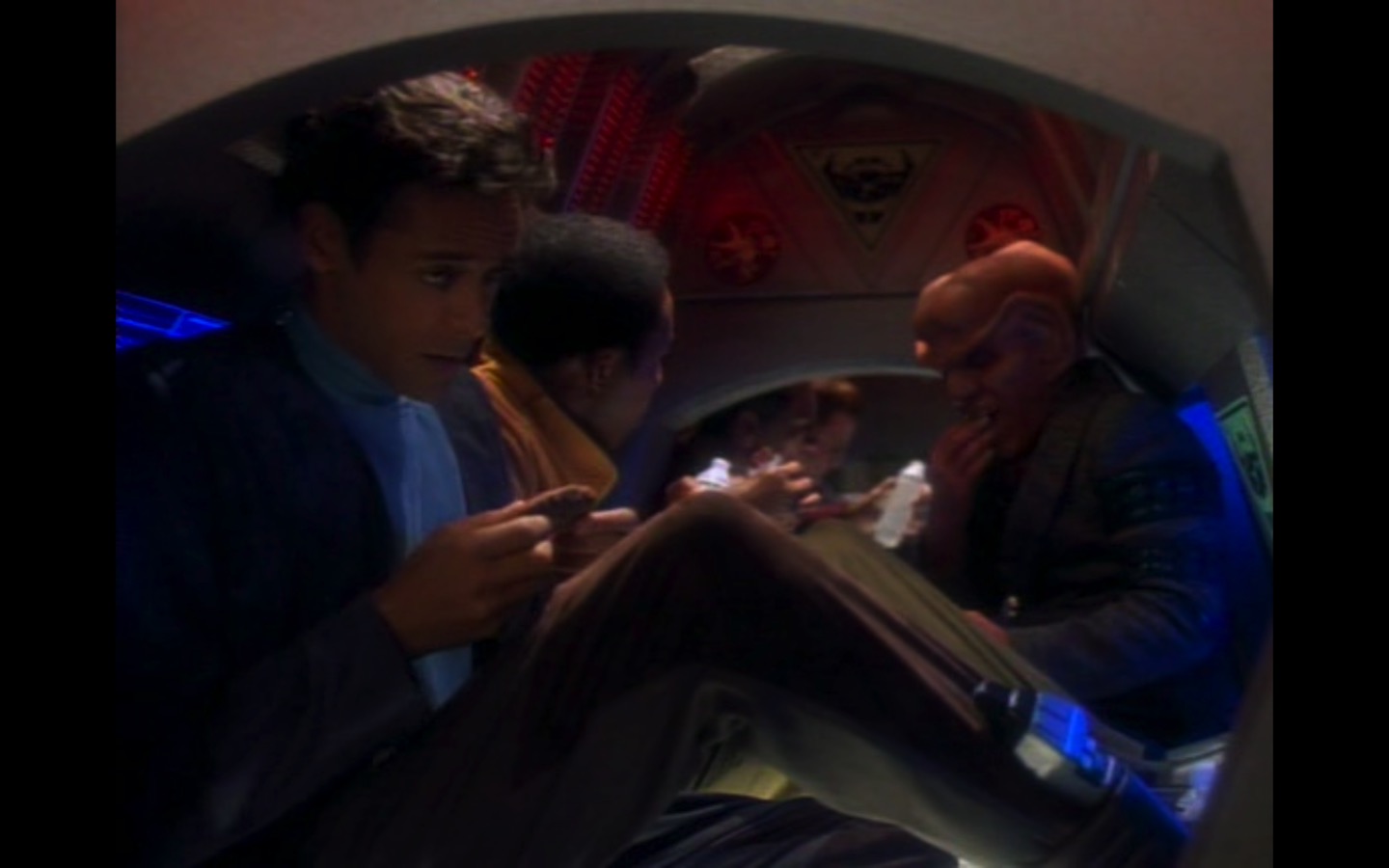
There is some good stuff here, though, and I want to talk about the things that I do like before digging into all the aspects of “The Siege” that really don’t work. First (and I already alluded to this above), most of the early, stage-setting scenes about the main characters’ decision to stay and fight, and the rush to evacuate civilian personnel, etc., are pretty effective. Sisko’s line in his opening speech—”Governments can break off relations with an edict; it’s not so easy when it comes down to our level”—functions, along with various lines from “The Emissary,” as a kind of thesis statement for the show as a whole, and the details about Starfleet personnel who have become engaged to Bajoran officers, etc., help to sell the dilemma that confronts everyone on the station. Jake and Nog have a nice little scene, Quark’s antics are…well, Quark’s usual antics, and the comeuppance that he faces when it turns out that Rom has sold his seat is actually somewhat funny. Li Nalas getting a moment to actually live up to his image by convincing his fellow Bajorans not to run feels right, and having Quark end up stuck with the rest of the regulars when they’re hiding in the conduits later on kind of works for me, too.1 On the other hand, I do wonder: What happened to all those other people who were on the point of rioting at the airlock but whom Li convinced to calm down and stick around? Are they somewhere hiding in the conduits with the main characters? We never seen more than maybe one or two Bajorans (besides Li), so that’s a bit confusing. (Also, as ever, I could have done without the Miles/Keiko friction over Miles’s decision to stay and fight. I don’t even want to get into which of them is being reasonable or unreasonable; that’s not the point. The point is, can’t the writers ever, even once, depict these two in a way that makes us believe that they love each other and would have chosen to join their lives together? Can they never be on the same page? Must they disagree and bicker about absolutely everything?)
Secondly, the whole Kira/Dax storyline is actually a lot of fun, even if there are things about it that raise questions and/or don’t quite add up. The characterization of Dax throughout their little adventure is interesting: much livelier and more full of personality than anything that we saw from her in season one, in a way that mostly feels more like the Dax we’ll come to know for the rest of the series…except, also, actually weirdly incongruent with later Dax. It’s hard to reconcile the Jadzia Dax who will be palling around with Klingons later on with the one in this episode who freaks out about “palukoo” on the Bajoran moon, frets about how allergic to insect bites she is, and seems wildly uncomfortable having to cope with broken-down technology. Still, the banter between her and Kira is entertaining and fun, and makes her come to life in a way that she rarely did in the show’s first season, and is packed with really memorable lines, from Kira’s commentary on resistance days (both “We were the insects, Lieutenant,” and “The guys flying those ships? They used to be the guys flying these ships”) to Dax’s dismayed “Great! Seat of the pants technology!” Their crash-landing, being rescued by Bareil’s people, and dressing up like vedeks (as foreshadowed in Kira’s orb vision in the previous episode!) are all engaging, too.
Alas, however, pretty much the entirety of the defend-the-station storyline turns out to be an incoherent, pointless pile of nothing. To begin with, while I like that General Krim continues to have a role in the story, I wish we had a clearer indication of where he stands. Is he genuinely pro-Circle, for instance, or is he just following the orders of whoever is in charge at the moment? For that matter, why is it the regular Bajoran military that Jaro sends to take control of the station, rather than his own Cardassian-armed Circle lackeys? (This ties into other questions that I’ll be raising in the next paragraph, so put that to one side for now.) Also, pairing Krim with a deeply stupid and quasi-insubordinate colonel whom Krim for some reason lets mostly run the show in a way that Krim himself clearly doesn’t agree with was a pretty lame move on the part of the writers. More fundamentally, though: What is the point of any of the stuff that happens in this (the on-station) part of the story? So Sisko and company trap a few imbeciles (including the aforementioned colonel) in a holosuite via a pretty obvious ruse, and they inform these prisoners about The Circle’s Cardassian connection, and then they beam Colonel Dumbshit to Ops. Why, exactly? Like, if they wanted to try to convince Krim that he’s being used as a pawn by Cardassians, why not take that message directly to him? Is making announcements via the comm something that only works in a holosuite, or what? Then later, Bashir and some other folks execute some kind of tactic (?) involving making a bunch of noise (apparently; we don’t actually witness this) and then surrendering (?), all while Sisko and Li Nalas surprise Krim in Sisko’s darkened office. What is the connection between these two events? Bashir’s thing presumably has some kind of point, right? And surely there is supposed to be some reason why Sisko and Li are able to corner Krim at this moment, but could not have done the same at literally any earlier point? If so, however, the episode does not make it clear at all. And finally: What Sisko and Li are up to is using Li’s status and moral clout to try to win Krim over to the side of reason. This is a good story idea (Krim, after all, has been set up as intelligent and potentially sympathetic, and Li ought to turn out to be useful for something), but what actually comes of it? Apparently, he does manage to convince Krim of the truth about Cardassian involvement and thereby get him to essentially stand down…but this happens offscreen!? Seriously, what the fuck?
Meanwhile: Who exactly is actually in charge down on Bajor? Some of the dialog seems to indicate that the provisional government has been straight-up overthrown (for example, in the episode’s opening scene, Bashir finishes Sisko’s thought about Starfleet being here at the invitation of the provisional government by remarking “no more provisional government, no more invitation”), but then Kira and Dax also talk about getting their evidence of Cardassian involvement “to the provisional government.” Also, when the latter duo show up in the chamber of ministers, Jaro has a line about not allowing them to “disrupt the orderly transition of power.” So, seemingly, there is still a process under way to transfer power from someone (presumably the provisional government) to someone else (presumably him), which process he is trying to present as “orderly.” Presumably that’s a facade, but…I dunno—is it? Has there actually been a military coup here, or not? Again, it’s the regular military, not armed Circle extremists, who are invading the station. And to whom, exactly, are Kira and Dax presenting their evidence? To someone who has the ability to put the kibosh on Jaro’s takeover, obviously. Are we seeing the radical Circle fanatics themselves being swayed by Kira’s evidence? That would be rather extraordinary…but the only alternative I can see is that it’s whatever is left of the legitimate government, and if that’s the case, then it doesn’t seem like there’s actually been a coup at all, does it? (Because if there had been, then by definition the remnants of the old government would not have the power to put an end to things.) And then, swinging back to the station: Does Li Nalas actually convince or persuade Krim of anything, or does Krim only yield because he has heard from whoever is in charge planetside that the jig is up? In other words, besides being nonsensical and disappointing, do all of Sisko and company’s doings end up being completely irrelevant to the outcome!? And finally, in yielding to Sisko, Krim’s actual words are “since the provisional government has prevailed.” This a) is weird because there has, as yet, been no outcome actually determined (moments ago he has said merely that “evidence of Cardassian involvement is being examined”); and b) makes it sound like he definitively understood himself as acting in opposition to the duly appointment government. He acts angry with his dipshit subordinate, and throws “I expect I will be asked to resign” at him as though the situation were the colonel’s fault (for not relaying Sisko’s message about the Cardassians to him), but—is he going to be asked to resign because he lost; or because he didn’t switch sides, like, a few minutes sooner (due to the withheld information); …or, you know, because he fucking supported an extralegal coup!?
Pulling back from all of this plot-level incoherence, “The Siege” also fails to provide much in the way of resolution to or fallout from the whole overarching story being told by this season-opening trilogy. One casualty is Li Nalas, who has his one nice moment speechifying at the airlock early on but thereafter mostly just doesn’t end up mattering much. The writers make an effort to present him as “willing to die for Bajor but not to live for it,” but I’m not sure that he really fits this mold. Yes, he’s weary of being made out as something he’s not, but he was genuinely a resistance fighter, and then he spent years in a Cardassian labor camp; does freedom, and a prominent role as an inspirational leader to the people for whom he spent his life fighting and suffering, really seem so awful to this guy? Worse, the writers then give him the easy out via death that he supposedly wants, rather than keeping him around as a recurring character who could have continued to play a role in Bajor’s ongoing story (and who, if they had to raise the “are you willing to live for your people?” question, would then also have had opportunities for character growth beyond this place of reluctance). Despite DS9’s reputation for serialization and addressing consequences, this is basically just a bad-old-fashioned TNG-esque reset button cop-out. Unfortunately, almost everything else about how the episode ends is along the same lines. Bajor just weathered an attempted military coup fueled by xenophobia and frustration with the existing government. That’s a big deal! Will there be any fallout from it? Well…pretty much no. We’ll see no ongoing strained relations between the Bajorans and the Federation, for example. No mention of Sisko’s mission here becoming any more difficult in the wake of these events. Did anyone, on any side, learn any lessons? Who knows. Hell, we don’t even find out what happens to Jaro! (We do get to see Winn losing no time distancing herself from him, and of course she will bounce back and continue to play a role in the ongoing story, which I guess is something.) Also not explicitly addressed is Kira’s reinstatement as the Bajoran liaison officer, or any direct resolution to the character journey that she went on in the previous episode. I didn’t necessarily need “The Siege” to spend a lot of time on this, but there should have been something! And then, back to Li Nalas: When Sisko doubles down on his insistence on remembering him as Bajor’s greatest resistance hero at the end of this episode, my reaction is very different from what it was when he first showed his willingness to use Li as “a symbol” back in “The Homecoming.” Now, in the wake of behind-the-scenes manipulation of Bajoran affairs by the Cardassians, and with Li himself dead, Sisko continuing to promote the lie no longer seems ambiguous or morally grey. If I take it seriously, it now seems cynical and wrongheaded—but I’m honestly more inclined to chock it up to the writers just wanting to wash their hands of Li and move on, which (again) is very disappointing. (Above, I questioned the lack of any lasting consequences of the xenophobia-fueled coup—but just the other way, one might point to how easily The Circle’s takeover collapsed in the face of evidence of Cardassian involvement, which looks sort of adorable in comparison to how impervious to facts these kinds of movements tend to be in real life. In light of this, might there not be an argument that perhaps Bajor—however divided and unstable it may be—actually can handle learning the truth about the late Li Nalas?)
So, there we have it. Season two’s opening trilogy means a lot to me, and as a whole, I’m wildly fond of it—but it deserved a much better ending than it got. Unfortunately, the TNG trend in which the final segment of most multi-part episodes ends up being disappointing holds true here. “The Siege” has its moments, to be sure, but the final word on it can only be that it’s a disappointing, incoherent mess. This is really too bad, and I dearly wish that it were not so.
- However, I’m afraid that I really can’t buy into “Never make fun of a Ferengi’s mother” as a Rule of Acquisition. ↩︎
**
Okay! Let’s start with something good. In this installment, I would say the trilogy succeeds in building some tension around the vacating of the station. I find these scene for the most part quite watchable… but unfortunately that’s mostly the only thing the episode is interested in, at least at first—goodbyes from Nog and Jake, O’Brien family tension, and random humans who have Bajoran ties being sad about leaving.
Then we move on to the plot, which doesn’t do anything to build on the already thin ideas established in the previous episode. We learn nothing more about Bajoran politics or what larger tensions are creating this situation. The villains remain two-dimensional (even the usually captivating Winn), and there’s no sense of connectedness to a larger world. It now seems as though the Circle, which I originally thought was a moderately influential organization that was dangerous but nowhere near on the verge of a government takeover—is simultaneously both omnipresent and incompetent. Now, there is no resistance to them left at all. What are they doing right now on Bajor, anyway, other than sending a small contingent of buffoonish Bajoran military to take over the station? We don’t know any of that, because we’re following these goofy Bajoran soldiers, who don’t have the ability to scan for life forms, and are surprised to discover they can’t rely on the ship’s internal security systems due to sabotage. They also can’t seem to detect the crew’s communications for some reason. Well, at first there’s no reason. Later we find out that duranium conduits are shielding the crew. Okay, but why didn’t the Bajorans notice the conduits much, much earlier? If you suspect that the station isn’t really abandoned—and the Bajoran commander really would have to be a fool to think there isn’t a good probability of Starfleet crew having stayed behind under these circumstances—checking (and gassing) the conduits would be the first thing you would do. I mean, he does basically assume they’re around, but why wouldn’t he bring a hell of a lot more troops in and be way more careful? The Bajorians who fall for the holosuite trap, meanwhile, really are the ultimate morons. And how is it that the crew beams them out of there? If they can do that, why did they need to trap them first? Then later, they resolve the whole thing by beaming into the captain’s office and surprising their enemy. The Bajorans didn’t notice that someone else had control over the transporters? If our heroes can beam themselves and the Bajorans around as they wish, they could have wrapped up the situation much earlier. So none of that really makes much sense… but the worst crime is that I don’t really care that much about it, because we’ve almost totally lost focus on Bajoran politics.
Almost—because we do eventually come back to Jaro and the rest in the B plot. To whom are they bringing the proof of Cardassian tomfoolery? Winn is there at least to represent the religious elders, but if these are government officials, why is she there at all? Is this the vedek assembly? Why would you bring the proof there? Is it the remains of the provisional government? If so, why are they all still hanging out now that there’s been some kind of coup? Or is this the new government? Surely it would be better to bring the evidence to the public via the media and not deliver it to people who are ostensibly your enemies. My real complaint, though, is that there’s really nothing to this. They fly in the evidence, the elders review it, and we are left to assume they all were convinced and then resolved the issues somehow offscreen without our characters’ involvement. So this organization that has a choke-hold on the government—just goes away. What happens with public opinion? What happened to Jaro? And I guess we just assume that because Li is dead, Kira gets her old job back? It’s like they just lost interest in the story completely by this point.
There are still some good character scenes, like Dax and Kira talking about the spiders, getting the ship working, and “seat of the pants” technology. I love the contrasts between these two here (though I could do without the “I’m not leaving you behind” bit which we’ve probably seen more than once in Trek already at this point, not to mention the countless times it’s been done generally). I also enjoyed the banter about the rations. The speech Li makes when Sisko’s wasn’t working is actually legitimately inspiring and a good use for the character that seemed like it was building to to the end of an arc for Li! Unfortunately, that was really the only good use of his character we ever get, and they pointlessly kill him off even though he could have been a great part of future stories. He could have helped to represent the provisional government, and frankly I think the arc here almost writes itself: He could have learned something about leadership from Sisko, and become inspired to take control over his political career instead of being told what to do by bureaucrats with personal motives. Once he realized his power his popularity gave him to basically tell governments what to do, he would have been a really powerful ally for our crew, and just think what kinds of enemies they would have to dream up to constitute opponents for them! It could have been amazing. But they utterly waste him by killing him in a not-very-interesting way. They set him up in part one as a man who needs to change, but the only real change he makes is that he dies. I think we’re supposed to see him as having played a role in persuading the military officer in charge (Krimm, is it?) that the Circle is bad or that the Cardassians were behind it all. But they had the dude at gunpoint, so that doesn’t seem to be necessary, and even if they hadn’t, it’s not really clear how Li would have used his hero status to change anyone’s mind. It’s a very underwhelming ending and frankly the misuse (or lack of use) of Li’s character is probably the most disappointing thing about the entire trilogy.
I had been leaning toward a three star when I started this, but I think I’ve convinced myself it’s a two.
Other stuff:
* So once again we show the O’Briens in conflict; it seems these are the vast majority of the conversations they have. It’s a reasonable thing for a couple to disagree about, I would say, but Keiko behaves very petulantly in a situation that’s caused by a fundamental issue associated with getting married to a career Starfleet officer. Obviously this concept does relate to what happened last time with O’Brien readily accompanying Kira on a “success or die” mission, so I guess there’s some continuity there. Still, there’s still no real grappling with the issue, no sense that the episode is aware of how this connects to the scene in the first part, and no movement or change from either of the characters (in fact, it just gets dropped).
* You gotta love these situations where the commanding officer offers people a chance to excuse themselves from a potentially dangerous mission or one where they’re defying orders and could get in trouble, but to do so you have to very publicly walk away and embarrass yourself. It’s almost like Sisko does this deliberately to ensure he has enough crew, but he wouldn’t do that, would he? I think he explained to Krimm in the previous episode that he’s a very above-board kind of guy. 😉
* Bashir, formerly characterized as a bit awkward in action-related situations, suddenly seems very confident and combat-savvy in this episode as he traps the Bajorans in the cargo hold.
* I appreciate Sisko’s passion for opposing Quark’s shady seat-selling behavior. He certainly reacts more viscerally than I can imagine Picard reacting. Still, I think he’s crossing a line by nearly *throttling* Quark. It’s interesting to contemplate how Picard would respond to Quark. I feel like he wouldn’t tolerate him at all, really. Then again, he did kind of let Worf get away with killing a guy.
* Kira had a broken hip mended… and they didn’t change her out of her phaser-burned clothes in the process? I guess Bajorans really *do* have an alien culture.
* You know, it kind of undermines one’s outrage when one feels obliged to explain immediately after that what you’ve shouted at them is actually a quote from a book about how to obtain stuff. It’s like they cared more about being able to compile a list of Rules of Acquisition than about writing good dialogue.
* In terms of continuity, Quark’s conversation with Rom about making a bunch of money from the evacuation process and Rom’s comment that Quark’s “passion never ceases to amaze” him doesn’t track super well with the previous episode, where Quark was rubbing his brother’s face in the fact that he made six (then seven) times what Rom does. Then again, Rom does seem to have a very peculiar and selective form of stupidity.