
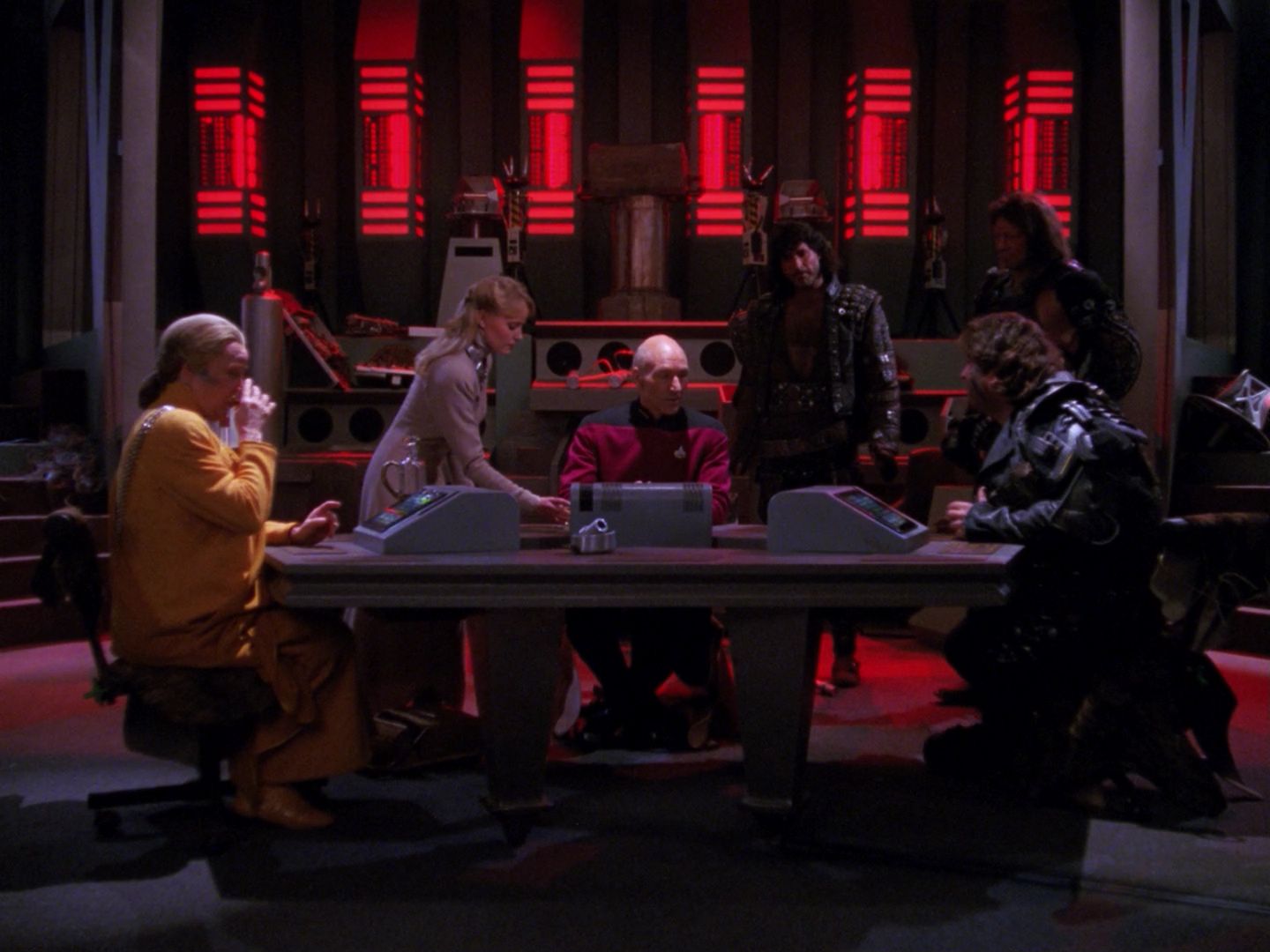
Though not an installment that has ever particularly stood out to me, this strikes me as a solid, watchable, and reasonably entertaining episode. It has some flaws, but it also has merits, and while it isn’t an especially riveting or remarkable episode, I find it more engaging than some (“The Survivors” comes to mind). It’s a pretty straightforward three-star offering, then, which features guest characters who are more competently drawn than those in many past episodes, yet not as interesting or memorable (nor, in one case especially, as convincingly portrayed) as those in better episodes; showcases Picard’s talents as a diplomat quite nicely (for the most part); and has the regular characters all behaving with admirable competence (prior to the bizarre climactic scene, anyway). Each of the parenthetical caveats in that last sentence alludes to one of what I see as the episode’s three most notable weaknesses, about which I’ll have more to say in due course.
For the most part, the story ideas present in this episode—negotiations with the goal of reconciling and reintegrating a renegade group into its parent society, the society’s history of violent clan feuds, the covert continuation of those feuds, and Riker’s involvement with the woman who turns out to be behind the latter—are serviceable, but hardly gripping. Given the Acamarians’ self-presentation as a formerly violent people who have gotten their shit together during the past century, it strikes me that some thematic heft might have been possible if the episode had drawn more explicit parallels between this society and humans/the Federation—exploring, maybe, the difficulties inherent in the project of successfully bringing together the people of an entire planet, and exposing some of the stitching, as it were, that has been put in place to mend its former seams. Aside from a token acknowledgement from Picard that Acamar’s history is not too different from much of Earth’s, however, the episode doesn’t really mine this potential well of relevance. In fact, although it’s not done in a heavy-handed or blatant way (far from it, in fact), the story positions Picard in a regrettably somewhat superior, aloof, and judgement-passing role—which is the first of the three flaws that I mentioned. Picard is his likable, rational, and diplomatic self throughout, but two moments in particular bug me a little. The first is when he semi-scolds Sovereign Marouk about how the Gatherers are “still your people” and how Acamar is still a “divided society” despite its progress. It’s not that I think he’s clearly wrong, exactly, but I do think that there’s more than one reasonable perspective on the matter, and the dialog fails to acknowledge this. I mean, consider the Vulcans; would anyone lecture them in a similar vein on account of the Romulans? Does anyone treat the Romulans as though they are essentially a “Vulcan problem”? Secondly, there is the scene in which the leader of the initial group of Gatherers, Brull, wants to consult with their main leader and then report back to the sovereign and Picard in twenty days, but Picard protests that he hopes to be “very far from here” by then. No doubt he does, but he is the driving force pushing two factions who have been apart for a century to reconcile and begin a new era together; he’s asking a lot of them, and this line conveys both an expectation of immediate results and an unwillingness to make any kind of significant commitment of his own time to the process. It’s only one line, but it’s a silly one—and one that lends weight to a criticism that one often hears about TNG as a series: that its episodic nature, with the Enterprise always on the move, prevents the characters and the show from engaging with any one situation long enough to see it through properly or to deal with fallout and consequences. For the most part, Picard plays the role of mediator skillfully in a way that I find satisfying to watch, but these couple of wrong steps by the episode put him in a rather less admirable light than I would prefer.
Turning to the guest characters, I find Marouk fairly convincing (and her somewhat self-important, long-suffering, and imperious demeanor mildly amusing) and Yuta genuinely affecting (and her flirtation with Riker engaging enough)—but both Gatherer leaders, Brull and Chorgan, are somewhat over-the-top caricatures. I wouldn’t go so far as to call either of them one-dimensional characters, but “two-dimensional” seems fair. Particularly bad is the scene between Brull and Wesley in Ten-Forward. Brull rather rudely descends upon Wesley, interrupts his studying, and behaves like a bit of a dick, then suddenly gets all defensive over his perception that Wes doesn’t “like” him; Wesley, provoked into speaking his mind, ignores Brull’s general condescension toward him and instead justifies his alleged dislike on the grounds that Brull is a “thief”; and Brull then launches way too readily into a big tirade about how justified his way of life really is. It’s just a really poorly written scene that is obviously trying way too hard, and it represents flaw number two.
By far the episode’s most egregious flaw, though, comes in its climactic scene, in which Riker kills (indeed, vaporizes) Yuta for no discernible reason at all. I have never understood why the writers chose to end this episode in this way. Okay, so she’s trying to murder Chorgan, and the stun setting doesn’t seem to be stopping her. Does the latter really mean that she’s totally unstoppable, short of using deadly force? Could she really not be overpowered, even by the combined efforts of everyone else in the room? (Riker doesn’t even bother trying to get in her way, for crying out loud!) Or, as another alternative, couldn’t she simply be beamed back to the Enterprise? Why must Riker very disturbingly phaser her to death while everyone else sits idly by and watches? And after he does so, why does everyone act as though he has behaved appropriately? I just can’t see any reason for what Riker does, either within the reality of the show or from the point of view of the writers; again, it’s just weirdly bad writing.
Up until that weird turn at the end, the episode is mostly competent and agreeable, but somewhat lacking in depth—hence the three-star rating. And even the inexplicable killing of Yuta, while I don’t like it at all, doesn’t kill the episode for me, since it’s more of a weird wrong turn than a flaw at the heart of the show; nothing else in the episode either depends upon or demands this ending, so it could easily have ended differently. It doesn’t, and that counts against it, but I still find the episode modestly entertaining, rather than blatantly sub-par, right up to the point when it goes astray. Thus, it’s still (albeit only somewhat marginally) a keeper for me.
Since the episode clearly means for us to assume that Riker had no other option, I think we the audience take it on faith that it is the case, even though this does not seem to be so, which is kind the only extent to which I’m willing to let that slide.
This is an excellent analysis of the episode that, as I read it, states clearly what I intutively feel about it and treats it fairly.