
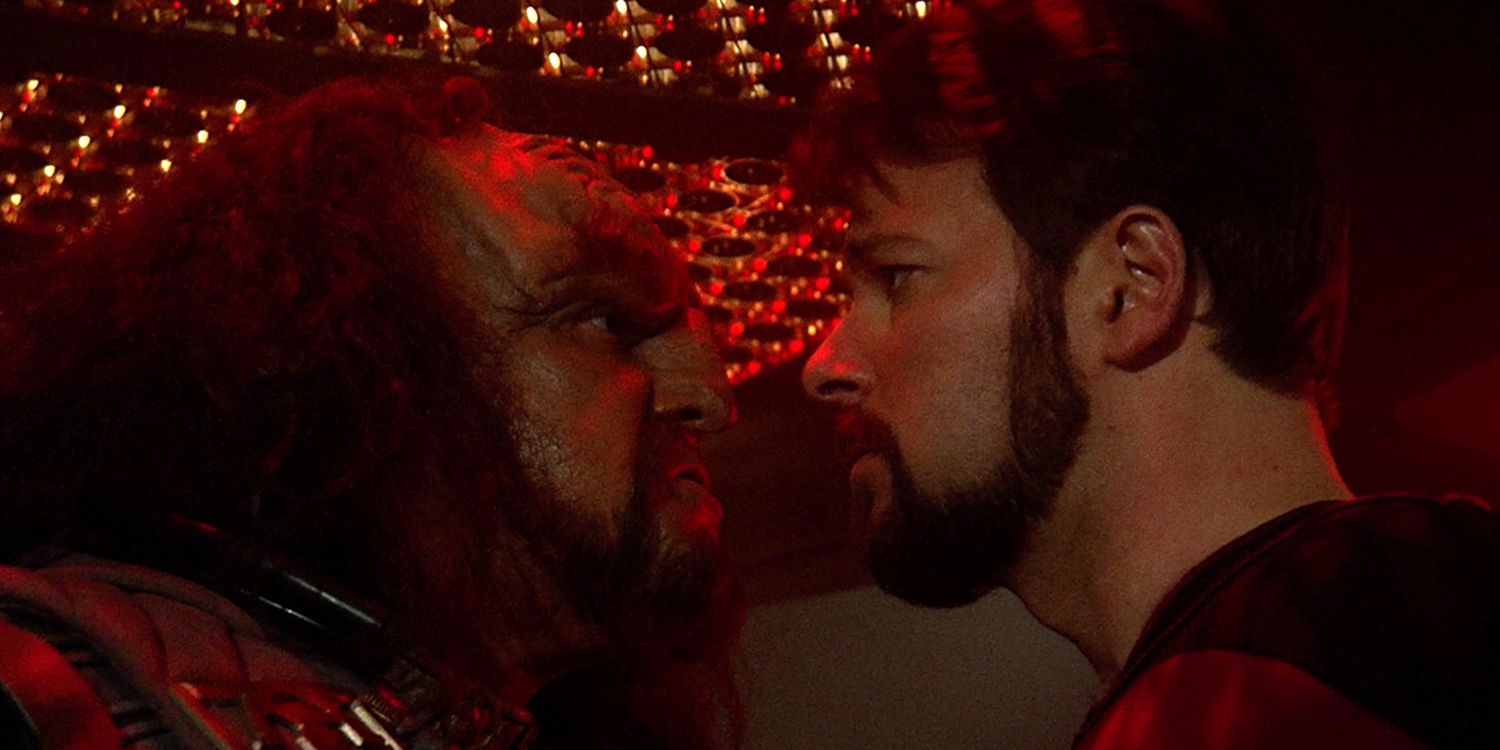
As my rating indicates, this is easily the best episode of the series thus far; it’s not perfect, but it just towers over the majority of what comes before it. Besides serving as a rather overdue exploration of the TNG-era Klingons, it’s also a great character piece with a plot that’s suspenseful, makes sense, and is brought to a satisfactory resolution. Kudos on all counts.
TNG was very slow to establish any specifics about the state of relations between the Federation and the Klingon Empire. Worf’s presence on the Enterprise implied that they were no longer enemies, but until the first season’s “Heart of Glory,” that was never made explicit. Even here, it remains unclear just what the history is, and how one chooses to fill in the gaps has implications for how one evaluates this episode. Specifically, how long have the two societies been at peace, and exactly how amicable are their relations? We’re explicitly told that they know very little about each other, which implies that things haven’t been friendly or peaceful for too long—but then again, Worf’s age suggests that it’s at least been a couple of decades. The irrational paranoia displayed by the Klingon captain is the main element of the episode that’s in question here; how plausible is it? Everything else about how the Klingons behave toward Riker I totally buy as just Klingon attitude, and I enjoy every minute of it. But their captain leaping to the conclusion that the Enterprise sabotaged his ship for no apparent reason, and deciding to perpetrate a sneak attack in response, seems questionable. The episode seems to want to say that the Klingons are at peace with the Federation, but are also still Klingons, and that there’s a persistent lack of trust. It may go too far with the captain’s behavior, and the episode would probably be better if (since the essentials of that behavior are required by the plot) a more plausible rationale or provocation could have been dreamed up. Even so, however, it’s very entertaining as is.
I will also note here that, when TNG first aired, a very young me was firmly of the opinion that it should have been the Romulans and not the Klingons who were now at peace with the Federation—partly because I’d always found the Romulans more interesting, and partly because it seemed more plausible to me, since the original series had portrayed the Romulans much more sympathetically than the Klingons. At this point, my perspective has been so molded by the TNG that was, and by its portrayal of the Klingons, that it’s hard to evaluate this long-ago opinion anymore. But I will say that episodes like this one make a decent case for my having been wrong. In a way, the Klingons make interesting allies of the Federation precisely because they’re so different. Indeed, they arguably make more interesting allies than adversaries—which probably wouldn’t have been true of the Romulans, who always made great adversaries. Even on the plausibility front, the Romulans are so much more cerebral and quasi-ideological in their antagonism to the Federation than the Klingons ever were, that it arguably would be much more difficult for them to overcome their enmity and not feel that they were losing face too much. It is, as Picard will one day remark, “always a game of chess” with the Romulans because they are cold, calculating, and implacable in the pursuit of their ends; for the Klingons, in contrast, war is essentially an end in itself, and who the enemy is doesn’t really matter all that much. As long as there was no humiliating defeat involved, being enemies with the Federation in one era and allies with them in another shouldn’t trouble the Klingons too much; it’s all just details to them, in a way. So, anyway, I guess my point here is that with this episode, TNG started developing its conception of the Klingons—who they are, how the Federation relates to them, etc.—and I appreciate a great deal about the choices made on these matters.
Getting down to some specifics, the “officer exchange program” is a great premise; it’s plausible and feels classically Trekish, but it isn’t something that had actually ever been done before. Unfortunately, though, the on-Enterprise subplot about the Benzite exchange officer, as executed, is iffy. Having such a subplot makes total sense; it allows the episode to explore the officer exchange premise from both sides, and it also provides for something to be happening back on the Enterprise, so that the story has a reason to go there and so that the main characters other than Riker have something to do. But the story needed work. For one thing, the premise is murky; who exactly are these Benzites? Are they members of the Federation, or not? The “exchange program” concept, and the fact that the character refers to how things are done differently on a “Benzite ship,” both seem to imply that they aren’t, but the character wears a Starfleet uniform (whereas Riker does not wear Klingon attire aboard the Pagh), and he also seems very familiar with the bridge stations of the Enterprise. Also, as the episode explicitly reminds us, a Benzite was previously seen as an aspiring Starfleet cadet. So what gives? Second, his difficulties with Enterprise protocol and whatnot don’t quite feel plausible to me, and there is also no resolution to the storyline; if, for example, he eventually made some suggestion or other through channels that genuinely benefitted the Enterprise, it would bring the “exchange program” idea full circle in the way that seemed called for.
The Riker-on-the-Klingon-ship side of the exchange program, however, is terrific; from his “because no one’s ever done it before” eagerness to tackle the challenge, to the fundamental brilliance of the idea as a vehicle for cultural engagement (both within the reality of the Trek world and also externally, as a storytelling device), it just plain works. The choice of Riker for the exchange, also, is perfect; it follows up on his interactions with Worf in “Where Silence Has Lease,” and probably no one else among the regulars could have pulled it off half as well (plus, of course, his rank is right for the story aboard the Klingon ship). Apart from the Bynars/Minuet episode, not much of note has really been done with the Riker character prior to this episode; here, though, he shines. As for the Klingons, I think the episode successfully portrays them (aside from the captain’s paranoia) as relatable and sympathetic despite being very different from humans and other Federation types. Admittedly, a few things about Klingon culture as depicted here do differ somewhat from what the series will later establish (in particular, the “a Klingon is his work, not his family” line rings false in light of later episodes)—but taken on its own terms, I have no real complaints. What we have here is a strong start to TNG’s portrayal of all things Klingon (“Heart of Glory” notwithstanding).
One of the perversities of TNG’s second season is the unevenness of its portrayal of Captain Picard. Whereas the rest of the main characters all pretty much “arrive” with the beginning of this season, the captain’s characterization varies from episode to episode throughout the season; sometimes he is still too much first season’s stodgy, officious guy, and other times he is his eventual, utterly likable self. This episode is a great example of the latter, and his scenes with Riker on the phaser range and in Ten-Forward are both fantastic. The interplay between the two of them as Picard pitches the officer exchange idea is a huge highlight; he’s playing a game, and Riker pegs it almost immediately, but he plays along, and they both clearly have a great time with it. Well-written and well-acted on all counts! This is how their relationship should always be! Also, the scene makes for a much better teaser than many other episodes have had. It doesn’t end on a lame “what the hell?” note like that of “Loud as a Whisper,” or clumsily flirt with breaking the fourth wall by bluntly announcing which character the episode is going to focus on like “Unnatural Selection,” or cheese things up by trying to manufacture a big dramatic hook out of nothing like many earlier episodes. Instead, it just skillfully introduces an intriguing premise (Riker participates in an exchange program and serves on a Klingon ship) via a great character scene, then cuts to the opening titles to let the audience savor the idea.
The basic plot of the episode is set up just enough to make it work, but not so heavy-handedly as to be obvious and predictable. When Riker and Worf discuss the Klingon practice of assassinating superior officers, it comes off as just buildup of tension and development of the “cultural differences” idea rather than acting as a flashing neon sign announcing what’s going to happen later in the episode. Likewise, when Worf gives Riker the transponder thingy, it’s not obvious how that’s going to come into play, since if Riker were merely to use it to escape from personal danger, he would seem cowardly, and the cultural exchange theme would not be well served. By the time he pulls it out of his boot near the climax, I’ve usually (when I’m watching the episode) more or less forgotten about it—and just as I’m about to yell at the screen for his apparent stupidity in pulling the thing out in plain view of the Klingon captain, I realize that the “mistake” is a calculated one on his part. Beaming the Klingon captain off the ship is an inspired idea, and the episode executes it well. Ultimately Riker manages to defuse a seemingly no-win situation without losing the respect he has earned from the other Klingons, and he even knows enough to allow the captain to beat him down in the end, so that he won’t lose the respect of his crew either. All in all, Riker comes out of the whole experience looking pretty darn great.
In short, then, this is a fun episode that brings the series to a level of quality that it has not previously attained, and shows what it’s actually capable of when it tries hard enough.