
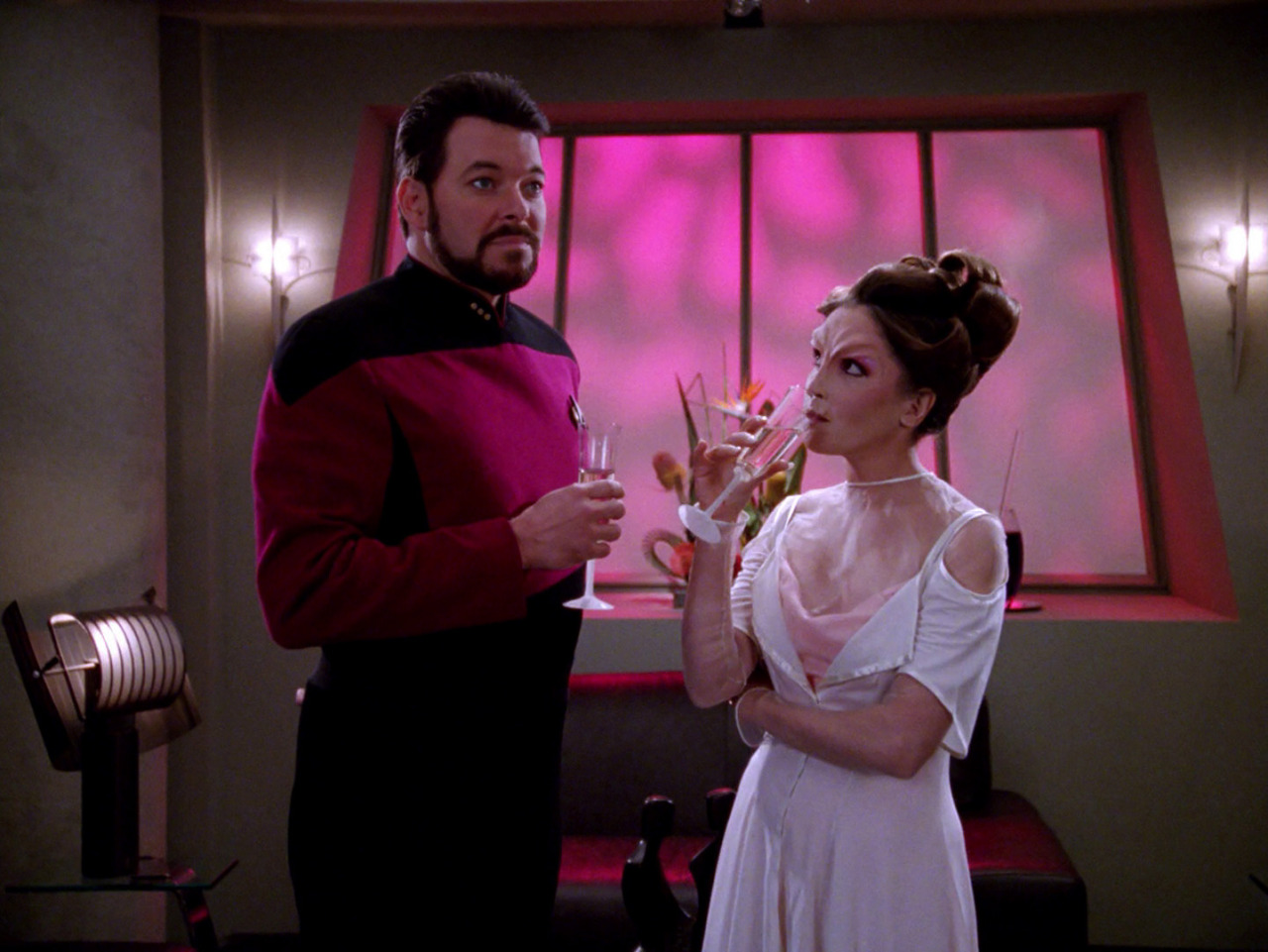
This represents a sort of archetypical three-star episode and is better than many others to which I’ve thus far given three-star ratings (often somewhat reluctantly or with misgivings). It’s a thoroughly competent episode that takes a reasonably interesting idea and plays it out, while handling all the characters skillfully. It starts with the basic idea that people will perceive, remember, and describe the same set of events differently due to their particular biases and perspectives, and that the line between outright dishonesty and more unconscious kinds of self-deception can be blurry—and it makes effective use of a science fiction element (the holodeck) to dramatize this concept. It also develops a mystery with enough depth and elements to be genuinely mysterious, but one that ultimately proves simple enough, and has enough clues laid in along the way, for its solution not to feel imposed out of nowhere. On the whole, in fact, there really aren’t many wrong notes at all. Still, the episode is hardly dazzling. No new ground is broken, nothing terribly insightful is revealed or developed about the characters, and nothing earth-shattering happens. It’s not the sort of episode that you cherish fondly as a classic—but neither is it as forgettable as some. It’s just TNG being TNG, and doing a pretty good job of it, at that.
Following a moderately entertaining opening character scene, the episode subtly foreshadows what is to come via the general demeanor of Geordi and (especially) Riker, creating a nicely understated sense of foreboding and discord. Then it hits the audience unexpectedly with the explosion of the research station, setting up the mystery. As the scenario develops, it’s satisfying to watch Riker contain his anxiety while Picard struggles to be objective, and gratifying that the inspector character’s demand for Riker to be turned over to his custody is not overplayed, nor is the character excessively one-note (both his demand and Picard’s resistance to it are rational, and when Picard shows him a willingness to cooperate short of handing Riker over, he relents). The heart of the episode, of course, is the series of re-playings of events from various perspectives via the holodeck, and that part works nicely; each version is different enough from the last to keep things interesting while being similar enough that most of it seems plausibly like different people’s perspectives on the same events, and it’s fun to pay attention to the little details via which each teller of the tale reveals his or her ego, interests, and identity. Meanwhile, the investigation being carried out by Data, Geordi, and Wesley keeps us guessing about what’s really going on. Indeed, it’s a big point in the episode’s favor that the eventual reconstruction of what happened actually does draw on both the testimony in the holodeck and the findings of Geordi & company.
It is a bit hard to swallow that Dr. Apgar’s wife (Manua) genuinely remembers Riker trying to force himself on her, given that we’re (presumably) supposed to infer that he didn’t really do so. Pretty much all the other differences between their respective recountings of events can, to my mind, be reconciled by imagining that the truth lies somewhere in the middle, and that each of them is just emphasizing different aspects and presenting what they see as the “essential truth” in the way most flattering to themselves, but it’s iffier in this particular instance. Indeed, a review of this episode at Trekkie Feminist criticizes it for sending the message that even if a woman is being honest in accusing a man of rape, the accusation might still be false. (The reviewer also points out that the episode drops the sexual assault issue entirely once Riker has been absolved of the murder). Unless you’re very careful about what message you’re trying to convey, perhaps choosing to depict a woman as making a false rape accusation in your story is just something best avoided. What the episode is trying to do, I think, is to underline its point about how biased and fallible memory can be, while still permitting the audience to assume that RIker is innocent—a bit of a “have your cake and eat it, too” move, really. Still, the handling of all of this comes across (at least to me) more as unsophisticated and a bit unskillful than as malicious or blatantly clueless, so I am inclined to see it as a non-fatal misstep.
The plot twist of the holodeck creating “krieger waves” out of the energy from the generator on the planet is definitely a stretch as well. Geordi tries valiantly to rationalize that the holodeck hasn’t created anything dangerous, and it’s pretty clever, but it doesn’t really hold up. After all, in the right context, anything could qualify as “something dangerous”; it’s not as if everything that exists can be classified as either “inherently dangerous” or “not dangerous.” Thus, for the idea that the holodeck has “safety controls” to actually mean anything, it would have to mean that “ordinary” holodeck-simulated things can’t cause harm to anything real. If you take a holodeck-simulated stick and try to whack someone over the head with it, you shouldn’t be able to hurt them, just like holodeck-simulated guns don’t really kill you if you get shot with them. By the same token, holodeck-simulated elaborate systems of mirrors and coils shouldn’t be able to alter harmless energy discharges in ways that make them dangerous. Still, it is, as I said, clever—and with some tweaks of the dialogue, it probably could have been rationalized better. So this, too, is more of a quibble than a major problem with the episode.
In short, this is pretty much a straightforwardly entertaining and clever, good-but-not-spectacular, episode of TNG.
I just want to add that the idea that the holodeck can create a machine that functions perfectly well is another one of those Trek technologies that should totally change everything about the way that society works, but somehow doesn’t.
Also, Mark Margolis (AKA Hector Salamanca) is the actor who played Nel Apgar here. Wild.