
The thing about TNG’s third season is that by this point, the writers had figured out the show and its characters, and mastered the basics of telling a story, well enough that even the episodes built around half-baked concepts without much to recommend them usually manage to hold up as coherent and reasonably entertaining hours. “Allegiance” is a prime example. What we have here is yet another iteration of the old “aliens who want to study humanity” trope (see both “The Child” and “Where Silence Has Lease,” as well as, arguably, “Encounter at Farpoint”), and one whose plot, frankly, is full of holes and not even especially well-constructed. Nor, for that matter, does it really have anything to say about its putative thematic topic of leadership. And yet, despite all of that, it’s a better episode than any of the others that I just named (which are all from earlier seasons). Indeed, if I expand the scope of this comparison to encompass all the episodes that I have thus far slotted into my TNG story typology under the “Encounter with a Weird Alien” heading (which still has one of the worst track records of the eight types for producing quality episodes), it’s notable that the only entries in this category that have merited even three stars, so far, have all been this season. The concept of this episode doesn’t really work for me—but the characters are themselves and remain fun to watch, it’s never boring or horribly cheesy or otherwise actively bad, and there are some entertaining moments along the way.
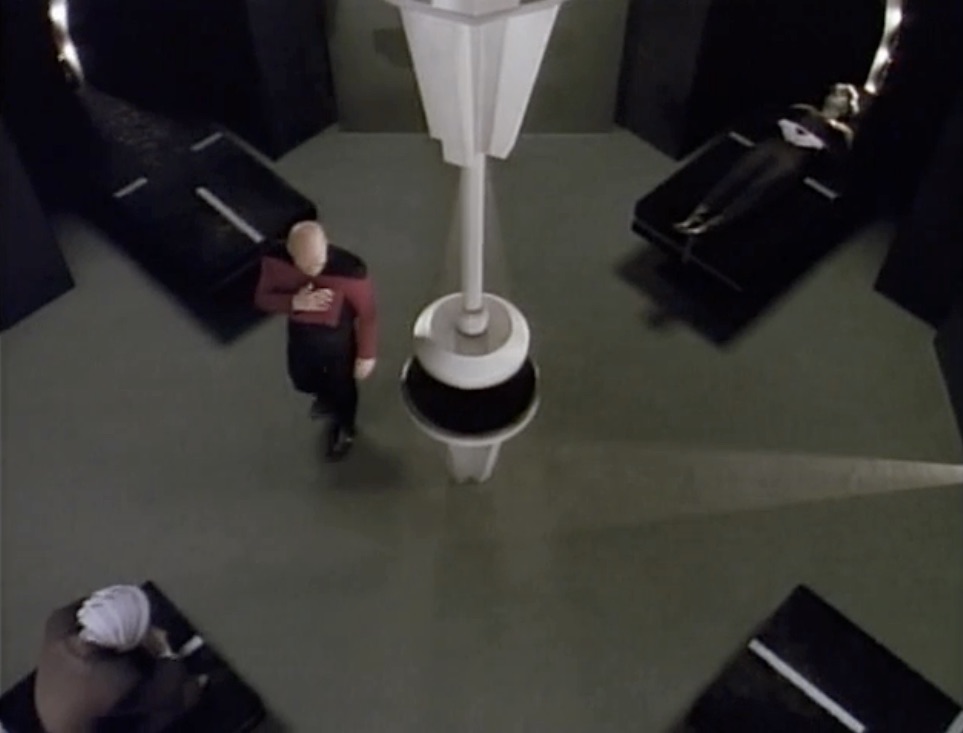
The unnamed aliens behind this episode’s shenanigans, oddly, have technology capable of replicating brains accurately enough to create replicas of real people that are convincing even to those who know them well, yet have to resort to abducting people and manipulating them to learn what makes them tick. Also, for beings who don’t understand the concept of authority, their replica of Picard seems perfectly capable of exercising it. So, the basic premise of the episode really doesn’t stand up to much scrutiny at all. On top of that, the way events unfold in the abductees’ portion of the story is somewhat lacking in both structure and substance. The characters bicker for a while, Picard tries to draw them into reasoning about their predicament for a while, they try and fail to escape—all in scenes that could mostly be rearranged chronologically without much impact to the flow of the story. Picard’s unmasking of the “cadet” as an imposter is well and good (although, why would a plague that the Enterprise just finished helping to eradicate be so top secret, exactly?), but after figuring it out, he continues trying to reason with the others or get the cell door open for a while before arbitrarily deciding that the time has come to out her. Likewise, the setup of four people who are each predisposed to respond differently to authority being trapped together is…fine, but only if you’re going to do something interesting with it. Do the interactions among the four elicit any particular insights about the nature of leadership? I don’t see that they do. In short, the story suffers from a deplorable paucity of ideas.
The shipboard side of things, however, at least exhibits logical narrative progression and is reasonably entertaining, even if it, too, doesn’t particularly add up to much in the end. This is the second time that the show has done “Captain Picard behaves erratically, forcing Riker and the other officers to consider relieving him of command”—and, yes, being superior to the first season’s “Lonely Among Us” is clearing a very low bar, but the concept is executed in a believable and satisfying way this time. Also, scenes in which the fake captain pushes up against (but doesn’t entirely overstep) the boundaries of normal behavior for our Picard—such as his intimate dinner with Beverly—are not without their charm…and, sure, the scene of him leading the troops in a drinking song is amusing. (Although I’m not clear what to make of the preceding “ales for everyone!” moment. It’s not as though one pays for one’s drinks in Ten-Forward, right?) The slight attempts at humor at the real captain’s expense at the very end of the episode, on the other hand, don’t really work, but at least they aren’t painfully cheesy and lame—more just “yes, yes, ha ha.”
Ehh. I’ve said a lot more negative things than positive, but it’s still a watchable and moderately entertaining episode, and three stars seems entirely apt.
(A small aside: In the scene where fake Picard drops in on the poker game, he apologizes for interrupting, and Data assures him “You are always welcome, captain.” Over four years later, in the series finale, Troi will say almost these exact same words to the real captain when he finally does join the poker game. Just a cool little detail that has always tickled me.)