
This is another difficult episode for me to rate; it’s really on the line for me between two and three stars. I first went with three, then later downgraded it to two out of an inability to fully justify the higher rating to myself, and threw in a comment saying that it’s an episode that I really want to like (or maybe, rather, one that I’m a little embarrassed by how much I like), but that I was just not quite comfortable enough with it to fully accept it into my personal Trek canon. Subsequently, after reading another fan’s thoughts, I gained a deeper perspective on it and decided to revert to my original three-star rating after all. It’s still kind of a borderline case, but this is where I have ultimately landed (for now, anyway!).
To be sure, I have little patience for the plot of the episode, concerning the Enterprise falling prey to an ancient booby trap. For one thing, the trope of encountering a ship on which something has gone wrong, only to have the same something quickly start going wrong on the Enterprise, has already gotten old at this point in the series. It comes across as a little too inevitable, and it’s also a little too convenient that every time something like this happens, our heroes manage to escape with their lives where the previous ship’s crew evidently failed. It helps, in this case, that the previous ship is an ancient one whose crew had a different mindset and tool set than what our heroes have to work with, but by the same token, the whole premise of falling into an “ancient booby trap” created by a civilization whose technological level is established to have been much lower than that of the Federation seems a bit pathetic. Additionally, the whole force/counterforce/delay time analysis of the trap is uncomfortably reminiscent of the first season’s “The Last Outpost” (except that this time, Geordi seems unable to figure it out on his own!), and much of what Geordi does to try to combat the booby trap is too made-up-tech-ish to be anticipatable, fully understandable, or even very interesting (though see below for more on this subject). Finally, the episode also features TNG’s recurring silly idea that one can precisely calculate, down to the minute, how long everyone on the ship can withstand exposure to dangerous radiation before it becomes lethal—with there apparently being no consequences at all associated with any amount of exposure short of that threshold. Most of these complaints are not, individually, so serious as to condemn the story, but taken together, they add up to a plot that drags the episode down rather than working in its favor.
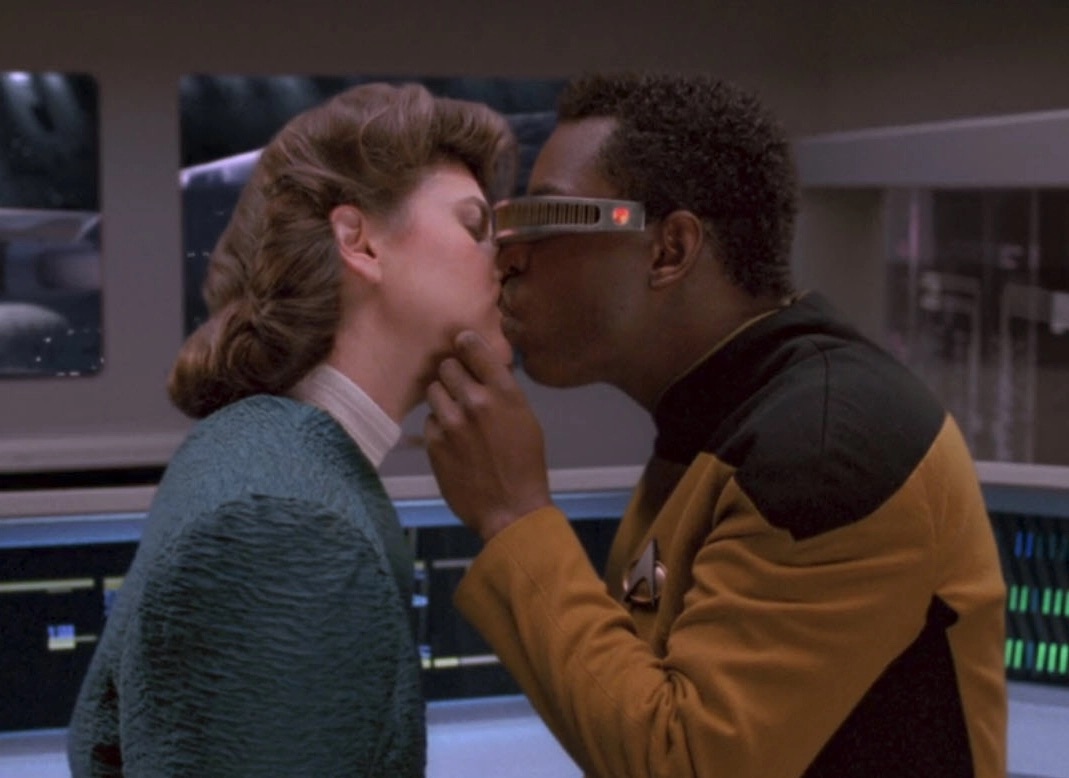
Plot aside, though, it’s pretty clear that the episode’s raison d’etre revolves around maneuvering Geordi into the situation of working one-on-one with a holodeck simulation of Leah Brahms. This was a worthwhile idea, and its deployment as part of a story exploring the socially awkward side of Geordi’s personality (i.e., his romantic insecurities) is handled reasonably well. However, the process of maneuvering him into this scenario strains credulity pretty thin. For one thing, the episode gives one the impression that the Enterprise‘s engineering department consists, pretty much, of just Geordi himself; for another, the moment when the computer first creates the holographic version of Leah Brahms is awfully contrived. Also, I question both the idea of Geordi having access to computer data about her personality, and the idea that, in the middle of trying to solve life-or-death engineering problems, he would really indulge himself by asking the computer to draw on said data to add personality to the simulation. Then, too, there is an undeniable cheese factor to the Geordi story—though I’m inclined to be pretty indulgent of said cheesiness in this case. The story is basically about a tech geek who has no luck with women, forging a successful relationship with a computer-simulated woman who is also a tech geek. It’s hard not to see this as a playful acknowledgement, by the show, of the stereotypes associated with Star Trek and its fan base. In other words, Geordi functions as a stand-in for all of us socially awkward Trek nerds who grew up watching this show. If it’s a little cheesy, it is so in what strikes me as a conscious and somewhat metafictional sort of way; the episode sort of embraces its own cheesiness, and its wink at Trek-nerddom appeals to me enough to induce me to embrace it as well. That said, lines like (I’m paraphrasing here) “every time you touch the engines, it’s me” still go a bit far for my tastes. Still, it is fun to watch Geordi interacting with Leah, and you do (or at least, I do) feel for him.
That about covers the substance of my own thoughts on “Booby Trap.” But my favorite commenter at Jammer’s Reviews, William B, offers an interpretation that goes a bit deeper than my thoughts did on their own, and I think it merits consideration. His take on the episode’s “technobabble plot” is to argue that “at their best in TNG . . . tech plots are about human relationship with technology and what this entails.” Here, Geordi spends the episode “in the holodeck with ‘Dr. Leah Brahms,’ because it’s easier to talk to a computer simulation of a person than the real thing”—but his “reliance on an artificial woman as his date/sounding board” yields, in regard to the booby trap (whose very nature is to turn its prey’s technology against them), only the idea of turning control entirely over to the technology. Thus, after acknowledging that he usually sees technology as the answer to everything, Geordi ultimately has to “step away from his reliance on technology to get the inspiration to shoot the engines once and coast, relying on the navigator.” And, consistently with this, he also ultimately shuts off the simulated Leah and “goes back to real life with real people (though without much dating luck, still).” Meanwhile, there is Picard, who “is not reliant on technology in quite the way Geordi is, but [is] fascinated by technical achievement . . . to the point where the crew can’t help but recognize [his] geeking out” over the discovery of the ancient ship. He gets the Enterprise into its predicament in the first place by letting that enthusiasm overwhelm caution and restraint, and then eventually gets it out by serving as the manual navigator required by Geordi’s shut-off-the-tech solution. “But notably,” this insightful commentator adds,
Picard’s flying the ship out is not actually a denial of technology, but a different relationship with it: Picard is still using tech . . . but he’s using his own experience with thrusters and with flying through gravitational fields. If the episode is about the danger of overreliance on and overinvestment in technology, the solution is not to throw technology away but to make sure that one is able to control it and wield it properly.
William B (9th comment beneath the review linked to above)
This strikes me as a very insightful analysis—one that, I’m now fairly convinced, captures a level of the writers’ intent here that never registered with me before. I had previously been quite critical of the hand-wringing near the end of this episode over the allegedly disconcerting idea of turning control over to the computer. In truth, I still don’t buy it; it seems to me, after all, that computer control on this level is pretty routine in Trek’s twenty-fourth century in general, and on a starship in particular. Plus, the episode’s attempt to sell the notion that the ship’s computer can make super-fast adjustments on a level that not even Data can match (?!) makes no sense at all. Still, now that I see more clearly what the idea behind it probably was, and how skillfully the entire story was structured as an illustration of that idea, I am starting to see the implausibility more as a bit of rough execution than as a sign of the writers’ desperation to inject some tension into an otherwise all-too-routine “technobabble plot.” Thus, while I still have qualms about the plot of the episode, I find myself more able than I previously was to justify the three-star rating that my gut kind of wanted to award this episode all along.
Finally, it’s worth noting that the early part of the episode—featuring Picard’s enthusiasm over the old ship, his insistence on beaming over and Riker’s inevitable reluctance about it (a dynamic whose handling is satisfactory to me this time), and the playful back-and-forth about ships in bottles—is good fun. I could quibble that the characters’ fascination with the old ship might ring a bit truer if the parts of said ship that they explore actually looked noticeably different from ships with which they are familiar (to my eyes, for instance, its bridge looks pretty clearly like another redress of the same movie-era Enterprise bridge set generally seen in episodes that feature older Starfleet vessels), but this is a minor point. Also, I appreciate the way the episode opens on an off-bridge character scene that indirectly introduces some of the exposition about the ancient battle site that the ship is checking out, rather than with the same old boring captain’s log directly telling the audience what the ship is up to this week. This is the sort of thing that the show is really getting much better at this season.
One of the weird (actually nonsensical) things about Data is that he operates the computers in the same way that humans do, by pushing buttons and such, when he should by all rights be able to just plug himself into it and control the ship directly. That he cannot, or chooses not to do so, is one of (many) strange things about the way AI is depicted in Trek. But if you assume that this is a reasonable thing for him to (not) be doing, it might make sense that the computer can navigate faster than he can, since it doesn’t have to interface with the controls in the same way that he does.
I agree with all your comments, though I naturally like this episode quite a bit compared to other three star episodes. To me, this is unreservedly in three territory, partly due to structural coherence, but also due to that subjective quality of just being interesting… or maybe, more than that, just because I really like Geordi’s development here.
I thought of that (about Data and the limitation of interfacing with the computer like a human). Theoretically, though, his brain should also be a faster processor than the ship’s computer, which would perhaps balance things out (?). (People generally appear impressed when Data mentions how many bazillion calculations per second he’s capable of, so I presume that it’s significantly better than “standard” computer technology of the time.)
I’m with you on a gut reaction level regarding this episode; I like it, and always have. But I also find enough faults with it that, as I discussed, I had a hard time justifying three stars at first, even though that was the rating I WANTED to give it. (Maybe this is the flip side of your comment that only nostalgia could justify my giving “Who Watches the Watchers” five stars? 🙂 )
Perhaps so, and maybe I’m not thinking about your rating system in quite the same way. I tend to think of a five star episode as being a particularly difficult thing to accomplish, transcending in some sense the limitations of their context, with only a small fraction of episodes meeting this bar—whereas a three star episode can be earned by adhering to certain narrative principles or being, for lack of a more eloquent phrase, decent, but entirely “of” their context. For a show that isn’t shitty, as we will grant TNG to be for the purposes of these reviews, a three star episode should be where *most* of the episodes fall unless they seem somewhat inept (two stars), utterly incompetent (one star), remarkably effective given the constraints of 90s episodic network TV (four stars), or rare, standout examples of captivating viewing transcending the source material (five stars). I think that’s my standard for a five star, anyway.
Rereading what you wrote here, I would say some your criticism is *slightly* more harsh than the way I would level it. Faulting the episode for the “our heroes manage to escape with their lives where the previous ship’s crew evidently failed” is fair, but also a hard bar to rise above for episodic TV with TNG’s formula of weekly sci fi jeopardy. To be sure, it is a trope, and perhaps a predictable one even given the standards of previous TNG seasons, but I don’t find it particularly objectionable—obviously we know something is going to go wrong, but I find it moderately entertaining to watch unfold. I’m not sure I find it hard to swallow that an old tech could cause difficulty for a modern vessel, though we are just sort of expected to take that on faith. Then again, it’s certainly true that “what Geordi does to try to combat the booby trap is too made-up-tech-ish to be anticipatable, fully understandable, or even very interesting,” which is actually a pretty damning flaw, I’ve got to agree. In the end, I’m just coasting on enjoying Levar Burton’s acting and Geordi’s likability, which also gets me through the cheese (except some of the stuff at the end, like you cite).
Two? Three? It’s all pretty subjective, and none of this is a hill I’m willing to die on.
I guess I would say that “transcending the limitations of their context” is a higher bar than I personally would expect even a five-star episode to reach. Honestly, I’m not even 100% sure what you mean by it/what it would look like. For me, 5-star episodes are the ones that wow me, are especially thought-provoking or intriguing or make me feel something more intensely than most; the really memorable, enduring, standout episodes that most thoroughly and effectively were and did what I want[ed] Trek in general to be and do. They can still have flaws; they just have to be good enough to motivate me to forgive their flaws.