
“Cause and Effect” is an undeniable TNG classic. It’s always been one of the first episodes that come to mind when I reminisce in a general way about TNG in its prime. I’m immensely fond of it, and so, as far as I’m aware, are most other fans. But it’s hard, when it comes down to it, to put one’s finger on what exactly is so great about it. I mean, it’s certainly not an episode with much depth to it. It’s not a particularly character-focused story, nor does it really engage with any “big ideas,” or have anything important to say about life or the human condition or anything like that. It’s just…incredibly fun! It takes an irresistible, offbeat sci-fi premise and runs with it, and the execution is absolutely top-notch. A penchant for wacky, high-concept sci-fi premises would emerge, from this point forward, as writer Brannon Braga’s signature style (sometimes for good, other times for ill), and “Cause and Effect” is the ultimate Braga episode and one of my favorite high-concept, weird-spatial-anomaly episodes.
The episode has the audacity to open in the midst of a catastrophe that leads, in short order, to the total destruction of the ship, then cut straight to the intro/credits sequence (!)…only to then commence act one with the Enterprise gliding gracefully through space as though nothing had happened. How could anyone fail to be intrigued? We are then treated to various shipboard scenes, leading up to an encounter with a space-time anomaly, from which a crisis materializes, and suddenly we’re right back where we started, and the ship blows up again. But following the act break, everything has once again reset itself and we start all over! There’s something about the repetitive structure (with no in-story explanation offered until we get several iterations in) that just really works. Part of it, obviously, comes from the small variations from one iteration to the next, so that in one sense you always know what’s coming, but you also kind of don’t, and the fun is in watching for what things happen differently each time, and why, and where the differences might lead. Theme and variation. Plus, of course, the sense of foreboding that comes from knowing that a total disaster is lying in wait just ahead, and watching the characters go about their business, unaware, and therefore heading inevitably toward the same outcome each time. It’s classic dramatic irony, I suppose. There’s the spooky running motif wherein Crusher knocks over the wine glass each time, even when her sense of déjà vu prompts her to purposely set it down somewhere else (and even better, the time when we experience the scene from engineering while she speaks over the comm to Geordi, and we merely hear the glass breaking without seeing it and know exactly what has happened). There’s the delicious way that Picard says “Back us off, ensign, nice and slow” during the final loop, when his awareness that he has probably said the same thing in each previous loop (to no avail) makes him self-conscious and unsure of himself, so that he almost sounds like he’s reciting a rehearsed line. Or that high camera angle as we join the final iteration of the observation lounge scene “already in progress,” which distances us from the characters’ experience of the moment and positions us as a fly on the (ceiling?), watching omnisciently as foreordained events play out yet again (a classic bit of Jonathan Frakes directing).
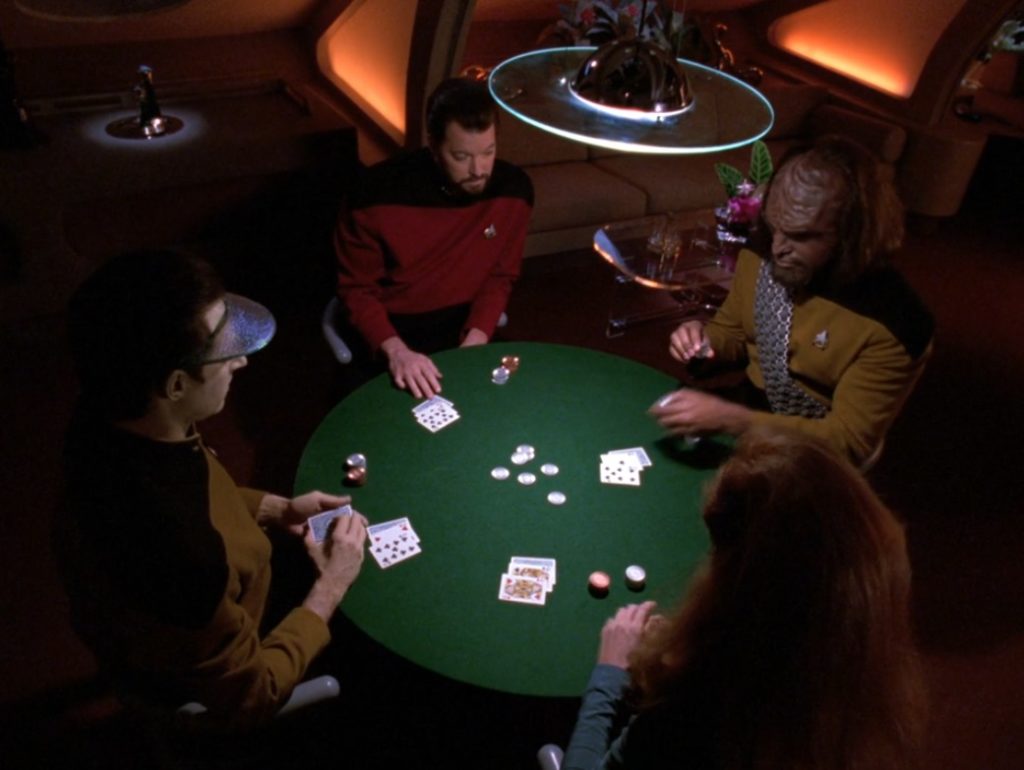
As I said, this is by no means a character piece. It uses Dr. Crusher as a kind of primary point-of view character, but it’s not “her” story in any meaningful way; we just experience the mystery of what’s going on primarily through her. But while I’ve said this in connection with other episodes, this one really doubles down on the fact that watching the characters work a problem until they manage to find a solution is a huge part of the enduring charm of TNG as a show. In that respect, the centerpiece of the episode is the classic observation lounge conference scene in which Geordi lays out what he thinks is going on. (“This is gonna sound pretty wild,” he says, before launching into the explanation about the time loop. That line has always stuck in my head.) He’s pieced together the clues, he lays out the wacky sci-fi scenario that they find themselves in, and then they all fall to calmly discussing what to do about it. You gotta love it. Then Data lays out the evidence that the whole thing was triggered by a disaster that led to their grisly deaths, and they contemplate how to avoid repeating that fate, and they even hatch a plan to send a message to themselves in the next loop in case they fail to avoid it this time! It’s just….so TNG. And despite not being a “character episode” as such, all the characters are delightfully themselves throughout. In that sense, the standout scene is the poker game that we see play out four different times over the course of the episode. Riker attempts a ballsy bluff, just because. Data emulates slangy human-speak in an unintentionally comical way and is somewhat socially oblivious. Worf scowls and mutters a lot, but also plays along with Riker’s joke about suspecting that Data is cheating. He also folds (because he takes the game too seriously to be able to accept a big loss, and because—let’s face it—he can be kind of a quitter), yet he still advises Crusher to call Riker’s bluff (“he does not have a straight”). And Crusher plays a hunch and calls the said bluff with a satisfied little grin, giving the impression that she doesn’t have much invested in whether she wins or loses, but that she does relish the chance to potentially deny the cocky commander the victory that he is trying to claim despite not having the cards. It’s all just delightfully fun.
The nitpicker in me has always balked a little at the idea that events a time loop would leave “echoes” that could be detected during “subsequent” loops (“subsequent” should have no meaning in this context!), and even if I choose to just accept the technobabble rationalization about “dekyons,” the idea that people would increasingly experience déjà vu—to say nothing of audible voices from prior loops somehow carrying over and cropping up at random moments—is pretty silly. But, whatever. This is 100% a case where I’m willing to overlook concerns of this sort because the episode is just so enjoyable.
Prior to this episode, season five had been dragging pretty badly. The first third or so of the season (up thru “Unification”) holds up reasonably well, with three episodes in the four- or five-star range plus several of what I would call relatively strong-for-three-stars offerings, but the middle third is decidedly lackluster (containing three one- or two-star episodes, as well as a couple of “weak threes”), and it really takes a nosedive with the two episodes immediately preceding this one. But “Cause and Effect” marks a big turning point! There are still a couple of clunkers to come, but the final third of this season is dominated by an unprecedented run of extremely strong episodes, of which this is the first (but by no means the best!). Part of the explanation for this, seemingly, has to do with a late-season writing staff retreat during which the ideas for several excellent episodes (and also a couple of terrible ones, but…whatever) were generated. But in any case, I’m excited to have arrived, in my re-watch and review-writing, at this memorable streak of classic episodes!
You’ve really been at this a while. I can’t believe you’re well into season five! There was a time I imagined you were only going to review the first and second seasons.
With episodes like this, I’d say, TNG helped define the high concept television sci fi… it’s hard to do well, but this does it about as well as you can. Just a pleasure to watch.