
I ended up deciding to start things out by joining a ranger-led hike going just a little ways down into the canyon on this first morning. The information said to meet the ranger at 7:00 am at the South Kaibab Trailhead to start this hike. But in order to do this, the first thing that I had to puzzle out was—what time was it? Useful factoid that I didn’t yet know as of this point: apparently, most of Arizona does not observe Daylight Savings Time. I had actually noticed, while checking in at the campground upon arrival the previous afternoon, that the clock there showed the time to be an hour earlier than what I thought was accurate—but between waiting for the employee to get off the phone, and then attending to the details of checking in (including conversation about the campfire ban), I forgot to ask about it, and afterwards, if I remembered it at all, I just wrote it off as a fluke. But then, while getting ready for bed, I’d noticed that my cell phone was showing the time to be an hour earlier than what my watch (which I’d duly set to Mountain Time) indicated. Huh. Still unsure what to trust, and not wanting to be late in the morning and end up missing the ranger hike, I decided to just go with “watch time” to be on the safe side. I’d planned to get up at 5:30, so get up I did—but of course, as it turned out, this was actually 4:30 (and when I thought I was going to bed at 10:30 or so, it’d actually been 9:30). I soon realized that I was, indeed, an hour ahead—but, I figured, better to be an hour early than an hour late! And in the end, it was a good thing, because between wondering about the time, making sure I had everything I thought I’d need for the hike, figuring out how to get to the trailhead, and futzing with my phone (wifi is (sort of) available at the visitor centers and the store, so I was doing some checking in, but my phone was meanwhile running out of juice from having been on all night unplugged to serve as my alarm clock)…anyway, between all those concerns, I somehow forgot to eat breakfast! 🙂 I was already on a shuttle bus to the trailhead when I suddenly realized “I haven’t eating anything!” So, since I had plenty of time, instead of getting off at the trailhead, I rode the bus back to where I’d gotten on, went back to my car, and dug out breakfast food. Yes: I’m a moron.
Food eaten, I got back to the trailhead in plenty of time, and off I went down into the canyon with a ranger-led group. This hike was to go 1.5 miles down the trail into the canyon (so 3 miles round trip). This, of course, meant going only a tiny fraction of the way down in—but as the rangers and signs all say out here, the thing to remember is that going down is optional, but going up is mandatory. Anyway, the hike down was very awesome! Even though, for the sake of an inside joke with a handful of friends who likely won’t even read this, I feel obliged to report that the canyon is, in fact, “a fake,” it seemed pretty darn real as I hiked the steep trail down into it, and learned about the different rock layers, how the canyon was formed, and the diverse plant life that lives there (against all intuition, the canyon is apparently home to a more diverse range of plant life than can be found in any other national park!). (The ranger leading my hike was a self-described “plant NERD” who would, I suspect, fit in well with my faculty back at work in the Dept of Horticulture.) But getting back to rock layers, I would be remiss not to mention that the top one is “kaibab limestone.” It isn’t remotely green, oddly, but then, I’ve known for a long time that Limestone usually occurs dyed in nature. 🙂
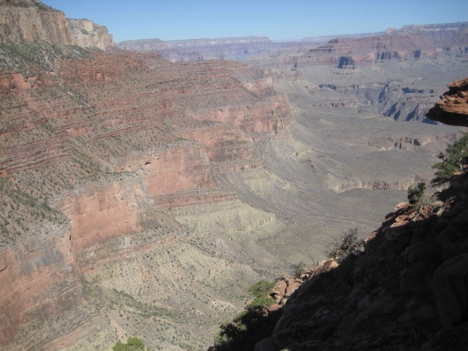
I took a bunch of pictures. Unfortunately, none of them really capture, very effectively, what it looked and felt like to be hiking into the canyon. Nevertheless, here are some of them:
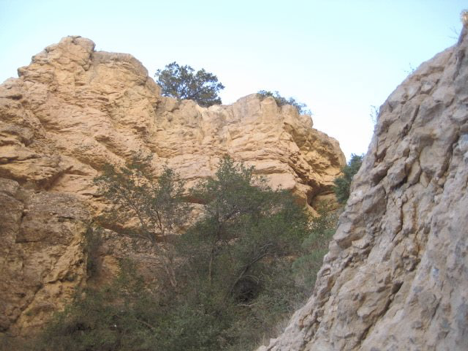
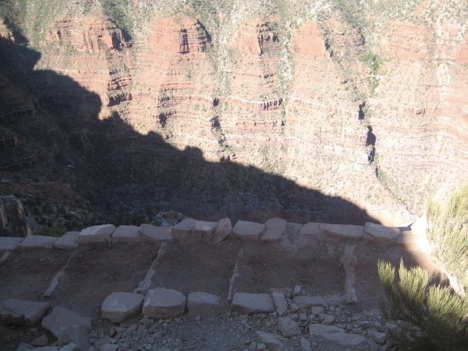
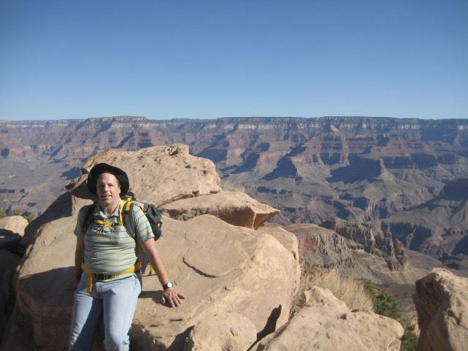
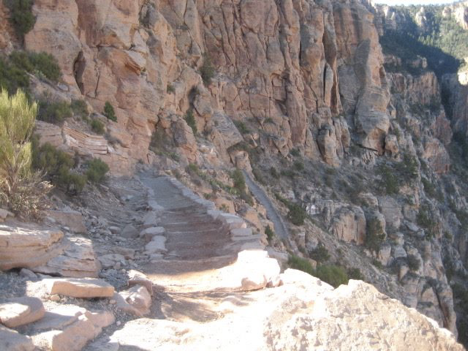
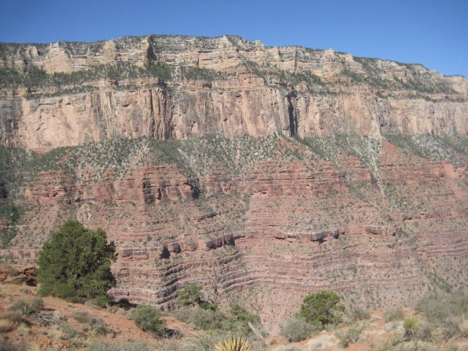
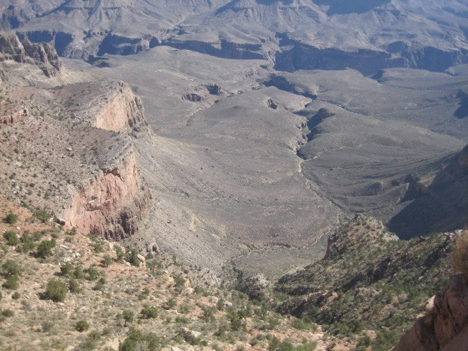
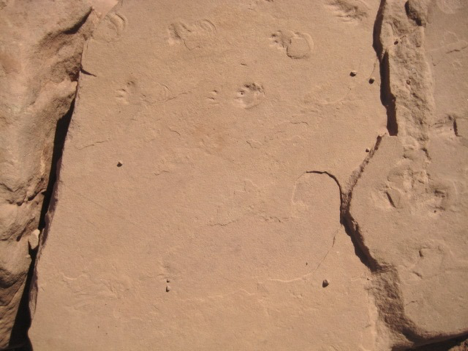
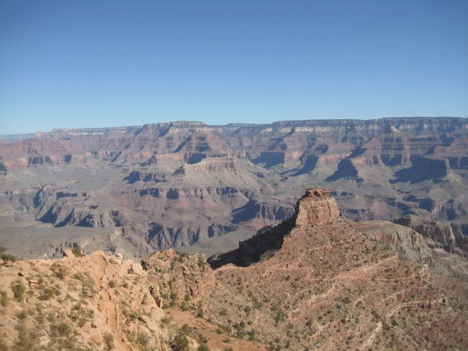
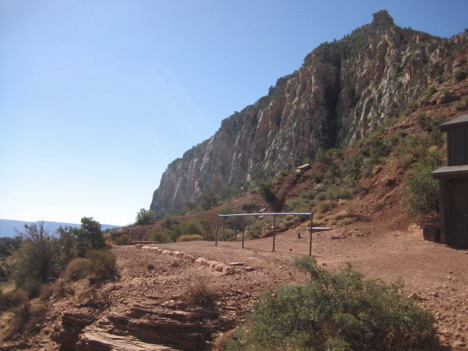
We arrived at the turn-around point of the hike (“Cedar Ridge”), which is a flat area equipped with “restrooms” (outhouses, essentially, albeit quite well-maintained ones). Yes, there are actually “facilities” at certain points along the various trails down into the canyon!
The ranger program actually ended here; the ranger hung out for a while, and one could make the hike back up with her if one wanted, but she wouldn’t be doing any more explaining about the canyon’s features & etc. So I actually headed back up on my own before she did. Oof. Yeah, about two switchbacks and I was panting with exhaustion! I took it slow, rested when I needed to, and was glad that I’d saved almost all my water for the return hike. Before long, my legs felt three times their usual weight. It was hot. But, you know what? I was okay with all this. I mean, it was extremely difficult—but I didn’t feel like I was going to die, or anything. And at no point did I lose my enthusiasm for additional hiking into the canyon. So, I felt pretty good about that!
Once I reached the rim (whew!), I rode the bus back to my car and then headed back to my campsite for an early lunch (the ranger hike had been timed with the aim of having the group up and out of the canyon by 10:00).
All this while, the main question preoccupying me was: How far can I go with hiking into the canyon during this trip? Because, here’s the thing: I would looooooove to attempt a hike all the way to the Colorado River at the very bottom. But this would pretty much mean taking two days, and spending the night at a back-country campsite down in the canyon. Hiking to the river and back in a day is dangerous and strongly discouraged; it’s extremely strenuous, and it’s very hot and dry (especially in the “inner canyon desert”), and many who have attempted it have gotten heat exhaustion and even died. But back-country camping is also a “hardcore hiker” threshold that I’ve yet to cross. In the past, my big thing has been that I’m really fond of hiking during the day, then retiring to my campsite, where my car is, with my cooler in it, and cooking myself a nice meal over a campfire. But even if I were to put that aside (after all, no campfires on this trip anyway!), the thing that really trips me up is my sleep apnea. I can’t lug the ton-weighing battery needed to power my C-PAP machine down into (much less back up out of!) the Grand Canyon. And without my C-PAP machine, I sleep very poorly—and a hike all the way up from the bottom of the canyon after that kind of night sounds like a terrible plan. Augh. I was unable to find any way around this problem, and it’s been very frustrating. Never before have I so keenly felt the limitations imposed on me by my sleep apnea!
I would continue ruminating over the logistics and trying to figure out what was or was not possible for me over the next few days. Meanwhile, in line with my comments in the previous post about the general patterns of the trip, I ended up taking it easy for the rest of my first day out here. Certainly, I was tired— from the morning’s strenuous hike, but also from getting up so early and from having spent the last three days on the road. Then, too, I was feeling frustrated upon realizing that hiking to the river was a pipe dream that I wouldn’t be able to fulfill, and this dampened my enthusiasm a bit. Still, I found it quite comfortable sitting on my reclining patio chair in the shade at my campsite, despite the heat; it was breezy, and of course not humid like it would be in this kind of heat at home. And in the evening hours, it gets really, really pleasant, I discovered. So that’s how I passed most of the afternoon and the evening—relaxing at my campsite, writing and/or reading. And when I eventually called it a night and climbed into the tent, I fell asleep freakishly (for me) quickly, and stayed that way for a good 10 hours. Guess I definitely needed my rest!