
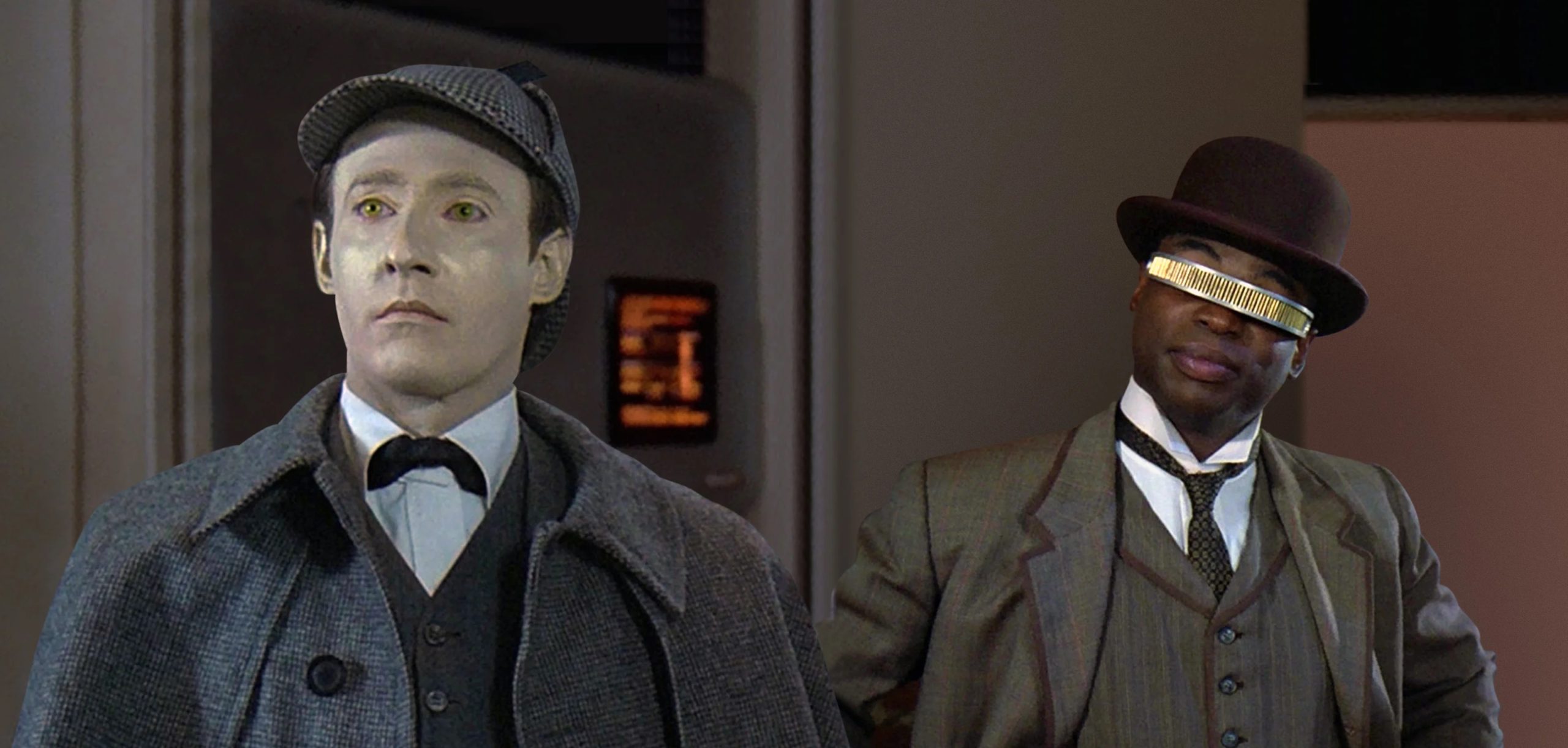
This is one of the first genuinely good and flat-out enjoyable episodes of the series (notably, only the second one that I have rated above two stars). Its main weakness is a lack of follow-through in the latter part of the episode on the issues that it raises early on—which not only leaves things unresolved, but also contributes to a rather anticlimactic ending. But before that happens, this is a memorable episode with several interesting ideas in it, most of which are executed quite well.
One thing has to be gotten out of the way at the outset: I will certainly grant that the fundamental premise—i.e. that the Enterprise’s computer is capable of creating an intelligent being—is totally implausible. That said, it’s also so intriguing and cool a story idea that I’m 90% willing to overlook the plausibility issue. Part of me, admittedly, thinks that it would be nice if there were at least some effort to explain how such an unlikely thing could have happened, but since I can’t really imagine any sort of explanation that would have worked and not just seemed even lamer than no explanation, another part of me suspects that not addressing the issue was probably the wiser course. Geordi asks for an adversary who can compete with Data, so the computer provides one—a huge stretch, but we’ll leave it at that.
It’s interesting that this episode pretty much totally dispenses with any need to have anything other than Data and Geordi playing Sherlock Holmes on the holodeck (and, obviously, the complications that arise from that) “going on”; the ship is merely awaiting a rendezvous, and there’s no framing plot (good, bad, or indifferent) to pad things out or to try (probably pointlessly and/or cheesily, if first season analogues are anything to judge by) to add tension to the main plot. This, I think, gives the episode the breathing room to really do justice to the holodeck world of Sherlock Holmes, which makes the latter a lot of fun. It also frees the characters to only have to concern themselves with one thing. Data throws himself into the part in ways that never fail to entertain, and in the process, he finally begins to emerge as the character whom some of us know and love. Also, the characterization (writing, casting, acting) of Moriarity is spectacular, and goes a long way by itself toward making the episode work. He genuinely comes across like a fictional creation who has suddenly achieved self-awareness; the portrayal is masterful. Plus, he’s just a great adversary; he’s intelligent, sophisticated, subtle, and three-dimensional, without any of the cheesy posturing typical of TV villains. What a contrast from most of TNG’s previous guest characters! The audience doesn’t want him to cease to exist any more than he wants to, which makes the impasse over what to do about him much more interesting than it otherwise might have been.
I also very much enjoy all the banter between Geordi and Dr. Pulaski over Data’s nature and abilities, and the extra level that her challenge brings to the “game” of playing Sherlock Holmes. To be sure, Pulaski is guilty of harboring a prejudice against artificial life forms—and arguably, particularly in her day, her viewpoint is actually pretty ridiculous. Still, it’s not necessarily too implausible that there would be people—even Starfleet officers—who would tend to feel as she does about Data, and portraying this, I think, was a workable way to keep Trek’s utopian future at least a little bit grounded in reality. The disagreement over Data’s abilities is kept friendly, and becomes a good-natured rivalry that provides some stakes for Data and Geordi’s holodeck recreation and a bit more of a sense of purpose to the episode than there would otherwise have been (prior to the introduction of Moriarity). It also proves intellectually interesting: When Data-as-Holmes starts solving the mystery presented by the holodeck and Pulaski cries fraud, Data defends what he is doing as constituting deductive reasoning. What’s interesting is that they’re both right: while Data hasn’t really met Pulaski’s challenge, in that (as she points out) he’s merely recognizing mixed-up elements from various novels with which he is familiar, his point that doing this constitutes deduction is valid as well. Moreover, Data’s point nicely demystifies deductive reasoning a bit. Pulaski wants to romanticize the mental powers of Holmes, imbuing them with a kind of mystique that helps her to sustain her conviction that Data cannot match them (as she illustrates when talking to Geordi in Ten-Forward before they go to the holodeck)—but here, Data brings the subject back down to earth a bit. The circumstances make Data seem like a charlatan, but his point forces you to stop and acknowledge that in a sense, it’s actually Pulaski who’s not playing fair. Very nice.
As super-enjoyable as most of this episode is, though, the lack of any resolution to Pulaksi’s challenge regarding Data’s ability to solve a Holmes-style mystery prevents it from being truly great. Essentially, this theme is kept going just long enough to provide the context and motivation for Geordi to tell the computer to create an adversary worthy of Data—and then, once the consequences of that act become clear, the episode shifts its focus entirely to Moriarity. Fortunately, this is a shift of focus from one interesting thing to another interesting thing, so one doesn’t immediately experience it as a letdown; still, an issue is raised but never resolved, which is frustrating. Coupled with this is the fact that the episode is, ultimately, a bit anticlimactic. Moriarity, to his credit, is intelligent enough to recognize that the main characters lack the ability to give him what he wants, so he gracefully resigns himself to this reality on the strength of a promise from Captain Picard that they’ll “work on the problem.” It’s admirable of him, and it contributes to my respect for the character—but it’s also a little boring. It would be nice, for instance, if it had proven necessary for Data to actually outwit Moriarty in some way before the latter acknowledged the reality of his situation, thus eliminating the anticlimax and providing a resolution to the Data-Pulaski-Geordi “challenge” storyline all in one fell swoop. Had the episode done something along these lines, it would almost certainly be a four-star treasure.
Even as is, though, it’s a keeper. As a final positive comment, I’d like to note that the end of this episode provides what I believe is the first-ever instance of Picard’s eventually characteristic compassionate mentorship of his officers. I’m talking, of course, about the scene in which he makes a point of reassuring Geordi that since all has ended well, he needn’t beat himself up over his carelessness in bringing Moriarity into existence. Finally—the Picard who would eventually come to be, beginning to emerge!
“It would be nice, for instance, if it had proven necessary for Data to actually outwit Moriarty in some way before the latter acknowledged the reality of his situation, thus eliminating the anticlimax and providing a resolution to the Data-Pulaski-Geordi “challenge” storyline all in one fell swoop.”
What a great point. And this is such obvious thing to do from a writing perspective. It solves almost all of the episode’s problems by tying together these two cool but (as they stand) thematically disconnected elements. If you hadn’t seen the rest of the series to this point, you might think the episode is half-finished and rushed to production, except this is still the best episode of the series to date—which is kind of sadly hilarious. This simple thing keeps it from being an actually competent, fully coherent bit of storytelling!
“Part of me, admittedly, thinks that it would be nice if there were at least some effort to explain how such an unlikely thing could have happened, but since I can’t really imagine any sort of explanation that would have worked”
No matter what you do, it’s going to be something of a stretch, but this is Trek, and stretching way past the bounds of plausibility to do weird cool shit is our bread and butter. 😉 My solution is to open the episode with Geordi having to “upload” Data into the computer temporarily in order to do some work on his positronic techno-whatsit that refreshes his information-processing capacity (kinda like de-fragging his hard drive). Later, when they ask to create an opponent capable of defeating Data, the computer uses this information to create a nemesis for Data, because, it thinks, Data is the only thing it has access to that has the potential ability to defeat Data.
Is it a reach technologically? Is it a reach in terms of the safety and security protocols that would have to exist on a starship? The answer to both questions is absolutely yes, but I think no more than the average TNG episode.