
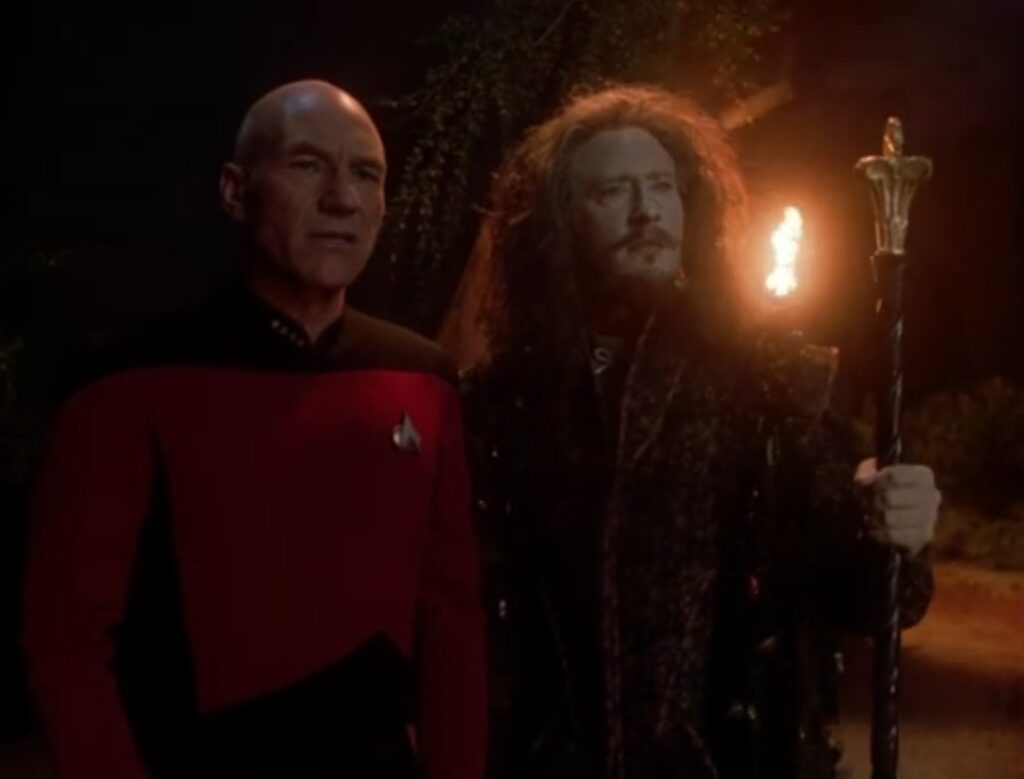
Even more so than the handful of episodes immediately preceding it, “Emergence” is explicitly an end-of-series episode; “Journey’s End” and “Firstborn” wrap up the show’s treatment of specific secondary characters, but “Emergence” thematically addresses the impending end of the series as a whole. In a way, it’s almost like a finale-before-the-finale (so much so that I have sometimes misremembered it as being the penultimate, rather than merely the antepenultimate, TNG episode). In fact, I actually sort of wish that the writers had saved this one for the penultimate slot. This is no slight to “Preemptive Strike” (which is surely the better of the two episodes, even); it’s just that “Emergence” so clearly represents the start of the writers saying good-bye to the show, what with its references to a “last creative act,” its featuring of the whole ensemble, and its metaphorical summation of what the show has been about. But, whatever; at least its placement gave me an excuse, just now, to use the word “antepenultimate.” More to the point, I am somewhat surprised to discover, from perusing other review sites, that “Emergence” is not well-regarded, for the most part, among fans of the show. Personally, I have always really enjoyed it! I mean, sure—at face value, it’s far-fetched, short on substance, and more than a little silly, even. Honestly, giving it four stars might be a bit on the generous side (though equally, three stars would strike me as harsh; it’s kind of on the line). But it’s also fun, and its symbolism hits (for me) the sweet spot between nonsensical gibberish and obvious literalism, and on the level of metaphor, it just works for me. (This is, after all, the product of a collaboration between high-concept-weirdness-loving Braga and myth/symbolism/metaphor-obsessed Menosky. Dreck like “Genesis” and “Masks” represent these two at their worst, sure, but their respective styles have both produced cherished classics, too. “Emergence” isn’t on the level of either’s very best work, but I’ll take it for what it is, here, as TNG prepares for its own end.)
At the risk of belaboring the obvious, the opening scene, in which Picard elucidates The Tempest for Data, does crucial thematic setup and tone-setting work for the episode. Shakespeare, Picard says, was living through changing times and reflecting on the end of an era; The Tempest, of course, is generally regarded as Shakespeare’s final play; Prospero confronts the waning of his own relevance, and intends to “perform one final creative act before giving up his art forever.” Obviously, this all applies not only to the writers as they prepare to bring TNG to its conclusion, but also to the story to be told in this episode, with the Enterprise developing an emergent intelligence that’s intent upon a single “creative act” of its own. (Meanwhile, the audience is being treated to one final instance of “Picard mentoring Data as the latter seeks to understand humanity via Shakespeare,” which has been a fun recurring motif since season three’s “The Defector.”) Also, can we perhaps tease some meaning out of the captain urging Data to make concessions to the needs of storytelling, rather than insisting on a level of realism (the darkness of the set) that impedes it? Is this the writers begging the audience’s indulgence, for a story that works as a metaphor even if it’s a bit hard to take seriously as something that could really happen? In any event, Picard also stresses that all this end-of-an-era sentiment shouldn’t be seen exclusively as sad; it’s also a triumphant culmination, and it opens the way for new beginnings. Then, just as he’s warming to the subject of how Shakespeare likes to juxtapose opposites, suddenly there’s a misplaced train barreling down on them! The teaser thus ends by signaling that we’re in for a bit of a wild ride…. I mean, come on; how is this not simply a great opening scene, from beginning to end?
So, the Enterprise is mysteriously manifesting a nascent intelligence, with the holodeck as the focal point of its developing neural net and functioning almost like its subconscious—or, as Troi says, as its imagination. Like, okay, that’s kind of out there, and as a science fiction concept, I find it a bit dubious. (Emergent intelligence in a complex system is an intriguing idea, sure, but it’s not justified very plausibly here; there’s one brief mention of a “Magnascopic Storm” that one might infer as a triggering event, but otherwise, all we have is the metaphor of it all. Should we think of this as a bizarre one-time fluke, or just something that happens to starships from time to time…or what? Who knows.) But again, even if it only really works on the level of metaphor, it’s cool on that level. The Enterprise has always carried symbolic meanings in Star Trek: representing the spirit of exploration and discovery, scientific progress and technological achievement, cooperation and mutual understanding, and (particularly on TNG) humanism (broadly speaking, of course, in a context that is actually inter-species), considering the 1701-D’s deliberately warm and inviting aesthetic. And, of course, the idea of the totality of the ship’s (and its crew’s) “experiences”—which is to say, of course, the stories that the show has told over the past seven years—serving as a foundation for its own nascent intelligence, adds onto those existing layers of symbolism. But even better, the idea of having this all represented on the holodeck was, to my mind, a stroke of genius. I realize that many fans saw this merely as “yet another lame holodeck malfunction episode”; I see it differently. Tehcnically, of course, it’s a “the whole ship does really weird stuff” episode, not an “oh no, the holodeck safeties are on the fritz” story. But what’s important is that the holodeck isn’t just an excuse for the episode to indulge in weirdness. As the place where the characters have gone to indulge their own imaginations and immerse themselves in stories over the years, it’s a good (figurative) focal point for the ship’s emergent intelligence, and a great vehicle for presenting a non-literal depiction of that intelligence in action. The train is a visually engaging setting and an effective stand-in for the ship, and the mishmash of misplaced characters from other programs adds a bit of surrealism that’s fun. It’s the perfect setup for images and dialog and happenings that seem pregnant with meaning, but may or may not resolve straightforwardly into any concrete or particular meaning. So like, yeah, the train is going to “Vertiform City” because the ship wants something called vertion particles, but why does the gunslinger shoot the engineer, and what the hell is the deal with the all-important brick? It all makes a kind of sense, but in a dream-like way…so when the characters interpret it as being about the ship’s developing intelligence trying to figure itself out and represent its own ideas and impulses to itself, I buy it (and dig it). And if some things don’t really seem to add up (like, why does the ship’s power rev up when Worf shovels coal into the train’s furnace?), it doesn’t really matter, because it’s not as though “how can we fix the engine problem” is a plot point with a bunch of tension attached to it; it’s mostly flavor. (And if you try hard enough, you can probably find a way to interpret sense out of it…like, it’s not that what Worf does actually powers the ship somehow, and more like, the ship’s intelligence worked through a difficulty, and represented this to itself by having a holodeck character get Worf to shovel coal.) In short, then, I find the basic shtick of the episode both serviceable and fun.
Arguably, the episode is pretty light on plot. Mostly, the characters just run around reacting to the weird stuff that the ship is doing, make educated guesses about what’s going on, and make various attempts to regain control and/or help it do its thing. Still, a few key points save it, for me, from being one of those lame episodes in which stuff just happens to/around the characters, and the plot resolves without needing much from them. One, the characters make an active choice to respect the ship’s nascent intelligence (though I do think they take the whole thing in stride a bit too cavalierly, and don’t react to it as much as they should), and switch at a certain point from trying to interfere to trying to cooperate with and help it. And two, there is an actual plot point where the ship opts for a solution to its problems that will, unfortunately, prove lethal to the crew, so the characters have to come up with an alternative and redirect the ship toward it. Both the problem and the solution are pretty technobabbly, true, but it’s still set up well enough that it works for me. On the other hand, one early plot point really doesn’t work for me—namely, the bit where the ship somehow detects a supposedly really dangerous phenomenon that it was not designed to be able to detect, and acts to preserve itself by warping away, thereby providing the characters with their first clue as to what’s going on. Really? If it hadn’t happened to have just started magically becoming intelligent, the Enterprise would have been randomly destroyed by some stupid undetectable space phenomenon? And upon learning of this, everyone pretty much just shrugs it off? Lame. Also, even though (I keep saying it) the story generally works for me conceptually/metaphorically, the ending, in which the Enterprise creates this new life form, then just…gives up the ghost and goes back to being an ordinary ship? I’m not saying I have a better idea, exactly, but that’s pretty weak, and very reset-button-y. (That the “offspring” life form ventures off and disappears, I’m okay with; again, what’s important here is the metaphor, not having a “starship baby” to subsequently study or try to establish relations with, or any of the weird world-building ramifications that this would have. But that the Enterprise itself just “reverts” at the end doesn’t make enough sense for me.) So, on the whole, the “plot” of the episode is a bit of a mixed bag. But I still enjoy it.
The final scene, of course, wraps the whole thing up quite satisfyingly. “If our experiences with the Enterprise have been honorable, can’t we trust that the sum of those experiences will be the same?” It’s a bit “meta” from Picard, it’s obviously the writers expressing their hopes for how the audience, and posterity, will view TNG as a whole, and it could almost have functioned as the final line of a series finale…except, of course, that we’re not actually quite there yet (and when we do get there, the real final line will be an even better one!).