
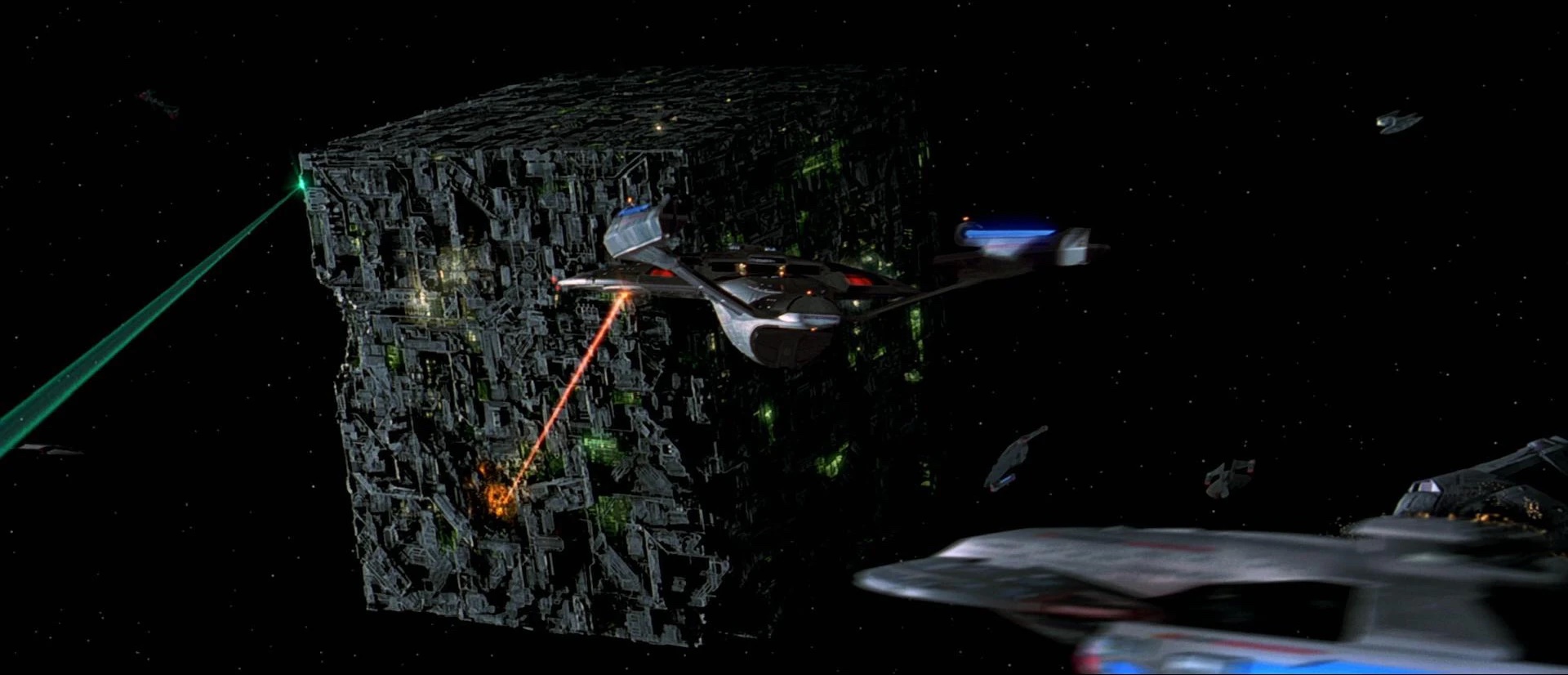
Overwhelmingly, the consensus among Trek fans is that First Contact is the best of the TNG movies. I have never understood this (especially in light of how great Generations is!). To be fair, this movie does have its detractors (and also, some of the people who think that it’s “the best” TNG movie still don’t actually think it’s all that great)—but for the most part, critics and fans alike enthuse about how awesome it is. Clearly, I do not share this assessment. Prior to my recent re-watch, I had not seen First Contact in many years; I remembered my overall dislike of it and several of the biggest reasons for that dislike, but I had forgotten a lot of the specifics of the movie. On this re-watch, I did find elements that I enjoyed and things that (I think) could have worked (though not without fundamentally changing almost everything else about the movie). This is definitely a two-star mess, as opposed to a one-star travesty. I’ll even acknowledge that there are some good thematic ideas in this movie, although their handling doesn’t leave me entirely satisfied. However, in terms of characterization, plot, narrative structure/storytelling choices, world-building (or world-ruining?), and even just general “feel,” First Contact strikes me as deeply misguided and wildly inept. This movie commits two flat-out unforgivable sins (concerning the Borg and Data) for which I will forever revile it, along with a whole host of other blunders and missteps, all of which add up to a movie that I wish had not been made (or, of course, had been made fundamentally differently).
Part of me thinks that some aspects of what went wrong with this movie were kind of inevitable. I mean…for sure, when TNG ended and they started making movies, there was going to be a Borg movie; they were one of the show’s most epic and compelling creations, and too popular to ignore. But with each story featuring them, the Borg became increasingly difficult to do well. In “The Best of Both Worlds,” the Enterprise only managed to defeat the Borg due a long-shot, last-minute, one-time fluke. Could the writers possibly have dreamed up a believable way for Starfleet to survive a second all-out Borg assault? I don’t have a definitive answer to that question (and certainly, in the months leading up to the release of First Contact, I very much wanted the answer to be “yes”!), but I have to confess to a pretty hefty dose of skepticism. All this to say, I have some trouble buying into (for a start) the Borg’s basic strategy in this movie. Going back in time to assimilate Earth/humans when they had nowhere near the technological capacity to resist? First, I feel like this depicts the Borg as taking humans much too seriously as a threat; the truth is, just sending another cube to Earth (and not abducting an individual human to serve as a “spokesperson” this time) should absolutely have been enough to do the trick. Second, while the Borg have a relentlessness that is part of what makes them terrifying, I don’t really feel like out-of-the-box thinking is their style; yes, they adapt as they encounter new threats that temporarily impede them, but in terms of their overall approach, I just don’t see them trying a straightforward assault once, and when that fails, chanting in unison: “We know! What if we traveled back in time, and…” Like, that’s the sort of crazy idea that a lone Starfleet officer might come up with, but then have a hard time selling to those above them in the chain of command; it’s not the sort of idea that emerges from groupthink, you know? Also, I have big problem with how, when the Enterprise shows up to the battle, Picard somehow magically knows how to destroy the Borg cube by having everyone in the fleet fire on one special area of it. There are a couple of distinct problems with this, for me, but the one I’ll focus on now is the fact that it represents a huge Borg retcon; the whole idea with the Borg has always been that everything is too decentralized and redundant for damaging any one part to have a significant impact on the whole. This is essential to what makes the Borg the Borg—implacable, relentless, nigh-impervious, and all but unstoppable. So, in short…from early on in the movie, I start to feel pretty disappointed with its take on a second Borg attack on Earth (and I haven’t even gotten, yet, to the huge Borg retcon that the movie has in store for us later on).
I need to back up, though, because my dissatisfaction with First Contact actually begins well before the Borg pull their time travel stunt. In fact, honestly, one of my biggest gripes about this movie is how it just…starts. Sure, the big opening pull-out shot from Picard’s eye, and out through the Borg ship, etc., looks cool—but that’s literally all the movie does by way of tone-setting, or catching us up with the world and the characters, before diving headlong into plot. This despite the fact that at the end of the previous movie, the Enterprise had been destroyed (!), leaving the future of its officers and crew an open question. First Contact opens with a new Enterprise already having been in service for almost a year, and all the main characters conveniently still serving together on her (except for Worf, of course; I guess you only get reassigned during the down time after your ship is destroyed if writers have need of you in the meantime)—yet offers absolutely nothing in the way of exposition that would help us to make any sense of this, or to understand what the characters were doing in the meantime, etc. On top of that, it also makes zero effort to get its audience invested in the new Enterprise. This is a stark contrast with all previous instances where a Trek offering has introduced a a new ship, as well as with nearly every previous Trek movie, even if it featured an Enterprise that was not “new”—and I, for one, really feel the absence of the sort of fanfare and buildup (slow establishing shots against a backdrop of dramatic musical flourishes; characters talking about the ship, its capabilities, how they feel about it; etc.) that we usually get. It’s hard to say how I might feel about the NCC-1071-E as a successor to previous Enterprises if the movie had bothered to build actual story around its introduction, or at least had made some minimal effort to get me, like, excited about it…but what I can say is that, as it is, I never developed any interest in it or attachment to it at all. Plus, the total lack of on-screen fallout or narrative consequences relating to the loss of the 1701-D completely blunts the impact of its having been destroyed in the previous movie; it’s like the Trek universe just shrugged and moved on. I hate that; the loss of that ship hurt (in, like, a good way, but still), and I wanted that to mean something to the larger story, you know?. I’ll say more later about some other consequences of the movie’s failure to spend any time either catching us up with the characters or letting us get to know the new ship, because I actually think it contributes to some of the problems that the movie has later on (in addition to just being jarring and disappointing when watching the beginning of the movie, I mean). Right now, though, I want to point out that these aren’t even the only ways in which, for me, the opening sections of First Contact feel jarringly abrupt—and, as a result, sort of hollow, and difficult to connect with emotionally. In particular, even the fact that the fucking Borg are invading again doesn’t really land with much of a sense of shock or dread in this movie. The initial communication to Picard from an admiral is dry and matter-of-fact (at least, until Picard interrupts with mysterious foreknowledge; more on that later); then there’s a captain’s log entry that really doesn’t add much, and in which Picard already feels a little “off” to me (more on that later, too); then it’s right into plot, plot, plot. In one scene, in fact, the short shrift given to introducing the new ship and the failure to convey any real sense of impact regarding the Bog invasion compound each other; the first and only establishing shot that we get of the new ship is on the screen while Picard’s “captain’s log” voiceover about the Borg invasion is playing, leaving me really unclear how I’m supposed to be feeling. Should I be checking out the 1701-E and admiring the imagery of it foregrounded against a colorful nebula, or am I supposed to be freaking out because “our most lethal enemy” is invading and may be unstoppable? I feel like the script and the visuals mutually undercut each other here, blunting any impact that either might otherwise have had.
Overall, it feels like the whole early part of the movie is in such a mad rush to get to the Enterprise traveling back in time that it just blasts its way (at like warp 11) past every plot point, character beat, or bit of background or tone-setting that might have made for an actually enjoyable viewing experience. This impression is so overwhelming, in fact, that it somehow manages to dominate despite the contrary tendency of the movie’s brief and utterly pointless putzing around with the inane notion that the Enterprise is not even going to join the battle against the Borg at all. The latter, frankly, is just stupid; it makes no sense in-universe, and it also serves no narrative or thematic purpose. What the fuck was the point of it? I mean, sure, on one hand, the movie will eventually sort of prove Starfleet right in its hesitation to trust Picard’s judgement where the Borg are concerned (though I take issue with this, as I’ll be discussing eventually)…but on the other hand, it is (naturally) the Enterprise that ends up saving the day. So, all things considered…bad call, Starfleet! In-universe, I pretty much agree with Riker’s assessment that Picard’s experience with the Borg ought, if anything, to be a plus rather than a minus (though the movie ends up making way too much of that, too!), but even putting that aside…what about Riker himself, and the rest of the regulars? You know—the only people around who have ever successfully defeated the Borg before, and the folks who literally saved Earth the last time the Borg came calling? We’re just going to tell those guys to sit this one out? Besides…all else aside, the Borg invading the Federation is what we might call an “all hands on deck” type situation, no? (I also think that, regarding Picard, Starfleet Command kind of has to either deem him emotionally stable and fit for duty…or not. If they they think he’s enough of a loose cannon to potentially be a liability if the Enterprise finds itself tangling with the Borg (or any other given thing), then he probably shouldn’t be in command at all.) So, okay, that’s one take on why this part of the movie is dumb. But even more importantly…why? How does spending a couple of minutes pretending that the Enterprise is going to patrol the neutral zone while the rest of the fleet engages in a desperate battle with the Borg (with, you know, the very continued existence of the Federation hanging in the balance), only to then have Picard abruptly decide to ignore his orders and show up to the battle after all, serve the story? Was this all just an excuse to manufacture another instance of that total Trek cliche in which our heroes boldly decide to go rogue and defy orders (complete with Data lamely calling back to/ripping off Spock’s “go to hell” moment from the end of The Undiscovered Country)? Or, alternatively, was it a cheat designed to minimize the amount of space-battle, ship-blowy-uppy special effects needed for the movie? And if it wasn’t either of these shitty things, then I have a hard time seeing that it serves any narrative purpose at all. As a plot point, it leads nowhere (certainly, for instance, Picard’s defiance of orders will never bring any consequences down upon him…), and the about-face comes so quickly (and with so little real provocation; like, sure, they hear the battle not going well, but was there ever any doubt that it was probably going to go poorly?) that it just ends up feeling like a perfunctory waste of time.
And, again, that seems especially absurd when you consider how, in every other way, the movie really does just bulldoze past everything in its mad rush to get to the 21st century. For instance, Picard feels “off” (not quite himself) pretty much from the very first scene. Now, I assume that this off-kilter characterization is basically intentional, and that it’s about setting up the idea of his lingering trauma from being assimilated by the Borg—and, don’t get me wrong; I can certainly believe that he might still have some buried issues to work through from that experience (!). But because the movie doesn’t bother to take its time with anything, his “issues” present as being already on the surface as the movie starts. He just doesn’t seem like the same guy who he was the last time we saw him (or any of the other times in the years since BOBW, for that matter), and the movie makes no effort to explain this. Specifically, too, we’re presented here with a Jean-Luc Picard whose response to being ordered away from the Borg battle is openly petulant in a way that just feels very out of character, and not really justified by the (presumed) rationale of his prior traumatic experience with the Borg. Also…he suddenly can somehow “hear” the Borg. Huh? Like, the writers apparently think this is a really cool idea, but they offer zero explanation for it. I’m not entirely sure if his dream at the very beginning of the move is mostly there just to remind the audience of his experience as Locutus, or if it’s supposed to provide our first clue that he’s somehow mystically connected to them (!), but either way, it’s kind of dumb, and it totally fails for me in terms of setting the stage in any way. (If it’s just a dream, it seems weirdly coincidental that he happens to have it right before Starfleet calls to tell him that the Borg are invading; if it’s more than that, it’s basically magical and unexplained. The fact that he somehow already knows that the Borg are invading, without having to be told by the admiral who contacts him, suggests that the writers probably intend the latter (worse) interpretation.) Then later, when he suddenly knows the special spot where the Borg cube is vulnerable, is this a) because he “hears” them / is mystically connected to them, or b) technical knowledge that he gleaned during his time as Locutus (but apparently never shared with anyone else until now), or c) something else? The movie doesn’t care; it just happens, because it’s a quick and easy way to dispatch the cube and move on with the plot. (Hell, he shows up at the scene of the battle and simply announces “I’m taking command of the fleet,” and everyone just accepts this without question! Quite apart from his having been ordered not to even come at all…was there no existing chain of command, or contingency plan for who should take charge in the event that the commanding admiral’s ship got destroyed? Again, the movie just doesn’t care how little sense any of this makes.) Also, when the Enterprise first joins the battle, there’s a quick “oh hey, look, it’s Worf commanding the Defiant!” moment. I’m not 100% sure whether to call the way that the movie reunites Worf with the rest of the gang clever or contrived, but what I do feel is that although some fun bits of character interaction happen here, the whole reunion would have more impact if the movie had taken even the briefest of moments before this to let us notice (and feel) Worf’s absence (what with this being the first time we’ve seen the TNG gang since Worf went to DS9). But, whatever. So the terrifyingly maybe-unstoppable Borg cube proves easily destroyable, and the movie sails on to it disgorging a sphere that then opens up a time portal, and this all just feels like a bunch of ho-hum “stuff” happening. There’s no impact, no “wow factor” to any of it. We literally get from that opening dream sequence, all the way to the Enterprise leaving the debris of the Borg cube (not to mention half the fleet, presumably) in its wake and following the sphere through a temporal vortex into the 21st century (and the movie’s first cut to Cochrane’s compound in Bozeman), in just under 14 minutes—and even then, the movie still isn’t quite ready to slow down; the Enterprise trivially destroys the Borg sphere (!), and we spend a few more seconds blazing through some exposition about “when” we are and what that means and what the stakes are, and the next thing you know, Picard (of all people) is leading an away team to 21st-century Earth. Throughout all of this, there is scarcely a single moment when I feel able to really engage, emotionally, with the movie.
So, okay; I’ve been ranting, and kind of getting into the weeds, and although I do think that everything that I’ve said so far needed to be said, I now want to zoom out a bit and address the movie’s overall narrative structure and themes. The writers made what has always struck me as the rather odd storytelling choice, with First Contact, of making a hybrid movie: a Borg invasion story on one hand, and a time-travel/protect the timeline story about first contact with Vulcan (a quintessential piece of the back story underlying all incarnations of Trek) on the other. I’m not going to argue that this was completely crazy; I do see what they were trying to do in marrying these two storylines and how they tied them together thematically, and I intend to give credit where due in this respect. But I also don’t think that it entirely works—and regardless, I mostly would have preferred not to visit the 21st century in this way. As executed, the dual structure results in some moments of absolutely absurd tonal clash between the two separate storylines, such as when the movie is cutting between shots of Picard grimly leading an armed team through the ship hunting Borg (and telling the other officers to go ahead and fire on any already assimilated crewmembers they might encounter), and the slapstick of drunken Troi and bemused Riker trying to wrangle Cochrane down on Earth. To be fair, I guess, this is actually more because of how the writers chose to characterize Zephram Cochrane (a topic to which I shall return) than because of the more fundamental choice to go to 2063 at all…but still. What I really don’t like about the “first contact” part of First Contact, though, is how it makes this pivotal moment in Earth’s (future) history something that ends up having been heavily orchestrated by players from the very future that it makes possible. I mean, Riker and Geordi are cool, and all, but did we really have to do a time-travel retcon whereby they end up playing a major role in making humanity’s first-ever warp test (right down to actually being physically on the craft during it!), and thus also its first contact with an alien race, happen? Can no important part of history just be left “organic” (i.e., understood to have happened on its own, without meddling from the future)? This is mainly what I guess I’d call a “world-building complaint” (though I’ll also be arguing shortly that the movie somewhat undercuts its own themes here), but also, on a more plot-nitpicky level, it feels awfully convenient that the Vulcans happen to notice what they’re “supposed” to notice (Cochrane’s warp flight) while remaining oblivious to the presence of both the Borg and the Enterprise (and I guess we have to just trust that no one from Cochrane’s group, including Lily, lets anything slip to the Vulcans about their visitors from the future…). Finally, one other thing that I don’t like here (and this is admittedly kind of petty, but it just rankles) is the very fact that the writers chose to reuse “First Contact” as a title for this movie, given that it was already the title of a fourth-season episode that I happen to think was much better than it.
Thematically, I find First Contact to be something of a mixed bag. On one hand, I both see and very much appreciate what it’s trying to do, which is something that I’ve frequently wished for TNG to do more of, and/or to do better, in general: namely, to explore and dramatize the fundamental Trek premise about humanity having managed to get its shit together and “better itself” during the intervening years between our time and the 23rd/24th centuries. There are a bunch of different, and often competing, ideas floating around in this movie that all relate to the idea of striving toward self-betterment. This is laid out most explicitly in the scene where Data tells the Borg queen (grrr) that he is programmed to evolve and better himself, and she responds by claiming that the Borg are the same; they pursue their own betterment (and the increased perfection of others) by assimilating the civilizations that they encounter. (This is not a new claim from the Borg; in “The Best of Both Worlds,” the collective asserted “We wish to improve ourselves. We will add your biological and technological distinctiveness to our own,” and Locutus presented similar arguments.) Then, in the next scene, we hear Picard explaining the Federation to Lily: a vast alliance of worlds, cooperating for their mutual benefit, in a time when profit is no longer the “driving force” in people’s lives; rather “we work to better ourselves and the rest of humanity.” (This, too, is familiar; Picard used to say things like this back in the early years of TNG. I have to say, though, that it is refreshing to hear Trek reaffirm the idea that there is no money in the 24th century, even though numerous TNG episodes have contradicted that premise.) Holding up the brutal, dehumanizing, and compulsory collectivism of the Borg as a mirror/foil for a Federation that sees itself as having evolved beyond narrow individual greed to embrace (voluntary) cooperation for collective betterment has obvious thematic merit, and while I think the comparison has been implicit in previous Borg stories, First Contact makes it much more explicit—and adding in the direct comparison to Data’s programming is a nice touch, too. Meanwhile, Geordi has apparently traded in his visor for some kind of fancy new ocular implants, and the movie subtly draws our attention to this in ways that are clearly meant to suggest parallels with Borg implants, and raise questions about the line between using technology to improve the quality of life vs. letting it slowly turn us into something inhuman. (The Data temptation stuff plays around with similar ideas, too.) And then, of course, we also have the planetside storyline, wherein a historical event that played a pivotal role in putting humanity on the road to betterment has been imperiled. There’s a pretty inspiring, classically-Trek scene where Riker, Troi, and Geordi lay out for Cochrane what hangs on his completing his planned warp flight—how it will unite humanity, and lead them to eradicate poverty, war, etc.—but then Cochrane himself turns out to be rather less admirable a figure than the regulars expected, and ultimately admits that his work toward developing warp drive has been motivated purely by personal greed. And finally, back on the Enterprise again, we are given reason to question whether humanity has actually improved itself at all, when we watch Picard allowing himself to become consumed by revenge while remaining in denial about it and continuing to mouth what become mere platitudes about his “evolved sensibility.” So, to a certain extent, a lot of this is actually set up pretty thoughtfully…and when Lily pulls Picard back from the brink, and Cochrane steps up, and Data resists the queen’s temptation, and all ends well, I feel like the movie is at least trying to say exactly what I would want it to say: that humanity has “evolved,” but not in some magical or perfect way. Humans are still humans, and still have all the same failings and weaknesses; they’ve just “grown up,” and gotten better, most of the time, at mastering them, and developed cultural norms that reinforce that, and so, mostly, they do pretty well. But it still takes work. This is good stuff, and to the extent that it is what First Contact is trying to be about, the movie has real merit, despite my overall dislike of it.
So, what (besides the things that I’ve already discussed) doesn’t work about it? Several things, unfortunately, but for starters, let’s talk about the Zephram Cochrane material. I can readily appreciate the writers’ choice to depict Cochrane as something less than the visionary whom we (and certainly the regular characters) might have imagined him to be. After all, it both makes some basic sense and also fits with the movie’s themes for it to turn out that he was a flawed guy and a product of his time, yet took the step that set humanity on a path to bettering itself in spite of all of that. However, I just have trouble buying into him as a real person, based on how the movie depicts him. For one thing, his sudden reluctance to go through with the warp flight (to the point of trying to run away!) doesn’t make a lot of sense to me. This was something that he was already going to do (had, in fact, been working toward for many years, presumably); why would being visited by people from the future, who assure him that he’s going to be successful, suddenly give him cold feet? These guys show up and start talking about the high regard in which future generations will hold him, and—okay, maybe that feels weird or hollow since he doesn’t see himself that way, but…I feel like most people would probably just kind of roll with it? Even if he really lacks any instinct for self-aggrandizement, why would he feel bitter and resentful upon learning that his self-interested actions are going to “accidentally” have an enormous positive impact on humanity? Also, there’s something about the whole “I was only in it for money” premise itself that just doesn’t quite hold together for me. Presumably, to get to where he is when we meet him, this is a guy who has devoted his life to next-level scientific/engineering research. Is that a thing that someone who is all about wanting to get rich quick and retire to a life of luxury does? I know people in real life who have chosen careers focused on scientific research, and while they (university professors) make pretty nice money by my personal standards, their lives and livelihoods are not what someone who only cares about money would choose! (For one thing, it takes years of hard work and dedication to become a cutting-edge scientist type.) The movie leaves things like how Cochrane’s work is funded completely unclear, but Lily does talk about spending years scrounging scrap metal; it sure doesn’t seem like he’s milking some lucrative corporate gig, or part of a high-stakes technological “arms race,” or anything. In fact, we see no signs of any connection between his isolated compound and the rest of the world at all—another thing that makes it hard for me to buy into its reality. I think the fact that civilization is somewhat in tatters after WWIII is supposed to explain some of this, but in a way, it actually makes Cochrane even harder to believe in—because if human civilization is at that low of an ebb, who exactly was he going to be collecting big bucks from for his space travel technology? And when the Vulcans show up, how do they react to the fact that this historic first contact is with…just some guy, who has no apparent connection to a larger civilization on this backward-ass, recently war-torn planet called Earth? It’s all just…weird. But stepping back from some of these details to look at a larger picture: First, I feel like this part of the movie suffers from a lack of story. Cochrane has to be all reluctant, and then get convinced to play his historic role, because otherwise, what was gonna happen in this part of the movie? And second, I strongly feel that having Riker and company practically force Cochrane to go through with the warp flight, and basically hand-hold him through it, massively undercuts the theme about flawed humanity struggling to better itself. Borg or no Borg, it feels hard to believe that the Cochcrane we see would ever have managed to play his history-making role without an assist from the already-“evolved” future that his achievement makes possible. For sure, though, what we end up with is a causality loop in which the relatively utopian Trek future makes itself happen, rather than an inspiring story about flawed people in a fucked-up world managing to take a big step forward on their own, in spite of their shortcomings—and that’s extremely disappointing.
Another aspect of the movie’s thematic core that doesn’t quite work for me revolves around the characterization of Picard. Honestly, I really want to like what the movie is trying to do here; Picard’s Borg assimilation experience is the sort of thing that ought to have messed him up pretty bad, and the series never really did as much as it probably should have with that, and even though I would like for this movie to have made more of an effort to show us the seemingly well-adjusted captain whom we’ve known through the later seasons and the previous movie losing his grip, rather than just depicting him as off-kilter from the get-go, I approve wholeheartedly of delving into his Borg trauma in this story. So I buy it that, as the Borg start taking over his ship, Picard kind of shuts down emotionally and starts making cold, calculating decisions. I buy that his judgement is compromised. But I don’t really buy the pettiness that we see from him in this movie (both early on in response to his orders from Starfleet, and then again when, for instance, he calls Worf a coward)—and, for the most part, I also have trouble buying into his revenge kick. In fact, although I acknowledge that it might not have worked very well in terms of crafting the overall plot/story, I kind of feel like the conflict between him and the others over whether to keep fighting might have made more sense, from a character perspective, had it been reversed—i.e., if Picard’s behavior were portrayed as being driven by fear, and he had been the one who wanted to “give up.” Jean-Luc Picard is just not really a guy who tends to thirst for revenge (at least, not since his arrogant youth; he learned that lesson pretty thoroughly, I feel, in the famous Nausicaan incident). He’s not a coward, either, of course, but backing down from an all-out confrontation rather than bulling hot-headedly into one really is more his style—and per “Family,” his experiences in BOBW left him feeling humbled and vulnerable and “only human,” not rageful and spoiling for a rematch with the Borg. I don’t know; I guess I’m not saying that I absolutely can’t believe in a Picard whose trauma makes him temporarily vengeful, but I am saying that the portrayal in this movie doesn’t really convince me. And in large part, again, this comes back to the movie not really having put in the effort up front to set it up and make it believable. For instance, the trouble with Picard’s big speech to Lily where he insists that “the line must be drawn here; this far, no further” (one of the movie’s most memorable lines, if only because it was probably in every preview), and talks about having already made too many compromises, fallen back too many times, etc., is that…I mean, is any of that true? His lines make it sound like the Borg and the Federation have been warring nonstop for ages, and no one has ever had the guts to make a real stand against them, when actually, this is only the second time they’ve attacked…and each time, Starfleet has thrown everything they had at them, and the first time, the Enterprise defeated them. Now, if the early part of the movie had been totally different, maybe it could have justified these lines. But as is? They just don’t work. Similarly, our captain’s all-out determination not to sacrifice the Enterprise would be a much better narrative beat, and the audience might actually feel tempted to agree with him on it (making it far stronger thematically), if (you know what I’m going to say…) we actually cared about this new Enterprise at all. But, nope—it’s a brand new ship with no history or legacy or character, and the movie has made no effort to get me invested in it at all, so it feels pretty expendable. (I mean, sure, destroying it would strand our heroes in the past, which is bad…but still.) (On a bit of a tangent, I have a similar complaint about the bits involving Geordi’s new implants; I feel like there would be more of a point to this if the movie had done more than merely present us with his “upgrade.” Again, though, we get no exposition, no chance to get to know this “new” version of Geordi, or learn how he feels about the transition, etc. So, it’s yet another instance of potential being ruined by the shortcuts taken in the first section of the movie.) Overall, then, while I do like what the movie seems to be trying to do with Picard, I just don’t think it does it successfully (largely, I think, because it couldn’t be bothered to take the time early on to justify any of it in a believable way).
I have more to say about the character stuff in this part of the movie, but first, I want to talk briefly about some plot incoherence. Can someone please tell me why it is that the idea of abandoning and destroying the ship only comes up at this point in the movie, after the big set piece in which Picard and Worf and several other crew members suit up and go outside the ship to destroy the deflector dish? I mean, things were at least as hopeless before that sequence as they are afterwards, right? Why muck around with destroying just that one part of the ship, in order to stop the Borg from communicating with other Borg, and then move on to “oh yeah, actually, if we were to destroy the whole ship, that would solve the whole problem”? It’s almost as though the movie needleslly delays bringing up the latter idea just so that it can have a tense and visually cool set piece first. Seriously—there’s a half-hearted gesture toward justifying the idea that now we have to give up, because the Borg are “on the move again” and have (as predicted) adapted to our people’s weapons modulations, but what has actually changed? My experience watching the movie is that the idea of destroying the ship comes up kind of suddenly and out of nowhere, but if you think about it at all, the problem is actually that it should have come up sooner. (Similarly, the movie’s earlier big set piece, with Picard and Lily in the holodeck, is not without a certain fun factor…but it makes no sense, and again seems like a case of the movie lamely contriving a fun, elaborate scene for its own sake, rather than something that has any actual plot logic to it. I mean, even if I thought it made any kind of sense for a machine gun to be effective against the Borg when phasers aren’t (which I don’t!)…couldn’t Picard have just replicated a machine gun? Why all the rigamarole and role-playing?)
The confrontation scene between Picard and Worf on the bridge has elements that I like and elements that I don’t. Whatever my qualms about both Picard’s characterization and underlying plot logic, this is, to be sure, an emotionally intense scene between two characters that I care a lot about. I like that Worf, in particular, is the one who faces off with the captain here. From one perspective, it’s great characterization for Worf to (for once) be the one arguing for prudence and restraint and the saving of lives (and for him to stand up and push back against his captain this adamantly, but without crossing the line into insubordination); or, looked at from the other side, it really underlines just how dire the situation is, if Worf is the one arguing to stop fighting and sacrifice the ship! As I already said, though, I balk at Picard calling Worf a coward; it’s just so, so petty and “small” of him. But even so, I also think that Worf’s “if you were any other man, I would kill you where you stand” response is over-the-top bullshit. No you wouldn’t, Worf! You’re not that thin-skinned; you’ve been called a coward, weak, etc., many times in the past, and you’ve always managed not to lose your shit. (I appreciate the acknowledgement that his respect for Picard prompts him to make allowances, but still.) Whatever else I may think, though, I will certainly say that Stewart acts the hell out of all of this (making parts of it come closer to actually working than they otherwise would, to be sure). And then, finally, I’m a little unsure what to make of Crusher being ready to go ahead and try to carry out the captain’s insane orders after he dismisses Worf from the bridge; McFadden definitely sells it, and her line about “once the captain has made up his mind” resonates with these characters’ history, but I’m still not sure that I buy her taking this stance, rather than seeking to further reason with Jean-Luc.
Similarly, I like significant aspects of the ensuing Picard/Lily scene, despite the criticisms that I’ve already levied against it. Actually, going a step further…I quite like Lily as a character, and the overall role that she plays in the movie—first as a total fish out of water who is utterly dependent on Jean-Luc to orient her to what the hell is going on and keep her safe as they traverse the ship (while also giving Picard occasion to talk about humanity’s progress and all that), and then eventually as a kind of confidant, and the outsider who can challenge the captain in a way that none of the regulars can, because she’s not an officer under his command. I would like to think that there might be, somewhere out there in roads-not-taken-land, a version of the story between her and Picard that could have fully worked. I like her following Picard into the observation lounge and calling him on his bullshit, even if I remain less than happy with aspects of said bullshit. On that: Jean-Luc Picard is a pretty self-aware person most of the time, and while that doesn’t mean that he can’t have moments of denial now and then, it does strike me that in this scene, he goes from “it’s not about revenge” to “and I will make them pay for what they’ve done!” awfully, and embarrassingly, quickly. On the other hand, though, he does then appear to hear himself, and to realize that he’s not making sense, so that’s something. Also, I do very much like the fact that it’s through a literary reference that he comes to recognize the path that he’s on; the moment he starts quoting from Moby Dick, I feel like we finally have our captain back, and it’s very satisfying. (It’s also a funny bit when Lily doesn’t actually recognize the quote.) And (jumping ahead a bit) in a similar vein, the moment when Picard tells Lily that he isn’t getting into an escape pod because he has to go try to save Data, and explains that when he was assimilated by the Borg, “my crew risked everything to save me”—this is a character beat that 100% lands for me, and actually tears me up. It’s partly, again, that it feels like Picard is “back,” but even more specifically, this is the post-“All Good Things” version of Picard, who has begun to let himself think of his officers as friends, and to be emotionally open about what they mean to him, and that’s really moving.
While I’m at it, one other scene from much earlier in the movie needs to be mentioned as something that I actually really like: the Picard/Data scene in which they discuss (and touch) the Phoenix. I was acutely aware, on this re-watch, of the fact that this was the first scene in the movie that I genuinely, fully enjoyed. Finally, here was the movie slowing down for a moment, letting the characters actually take in the significance of what’s happening, giving them a chance to interact and make observations and just be themselves. Echoing the scene’s own dialog, it’s the first time anything in the movie “felt real.” For a few moments, Picard seems like himself again, and Data has a very Data-like reaction to the importance that the captain attaches to touching the ship, and the interplay between them is wonderful. Plus, of course, the scene is actually doing some thematic setup work and some foreshadowing, both via Data’s observation of the “historical irony” that Cochrane built his warp ship prototype out of a nuclear weapon, and then with the exchange about the significance of touch to humans’ experience of things This is exactly the sort of scene that is so sorely missing from the entire preceding portion of the movie. (Although, as a counterpoint: Did this need to be a scene between Data and Picard, specifically? Because probably Picard should have remained on the ship rather than leading the away team personally…and surely, his lines about his boyhood interest in the Phoenix, and then about the significance of touch, would have worked nicely coming from Geordi, who after all is a) an engineer, and b) Data’s best friend?)
But anyway… I said near the start of this review that, among its assorted merits and flaws, First Contact commits two unforgivable sins; the time has now come to delve into them. Of the two worst things about this movie, one is actually so incidental to everything else about it that there was absolutely no need for it to be included at all (which, on the one hand, makes it less damaging to the movie as a whole than otherwise, but at the same time also makes it incredibly frustrating). I’m talking, here, about the quick bit of dialog between Picard and Data establishing that Data is now able to deactivate his emotion chip whenever he chooses. This moment absolutely shits all over the best scene from the (much better) previous movie in the most egregious way possible, and I despise it. In Generations, Data was having trouble coping with his new emotions, but Picard told him that learning to do so was fundamental to having emotions, and to being human, and this was a key thematic point of the movie (as well as a compelling character beat for both of them). Now, though, Picard is suddenly uninterested in Data’s emotional journey, and tells him to just turn off his feelings so that he can be a Borg-killing machine. And while I can understand him being impatient with Data’s self-reflection in this moment, that doesn’t explain why Data has come around to dispensing with his lifelong pursuit of humanity whenever it becomes a nuisance. Granted, it does make a certain sense from the character’s own perspective (who wouldn’t find it useful, in certain situations, to be able to just “turn off” their distracting, distressing, or otherwise inappropriate feelings?)—but both narratively and thematically, it’s a profound misstep. Thematically, it negates the exact aspect of having emotions that Picard so compellingly impressed upon Data in that stellar cartography scene (i.e., that the tricky bit is learning to live with them). And narratively… How will we we ever get to see Data struggling with difficult emotions, and undergoing growth and change through such experiences, if he’s able to just turn off his emotions whenever they become inconvenient? The answer that we won’t, unless the writers contrive ways of temporarily taking away this handy ability that they just boneheadedly gave him. What a stupid, stupid move.
As for unforgivable sin #2: We come, at last, to the subject of the execrable Borg queen. Where to even begin, with this? Others have certainly made all the major points about how much of a retcon she represents, and how this retcon completely wrecks the whole concept of the Borg. Some fans, seemingly, just don’t care about this (or even manage not to see it); others acknowledge it as unfortunate, but wave it away as some kind of necessary compromise to make a movie that would appeal to a wide audience. Only a few, it seems, dislike it as vehemently as I do (though they are out there). So: The Borg were always interesting, and confounding, and terrifying, because there was no “mastermind” behind everything; no single, knowable, ego-driven leader; no anger, blood lust, pride, malice, or other relatable “motives” in the ordinary sense. They were sort of like a machine on auto-pilot; there was no reasoning or negotiating with them; none of the reasonable kinds of responses to threats that our Starfleet heroes are best at were of any avail. One imaged them to be the end result of some society whose unreflective pursuit of automation and efficiency got out of control to the point where it ceased to serve any particular goals or values, apart from the empty and circular one of just continually maximizing “efficiency.” In short, they were both a provocative piece of high-concept science fiction and a terrifying, overwhelming adversary to pit against our protagonists. But then, along comes First Contact, and now it turns out that actually, the Borg are just a vast army of mindless drones doing the bidding of some lone megalomaniacal badass dominatrix-like being. In place of the impassive chorus of voices chanting as a collective, we get a boringly typical, posturing, quippy (and weirdly sexualized!) Hollywood “villain.” Sure, the dialog tries lamely to muddy the waters and deny that any substitution has been performed, by having the queen assert that she doesn’t lead the collective, she is the collective (“the one who is many,” who “bring[s] order to chaos,” etc.), as though she were just some kind of avatar of the whole, or something. But this is a lie; she clearly is a “person”—an individual, self-aware ego, with motives and an agenda and a messed-up psychology—and the rest of the Borg, just as clearly, are merely mindless drones who obey her whims. She boasts about all the civilizations the Borg have assimilated, taunts Data, conveys scorn and anger, shows pettiness and duplicity, and even utters cringe-worthty one-liners like “Was it good for you?” (the stupidest fucking line in the entire movie). All of this is an awfully far cry from the impassive, multi-voice chanting of the collective that we’ve heard from the Borg in the past, chillingly yet matter-of-factly stating things like “We have analyzed your defensive capabilities as being unable to withstand us.” This “queen” can claim “I am the Borg” all she wants, but in fact nothing about her is Borg. The fact is that the writers chose to trash one of TNGs most compelling and intriguing creations, dumbing it down into something boringly ordinary and cliche.
(Also detestable, I might add, is the additional grotesque retcon that we get once Picard meets the queen, where he suddenly “remembers” her from his prior Borg abduction ordeal. “Oh yeah, that’s right…the most traumatic experience of my life actually wasn’t (just) about having my identity, my individuality, and my humanity brutally stripped away, and being forcibly subsumed into a horrifying collective and then used as a helpless pawn in the attempted destruction of of my entire world. In fact, it was actually about a creepy ‘queen’ playing fucked-up mind games with me, trying to convince me to willingly become her ‘companion’ for no fathomable reason whatsoever. Huh. So weird that I completely forgot about that.” Barf. Sure, go ahead, movie: shit all over one of the best stories that we all loved from the TV series that gave birth to you some more, why don’t you?)
So is there anything to the argument that, while unfortunate, this whole Borg retcon was somehow “necessary” to make an exciting movie, or at least one that was more accessible to a broader audience? Frankly, I find this assertion cynical and insulting. “We had to make the movie bad in order to make it successful” is never going to be a winning argument with me, and I would hope that the makers of Star Trek would have more respect for their audience (or even the general movie-watching public) than that. Besides, the characteristics of the Borg that got thrown out with this retcon (e.g. their faceless, implacable “otherness”) were exactly the things about them that captured our interest in the first place! And, I mean, weren’t both “Q Who” and (especially) “The Best of Both Worlds” among the most well-loved episodes of the series? Anyway, movies that feature generic, straightforward “bad guys” are a dime a dozen. Trek had an opportunity here to do something fresher and more interesting than that, but the writers chose not to, and that in itself is disappointing. But if they were going to make that choice, they could at least have refrained from pretending that they were making a Borg movie, and just done something else! Making a movie featuring “the Borg,” but changing what “the Borg” actually are in order to do so, because you can’t think of a good way to tell a story featuring the Borg as previously conceptualized…is not actually making a movie about the Borg; it’s co-opting a popular preexisting story element and using it as a hook to dishonestly generate audience excitement for a movie that is actually something else entirely. But also…the introduction of the Borg queen is worse even than that, because it doesn’t “merely” ruin the Borg, pull the rug out from under previous stories featuring them, and make the Trek universe that much less interesting overall; it also undercuts this movie’s own themes! I gave First Contact some credit, earlier in this review, for the ways that it tries to set up the Borg as a dark mirror for the Federation, juxtaposing the former’s total suppression of individuality in pursuit of its definition of collective “betterment,” and its total embrace of the “efficiencies” of technology to a degree that precludes other values, against the latter’s own techno-optimism and its ethos of cooperation for mutual benefit. But if it turns out that the Borg are actually just the personal army of a posturing baddie who’s full of herself, then they really don’t serve as a meaningful foil for the Federation’s versions of futurism and collectivism, do they? Plus, on a plot level, the queen all-too-conveniently provides the writers with an “out”—i.e., the disappointing cheat that they need in order to enable our protagonists to (relatively easily, as it turns out) defeat the Borg and save the day. She does this, of course, partly via the age-old “kill the leader and the whole army collapses” crutch. But also, consider that there was no actual reason for the Borg to attempt to “seduce” Data, and in the process, to put him in a position to be able to betray them and save the day. These kinds of prideful, boneheaded missteps, and all-eggs-in-one-basket weaknesses, represent the exact ways in which the Borg aren’t vulnerable—or weren’t, anyway, prior to this movie’s garbage retcons! So, like, sure…Data revealing that he hasn’t actually been won over by the queen, and dramatically betraying her just when all seems lost, creates a satisfying moment, and all—but it comes at such an enormous cost in plot logic, thematic coherence, our ability to take the Borg seriously as an existential threat, the interestingness of the Borg as a concept, and the integrity of previous Borg stories and the overall Trek universe, that it’s not remotely worth it. (Although, that said, I can’t deny that I do quite like Data’s later line about having been genuinely tempted by the queen’s offer…for “0.68 seconds, sir.”) For all that I’ve acknowledged positives about First Contact that, to some degree, mitigate my historic dislike of it, this absolute rot at its core remains, unfortunately, pretty fatal to it.
People have often referred to First Contact as “Die Hard in space,” and while (as I’ve had occasion to confess once before in these reviews) I’ve never actually seen Die Hard, I do remember feeling, after my initial viewing of First Contact, that it was too much of a generic, mindless action movie for my tastes (at least in the context of Trek). Honestly, I can report feeling somewhat less this way about it after re-watching it (for the first time in many years) in order to write this review. I mean, yes, it does have its share of big-action-for-its-own-sake moments. The shoot-up in the holodeck, for one, always stood out to me in this regard back in the day. Also, I still, as much as ever, hate Worf’s dippy gun-toting tough-guy action movie one-liner from the zero-g, destroy-the-deflector-dish sequence (“Assimilate this!”), which I’ll call the second-dumbest line in the movie, even though it stuck in my head much more indelibly, on first viewing, than the quip that I labeled the dumbest above. (Seriously, these two words from Worf pull me right out of the story, reminding me forcefully that I’m consuming a piece of mid-90s pop culture, not watching 24th-century heroes confront an existential threat. The line is out of place, it doesn’t feel like Worf or like Star Trek, and I hate it.) (Oh, and for the record: Cochrane uttering the words “star trek” is also right up there on my personal list of the movie’s dumbest lines. Yes, a similar line worked, in my opinion, for Q in “All Good Things,” but repeating the gag here—and in an even more on-the-nose form, and without the smidge of meta-leeway provided by it being Q? Just, no.) Anyway, back to the whole “just an action movie” issue: the boringly ordinary defeat of the Borg via physically overpowering the “queen,” of course, doesn’t help matters. Still, my objections to First Contact aren’t fundamentally about it being “too much action and not enough ideas/Trekkiness”; the movie does, as I discussed earlier, actually have some big ideas floating around in it, and some of what it tries to do is actually up my alley. It just, all things considered, doesn’t actually end up doing those things very well—and it does serious damage both to the larger Trek universe, and to the overarching, ongoing post-TNG story, along the way.
That latter issue, in particular, is the thing that most killed this movie for me, honestly. Sometime in the weeks or months after the theatrical release of First Contact, a close friend/fellow Trek fan and I—dismayed by many aspects of the direction that all things Trek were taking at the time—made (with tongue somewhat in cheek, admittedly, as well as with a generous dash of gallows humor) the dramatic declaration “Star Trek is dead.” My minimal tolerance for Voyager (which was terrible pretty much from the get-go) finally ran out right around this time, prompting me to actually stop watching it; Deep Space Nine was still good more often than it wasn’t, but it was starting to make what I felt to be some pretty big narrative missteps of its own; and the second TNG movie had been not just a colossal disappointment, but something that I actively wanted to edit out of my personal head canon for what it did to the Borg and to Data, as well as for how it failed to push the TNG characters’ story forward satisfactorily from where Generations had left it. (Speaking of Voyager: it’s nothing at all, in the scheme of things, but Robert Picardo’s quick cameo as the EMH on the new Enterprise in this movie left me predictably cold—and having him offer up one of his McCoy-ripoff “I’m a doctor, not a…” quips was salt in the wound.) To be fair, my friend and I were being overly dramatic on purpose, as a way to make light of our own increasing disappointment with our favorite entertainment franchise (and also, DS9 did still have great things in its future, however I might feel about the overall direction that its later seasons took—which is very much a subject for other, future, reviews). Still, in the years to come, precious little that Trek would produce (good episodes of DS9 aside) would argue very compellingly that we were wrong. As I said at the end of my Generations review, I look upon that movie as pretty much representing the final chapter of the TNG that I knew and loved. First Contact remains, for all its serious flaws, a movie about which I have strong feelings…but those feelings are mostly negative ones, and also, this is the last story featuring the TNG characters about which I care particularly much. It also—at least symbolically, if not quite literally in terms of chronology, because of DS9—pretty much marks an end point for my enthusiastic engagement with Trek as a whole.
I haven’t finished reading the review yet, but here are some thoughts at the halfway mark.
“the line must be drawn here; this far, no further”
Right?? This line just always seemed out of nowhere to me. Who in the Federation is compromising with the Borg? If they have been, it’s all happened offscreen. I mean, you could depict that, and it might even be interesting to do so, with the Federation avoiding conflict with the Borg as they make incursions into the edges of Federation space out of a lack of confidence in their ability to defeat the Borg and worry about provoking them further. But if you haven’t established this before, it rings totally hollow for the audience.
I don’t think I’d considered until I read this how severely the movie’s lack of interest in what had happened between Generations and this movie impacts the experience of the movie negatively for me. Firstly, there was such a big opportunity for worldbuilding—showing emotionally how the impact of the loss of the ship impacted these relationship and careers. A movie which explores these personal issues for the entire bridge crew in the context of some major new challenge threatening the Federation and tied this into the theme could have been really cool. And as I’ve said for years, the obvious way to do that would have been to bring the only crew that had ever successfully vanquished a Borg ship back together from a host of other assignments that they had been doing in the meantime with a new ship. You explore what they’ve been doing in the meantime, and part of the story (ideally one you tie to the theme) is how they feel about themselves, their careers, and the value of their relationships with each other while coming back together under these challenging circumstances. It also makes Worf’s arrival feel a lot less contrived.
And if you’re doing this okay, you can rechristen new the ship the “Enterprise-E” if you want to—though frankly, wouldn’t it be more interesting if you didn’t? That may be mere symbolism, but I honestly think it would represent a difference in a writing philosophy that would be extremely refreshing about defining new a new era of storytelling. We will always have the seven-year mission aboard Enterprise; now we are doing something *else*, with the characters now in different roles and contexts (and since you don’t have a weekly TV series you need to stay consistent with but instead a movie series that comes out every few years at most, you can play around with that a lot). In fairness to the cultural environment the writers exist in, this seems like exactly the sort of thing that the portion of the fanbase would rebel against (Star Wars has a very large contingent of the exact same kind of fans) because whatever they’re looking for in their sci fi franchise media, it’s not character-driven stories with new kinds of plots that challenge the audience to think about things in different ways. No, they’d probably think that this was an insult to TNG or something like that. But wouldn’t it be nice to be unconstrained by a kind of thinking I’d characterize as kind of childish, or at least conservative, based on.. what? Fear of letting the franchise go boldly?
But the other way this ignores worldbuilding (and represents a start to something that a *lot* future Trek is guilty of) is by showing not much interest in creating a universe consistent with how it’s been defined in the past. There may be plenty of interest in reminding us of the past with one-dimensional fan service (though I don’t remember a lot of that in particular in this movie, at least apart from Barclay’s appearance). But the introduction of the Enterprise-A in the original movies was a big occasion occurring after Kirk and his crew saved Earth, and that only happened many years after the five year mission. The TOS crew was a bunch of geezers by the time the Enterprise-B left spacedock, and none of them were part of the crew. After that, a total of around seventy-some years passes between the christening of the Enterprise-B and the Enterprise-D, and neither of those ships presumably was crewed by *any* of the people from the previous ship. But somehow, when the D is destroyed, the entire bridge crew just shuffles along to a new vessel as if nothing happened and with no justification provided. This really negatively impacts my ability to believe in the universe as a real place.
Also, this is a really good point—what you’re saying here is that Cochrane doesn’t complete his arc in this movie. They went through the trouble to create a theme for the movie about humanity becoming better than it is, and they even give him the start of an arc to resolve, and then he just kind of… doesn’t. He just gets pushed into it without any real revelation or choice from himself. Now, assuming we’re going with the basic concept behind this movie (and to be clear, I’d really rather we gave it a rewrite starting almost from square one, but if we must), I think we really needed to see him make a sacrifice of the profit he was going to make from his invention in order to better humanity. I don’t know how interested I am in exploring how this might have worked, but it seems like this could be tied in fairly easily by resolving another (more minor, but still) problem that you mention, which is the way warp drive is invented here stretches plausibility, in that there is no government, corporation, or institution of any kind behind it. If Cochrane had been put in a position where he had to betray the corporate backers of his endeavor in order to test the drive, maybe by forcing them to unite with other nations that were in competition to get to warp drive first at the cost of his career… now *that* would have been a compelling arc for him. And that is at least the beginning of rectifying the movie’s thematic issue with showing us how we become a better society. It would also make for a real reason for Cochrane to be a hero and not merely an inventor who made something cool.
Your thoughts about how great it would have been to have a movie that followed up reasonably on the destruction of Enterprise-D (“showing emotionally how the impact of the loss of the ship impacted these relationship and careers” and exploring stuff related to that “in the context of some major new challenge” and tying it into the movie’s overall themes are great, and open up all kinds of intriguing possibilities. Also, it wouldn’t even have been very hard to tie this stuff into the themes of a Borg movie. It could play with tensions between the individual characters’ diverging life paths and career ambitions, vs. their need to put the greater good ahead of their personal desires and work together to defeat the Borg, and the movie could still do some of the stuff that this one tried to do with holding up the “collectivism” of the Federation/Starfleet vs. that of the Borg as mirror images of each other. Plus, it would just have been super-fun on a character level to see where each of the regulars had ended up, and how that was going, and who they were starting to become in their various new contexts/roles, and stuff. God, I can imagine REALLY getting into that.
Bringing the Doctor from Voyager was another moment of fan service, I suppose. In retrospect I’d consider it fairly harmless, as it *did* make sense. I believe part of the concept behind mimicking the “I’m a doctor, not a dope dealer” (or whatever) line was that the EMH was trained on historical doctors, and McCoy was presumably one of those. Given that, I think it’s kinda cute to do it as a one-off, but I don’t like that they kept re-using the joke.
Having myself seen Die Hard, I can tell you that it was a lot more clever than First Contact with respect to action sequences and character development. The villain there, played by Alan Rickman, is kinda fun and compelling. That was the also first movie in its own franchise, so there was nothing to retcon, and that makes it a strange comparison to First Contact, which even at the time was resting on quite a lot of Trek history. Anyway, Die Hard wasn’t a complicated movie, but it had some heart, and a lot more coherence than First Contact.
A major contrast, it seems to me, between Generations and First Contact is that the former seems start from a place of creativity, while the latter at least starts mostly from the obvious formula you’d follow if someone told you to make a movie about a relentless enemy that’s threatening the existence of the Federation. In Generations, we have unexpected external forces (Soran’s actions in coordination with the Duras sisters) intersecting with unexpected character developments (an incident at Worf’s promotion prompts Data to install his emotion chip; Picard’s family dies). Though this is, as I said, unexpected (none of this could be readily intuited as a probable future happenstance from merely watching TNG), it’s also all totally *consistent with* TNG and makes sense as a thing that could happen at this point. First Contact, on the other hand, really does nothing with its setup that isn’t just an “action movie” thing. Picard is acting weird not because anything happens to make him different, exactly, but just because he is. It could be that he’s now suddenly having visions or flashbacks or something, but why is it happening now, and what are these visions exactly? This seems like a clear instance of the writers just using the obvious trope of flashbacks/visions common to stories about a protagonist haunted by trauma. That wouldn’t have had to have been a bad thing if the movie actually showed interest in *why* it was happening now, but they never explore that, despite seemingly (?) implying that it actually gives him some kind of special insight sufficient to blow up a Borg cube, in spite of (as you say) the Borg *specifically not being vulnerable to that exact kind of weakness* and no explanation of what the vulnerability even was, much less how Picard suddenly knew about it!
Anyway, with the exception of the incident with the Enterprise being ordered away from the battle (which itself doesn’t seem to serve the theme or the plot at all, but is just a random digression), everything just lines up to drag the crew back in time without anything that isn’t totally obvious and in-line with the movie premise happening. I submit that if you want to create an intriguing plot for a movie such as this, start by asking yourself “what if” about some cool premise, then explore what kinds of situations and challenges that might actually add up to and where it might go. Let go of the expectation that it’s going to take you to a predefined point, or if you have a predefined point that you absolutely need to get to, then be ready to let go of that initial premise and start again (or at least change it up at some point). But the writers here didn’t get any further in plot development here than “let’s make this movie about the Borg, and also let’s combine with this seemingly unrelated time travel to first contact days.” We know before we start writing, then, that the Borg are going to attack the Federation, lose the fight, and then go back in time. The plot beats to get us there are empty and designed around making that happen regardless of whether that seems like it would happen. None of it emerges as a logical result of the choices of the characters, nor is it even consistent with Borg behavior, either, as you point out. You also mentioned how boring all that feels, and I think that’s a good part of why. It doesn’t feel real. None of it has been earned.
In First Contact, it’s a given that the Borg are attacking Earth, but is there even a setup for why this is happening *now* as opposed to later or earlier? Maybe I’m forgetting, but I don’t think there was. Something like that, too, would have provided an opportunity for additional depth to the movie—background politics taking place in the world, motivations for the main characters, opportunities for the introduction of new characters who had been affected by or witness to the motivation for the attack just now (just for example). And thinking about that kind of thing as a writer also provides you with a way to write a plausible ending (one that isn’t the total assimilation of the Federation and one that doesn’t depend on the stupid “kill the leader who unnecessarily makes itself vulnerable, destroy the army” trope). It’s also very Star Trek, in that it would tend to create a solution to the problem that’s based not on scientific reasoning and problem solving rather than just phasering stuff.
But if there’s one easily-summed-up central criticism one could offer against this movie, it’s gotta be to the project of redefining the Borg as a species with weaknesses that had specifically been its strengths before this movie. It’s what you say here. This just isn’t a movie about the same enemy from previous Trek installments, and its replacement by a weirdly sexualized, quippy “queen” without any coherent motive for her behavior is strange and just so fucking disappointing. It seems like because there’s an obvious metaphor for the Borg with bees (because they, too, have a sort of “collective”), people just accept the idea that it makes sense that the Borg would also have a queen, too (even though, obviously, with bees, the queen isn’t in charge of the collective or anything like how she is depicted here). The bee metaphor is the misdirection—the slight of hand the writers use to transform the Borg into something entirely other than a collective, and get the fans to sign on to a total dispensation with the nature of the villain into something wholly generic without a fuss. (If you’ve seen future depictions of the queen on Voyager and the show Picard, too, the queen character gets even more ridiculous and annoying with her cartoonish villain personality). The fact that this slight of hand isn’t generally recognized is one of those major moments where I get incredibly frustrated with the lack of media literacy in the fan base. And I’ll be the first to admit don’t understand a large portion of said fandom (I’m talking here about the people who seem to object to any developments in a franchise that might change up a predefined formula), so I could be wrong—but I do wonder if an approach to the second TNG movie that took an interest in the events leading up to the film might have led us down a very different path when it came to the following movies ( and maybe even to better subsequent Trek TV series) as well. No one seems to particularly like Insurrection or Nemesis, and Nemesis did seem to be the final nail in the coffin of the franchise for a good while, but I think you could argue that the actual end of the franchise was sown in First Contact’s lack of creativity and consistency with its own premise. Fans got dazzled by the “bigness” of the Borg on the wide screen and failed to see it… but if First Contact had shown a bit more creativity and been a better movie, there would have been context to build more stories on down the line. Having the characters coming back together under challenging circumstances with a fresh infusion to their motivations might have forced the writers to do something more unique for the next movies, at the very least.
“this comes back to the movie not really having put in the effort up front to set it up and make it believable”
You know, that’s it, in a nutshell. Not putting in the effort to make it believable, and not putting in the effort to draw us into the story by letting us into the lives of the characters. I don’t know that before reading your review or thinking thorough this I would have characterized this as the problem with First Contact, but now, I really think it was. It’s a lazy movie—not lazy to the tragic extent that a lot of Trek will eventually become (like how Picard the show trots out Moriarty again in a way that makes literally zero sense just to say nothing more than “look! remember when we did this!”), but lazy like Voyager was lazy, by ignoring its own unique, interesting premise to tell stories in the same style as TNG.
“A major contrast, it seems to me, between Generations and First Contact is that the former seems start from a place of creativity, while the latter at least starts mostly from the obvious formula you’d follow if someone told you to make a movie about a relentless enemy that’s threatening the existence of the Federation.”
What’s ironic is that this is pretty much the exact criticism that a lot of other people make in reverse; they see Generations as suffering from having been sort of cobbled together out of the need to fulfill arbitrary externally mandated requirements (mainly the idea of Kirk and Picard working together). I talked about this, and how it doesn’t seem particularly true to me, in my Generations review. With First Contact, I suppose people don’t level this criticism b/c the “eternally mandated” thing was just “the Borg attack”–and, of course, everyone really WANTED a “Borg attack” movie, so no one complains. But, you know, whether the “external mandate” comes from studio executives or from fan pressure/general enthusiasm, the important thing either way is to craft a story that satisfies that mandate, sure, but that also feels organic, and is narratively satisfying. For my money, the writers put in the effort and (mostly) accomplished that with Generations…but when those exact same writers tackled the next movie, it feels like they just said “fuck it,” dispensed with the preliminaries, and leapt right to “okay, so, the Borg attack–and also, time travel!”
“I do wonder if an approach to the second TNG movie that took an interest in the events leading up to the film might have led us down a very different path . . . there would have been context to build more stories on down the line. Having the characters coming back together under challenging circumstances with a fresh infusion to their motivations might have forced the writers to do something more unique for the next movies, at the very least.”
YES!!!!!!!!!!! It pains me to contemplate the kinds of possibilities that could potentially have been opened up, and the unexpected directions that future TNG movies might have taken, in a scenario like this. God, how I would like to live in the alternate universe where that happened…!!
Good point. And maybe it’s not fair to take the assignment of First Contact as “Borg + time travel to first contact days,” and the assignment for Generations as “Kirk and Picard meet,” since the latter is a simpler premise… but I can’t really think of anything else that *was* baked into the premise of Generations beyond that, so… Anyway, if we do start there, I’d say the first part of how First Contact plays out is just about the most obvious/least creative way I can think of to accomplish that. If you knew that premise, would you have been surprised at all by any of the story beats until they went to the past? Even after that point, nothing in the movie feels all *that* surprising, even if it’s not as entirely predictable as the first part. Generations, on the other hand, invents the concept of the nexus and ties it into Guinan’s history by way of Data’s emotion chip… and lots of other stuff that doesn’t feel remotely to me like the obvious thing to do for a movie that brings the two generations together, and I, at least, find it quite interesting!
One of the other things that could have been going on was the beginning of the transformation of Picard (arguably into Patrick Stewart) for reasons that might have had to do with Stewart’s rising power as an actor. In fairness, I don’t know if that was what happened.
Oh, you know what maybe was the most tragic part of may be, though? The fact that we had a character who canonically changed a huge amount… and they just ignored it. Even with two more two hour movies to go where Data is a major character, you can’t even tell if he still has the emotion chip or not ever again after this point! It’s really like they totally lost interest in discovering who that character was becoming after Generations. You’d think that having the chip would suggest *something* about his development as a character going forward!
I’m not sure how much truth there is or isn’t to either of these, but I think some people perceive that Generations also had the “arbitrary” starting mandates of “Data installs emotion chip” and “destroy the Enterprise-D.” But in any case, yes—I entirely agree with your assessment of the contrast in creativity between how each movie approached accomplishing whatever preordained plot objectives the writers may have been given. With First Contact, it feels like they just 100% DID NOT CARE. They wanted to put the Borg on the movie screen, and they wanted to get the Enterprise back in time, and they just SPRINTED toward those two goals in the least imaginitive way possible, not caring about plausibility, and shortcutting past all the “tedious” character and world-building stuff that would have slowed them down (and, I guess, left less time for…the nothing all that terribly interesting that happens in the latter part of the movie? or…for the friggin’ Borg queen to vamp it up?).
(People whose opinions are the opposite of ours, I guess, like the “fast pace” of the opening parts of First Contact, and claim that Generations meanders around with not much happening until, I guess, the battle with the Klingons, or some such. I don’t get it…but these are things that I’ve seen people saying.)
(Also: I mean, in terms of having surprises vs. being predictable, I’d call the Borg queen a pretty big swerve that we didn’t see coming. Just—you know—a dumb one.)
As for Data: Well, yeah. One of my favorite characters, and they just killed his ongoing arc with this movie. Like I said, an unforgivable sin. God dammit.
I honestly think the difference might be whether you appreciate storytelling or you just like to watch stuff happen quickly. I like character-driven plots and worldbuilding, and “action” to the extent to which it serves those interests. The main rift in sci fi fandoms might be between people whose taste grew up and people who still like what they liked when they were pre-adolescents… with all due respect to children.