
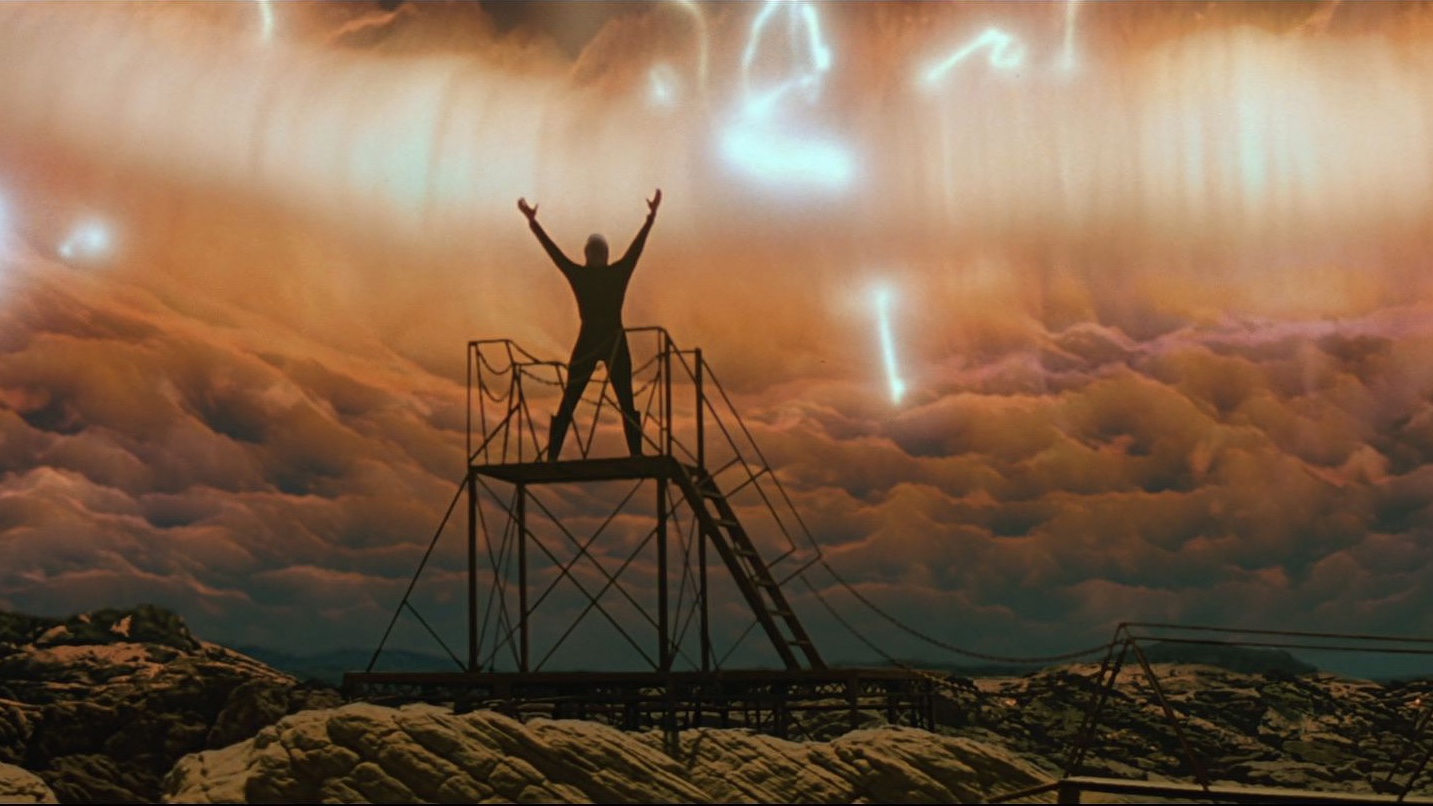
I’m very much aware that my assessments of the first two movies are probably where I differ the most starkly from the majority of the TNG fandom, in that, in a nutshell, I love Generations and loathe First Contact. The latter, of course, is a subject for another post, but I felt like I had to lay the whole picture on the table at the outset. As for Generations: on the whole, this is (undeservedly, I will argue) a much-derided movie. People dissed it when it first came out, and it is still widely looked down upon to this day. Some people, unaccountably, hate it; others merely consider it a disappointment. Some few, I’ve found, do actually share my liking of it to a degree, but even they usually damn it with faint praise—saying things like “it’s not that bad,” but still dwelling on its weaknesses at least as much as its strengths (even if they may be inclined to make excuses for the former). I, too, recognize it as an imperfect movie—but to me, it’s a great imperfect movie, whose flaws hold it back from being everything that it could have been, yes, but still don’t really detract all that much from my great fondness for it. I cannot, alas, award it a five-star rating or anything, but it easily warrants a wholehearted four stars. I saw Generations in the theater twice when it came out in 1994 (I was a junior in college at the time), and both viewings stand out in my memory as among the most intensely and thoroughly enjoyable movie theater experiences of my life. I’ll address others’ criticisms, and I’ll also get to my own thoughts on where the movie falls short (and how it might have done better)—but before any of that, I have to start by talking about my love for it.
A starfield; we could be anywhere. Off in the distance, there’s something moving through the emptiness of space. Music starts, softly at first, and a bit unearthly, conveying a sense of wonder and mystery. What is that out there, drifting through space? The music gets a little louder, previewing a few of the themes that will feature throughout the soundtrack. The object comes a bit more into focus; it appears to be…a bottle? Why is it out in space, and what is its significance? The music continues to build, seeming to imbue whatever it is that we’re watching with an air of momentous importance. It’s definitely a bottle, slowly spinning end over end as it drifts through the vacuum. That wonderful, weirdly visceral close-up shot of its bottom fills the screen, and the music starts to sound like it’s going somewhere definite. Then the whole bottle finally tumbles into our field of vision up close, so that we can read the label on it: it’s a bottle of champagne, vintage 2265. Now the music is really crescendo-ing, and it feels like we’re virtually flying along with the bottle…but suddenly, there’s a large object directly in its path. Smash! The camera pulls back to reveal a ship—it’s the Enterprise, of course, but NCC-1701-B—and as the bottle shatters and the champagne splashes across the hull, the music hits its climax, capped off by the Alexander Courage fanfare that is Trek’s most signature musical motif. Aha! A christening! And, of course, a torch-passing; classic Trek symbolically giving its blessing to those who will carry its spirit forward into a new era. I just… Sorry, but I don’t know how any Star Trek fan could fail to feel a shiver, and a warm appreciation, in these moments. The opening to Generations just grabs me, immediately, and gets me emotionally invested from minute one, before anything has even, per se, “happened.”
And over the course of the next hour-plus, it scarcely lets up, packing emotional punch after emotional punch (yet managing to fold no small amount of outright fun into the mix, too, along the way). We’re on a previously unknown Enterprise as she prepares for her maiden voyage, and a few “living legends” from the previous Enterprise are on hand to see her off; then, suddenly, we’re plunged into a rescue mission for which ship and crew are scarcely prepared. One of the in-trouble ships explodes; people die, and even though they’re unseen strangers, the Starfleet personnel on the bridge of the Enterprise keenly feel the loss, knowing that they failed those people, and the moment has weight. The inexperienced young captain, at a loss, defers to Kirk, who takes charge and makes things happen, and adrenaline starts flowing…but then, our aged hero remembers his place, and yields the center seat to its proper occupant. Meanwhile, refugees are being beamed aboard; one of them is…a confused-looking Guinan? Another, half-crazed, creates a big fuss. In due course, Kirk performs his heroics below-decks and the ship escapes, but not before taking a final beating…that breaches the hull in his vicinity. The remaining characters digest the loss of a legend, and the end of an era…and the starfield melds into waves in an ocean, as we jump 78 years into the future. There follows some pure fun (more on it later), but in its midst, Captain Picard apparently receives some terrible news, darkening the mood for him and the audience. Then there’s a distress call, a red alert, and we’re plunged into investigating an attack on an observatory. The captain is barely holding it together, going through the motions of being in charge while leaving it to Riker to actually make the decisions. This hits hard for me; the characters are utterly themselves, but Picard is so clearly not okay, and Riker is nonplussed, but steps up and carries on, and the narrative doesn’t pause to give anyone time to catch up, emotionally, because sometimes, that’s just how life is. There’s just this emotionally charged intensity to almost every scene in the whole first hour of the movie. Soren’s first real scene, wherein he asks the captain to let him go back to the observatory and the captain tries to brush him off, and then he cuts through Picard’s paper-thin facade of self-control (coming across like a dark reflection of Guinan, with his undefined El-Aurian insight into what’s going on with the captain—but used to manipulate rather than to help), adds to the atmosphere, while simultaneously establishing our villain’s obsession with time and mortality. Eventually, then, we get the scene in which Troi visits the captain and actually functions as an effective counselor, and we find out about the tragic deaths of Picard’s relatives (characters whom we met back in “Family”), and he ruminates about his family’s history and its lack of a future, and his growing awareness of his own mortality. Bam, bam, bam; every scene just keeps hitting you in the feels. It keeps going, too (I haven’t gotten to all the instances yet), but I have to switch gears and cover some other things (this is, after all, supposed to be a review, not a blow-by-blow synopsis!).
One of the complaints that I’ve been hearing from detractors of Generations for 30 years now is that it’s not “cinematic” enough. It doesn’t feel big and epic and movie-like, people say; it’s more like a glorified TV episode. I’ve never been able to understand, in the slightest, what people mean by this. I mean, just for starters, this is a movie that begins 78 years before TNG, on a different Enterprise, and gives us the apparent death of James T. Kirk; later, it features a full-blown space battle with the Duras sisters that results in both their death (!) and in the destruction of the Enterprise; Data installs his emotion chip, Worf gets promoted, and Picard grieves the death of his two closest family members. These are momentous events! But also, the movie has a very distinct visual style, and other elements of presentation, that, to me, definitely feel…cinematic (to the extent that I can even make meaning out of that notion). Many have criticized, for instance, the suddenly darker Enterprise sets—but I love this about the movie. And look…I don’t think we need to make too much of this change from an in-universe perspective; that is, my take is that we’re not to understand, necessarily, that sometime between “All Good Things…” and Generations, somebody decided that the lights should all be turned way down throughout the ship. I see this as purely an element of visual style, and of artistic license, and I’m totally fine with it. (Actually, it’s my understanding that the choice was dictated, at least in part, by the need to make sets that were designed for television look good on the big screen.) But what it does is contribute to the mood and tone of the movie, while at the same time helping to set it apart from the series. Everything does feel “bigger” and more epic, to me, than the TV show usually did; it works. Also… I venture outside of my comfort zone in trying to comment on this, but I feel like there’s something about the directing, and even the sound editing, that further contribute to what I’m talking about here. It has to do with way certain scenes are cut together, where the new scene’s dialog begins before the camera “catches up,” and there’s also an almost echoey, intense, and somehow “dramatic” quality to the dialog. (These elements have always especially grabbed my attention when Riker is reporting to Picard after leading the away team to the observatory, when he says “We found two dead Romulans on the station.”) Again, I’m not well-equipped to articulate what I’m trying to convey here, but together, these elements of presentation are powerful, at least for me. (On the other hand, one quirk that does detract, for me, is the movie’s confusion concerning uniforms; for some reason, some of the characters wear DS9-style uniforms some of the time, with no apparent rhyme or reason. I like DS9’s uniforms just fine on DS9, but I kind of want to see the TNG characters in their characteristic uniforms—and the lack of any apparent logic or consistency to the change-ups make this even more irritating.) Anyway… The movie does have some very TNG-episode-esque touches to it, granted, but why shouldn’t it? Honestly, I love things like the fact that the movie features Riker leading an away team, and the characters hunting through the wrecked observatory with their signature palm beacons—or even that the TNG-era portion of the movie opens with our beloved characters screwing around on the holodeck. This is still TNG, after all. It’s “bigger,” and status-quo-shaking things happen, and there are novel elements of visual style, etc., but it’s still the characters we know doing the things that they do. Honestly, to me, this aspect of the movie is pretty much pitch-perfect.
Then again, maybe what some people mean by “glorified episode” is that the stakes aren’t high enough, or the villain isn’t bad-ass enough, or that there’s not enough action and explosions, or something. One certainly hears Soren dismissed as just some boring mad scientist who is hard to care very much about. I’ve never really connected with these criticisms, either, though. I mean, sure, Soren doesn’t loom as large as, say, Khan Noonien Singh, but I guess I just don’t see this as a problem. Too often, in fact, movies (and TV shows) err by trying too hard to make their villain characters all epic and badass and over-the-top. When done both well and sparingly, a villain of that sort can be fun, sure (Khan being a prime example)…but posturing and mustache-twirling more often take me out of a story than get me more invested in it. What I most want is a villain whose motives I can believe, and whose role in the story means something—and Soren fits that bill, for me. Here is a guy with a traumatic past (that he shares with Guinan and with the entirety of the El-Aurian people), who once experienced a few moments of bliss and contentment, but was then ripped away from it and dumped back into the familiar world of suffering and pain. Guinan experienced the same thing, and dealt with it by doing her best to put it out of her mind and go on living her life according to her values; Soren, however, became obsessed, devoting decades to finding a way back into the nexus, and ultimately abandoning any other values that he may once have held if they got in the way of his all-consuming goal. Along the way, he begin conceiving of time, and mortality, as arch-enemies of a sort, while at the same time rationalizing the killing of innocents on the grounds that, after all, we’re all going to die eventually. These are lines of thinking to which many of us could potentially fall prey; they’re relatable (if extreme), and illustrate the dangers of succumbing to obsessive wants that blind us to the rest of what life has to offer. He and Guinan represent contrasting responses to coping with life’s pain and struggles, and in the movie, Picard implicitly faces a test concerning which type of response he will choose. Also, even if the “stakes” in the movie aren’t (literally, as in some past Trek movies) “Earth-shattering,” Soren represents a pretty extreme case of how not to live your life, and the “stakes” of not coping wisely with your shit. Plus…after all, the plot of the movie does involve our heroes trying to stop Soren from wiping out an entire planetary civilization. Sure, it’s not Earth, or any planet that we “know,” or something that we even get to see. But throughout the movie, any time actual or potential lives being lost comes up, the characters react emotionally in a way that makes it feel real. I already touched on this when discussing the Enterprise-B section. It happens again when the Enterprise-D arrives at the observatory, finding only five life sign on it, and RIker mentions that its regular complement is 19. And then, when Data and Picard puzzle out what Soren is up to, and Data notes in a hushed voice that his plan will destroy a planet with a population of 230,000,000, the movie again pauses for a moment while the two of them (and the audience) digest this information. Somehow, through a combination of the writing, the acting, the sound track, and probably other elements that I’m not as good at pinpointing, the move repeatedly makes the “stakes” feel real, and humanizes its characters through how seriously they take them, even though they always amount to the unseen death of anonymous hypothetical strangers. For me, this is all extremely effective, and absolutely results in a story that feels big and weighty and epic. If it doesn’t work for others, I guess I’m at a bit of a loss to understand why.
And then, on top of all of that: For chrissake, the Enterprise gets destroyed in this movie!! The actual battle, with the Klingons finding a way to even the odds against the more powerful Enterprise, and Worf and Riker using their knowledge of the old Klingon ship to throw together a counter-plan, and the death of the Duras sisters, is good exciting stuff, notwithstanding a few issues that I’ll discuss in due course. But then, just when you’re ready to breathe a sigh of relief, there’s the aftermath: the ship is badly damaged, and Geordi is scrambling to hold it together, but then he has to evacuate engineering, and reports to the bridge that he can’t reverse an imminent warp core breach. Riker orders emergency separation (something so baked into TNG on a premise level, but that we hadn’t seen since “The Best of Both Worlds”), and there’s a bunch of tense action as everyone is evacuated from the drive section (we’re reminded, again, of the lives at stake—all the people on board, the families, etc.)…and then, the drive section actually explodes! I, for one, was unprepared for this when I saw Generations for the first time. They really destroyed half of the ship! And even then, the danger isn’t over; the explosion hurls the saucer section toward the planet, and the helm controls aren’t responding…and then the movie cuts away to Soren and Picard down below, giving us a respite. You sort of assume, of course, that when we cut back, it will be to the characters managing to avoid crashing into the planet…but wait…no? Seriously, this part of the move was such an edge-of-my-seat ride when I saw it in the theater those two times. (I don’t even remember if any part of me was anticipating a possible take-back of the whole thing, given time travel and the nexus and all that. Obviously, I’m glad nothing like that happens.) People quibble about this or that detail, crack stupid sexist jokes about how the one time that Troi took the helm, the ship crashed (!), or even cynically dismiss the narrative choice to destroy the Enterirpse-D as merely a clearing of the way so that a new, big-screen-worthy ship could be introduced in the next movie…and it just baffles me. This is the ship that we knew and loved, and that served as our characters’ home and the vehicle for all of their adventures, for the full seven-year run of TNG! And it was just destroyed, in a gripping sequence of scenes that left me, at least, tense and breathless and fully emotionally engaged! It’s the end of an era, and who knew what would come next for our heroes now? All this amounts to “just a glorified TV episode”?
Another major critique that tends to get repeated about Generations is the perception that its story was sort of reverse-engineered from externally mandated starting points, the main one being that it needed to “bridge the generations” and give us Kirk and Picard working together (but without being, per se, a “time travel” movie). This is true, to a point, but the implication that it resulted in a cobbled-together story that lacks narrative cohesion, or an emotional center, or whatever, has never struck me as accurate. I mean—okay, so one complaint has always been that the inclusion of Scotty and Chekov in the Enterprise-B section, rather than, say, Spock and McCoy, is self-evidently a real-world compromise dictated by which original Trek actors did or didn’t agree to participate, and more than one person has pointed out that some of their lines come across as clearly having been intended for, say, McCoy. I see this, but honestly, it just doesn’t bother me all that much. Would it have been fun to see Bones and Spock there along with Kirk for the launch of the Enterprise-B? Sure. But was it necessary? I’m not sure that it was. The roles are so small, and not really crucial to what that part of the movie is trying to do; also, I’m content with the idea that, at this late date, after all their experiences together, Kirk’s other officers have become more like peers than like subordinates, and so I can buy Scotty and Chekov teasing him a bit in the way that Bones would have done back in the day. (And frankly, the “Is there something wrong with your chair?” line was gold, no matter which TOS-era character uttered it.) There’s also an in-universe plausibility, I think, to the fact that the “living legends” from the original Enterprise who turn up for the 1701-B’s launch are more or less an arbitrary subset based on who happened to be available at the time. (Now, when I get to discussing the nexus, I may find myself wishing that Spock or Bones could have been in that part of the movie—but I’m not there yet.) Getting back to the overarching criticism, though: I guess I feel like critics and fans alike have tended to miss how well the movie weaves a coherent and thematically resonant story around the idea of passing the torch from one generation to the next. (One review that I read, ridiculously, goes so far as to dismiss the entirety of the movie between the 1701-B prologue and the eventual Kirk-Picard team-up as “a distraction”1 (!).) What I see is this: First, a movie whose villain is defined by his failure/inability to come to terms with with trauma/mortality (whether his own or that of whomever he once loved), and whose pursuit of an escape from these things is what drives the plot; second, a legendary but now retired Starfleet captain confronting the end of his “relevance” and the need to step aside and allow fresh young officers to take his place; and third, our primary protagonist, another Starfleet captain who is aware of his advancing age, and who is reeling from news of the tragic deaths of his closest family members and grappling with the realization that there now will be no “next generation” to carry on his (family) legacy. (Incredibly, two different reviews that I came across while writing my own are both critical of the movie’s portrayal of Picard, and of his grief over Robert’s and René’s deaths. Jammer, whose site I’ve linked to numerous times from my reviews and whom I generally respect, even if I disagree with him often enough, sums up his take with the astonishing remark “I think, in a way, we simply don’t want to see the captain of the Enterprise sitting in the dark, crying.” Zack Handlen of the A.V. Club expresses a weirdly similar view, complaining that the movie “goes out of its way to make Picard seem weak and soft-hearted,” that his “grief is too much,” and that he doesn’t come across as “taking the mantle from Kirk” in the movie because he’s “just too broken.” I…scarcely know what to say, here. This take just seems bizarre to me.) Our two captains both end up in the nexus—the very “escape” that Soren seeks—and have to overcome its temptations and choose to return to “reality” in order to prevent the millions of innocent deaths via which Soren has bought his own ticket there. In the process, Kirk gives his life, while Picard (who of course survives) works through his malaise and emerges with a renewed sense that grief, aging, and the inevitability of death are reminders to us that we are alive, and to fully inhabit our present reality while it lasts. And, yes, I will absolutely be getting to some execution issues with some of this in due course, here—but in broad strokes, this is a well-constructed and powerful story, with some fantastic character moments, that speaks eloquently to the human experience! So say I, anyway.
Then, of course, there’s Data and the emotion chip. Boy, do a lot of people ever not like what this movie did with Data. Now, at the outset, and notwithstanding the fact that I take a different view, I am going to cut the detractors some amount of slack on this. Yes, the movie does lean pretty heavily into the “Data finally gets humor” angle, and yes, there are moments when this zany, humor-obsessed version of Data gets a bit grating. Also, yes, I agree (to a point) with the common criticism that Dr. Crusher, and the other characters in general, overreact to his pushing her into the water at the beginning. (There are context issues that make what he does different from what Riker does to Worf, and for the others to find his action un-funny and less than appropriate does make sense to me. But still, the reaction is a bit extreme.) However, anyone who sees the Data/emotion chip stuff as just some minor, pointless subplot that’s unconnected to the rest of the movie (and present merely because the writers thought fans would like it), or who dismisses it as nothing but superficial humor stuff, really seems (to me) to be missing and/or ignoring the obvious. Data’s first (extended and genuine) experience of real emotions, and his struggle to integrate them into his life (in Picard’s words), form another clear parallel with (and, ultimately, a contrast to) Soren and his inability to deal with his trauma, as well as mirroring Picard’s emotional journey. In fact, the very first glimpse that we get of Data having “emotions” (when he tastes the drink in Ten-Forward), besides being genuinely funny, is on-theme for the movie, in that it illustrates how even an experience that is, on its face, negative, can, in its own way, enrich one’s life, if one approaches it with the right mindset. Before long, though, Data of course starts to feel overwhelmed by the sudden onslaught of emotions for which none of his prior experiences have remotely prepared him (especially once he gets his first real taste of fear, followed quickly by guilt and remorse and concern for Geordi)…which brings us to what is, for me, the most compelling scene of the movie: the stellar cartography scene. There’s so much going on all at once in this scene, beginning with the backdrop of the beautifully realized and very cool stellar cartography lab itself, and extending also to the clever and satisfying deductive work that Picard and Data do to figure out what it is that Soren is up to. But the highlight, of course, is the moment when Data (Data, of all people!) has his little meltdown, and demands (raising his voice at his captain) to be deactivated. Like Soren, he seeks an “out”—an escape from the burden of feelings that he doesn’t know how to handle. Picard, who has already had a few similar moments earlier on (when he left the investigation of the observatory up to Riker and retreated to his ready room), and who is even now barely holding it together, fully empathizes, and is uniquely able to talk Data through his crisis (deploying his signature one-two approach, first playing the stern captain and informing his officer in no uncertain terms what is expected of him, then softening that by offering words of connection and encouragement). “Sometimes it takes courage to try, Data—and courage can be an emotion, too.” I’ve already expressed, too, my appreciation for the moment shortly after this, when Data calls attention to the fact that Soren’s plan will result in the death of hundreds of millions, but I think part of what makes that moment hit the way it does is that we can imagine both of the characters in the scene reflecting on the depths to which Soren has allowed himself to sink, under pressures not dissimilar to what they themselves are feeling. Data’s desire to be deactivated would have deprived the Enterprise of his expertise, but a few words from his captain were enough to remind him of his duty; Soren’s yearning for the bliss of the nexus has led him to casually dispose of an entire planetary population, and Picard’s attempt to talk him down (or “dissuade [him] from [his] evil plan”) will not be so successful. Neither Picard nor Data is remotely the person Soren is, but the moment still functions as a wake-up call for each of them. Anyway, it’s just an awesome scene. From there, though, I’ll admit that most of the rest of the “emotional Data” stuff in the movie is a bit fluffier, and I don’t strongly love or hate it. The dorky little “life forms” ditty is good for a laugh, sure, and the gag of Data being, due to his inexperience with emotions, the one guy on the bridge who is juvenile enough to fist-pump triumphantly at the destruction of the Klingon ship kind of works, even if it also feels like a bit of a tonal clash with the rest of the movie. Finally, though, the ending beat of the Data story, when he is reunited with Spot…? I dunno—maybe it’s cheesy and obvious, but it gets me every time.
Okay, so, next I’m going to try to dispense quickly with a few other common complaints that one hears about Generations (moving from some of the sillier ones, to a few that have somewhat more merit), before finally getting to my thoughts on the aspects of the movie that, in my view, truly do fall short. One thing that I’ve heard/read with surprising frequency, for instance, is the perception that the movie (and actually, to some extent, all of the TNG movies) abandons the ensemble style of the show to focus almost exclusively, character-wise, on Picard and Data. One reaction that I have to that criticism is that, since Picard and Data are for sure my two favorite TNG characters, I find it hard to get too upset about this. But also, I feel like this perception ignores both the fact that many, many episodes of the show also focused on one or two characters to the near-exclusion of most of the others, and also some of the fun stuff that several of the other characters do get in the movie. The TNG-era opening sequence of the movie, with the whole ensemble gathered in the holodeck to celebrate Worf’s promotion, is pakced full of fun bits (especially for Riker, who not only pulls the plank-removal stunt and humorously takes the wind out of Picard’s romanticization of life at sea, but also has way, way too much fun shouting orders about obscure old-time sailing vessel stuff). Riker also gets to command the ship for a solid chunk of the movie, including during the big battle, and he, Worf, and Data collaborate to come up with the plan that prevents the Duras sisters from blowing them all up. I already commented on Troi being an effective counselor to the captain, and Geordi has some assorted good moments as well. True, the story doesn’t “feature” these characters (in the sense of giving them arcs or having the story be “about” them in a significant way), but it hardly neglects them, in my view. Other common criticisms concern just about everything about the nexus, from the dubious logic of how the energy ribbon works, to the whole idea of this outside-of-normal-time cosmic realm of bliss. And, I mean, sure, it’s kind of out there. What exactly is it, and why would a thing/place such as it exist? If you approach it from the perspective of someone who likes “hard” sci-fi and prefers a fictional universe that makes basic sense, it’s gonna bug you, and I get that. But if you take more of a speculative fiction view of it, as a “what if” concept via which to explore human questions (like whether such a place would truly be fulfilling if you knew that nothing there was “real,” etc.), there’s value in it. (Personally, I kind of approach it in both of those ways, so I both like it and find it a bit silly.) (Also, granted, the logic of how to get into the nexus without getting killed by the energy ribbon, and why Soren needs to do what he does, is a bit dubious.) People who cynically dismiss it as simply a device that can conveniently do whatever the plot requires of it (like bring the two captains together, and let them exit at whatever point in time they want—or contain an echo of Guinan to help Picard find his way) are “right’ insofar as it’s nature indeed was, presumably, dreamt up in order to make the story work, but for me, it nevertheless holds together as a concept well enough. Soren tells Picard that “time has no meaning there” before the captain ends up there, and this aspect of it relates to the character and theme issues surrounding Soren, so when Picard gets there and that proves to be the case, it doesn’t feel like “merely” a plot contrivance, to me. (And the Guinan echo makes sense, too; if time has no meaning in the nexus, then anyone who has ever been there is, in some sense, sort of always there.)
More genuinely problematic, for me (although still not getting to the meat of my own criticisms), is the fact that there is clearly something…missing, in the section of the movie wherein Soren has abducted Geordi, and is working with the Duras sisters, and eventually the villains and the Enterprise do a prisoner swap of Geordi for Picard. I like the scene in which Soren talks to Geordi about his visor and seems to be about to torture him, but it’s not clear what Soren’s goals are…and then we skip to him later telling Lursa and B’etor that he didn’t get anything out of him, and saying the line “his heart just wasn’t in it,” which apparently references a cut scene that (maybe?) would have connected some of these dots. They do use the visor for espionage, of course, and that’s cool, but even there, I wonder: like, they just lucked into this, right? Because Soren just happened to take Geordi with him when he beamed off the observatory for…reasons? And then, Picard gets Geordi back by offering himself in Geordi’s place, on the condition that they beam him down and let him talk to Soren, because someone needs to try to stop Soren…but did it have to be Picard? And Riker has no objections to this? The movie just kind of sails past some of these points and expects the audience to swallow them, which is honestly a bit much. Finally, it’s not entirely clear to me why Lursa and B’etor are even sticking around at this point, much less what their motives are for attacking the Enterprise. They’re only helping Soren in exchange for the weapon that he has offered them, and he promises to transmit the info that they need once he’s down on the planet. Assuming that he follows through on that, why wouldn’t they just take off once they got what they wanted? Or alternatively, if we assume that he never did transmit the info, then wouldn’t they be upset about that and focused on trying to get it from him, rather than on attacking the Federation’s flagship for no particularly good reason? I want all of this to make sense, because I like the movie and I specifically enjoy the battle and everything…but unfortunately, it really does feel like some of the plot stuff here doesn’t quite hold together.
(Also: This is Trek nerd nitpick-level stuff, but as much as I enjoy the battle with the Duras sisters, it seems like the writers’ brains must have been on a coffee break when they opted to have the Klingons firing photon torpedoes at the Enterprise. Photon torpedoes are physical objects; they can’t be set to a “frequency” that enables them to somewhow penetrate shields whose “modulation frequency” you have managed to learn. Doing this with an energy weapon (like phasers or disruptors) seems consistent with the established tech/lore of the world, and thus would register as clever and plausible…but photon torpedoes!? Not sure what they were thinking there. Also, my sense is that a ship that gets hit by a photon torpedo, with no shields to protect it, ought to be pretty much done for; it’s supposedly a matter-antimatter explosion, similar to what happens in a warp core breach. Yet the Enterprise takes numerous direct hits, with no shield protection, and remains essentially intact (until it doesn’t). Both problems would easily have been fixed by just having the Klingons use disruptors rather than photon torpedoes. Hmph.)
Finally, though, what really doesn’t work for me about Generations comes down to two things: first, the specifics of what our two captains experience in the nexus; and second, the somewhat underwhelming climactic fistfight via which they actually defeat Soren (at the cost of Kirk’s life). I’m very far from being the first person ever to criticize these aspects of the movie, of course; it’s just that, whereas most of the other complaints that I’ve heard over the years strike me as either off-base or trivial, these ones represent (to my mind) the movie genuinely falling short of what it could and should have been. On the other hand, though, they also (obviously) don’t kill the movie for me—and, in fact, I have some thoughts to offer about what could have been done differently to fix the problems, without radically altering the overall story. (Admittedly, these thoughts are somewhat incomplete; I aim merely to point the way toward some farily easy and obvious avenues for improvement, while preserving most of what I like about the movie.) So—without further ado…
First and foremost, Picard’s nexus experience is total crap—and it totally didn’t need to be. Yes, I get that he finds himself in the nexus at a point when he’s mourning the deaths of his closest family members, and grappling with the realization that his “family line” will not continue. That’s fine. But this shouldn’t change who he fundamentally is as a person. In particular, even if I were to accept that he’s entertaining, at this moment, serious regrets concerning his own life path (not having children, etc.)—which, to be clear, I don’t, but I’ll get to that—this doesn’t mean that it makes any sense for his fantasy alternate-life to look soooo conventional and old-fashioned (even by late-twentieth-century standards). From the hideously dated gender roles implied by the barely-sketched wife figure, to the ludicrously old-fashioned toys, to the overly sweet tone of the Christmas scene, nothing about it says “Jean-Luc Picard” in really any way (reference to Earl Grey notwithstanding). But also: Yes, sure, Picard is sad about the death of his nephew René, and has family on his mind…but it really would not have been difficult to craft a nexus fantasy sequence for him that spoke to these things (and to the overall themes of the movie) in ways that would have been truer to the character. Suppose, for instance, that we had started with a scene where he has gone home to visit his (still alive) family, a few years in the future, and we see that he and Robert have fully reconciled; meanwhile, an eighteen-year-old René is preparing to leave home and go off to Starfleet Academy, following in his uncle’s footsteps. Then maybe we jump ahead to see Ensign René Picard, fresh from the academy, reporting for duty aboard the Enterprise, and our captain getting to act as mentor and surrogate father figure to the young man as he blossoms into a fine officer, and gets to have the very sorts of experiences that Picard, in the earlier scene with Troi (back in the real world), lamented that his nephew would now never get to have. Now we have something that speaks to this moment in Picard’s life, and to the movie’s eponymous motif about the passing of generations (while simultaneously tempting our protagonist with a pain-free alternative to how things are playing out back in the real world), all while still showing us a recognizable and believable Jean-Luc Picard. Wouldn’t that have been great?
(A secondary issue concerning Picard’s nexus experience that often comes up is that of how easily he seems to shake off its hold on him, despite Guinan having warned him earlier that, if he found himself there, he wouldn’t care about anything else, and wouldn’t want to leave. I understand this criticism to a point, in that, for our protagonist’s temptation by the nexus to feel significant, and his choice to leave it to seem heroic, we should see him struggle to arrive at that choice. But to be honest, this doesn’t really bother me too much. Sure, it probably should look a bit harder for him. But we’ve already seen him struggling to soldier on in the face of his grief through most of the movie prior to his winding up in the nexus, and already heard him tell Data that “sometimes it takes courage to try”—and also, of course, we don’t want the movie to linger overlong in the unreality and inconsequentiality of the nexus. Plus, as regards specifically the contrast from what Guinan described, I’m of the view that, however insightful and wise, Guinan can, after all, be stuck in her own perspective, and fail to reckon with the contextual differences pertaining to Picard’s experience. After all, she’s basing her warning on a few brief moments that she spent in the nexus, 78 years ago, and at a point in her life when she had just lost everything, and thus presumably had very little to tether her to life in the real world—and from which she was then unceremoniously yanked, without having any say in the matter. Our captain, by contrast, has enough time to actually contemplate his situation and the agency to make decisions about it; has plenty to live for, however much he may be grieving; was in the midst of trying to accomplish something important, which his trip to the nexus interrupted; and has the cautionary example before him of Soren’s obsessiveness over the nexus (not to mention the benefit of Guiinan’s warning itself). Small wonder that his experience of how compelling the nexus is should be different from hers!)
Kirk’s nexus experience is a slightly tougher nut to crack, especially given the constraint of Leonard Nimoy and Deforest Kelley having declined to appear. What we get for Kirk isn’t as egregiously wrong as the Picard Christmas scene, either, although a) making it be about a blown relationship opportunity with a woman whom we’ve never heard of before was an uninspired storytelling choice, and b) it really does seem, as others have argued before me, like his happy place would be on the bridge of the Enterprise, surrounded by his friends/old officers. (Since the opening part of the movie features him struggling to let go and allow a fresh young captain to command a new Enterprise, I think it makes particular sense that his nexus wish fulfillment scenario should be backward-facing, as opposed to the forward-looking fantasy that I suggested above for Picard.) I do like what the movie does with having him grow disenchanted with the nexus specifically because nothing matters there (making him every bit as irrelevant as he was as a bystander watching Captain Harriman claim the center seat on the 1701-B), but I think more could have been done to connect his arc with core character concerns for the James T. Kirk we knew from previous stories. Again, in part that probably means giving him Spock and McCoy to interact with, which may simply not have been feasible (unless offering expanded parts to the actors would have enticed them to participate, that is?). But also, what about revisiting the whole question of the Kobayashi Maru and Kirk “cheating death”? On one hand, continuing to exist in a nexus fantasy scenario after being presumed dead back in the “real world” takes cheating death to new levels; on the other, leaving the nexus with Picard to “make a difference” in the real world again, 78 years after his apparent death, might look to him like a fresh new way to metaphorically beat the Kobayashi Maru (not unlike Spock’s return from the dead at the end of Star Trek III). So the movie could have played with this ambiguity for a while, before resolving it by having him ultimately choose to sacrifice himself to save the millions of lives on Veridian IV—thereby finally and irrevocably accepting his own mortality.
Dispensing briefly with two smaller issues concerning the nexus portion of the movie, before moving on to consider the confrontation between the captains and Soren: First, while I approve of how events unfold overall, with Picard being the one to decide of his own accord to leave the nexus, then persuading Kirk to accompany him (because Picard has information that Kirk lacks, because he’s the one who has an urgent thing left undone back in the real world, and because, from a narrative perspective, he’s the primary protagonist), I do think that the specifics of how they actually meet up feel kind of contrived. Echo-Guinan plucking the idea of Picard seeking Kirk’s help more or less out of the blue, and her lame expository line about how “from his point of view, he just got here, too,” represent one place where I feel like the writers’ stitching shows a little too much, and also isn’t very well justified (yes, time has no meaning…but surely that merely means that Picard could choose to appeal to a just-arrived Kirk versus one who’s been in the nexus for longer—not that this somehow just “happens” to be the case?). Second, of course, there’s the whole issue of “why not go back to reality at an earlier point, thus giving yourself more time to stop Soren?” This is, indeed, dumb, but it’s also kind of par for the course in stories of this ilk. I mean, it’s exactly the same as Marty McFly saying to himself “I’ve got all the time in the word!” and then going back to 1985 a mere ten minutes before the Libyans will shoot Doc Brown. Is it nonsensical? Absolutely. But is there anyone out there who hates Back to the Future because of this? Of course not.
We come, then, to the captains’ team-up, the final fistfight, and Kirk’s death. First, let me just say that I have exactly zero sympathy with those who question whether the movie should have killed Kirk off at all. Not only was it beyond time (I, along with plenty of others, had fully expected him to die in The Undiscovered Country), and not only is it silly to resist or resent the idea of a favorite character ever meeting his or her end (especially when it’s pretty much a given anyway that he won’t be appearing on screen again), and not only is it more fitting for Jim Kirk to die nobly in action rather than lingering through years of retirement…but it’s also, obviously, entirely on-theme for the movie. Kirk dying was absolutely the right call here. But those who acknowledge that, yet find something lacking in the manner of his death, have a point with which I rather agree…and for which I have only a partial solution to present. One form that this objection often takes is the view that ideally, Captain Kirk should have met his end on the bridge of a starship. I largely agree with this, but I don’t really see a feasible way for this to have happened, short of reworking the entire movie in a pretty fundamental way. Even so, though, the fisticuffs don’t really make for a very inspiring climax, and the specifics of his death end up just feeling kind of random, and his dying words hardly feel like the stuff of legend. So, even working within the parameters of the rest of the movie (and thus giving up the idea of him being on a starship), I do feel that something much more compelling than what we got could have been cooked up—and I have some ideas about what that might have looked like, at least in part.
So, Soren suddenly finds himself confronted, out of the blue, by someone who wasn’t present a moment ago, and asks him “Just who the hell are you?”, and from behind him, Picard answers: “He’s James T. Kirk. Don’t you read history?” Then, a bit later, Soren acknowledges that he does know who Kirk is, and that history records him as dead. Well and good. But shouldn’t Soren, then, be able to put two and two together, and realize that to be alive, and here, Kirk must have ended up in the nexus when the 1701-B pulled him and the other El-Aurians out? From which, then, it wouldn’t be too much of a leap to guess that Picard, also, must have gone there (meaning that he, Soren, had succeeded in his plan), and that the two of them must then have come back to retroactively stop him. This information, to my mind, should have given Soren pause. He’s spent almost eight decades obsessively pursuing the goal of returning to a nexus that he once experienced for a few brief moments, ultimately cutting a weapons deal with Klingon thugs and cavalierly consigning an entire planetary population to death in the process…and here come two guys who fell into the nexus by accident, then voluntarily chose to leave it. “What does this say about me?” he might wonder. Even Picard’s earlier jab about how what he’s doing is no different from what the Borg did to the El-Aurians seemed to make him reflect for at least a second; now, perhaps, he hesitates a bit more—enough, at any rate, to permit our captains to get the upper hand, enabling them to secure his person without a protracted physical fight. Now, this wouldn’t be the end, or anything; I mean, I would have preferred something a bit more cerebral than the boring fight sequence that we got, but I also recognize the need for something a bit more suspenseful and adrenaline-evoking to provide a climax. So maybe there’s some verbal back and forth between an incredulous and now somewhat self-doubting Soren, and our two heroes, that draws out some of the philosophical and thematic ideas (and character motivations) that are at the heart of the movie. (Kirk ruefully compares himself to Soren, in light of his own history of “cheating death”? Maybe Picard voices thoughts similar to the ones he expresses to Riker at the end of the actual movie, about seeing time not as a predator, but as a companion? Soren has trouble seeing any of this as more than just empty words, yet he can’t entirely dismiss them, either? I dunno; just brainstorming, here.) And then…something happens. Perhaps Soren was almost convinced of the error of his ways (or maybe he just lets the captains think that he’s had a change of heart?), but then something prompts and/or allows him to make a break for it…and the captains discover that all this time, the missile that’s going to be launched at the Veridian star has already been irreversibly on a countdown to launch? I don’t have this entirely figured out at all, but I feel like I’m on the track of something, at least. In the end, my idea (borrowing from what actually happens a bit) is that, perhaps while Picard is chasing down an escaping Soren, Kirk works out that the only way to stop the missile from launching is to engage its locking clamps—but he won’t have time to do this and still get away before the launch pad blows up. (Not sure exactly how this dilemma would be conveyed to the audience, but surely it could be done.) So he makes a deliberate choice to do what has to be done, knowingly sacrificing himself (and doubtless uttering some dramatic and very Kirk-esque final words right before the countdown arrives at zero). Soren, meanwhile, dumbfounded by Kirk’s willing embrace of death, perhaps has a bit of a meltdown, which allows Picard to recapture him (I rather think that winding up in prison, rather than dying, is the proper fate for Soren; nothing but time on your hands in prison, and no convenient escape from the truth of who you are and how you’ve spent your life). Do I have anything here?
I could certainly find more to say about this movie, if I wanted to. For sure, there are lots of memorable lines, or fun little moments, that I could comment on, if I let myself (and probably some more nitpicks that I could raise, too). But I think I’ve said all that needs to be said, so I’m going to call it done. In the end, Generations is (for me) an extremely enjoyable and beloved movie that provokes me to both think and feel deeply…but that also, sadly, kind of biffs its final half-hour or so, thus falling short of being the masterpiece that it might have been. Even so, though, I love it to death. In fact, considering how the remaining TNG movies would turn out—as well as the fact of the 1701-D meeting its end in this one—I pretty much think of Generations, head-canon-wise, as the final adventure for these characters, and the culminating installment of this particular iteration of Star Trek. As such, it occupies some prime real estate in my heart.
- By quoting this particular review, it may be that I risk strawmanning other critics who don’t like the movie. I mean, I guess I shouldn’t be too surprised that someone who, elsewhere in his review, opines that “Star Trek: The Next Generation didn’t work,” would be inclined to dismiss any portion of the movie that doesn’t involve Kirk. The fact that Kirk dies (twice) in it is the only thing that really matters about Generations, according to this guy, and the two captains’ “final act team-up” is “the unquestionable highlight of the film,” even though he also finds it underwhelming (I don’t entirely disagree there), and even feels that Kirk’s “presence in the movie has no greater meaning other than it being predetermined that he had to die.” Honestly, I can’t make much sense of this particular take. ↩︎
I would have posted this sooner, but the site was showing me how to “get down,” per its namesake. Seems it didn’t stay down long.
Yes! It’s so satisfying to watch someone say all the true things about this movie when it seems like everyone else I’ve ever heard talk about it is so utterly wrong. It’s like there’s groupthink when it comes to… well, a lot of things, obviously, but certainly Trek movies, like the “odd number curse” that by this point seems like it had become almost a thing fans were determined to believe rather than something that followed from the quality of the movie. That was only ever really true, let’s be honest, with respect to I and V. I think the whole notion that Generations felt like “just another episode” comes from people who didn’t really know what to expect from the movie exactly, but just had it in their heads vaguely that it would be different from the series in a similar way to how the TOS movies were different from TOS. It was set on the same ship, and the crew were still in same “place” (at least initially) that they were when we last saw them, so… it just isn’t different enough, I guess. You point out all the ways it really was very different in the ways that matter, but it was never going to feel different to most people when it had essentially the same sets, props, characters, and premise of TNG.
I really love the connections you draw between the need to experience negative emotions for Data to the overall theme here. I don’t know if I really ever thought about that.
Re: “it ignores the full cast”
I mean, all Trek movies do that. It would be pretty hard to give a major arc to all of them in a single movie and still have the movie be good. It would almost certainly seem like an exercise rather than a plot.
Re: torturing Geordi
The way it’s presented doesn’t make a ton of sense (or really it reads almost as though they had an idea that didn’t survive transition to the film’s final cut), but wouldn’t it work just to assume they kidnapped Geordi for his visor and tortured him in order to make him *think* it was for another reason?
Re: leaving the nexus
If you can leave the nexus anyplace, anytime, then why is there only one Picard when he gets out of the nexus on the planet?
Re: uniform weirdness
This begins a tradition that seems really weird to me, which is that different crews wear totally different types of uniforms even in the same era in subsequent incarnations of Trek for some reason. I don’t know if there’s some real-world military precedent for this, but I personally find it rather annoying and continuity breaking, and it’s like the showrunners don’t even want us to believe we’re in the time they’re telling us they’re in.
Re: “the nexus is weird”
I mean, yeah, maybe it doesn’t seem likely that such a phenomenon would exist naturally, but if you assume it was created by aliens, it doesn’t seem *so* far off. But that’s beside the point. I mean, obviously I agree with everything you said here. But the fifth episode of the first incarnation of Star Trek features Kirk being spit by the transporter into a good half and an evil half, and that’s just the beginning of all kinds of nonsensical plot points and pseudoscience that Trek embraces and embraced from the very beginning. Telepathy, “aliens” that look identical to humans, androids that short out when confronted with illogical statements, “energy beings” with godlike powers, transporter tech to begin with–the list is endless. If you want hard sci fi, you’re just going to have to look for a series that isn’t Star Trek. The nexus is less ridiculous than *any* of the things I just mentioned, and that’s without even getting to the TNG era!
About the nexus, too: I do think that if it were clearly just a fantasy, realistically it would be only a little better than a holodeck and it would get old pretty fast as a substitute for real life, at least unless it were messing with the pleasure centers of your brain or something–which, based on Guinan’s description, I sort of assumed it was. It made you foggy and happy, and entertained you with what you most wanted, without even letting you know that it wasn’t real. Honestly, the changes you suggest almost completely fix the movie’s imperfect depiction of the nexus. I don’t know what they were even thinking by giving Picard a traditional 19th Century family Xmas. Now, I’m not sure how much screen time you’d want to devote to it, but imagine Picard in the nexus enjoying the future experiences you noted and believing that they were really happening, but throw in little “hints” about reality–like the exploding stars in the Xmas tree (but maybe not that if it’s not Xmas in his fantasy anymore)–that start to nag at him. Show the experience being surreal. Start in the middle of his fantasy instead of the beginning. Imply that a large amount of time has gone by where he has given in to it and struggled with it. I mean, he’s experienced a subjective lifetime before. Maybe this takes months or years. Have him meet Guinan, who becomes a representation for his conscience, who helps snap him out. And when you get to Kirk, it seems so perfect to have him looking backward as opposed to Picard’s forward, preferably toward the time in TOS. Get some special effects in here to bring him back to that time if you can, or just use old Shatner on the classic bridge. The fans would have loved to see that, don’t you think? Young Kirk on the bridge of the Enterprise, no bloody A, B, C, or D. He’s engaging in cowboy diplomacy, saving planets… maybe he’s been at this for a while, rescuing civilization after civilization, high on the heroism… but it’s not real, and that’s how Picard brings him out, by helping him to save a *real* planet. I’d also like to hear it more clearly stated or shown that if you choose to embrace time in the nexus, it brings pure joy, but you can pull yourself out of the joy if you fight it. Kirk should not want to give up the joy he is experiencing, and only the knowledge that no one else benefits from his heroics can bring him out. Accordingly, and it should *hurt* when Kirk and Picard emerge. Maybe they don’t get a choice about where they come out. Not that I fundamentally disagree with anything you said about this, either, but I think stuff like this might make leaving the nexus in itself feel heroic, and I want to see more heroism from these two.
I really do think you’ve got something here. The emptiness of the fist fight is completely livened up by the addition of banter (while they fight) about cheating death and Soren’s realization that these two left paradise to come stop him (!). Ultimately, Picard has to subdue him so that he can go to prison, which as you point out is definitely the right punishment for Soren, where he has plenty of “time” to think about what he did (attempted genocide, I suppose you’d call it, but a weird sort of genocide that kills every single person on a planet, but if you fail kills nobody). I definitely think you nailed the fundamental issue with Kirk’s death. Should it have happened on the bridge of a starship? Okay, maybe, ideally. But the real problem with it here in my view is that he just dies without ever getting a choice about it. He chooses to come back to reality to help, sure, but that just means re-entering the real world. He should die because he chooses to die to prevent the launch. And your idea about this is great—there’s no way to avoid it without engaging the locking clamps, which he could tell Picard by communicator, make a pithy Kirk comment, and explode. Maybe something about cheating death or not being able to. Sometimes, your luck runs out.
(Never mind that the smarter thing would be to ride back into the nexus and try one more time… that might just get too confusing.)
“All Good Things” is a great finale and I thoroughly enjoy it. But I definitely don’t love it in the same way I love Generations, even though in some ways Generations has more flaws as a movie than AGT. It tackles themes that I personally find extremely emotionally provoking, yes, but it’s more than that. Like you point out, even the intro with the bottle grabbed me from the very first time I saw it in a way that I’m not sure *any* other trek movie ever did. Data’s experience with emotion is so personal and so relevant to anyone who has ever grappled with difficult feelings or experienced adolescence (so nearly everyone). The movie feels totally epic to me, and the first two acts absolutely have a grip on me that doesn’t let go with subsequent viewings. If they’d addressed the two concerns you mention, it would be without a doubt my favorite Trek movie, and one of my favorite movies to boot. I agree that in the end, its problems, which are all to do with the resolution in the third act, don’t permit it to be fairly regarded as a five-star experience. But for that, its ambitions, its character moments, and maybe more than anything its skill in dramatizing its themes make love it more than I love a lot episodes/movies that ultimately come together more perfectly.
I appreciate your responses and comments! 🙂 In particular, I’m glad you like my ideas for how the weak aspects of the move could have been fixed. Most of the rest of what I said in this review reflects thoughts and opinions that you and I have both held for a long time, but those bits were things that I only just came up with while pondering the movie after my recent re-watch. Your further elaborations on my thoughts are good, too.
A few other comments:
Re: torturing Geordi, and your question “wouldn’t it work just to assume they kidnapped Geordi for his visor and tortured him in order to make him *think* it was for another reason?” Maybe, but it would take a bit of re-writing, I think. In the movie as it exists, it doesn’t seem like abducting Geordi was something that Soren had *planned* to do; he just happened to be there when Soren was beaming off the observatory. (And even then, it’s not clear *why* he takes Geordi with him. I guess we could choose to suppose that he knew all about the visor and saw an opportunity in the moment, but the movie really doesn’t suggest this in any way.)
“Why is there only one Picard when he gets out of the nexus on the planet?” Yeah–I had intended to comment on this, but it seems that I forgot. It is, indeed, a plot hole.
About uniforms: Initially, I thought they came up with the DS9 uniforms basically out of a desire to (help) give the new show a distinctive visual aesthetic (though arguably the Cardassian space station architecture already set it apart pretty starkly from the look and feel of the Enterprise), and sort of justified it via the idea that space station personnel had different uniforms from starship personnel (or is that just something fans came up with?). But then Generations did its weird thing…and then Voyager used the same uniforms as DS9 (right), which seemed dumb. Beyond that, I’m not 100% what you mean about different uniforms in the same time period. I may be forgetting stuff and/or just not be aware (?). In any case, I do wish this movie had just stuck with the standard TNG-style uniforms. Oh, well.
About “All Good Things” vs. “Generations”: I dunno. I can’t easily compare my fondness for the one vs. the other. They’re both REALLY good, but they’re just two entirely different beasts. They BOTH address themes that mean a great deal to me. I’m glad they both exist. 🙂 For sure, though, Generations is more “epic,” and more *daring*…as, indeed, one would expect for a movie as opposed to a TV episode (even a finale).