
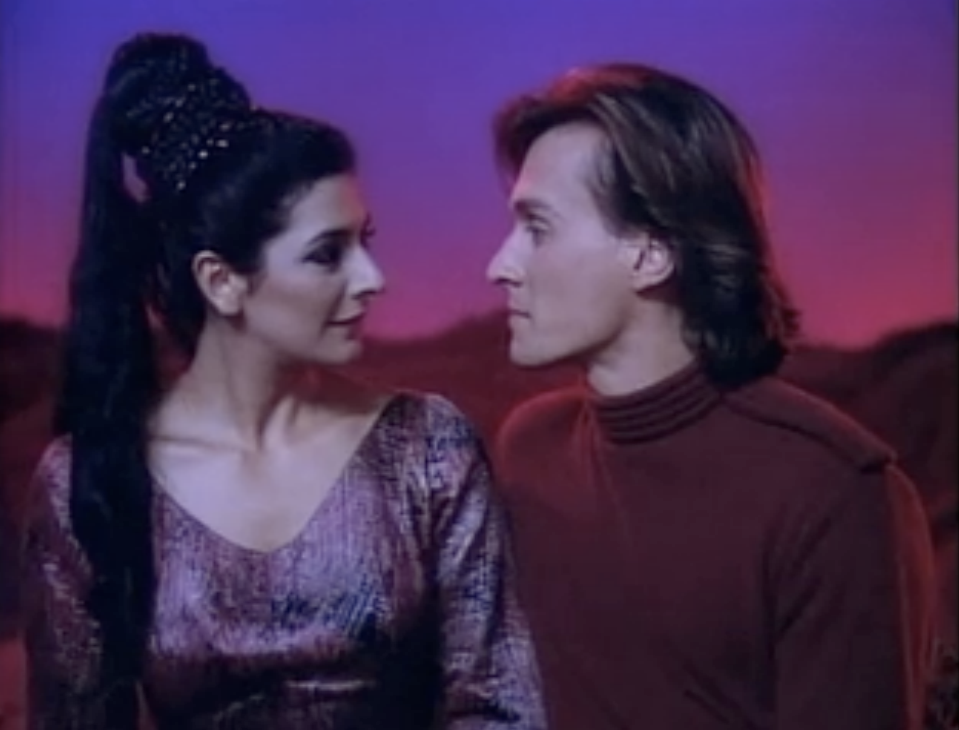
This episode sucks. The arranged-marriage story seems wildly out of place and at odds with the values and ethos of the Starfleet/Federation world; Troi seems like a volitionless pawn who just goes along with it for no reason that ever feels real; no explanation is ever given for why the arranged marriage is happening; the plague ship “story” is utterly uninteresting; and the episode’s two plotlines resolve each other all by themselves once they intersect, with no need for any of the regular characters to make any hard decisions or really do anything at all. The closest thing the episode has to an actual point seems to be to suggest the idea that some people are magically meant for each other, and can even tune in to each other’s thoughts across time and space from childhood. Um…great. The whole episode is just terrible.
The episode opens—as so many first-season episodes do—with an awkwardly expository captain’s log that strikes one as lacking anything resembling Picard’s authentic, individual “voice,” and as trying way too hard to manufacture, out of nothing, a sense of mystique about the planet of the week. It then gets its main story started by having Riker called to the transporter room to supervise the beaming up of one of the most horrible props ever to appear in a TNG episode. Right after it is beamed up, moreover, Troi—on whom the episode will focus, and who is the only person who would recognize the bizarre object that has just materialized on the pad—happens, for no apparent reason, to wander into the room and ask “What’s going on?” so that the teaser can conveniently end with her distraught announcement that she is apparently getting married. We’re really not off to a good start here.
I’ll just pick and choose a few high/lowlights to comment on from the rest of the episode. For one thing—obviously, the most significant thing about it in retrospect is that it serves to introduce the “terribly interesting” character of Lwaxana Troi. This hardly works in its favor. If this episode was in some way supposed to start fleshing out the character of Counselor Troi or to provide any kind of insight into her background, it fails abysmally. It also doesn’t really do much of genuine value with the Troi/Riker relationship, though the scenes in which it tries to do so—along with a couple of the scenes between Counselor Troi and Wyatt—are probably the ones that come closest to justifying the episode’s existence. Also, here’s a puzzling detail: Early on, when Picard asks Troi whether she’ll be staying on board as ship’s counselor after she gets married, why does she answer “no”? She hasn’t even met the groom yet at this point; how does she know what life decisions/arrangements she and he are going to make? Finally, while it isn’t worthwhile enough that I would have wanted any more time devoted to it, the “resolution” of the episode’s two stories—in which Wyatt beams himself over to the plague ship—is definitely very much rushed; it takes an outright insane leap of faith for Wyatt to do what he does without so much as even talking to the people on the plague ship first!
Perhaps I should be slightly more charitable than I feel inclined to be about this episode, at least in one respect: however badly it may have botched the effort, this was arguably the show’s first attempt at an episode focusing primarily on the personal lives and relationships of its characters, rather than on a wacky POTW (despite my use of that phrase above) and/or on some cheesed-up, end-of-the-world crisis or other (though it does still attempt to ramp up tension via the plague ship subplot). In terms of my “story types” categorization scheme, this one would fall into what I’m calling the “Personal/Cultural Encounter” category: episodes in which the story focus is an encounter or interaction between one of the regular characters and a guest character (or sometimes a featured culture—say, the Klingons) who (ideally) is interesting or significant in some way, or who, at any rate, has a significant impact on the featured main character. For the show to move in the direction of doing stories of this type is definitely a positive sign; still, in this instance, the writing is so bad (and the existence of an actual “story” so minimal) that I scarcely feel inclined to give it much credit.
I will grant that along the way, some moderately entertaining moments are squeezed out of the over-the-top (and often irritating) clash between Lwaxana and the groom’s folks, but this is not remotely sufficient to redeem the fundamental irritatingness and pointlessness of the entire episode—which, as I commented at the outset, just plain sucks.